The ARRL Solar Update
Solar activity has remained at low levels, with an occasional
low-level C-class flaring observed, including a C3.3/Sf flare on July
15 from Region 4489. The largest event of the period, a long-duration
C8.9 flare that peaked on July 15, originated from a returning region
on the eastern limb. This region is not yet numbered and will be
assessed once it has become visible from Earth’s perspective, but the
latest imagery from Solar Orbiter suggested only a simple and rather
average bipolar group with a relatively small penumbra.
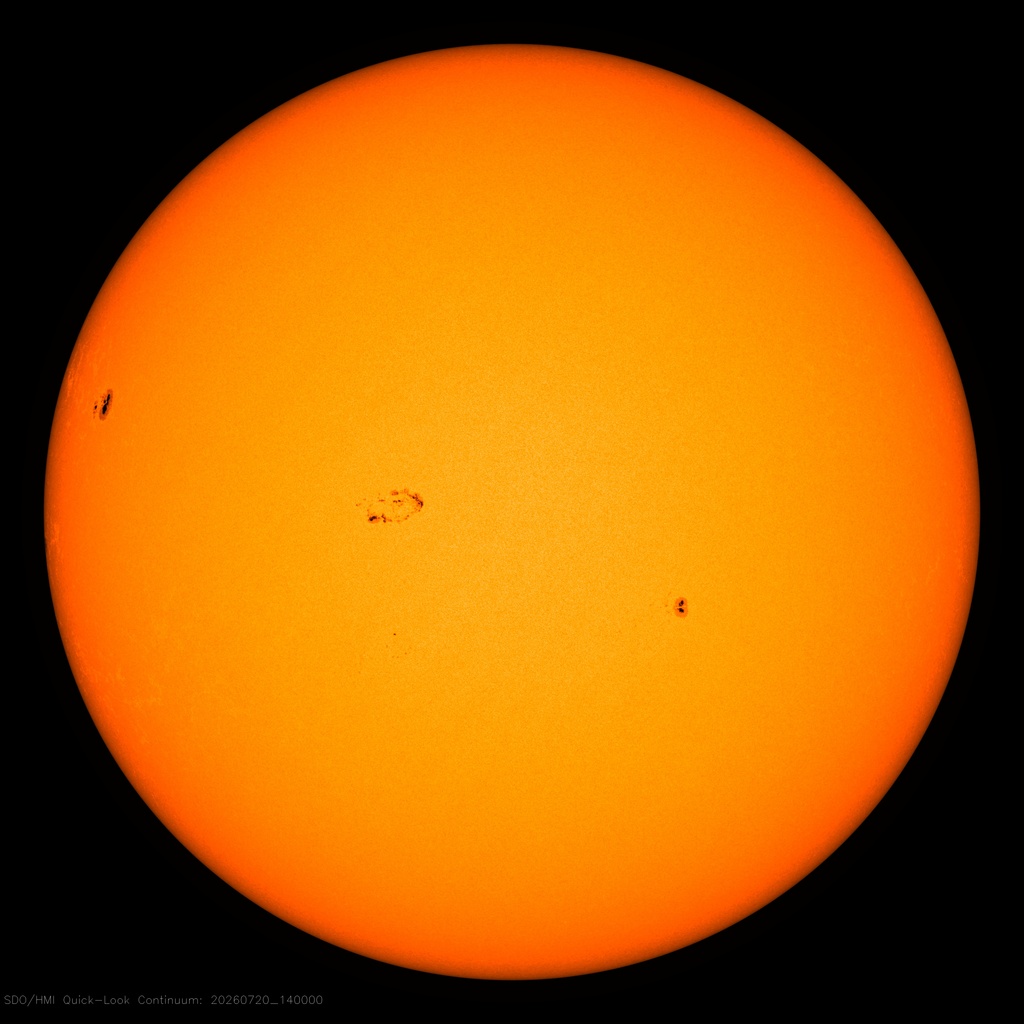
There are two numbered sunspot regions on the visible disk. Region
4482 showed minor new flux emergence behind its mature primary spot,
developing a bipolar configuration. As Region 4489 rotated further
into view and limb foreshortening effects decreased, very small
opposite-polarity trailing spots became visible, making it a stable
bipolar group. Additionally, a small, magnetically simple, region
tracked in Solar Orbiter imagery has begun to rotate over the east
limb near S10. No Earth-directed CMEs were observed in available
coronagraph imagery.
Solar activity is expected to remain at low levels through July 18,
with a slight chance for M-class (R1-R2/minor-moderate) flares,
primarily driven by active regions anticipated to rotate onto the
visible disk over the next few days.
Solar wind parameters reflected possible combined glancing coronal
mass ejection (CME) effects and subsequent weak positive polarity
coronal hole high-speed stream (+CH HSS) influences.
A return to more ambient-like conditions is expected over the next
three days.
Weekly Commentary on the Sun, the Magnetosphere, and the Earth's
Ionosphere, July 16, 2026, by F. K. Janda, OK1HH:
The significant decline in solar activity throughout the first half
of July is clearly illustrated by the solar flux values, which fell
from 203 s.f.u. (July 2) to 100 s.f.u. (July 14–15), as well as by
the number of sunspot groups, which dropped from five to two. A
significant drop in the critical frequencies of the F2 layer began as
early as July 4 during the geomagnetic disturbance of July 4–5, and
due to the sharp decline in solar activity, these values returned to
average levels only very slowly in the following days. Consequently,
the sporadic E layer had an even greater impact on shortwave
propagation (particularly in the mid-latitudes of Europe on July
14–16).
The increase in solar activity, which is expected to begin as early
as the end of this week, while should last nearly until the end of
the month, will result in significantly better shortwave propagation
conditions than those experienced in the first half of the month.
More significant changes (possibly an initial rise, but then very
likely a temporary drop in MUF) will likely be caused by a
geomagnetic disturbance, which is tentatively expected on July 21–22.
The predicted Planetary A Index for July 18 to 24 is 5, 5, 5, 5, 12,
10, and 7, with a mean of 7.0. The predicted Planetary K Index is 2,
2, 2, 2, 4, 3, and 2, with a mean of 2.4. Predicted 10.7 centimeter
flux is 135, 135, 135, 135, 135, 135, and 135, with a mean of 135.0.
For more information concerning shortwave radio propagation, see http://www.arrl.org/propagation and the ARRL Technical Information Service web page at, http://arrl.org/propagation-of-rf-signals. For an explanation of numbers used in this bulletin, see
http://arrl.org/the-sun-the-earth-the-ionosphere . Information and
tutorials on propagation can be found at, http://k9la.us/ .
Also, check this:
https://bit.ly/3Rc8Njt
"Understanding Solar Indices" from September 2002 QST.
Photo Gallery
-
 Photo Courtesy of...
Back


