The ARRL Solar Update
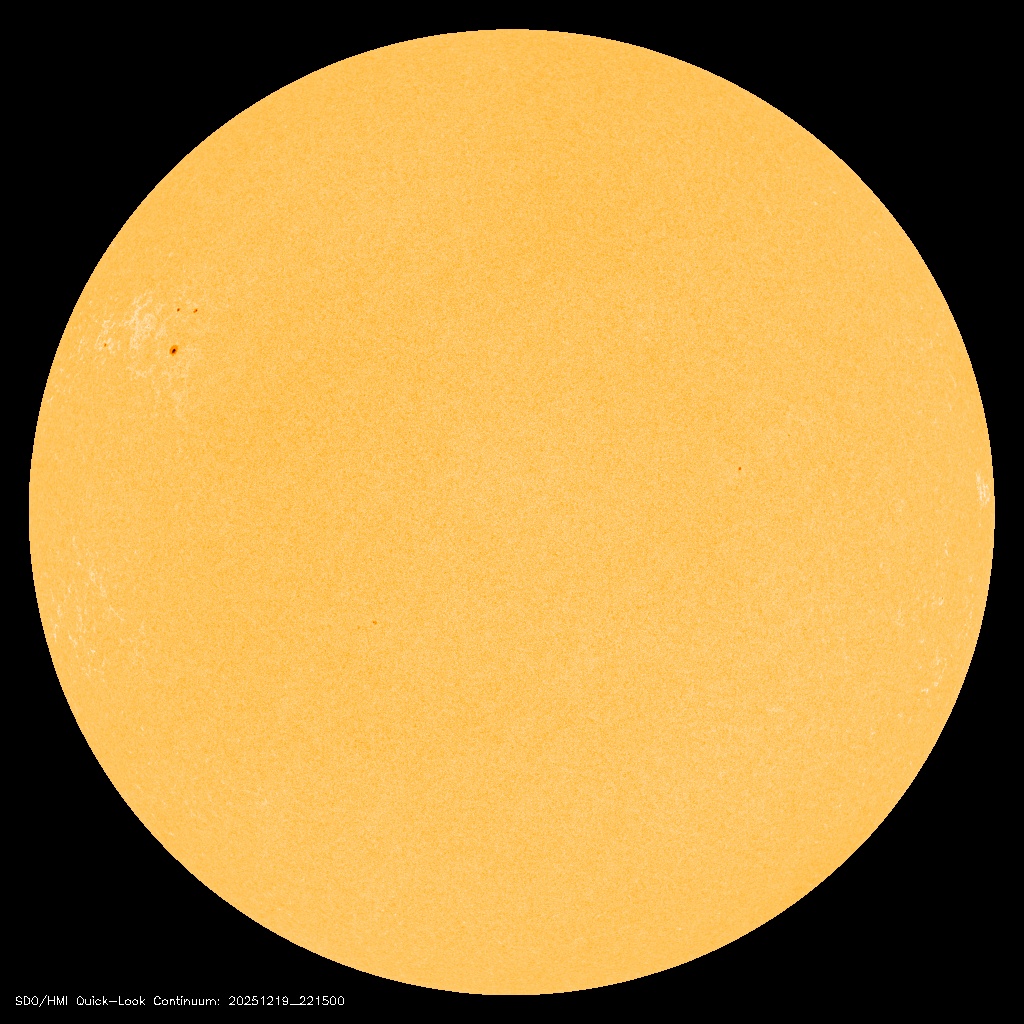
Solar activity has been at low levels with only a few C1 flares from
Region 4307. Slight growth and consolidation were observed in that
region as it neared the southwestern limb. Slight decay and
separation were observed in Region 4311. The rest of the spotted
regions were either stable or in decay. CME analysis will be
conducted as imagery becomes available. Solar activity is expected
to be low with a slight chance for M-class flares (R1-R2,
minor-moderate) December 18 to 20.
Solar wind parameters continued to be under the influence of a
negative polarity coronal hole high-speed stream (CH HSS). Solar
wind speed was mostly in the 550 to 650 km/s range. HSS influences
are expected to gradually diminish December 19 – 20.
Solar activity is expected to continue at low levels over December
19 to 21. There is a chance for R1/R2 (Minor-Moderate) events
through December 21. The solar wind environment is expected to
remain mildly enhanced over December 19 to 21 as negative polarity
CH HSS influences diminish.
Weekly Commentary on the Sun, the Magnetosphere, and the Earth's
Ionosphere, December 18, 2025, by F. K. Janda, OK1HH:
The occurrence of an extensive coronal hole in the western half of
the solar disk is consistent with the increased speed of the solar
wind, as measured by geostationary satellites. The edges of another
relatively large coronal hole in the east are likely to be the
source of the next period of enhanced solar wind during the coming
week. However, overall solar activity is low, as reflected in the
low values of the critical frequencies of the F2 ionospheric layer.
The decline in geomagnetic activity in mid-December did, however,
have a positive effect on shortwave propagation conditions, albeit
mainly at lower frequencies. This included the occasional formation
of ionospheric waveguides.
Although solar activity is likely to increase next week, the
activity of the Earth's magnetic field is also likely to increase.
Therefore, unstable conditions can be expected in the Earth's
ionosphere, with short intervals of improvement followed by longer
intervals of deterioration in shortwave propagation conditions.
The current Solar Cycle Progression from the NOAA/Space Weather
Prediction Center can be found at,
https://www.swpc.noaa.gov/products/solar-cycle-progression .
The Predicted Planetary A Index for December 20 to 26 is 10, 5, 20,
20, 25, 20, and 20, with a mean of 17.1. Predicted Planetary K Index
is 3, 2, 5, 5, 5, 5, 5, with a mean of 4.2. 10.7-centimeter flux is
115, 115, 125, 135, 145, 155, 165, with a mean of 136.4.
For more information concerning shortwave radio propagation, see
http://www.arrl.org/propagation and the ARRL Technical Information
Service web page at, http://arrl.org/propagation-of-rf-signals. For
an explanation of numbers used in this bulletin, see
http://arrl.org/the-sun-the-earth-the-ionosphere . Information and
tutorials on propagation can be found at, http://k9la.us/ .
Also, check this:
https://bit.ly/3Rc8Njt
"Understanding Solar Indices" from September 2002 QST.
Photo Gallery
-
 Photo courtesy of...
Back


