ARRL Audio News
| · | To subscribe, unsubscribe, or change your e-mail delivery address: see How to Get The ARRL Letter, below |
| · | Delivery problems (ARRL member direct delivery only!): letter-dlvy@arrl.org |
| · | Editorial questions or comments: Rick Lindquist, N1RL, rlindquist@arrl.org |
| · | ARRL Audio News: http://www.arrl.org/arrlletter/audio/ or call 860-594-0384 |
| · | The ARRLWeb Extra: http://www.arrl.org/members-only/extra |
IN THIS EDITION:
- +Kenwood seeks FCC ruling on "Sky Command" system
- +Venezuelan hams respond to flood disaster
- +Wisconsin governor thanks hams via 40 meters
- +Hams help solo rower
- Amazon Queen 2000 expedition set to sail
- The Y2K Song
- Solar update
- In Brief: This weekend on the radio; AMRAD LF beacon heard in Ontario; Cash only for W1, W2 bureaus; Foale back in space; Kid's Day is coming New Year's Day; QST Cover Plaque Award; Santa Claus comes to town; UK to allow Amateur Radio-Internet links
+Available on ARRL Audio News
Editor's note: Because of the Christmas holiday, this week's editions of The ARRL Letter and ARRL Audio News are being distributed a day early, on Thursday, December 23. These are the final editions for 1999. The next editions of The ARRL Letter and ARRL Audio News will be distributed Friday, January 7. Important late-breaking news will be announced via W1AW bulletin and/or in The ARRLWeb Extra on the members only Web page. Best wishes for a safe and happy holiday season.--Rick Lindquist, N1RL
KENWOOD ASKS FCC TO RULE ON "SKY COMMAND" SYSTEM
Kenwood Communications Corporation has asked the FCC either to declare that its "Sky Command" system complies with Commission rules or to waive applicable sections of the rules to make it legal.
The "Sky Command" system, which Kenwood has been marketing for about two years, lets the user control a fixed HF station via a pair of dual-band transceivers. Sky Command operates in full duplex, using a 70-cm frequency to transmit audio and control commands to a dualband transceiver at the remote station and a 2-meter frequency to transmit received audio via the remote station's SkyCommand transceiver to the operator's transceiver. Sky Command's VHF link also includes a Morse code ID.
The ARRL has declined to permit Kenwood to advertise its "Sky Command" system in QST, maintaining that the system is not legal to use as it's configured. The League says that Kenwood's use of a 2-meter frequency would cause amateurs using the system to violate Section 97.201(b), which limits auxiliary operation to certain frequencies above 222.15 MHz.
The League in the past has opposed lowering the minimum frequency for auxiliary operation. The Sky Command issue arose during the ARRL Executive Committee meeting December 4. After some discussion, the EC requested that Executive Vice President David Sumner, K1ZZ, prepare a paper to explain the rationale for the present rule and to provide a basis for future discussion on whether the restriction was still needed.
In its petition for a declaratory ruling or waiver--filed November 4 but not released until December 15--Kenwood claims that the Sky Command VHF transmission link "should be viewed as merely providing third party communications" and not as part of an auxiliary link.
"Kenwood is confident that the Sky Command System fully complies with the remote control, telecommand, and auxiliary station provisions of Sections 97.109(c), 97.213, and 97.201," the manufacturer told the FCC. Kenwood wants the FCC to confirm in a declaratory ruling that the Sky Command System complies with those rules. But, Kenwood said, if the FCC does not concur, then Kenwood requests a "blanket waiver" of those rules for amateurs using Sky Command.
Kenwood also asks for either a declaratory ruling or a blanket waiver with respect to Section 97.111, which covers authorized transmissions.
The manufacturer says the VHF link complies with the rules because it only carries audio from the HF station receiver, is not involved with telecommand of the remote station, and is under the supervision of the control operator.
Comments on the Kenwood petition are due by January 31, 2000. Reply comments are due by February 14, 2000. Commenters should reference DA 99-2805.
VENEZUELAN HAMS ACTIVATE IN FLOODING DISASTER
Word from Venezuela is that hams activated early on during the flooding and mud slide disaster that struck that country's Caribbean coast December 16.
"The emergency is by all means the major disaster that ever happened in Venezuela in modern times, and there is an ongoing need for further communication support," said Pedro Seidemann, YV5BPG.
Seidemann says Radio Club Venezolano club station YV5AJ and national emergency net station YV5RNE are on the air on the official emergency frequency 7090 kHz as well as on local 2-meter repeaters and monitoring 146.580 simplex.
Initial flooding following several days of sustained rainfall was exacerbated by mud slides resulting from overflowing creeks coming down from the Avila mountain range. "Mud slides, some high in the mountains, were the major cause of the disaster in this part of the country," Seidemann said, noting that the sustained rains are considered "rather unusual" in that part of the world.
Officials say the death toll in the flooding and subsequent mud slides could go as high as 20,000. Seidemann said countless people are still unaccounted for, and--especially in the seacoast area near Caracas--many bodies have been buried by thick mud.
"Venezuelan Civil Defense organization and Conatel--the national telecommunication administration--and the Red Cross have asked RCV for its urgent ongoing support in the seacoast townships near Caracas," Seidemann said this week. Hard hit are the Barlovento area east of Caracas and the Falcon State in northwestern Venezuela. "There, local radio communications have collapsed, and highways are cut. Large areas are without electricity." Seidemann said the power outages also are affecting telephone service.
Seidemann says RCV is focusing its communications support toward these two disaster areas, where flood survivors remain in isolated regions.
Just before the disaster, RCV had tested its facilities on HF and VHF to check for Y2K compliance. As a result, Seidemann says, RCV already was in a state of readiness when the disaster struck. RCV has acknowledged the cooperation on 40 meters of foreign stations in avoiding the Venezuelan Emergency Net frequency.
Seidemann indicated a need for additional Amateur Radio gear in Venezuela.
Elsewhere, the Salvation Army's SATERN has set up a health-and-welfare network accessible via http://go.to/satern. Salvation Army volunteer Quent Nelson, WA4BZY, in the Atlanta area has been coordinating the H&W operation. Nelson has established direct contact with Mike Anson, YV5/VE7AMV, who is within two blocks of the catastrophe in Caracas, Venezuela.
WISCONSIN GOVERNOR ADDRESSES STATE'S HAMS
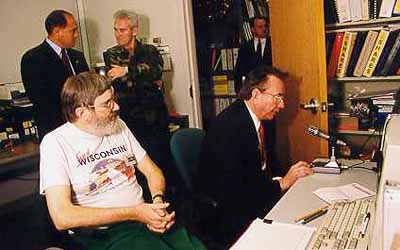
Gov Tommy Thompson (right) speaking to WB9RQR on 40 meters from the Wisconsin Emergency Management emergency operations center radio room. Next to the governor is control operator Sam Rowe, KN9NG. In the background are (left) Wisconsin Emergency Management Administrator Ed Gleason chats with Wisconsin Adjutant General Maj Gen James Blaney. [Photo by Larry Sommers/Wisconsin Dept of Military Affairs] |
Wisconsin Gov Tommy Thompson took to the Amateur Radio airwaves December 16 to express his appreciation to the Badger State's ham community--and especially to those volunteering to remain on alert during the Y2K changeover.
"I want to take this opportunity to thank all the ham radio operators out there who are volunteering their time on December 31 and January 1 to make sure that we do not have any problems," Thompson said. The governor made his remarks from the Wisconsin Emergency Management emergency operations center radio room in Madison during a pre-arranged contact with Wisconsin Section Emergency Coordinator Stan Kaplan, WB9RQR. The contact was carried out on 40 meters. Dane County EC Sam Rowe, KG9NG, served as control operator.
Thompson and his cabinet were visiting the Wisconsin Division of Emergency Government headquarters to review Y2K preparedness.
During the contact, Kaplan told the governor that about 1000 of Wisconsin's 12,000 amateurs are regularly involved in emergency communication. Because of Y2K, many hams not normally active in emergency communication would be standing by on New Year's Eve, Kaplan added. Hams across the state have been recruited by public safety agencies, utilities, hospitals and local government to stand by during the Y2K transition.
Calling amateurs "valuable citizens of the State of Wisconsin," the governor said it was comforting to know that they were willing to spend their own time "to make sure that other citizens are taken care of."
Thompson also took the opportunity to wish happy holidays to everyone who had tuned in for the occasion. The scheduled contact had received some advance publicity. After the scheduled contact, Thompson stayed around to greet other amateurs who checked in.
"As each ham announced his town or county, it was obvious that the governor understood--and was delighted--that the circuit he had just used had connected him to the whole length and breadth of Wisconsin," said Daniel Gomez-Ibanez, W9NXE, who was among those on hand for the occasion.
Gomez-Ibanez said equipment used was a Kenwood TS-440 and a vertical antenna.--thanks to Bette Kratz, KF9ZU; Daniel Gomez-Ibanez, W9NXE, and Jim Romelfanger, K9ZZ
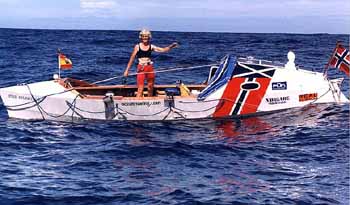
After more than two months alone at sea in her boat Star Atlantic II, Diana Hoff--looking incredibly fit and well--waves to greet her mid-Atlantic visitors. Her boat displays the flag of Scotland. [Brenda Trainor] |
Hams in Barbados and on the high seas assisted solo Atlantic rower Diana Hoff last month.
Hoff, an eye doctor from Scotland, and Tori Murden, a lawyer from Kentucky, both left Tenerife in the Canary Islands September 13 trying to be the first woman to row solo across the Atlantic to Barbados. Murden, 36, in her boat American Pearl, arrived in Guadeloupe December 3--the first woman and the first American to complete the solo row. When she reaches her destination, Hoff, 55, will become the oldest person to ever row an ocean solo. As of December 19, Hoff had another 500 miles to go on the approximately 3000-mile transatlantic journey in her 22-foot boat Star Atlantic II. Early this year, Hoff's daughter Elisabeth failed in her attempt to make the solo crossing in a similar vessel.
On November 12 and still 1000 miles from her goal, bad weather, wind and sea conditions forced Hoff to put out her sea anchor and remain almost stationary. Hoff's husband, Stein, in Norway sent her position to Trudi Smyth, 8P6QM, who runs the Transatlantic Maritime Mobile Net. 8P6QM relayed the information to Geoff Green, G3ZNV/mm, who was crossing the Atlantic aboard the 617-foot luxury MSY Wind Surf, also bound for Barbados.
By November 22, Wind Surf was in position to rendezvous with the still-marooned Hoff. "Despite heavy swell conditions a boat was lowered from Wind Surf and a line established with Diana to enable her to take on fresh supplies, also a replacement 'world radio' and cassette player, together with Christmas greetings, papers and books," Green recounted.
Green said that following an emotional farewell, Wind Surf hoisted her 26,000 square feet of sail and continued under way, wishing Diana and Star Atlantic II "every success and Godspeed" in her quest.
"It certainly was an experience meeting up with her in mid-Atlantic," he said.
For more information on Hoff's transatlantic progress, visit http://www.oceanrowing.com. This site contains links to other sites with updated information on Hoff's journey.--Geoff Green, G3ZNV
AMAZON QUEEN 2000 AMATEUR RADIO EXPEDITION READY TO SAIL
Phil Gonzales, HK3SA, reports his Amazon Queen 2000 ham radio expedition is nearly ready to get under way. Gonzales says the four to five-month long journey aboard the 47-foot wooden Amazon Queen will cover almost 3000 miles--from Iquitos, Peru, to the Atlantic Ocean near Belem, Brazil.
Gonzales told the ARRL he expects the expedition to begin the second week of January, but crew members might be on the air as early as the first of the year. The expedition hopes to use the call sign 5K9AQ, although Gonzalez said that was not certain, and the actual call sign could be different.
Gonzales says the purpose of the voyage is to bring the world together through the use of Amateur Radio and the Internet. "We will be transmitting daily photographs from the voyage," he said.
The crew will be active primarily on HF SSB and plans to check into the Intercontinental and Maritime Mobile Net on 14.300 MHz "every few hours." The expedition will maintain schedules with several other nets as well. The primary operating frequency will be 14.347 MHz. Other frequencies include 7.0935 (Amazon Net frequency and outside the US phone band--Ed), 21.287, and 28.400 MHz.
The Amazon Queen 2000 Expedition is interested in setting up schedules with schools on SSB or other modes. Gonzalez said he hopes to have CW, AMTOR, and SSTV capabilities on board, and may even have 6-meter capability. Cliff Clark, KZ9E, is coordinating phone patches from US schools to the Amazon Queen. He is active on 14.300 MHz. He also may be contacted at kb9ksl@midwest.net or call 618-648-2499. Teachers seeking additional information about Amateur Radio in the classroom should visit http://www.arrl.org/ead/teacher/ .
For more information, visit the Expedition's Web site, http://www.amazonqueen2000.com. Contact Gonzales via e-mail to philincolombia@openway.com.co. QSL via Roberto Rey, HJ3PXA, and include an SASE or IRC for return postage.
(with apologies to "Santa Claus is Coming to Town")
You better watch out,
The lights might go out,
The TV shuts off,
Then everyone shouts
Y2K is coming to town
They say that we'll be
Safe as can be
But don't drink the water, naturally
Y2K is coming to town
If everyone is ready
Why do we hold our breath
They're telling us to hoard water
And it's scaring folks to death!
So you'd better prepare
Your grab-and-go kit
If everything fails guys
Looks like we're it
Get those batteries charged!
Y2K is looming!
Amateurs are ready for Y2K!
--Kim Paquette, N8YWX (Asst EC, Adams County, Ohio)
Solar seer Tad Cook, K7VVV, Seattle, Washington, reports HF radio conditions improved over the past week, with solar flux and sunspot numbers higher than the previous period, and geomagnetic indices more stable. Average planetary A index declined from 9.7 to 3.7, and average solar flux was up over 40 points. This is a happy combination, because often higher solar indices are coupled with less stable geomagnetic conditions. Look for solar flux to remain around 200 for Thursday and Friday of this week, and slip just below 200 on Christmas day. Planetary A indices are predicted at seven for all three days.
Beyond this weekend look for solar flux to decline to around 150 by the end of the year, rising above 160 after the first week in January. Solar flux should top 200 again by the middle of next month. Look for unstable geomagnetic conditions returning around December 31 through January 2.
Sunspot numbers for December 16 through 22 were 146, 179, 190, 154, 149, 129 and 130 with a mean of 153.9. The 10.7 cm flux was 194, 200.7, 205.5, 206.9, 209.2, 217.2 and 201.7, with a mean of 205. The estimated planetary A indices were 5, 5, 5, 4, 3, 2 and 2, with a mean of 3.7.
In Brief:
- This weekend on the radio: ARRL Straight Key Night and the 14th Internet CW Sprint are December 31-January 1. Just ahead: the PSK31 Millennium Contest, the SARTG New Year RTTY Contest, and the Y2K QRP Contest are January 1-2. The ARRL RTTY Roundup, the Japan International DX Contest (CW), Meet the Novices and Technicians Day, and the North American QSO Party (CW) are January 7-9. See December QST, page 88, and January QST, page 100, for details.
- AMRAD LF beacon heard in Ontario: The second Amateur Radio Research and Development Corporation experimental LF beacon, WA2XTF/12, has been heard in Canada. Mitch Powell, VE3OT, recently e-mailed a report to AMRAD from London, Ontario. The WA2XTF/12 beacon on 136.745 kHz is a part of AMRAD's experiments to gain LF experience in anticipation that the FCC may allocate an amateur band at 136 kHz. AMRAD obtained its Part 5 experimental license for the project earlier this year. Powell said the signal was so strong he was able to hear it coming his headphones ten feet away and was easily able to copy the e-mail address to file the report. He said the signal ranged from 459 to 559. VE3OT's receiver is a Drake R8, operating in upper sideband mode, with a 500 Hz filter followed by a 600 Hz audio filter (SCAF). His antenna is a 12-foot loop using a homebrew preamplifier. "WA2XTF/12 is right at the noise level but 100% readable," he said. AMRAD's André Kesteloot, N4ICK, says the report from VE3OT was the best DX received since the beacon went on the air in mid-November. Reports go to Kesteloot at n4ick@amrad.org.--André Kesteloot, N4ICK
- Cash only for W1, W2 bureaus: The W1 and W2 QSL bureaus no longer accept stamps and/or envelopes. Funds sufficient to cover the mailing of anticipated cards should be sent by check or money order (or cash, at your own risk). Addresses of all ARRL QSL bureaus are at http://www.arrl.org/qsl/qslin.html.
- Foale back in space: After nine launch delays, space shuttle Discovery lifted off on December 20 on the first of two shuttle missions designed to repair and upgrade the Hubble Space Telescope. The crew will be the first in a long time to spend Christmas in space. Three ham-astronauts are aboard, including Mir veteran Mike Foale, KB5UAC. Foale is making his fifth flight into space. He spent more than four months aboard the Russian Mir space station and was aboard when a Progress supply rocket rammed Mir causing serious damage. Other hams aboard are NASA astronaut John Grunsfeld, KC5ZTF, and European Space Agency astronaut Jean-Francois Clervoy, KC5WKG.The flight is the 96th space shuttle mission and the last for 1999. It's scheduled to return to Earth on December 27.
- Kid's Day is coming New Year's Day: Kids say the darndest things! If you want to hear just what they're saying, get on the air January 1, 2000 for Kid's Day. Between 1800 and 2400 UTC, you'll hear young people chatting with both adults and other kids. This event is a painless way for your kids, or someone else's, to experience the fun of Amateur Radio. For more details on Kid's Day, visit http://www.arrl.org/ead/kd-rules.html or check out December QST, page 48.
- QST Cover Plaque Award: The winner of the QST Cover Plaque Award for December was Robert R. Brown, NM7M, for his article "Bubbles in the Ozone Layer." Congratulations, Bob!
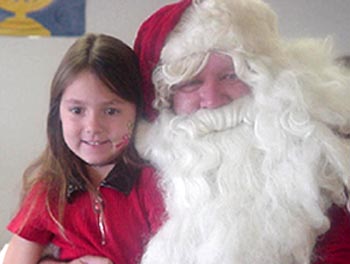
Santa (Tuck Miller, K6ZEC), and Friend.
- Santa Claus comes to town: Santa Claus--in the person of none other than San Diego Section Manager Tuck Miller, K6ZEC--visited youngsters at the San Diego Trolley earlier this month. Among his visitors was Summer Skye Olson, aged 5.--Tuck Miller, K6ZEC
- UK to allow Amateur Radio-Internet links: The Radiocommunications Agency in the UK has announced that it will allow interconnection between Amateur Radio and the Internet starting in late January. The action followed consultation with the Radio Society of Great Britain and a number of interested individuals. David Hendon, the Agency's Chief Executive, made the announcement in response to requests from the Amateur Radio community to be permitted to link their radio equipment through the Internet. The RA said it recognized the need to encourage young people to become involved in Amateur Radio as "a valuable training ground for future careers in radio and electronics" and expressed hopes that its decision would "open up whole new avenues into Amateur Radio." Connection of ham equipment to nonamateur networks in the UK will require written permission from the Secretary of State.--RA via Ian Abel, G3ZHI