ARRL Audio News
| · | To subscribe, unsubscribe, or change your e-mail delivery address: see How to Get The ARRL Letter, below |
| · | Delivery problems (ARRL member direct delivery only!): letter-dlvy@arrl.org |
| · | Editorial questions or comments: Rick Lindquist, N1RL, rlindquist@arrl.org |
| · | ARRL Audio News: http://www.arrl.org/arrlletter/audio/ or call 860-594-0384 |
| · | The ARRLWeb Extra: http://www.arrl.org/members-only/extra |
IN THIS EDITION:
- +ARRL seeks partial reconsideration of PRB-1 petition denial
- +A "new" QST to debut
- +Riley Hollingsworth is Dayton Hamvention keynoter
- +Nominations open for Maxim award
- +Charles J. "Chod" Harris, WB2CHO, SK
- Leslie Schmarder, WA2AEA, SK
- TAPR releases draft APRS protocol spec
- Solar update
- In Brief:This weekend on the radio; ULS Step-By-Step available on ARRLWeb; ERAU President Tiit Praks, ES7RE, SK; ARRL insurance administrator changing name; FCC warns against nonamateur use of modified gear; JAWSAT launch delayed; Smokin' up the Web
+Available on ARRL Audio News
ARRL SEEKS PARTIAL RECONSIDERATION OF PRB-1 PETITION DENIAL
The ARRL will ask the FCC to partially reconsider its dismissal of RM-8763, the League's 1996 petition that sought to strengthen and clarify the limited federal preemption policy governing Amateur Radio antennas known as PRB-1. The League also agreed to fund a Florida antenna case with PRB-1 implications.
In its petition, the ARRL wanted the FCC to prevent states and localities from enacting provisions that frustrate the intent of PRB-1 or make it costly to apply for permission to erect an amateur antenna. The FCC dismissed the petition in its entirety November 19 and indicated it was unwilling to go beyond what is already spelled out in PRB-1. "We continue to believe that the standards the Commission set, that is 'reasonable accommodation' and 'minimum practicable regulation', have worked relatively well," the FCC said.
The League will ask the FCC to reconsider two important aspects of the original petition. Meeting December 4 in Texas, the ARRL Executive Committee voted to instruct the League's General Counsel to seek reconsideration of the FCC Order regarding the application of PRB-1 to restrictive covenants and to excessive costs that localities might levy or require in order to install an antenna structure.
In its dismissal, the FCC pointed out that PRB-1 excludes restrictive covenants in private contracts as "outside the reach of our limited preemption." The Commission added, however, that it "strongly encourages associations of homeowners and private contracting parties to follow the principle of reasonable accommodation" with respect to Amateur Radio.
In addressing zoning laws and application costs, the FCC dismissal Order asserted that the PRB-1 principles of "reasonable accommodation" and "minimum practicable regulation" already provide sufficient guidance to communities. Local zoning ordinances should be written so as to "not impinge on the needs of amateur operators to engage in amateur communications," the FCC said.
In a related action, the Executive Committee agreed to have the League fund an appeal in a Florida Amateur Radio tower case. Lenard Persin, WB4HZQ, had applied to Seminole County for a special exception to a 35-foot tower height limit to build an 80-foot tower on his nearly one-acre lot. Initially granted, his application was later denied after a neighbor appealed. Persin appealed in federal court, and the ARRL filed a "friend of the court" brief in the case. On November 2, a US District Court in Florida ruled for the County, saying it had "properly balanced Mr. Persin's interests with the needs of the community."
In its November letter dismissing RM-8763, however, the FCC declared that, given the express language of PRB-1, "it is clear that a 'balancing of interests' approach is not appropriate."
ARRL President Rod Stafford, W6ROD, has appointed a committee to study how the ARRL provides support for antenna cases.
A "NEW" QST DEBUTS IN JANUARY 2000
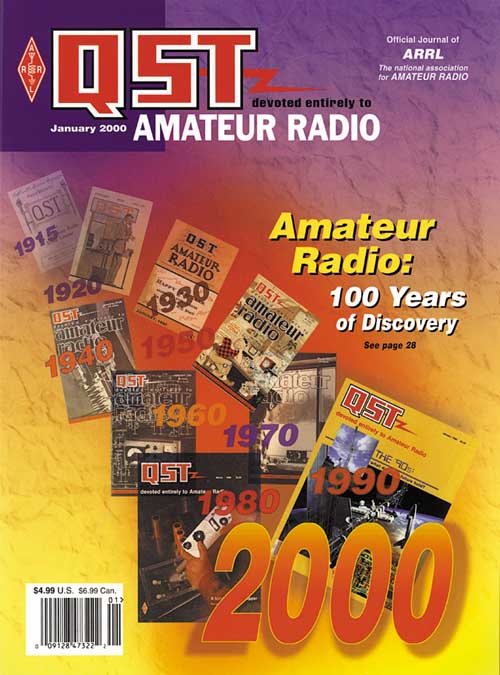
January 2000 "QST"Cover. |
The page design of QST was altered to improve readability, and to provide a more modern, attractive appearance. Three new columns will debut as well:
- "QRP Power"--a monthly column by Rich Arland, K7SZ--will track developments in low-power hamming, one of the fastest-growing areas of Amateur Radio.
- "Old Radio" by John Dilks, K2TQN, will focus each month on vintage radio collecting and restoration.
- "Radios to Go" by Roger Burch, WF4N, will be a bimonthly column highlighting mobile, maritime, aeronautical mobile and portable operating.
The highly successful "New Ham Companion" section of the magazine will get a new name and revised content. Starting in January it will become "QST Workbench." The new section still will contain long-time favorites such as "The Doctor is IN" and "Test Your Knowledge" and will incorporate "Hints and Kinks" as well. The content will continue to focus on "how-to" articles, but there will be more single-weekend or single-evening projects.
A new page titled "The Help Desk" will offer reference information such as schematic symbols, band plans and so on.
"Workbench" also will feature software and hardware accessory reviews under the title "Short Takes."
QST Managing Editor Steve Ford, WB8IMY, says the alterations were made in response to the changing needs and lifestyles of the ARRL members.
"Amateur Radio is undergoing a significant transformation, and license restructuring will only accelerate the process," he said. "The magazine must meet the needs of 21st century amateurs who are, as our survey data indicated, extremely busy individuals who are hard pressed to integrate ham radio into their active lifestyles. They want QST to provide information that they can read and use quickly."
Ford says QST will continue to publish technically complex material. "There will always be a portion of the QST audience that's fascinated by the 'science' of Amateur Radio, as well as the more complex aspects of circuit design and construction," he said. "QST will continue to serve that audience." He pointed to an article by John Devoldere, ON4UN, in the January issue that discusses the effects of the 1999 European total solar eclipse on HF propagation.
The January 2000 QST will feature a special "collector's cover" celebrating 100 years of Amateur Radio and 85 years of QST. The lead article, "Amateur Radio: 100 Years of Discovery," is a historical overview by ARRL Pacific Division Director-elect Jim Maxwell, W6CF.--Steve Ford, WB8IMY
RILEY HOLLINGSWORTH TO KEYNOTE HAMVENTION
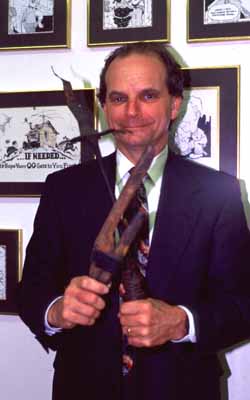
As a warning to rulebreakers, Riley Hollingsworth wields the dreaded Wouff Hong and Rettysnitch during a visit to ARRL Headquarters. |
FCC Special Counsel for Amateur Radio Enforcement Riley Hollingsworth, K4ZDH, will be the keynote speaker at the 2000 Dayton Hamvention banquet on Saturday, May 20. For the first time ever, the Dayton Hamvention will host the ARRL National Convention, and Hamvention 2000 promises to be the biggest and best ever. Because it's also the League's national convention, Dayton Hamvention 2000 will include an expanded forum schedule.
Hollingsworth already is well known to the amateur community, and his appearances at last year's Hamvention drew large and enthusiastic audiences. He says he's pleased to be invited back to Dayton and honored to be the banquet speaker for Hamvention 2000.
In the fall of 1998, Hollingsworth--who's headquartered at the FCC's Gettysburg, Pennsylvania, office--spearheaded an Amateur Radio enforcement initiative that reversed a long period of Commission inattention and apathy. Hams across the US have credited Hollingsworth with helping to reduce malicious interference and other problem behavior, both on and off the air. The result has been a marked upswing in morale within the amateur community.
Hollingsworth says his message is a simple one. "Our communications services in America, whether our telephone system or our computer networks, are the envy of the rest of the world," he said. "Our Amateur Radio Service should be, too. There's no reason why our Amateur Radio Service can't be the finest radio service in the world."
A native of South Carolina and a ham for 39 years, Hollingsworth holds an Advanced class ticket. He's a graduate of the University of South Carolina and Wake Forest University Law School. Now an FCC veteran, Hollingsworth, 53, previously served in several prominent positions within the FCC's Wireless Telecommunications Bureau.
Hollingsworth joined the former Compliance and Information Bureau as Legal Advisor for Enforcement in 1998. As a result of the FCC reorganization in November, Hollingsworth became Special Counsel for Amateur Radio Enforcement within the FCC's new Enforcement Bureau.
In addition to his enforcement duties--which include the Land Mobile Service in addition to Amateur Service--Hollingsworth has been temporarily detailed to the new FCC Consumer Information Bureau to manage the Gettysburg Consumer Center.
A member of the ARRL, Hollingsworth also belongs to the Quarter Century Wireless Association and the Radio Club of America.
Dayton Hamvention will take place May 19-21, 2000. As part of the banquet festivities, the sponsoring Dayton Amateur Radio Association will present awards for Dayton Hamvention Amateur of the Year, Technical Excellence and Special Achievement.
Advanced registration now is available. Call 937-276-6930 or e-mail tickets@hamvention.org. For more information on Dayton Hamvention 2000, visit http://www.hamvention.org, e-mail info@hamvention.org or call 937-276-6930 weekdays 10 AM-5 PM.
NOMINATIONS OPEN FOR MAXIM MEMORIAL AWARD
Nominations are open until March 31, 2000, for the 1999 Hiram Percy Maxim Memorial Award. The award goes each year to a radio amateur under the age of 21 whose accomplishments and contributions are of the most exemplary nature within the framework of Amateur Radio activities. These include, but are not limited to:
- Participation or leadership in organizational affairs at the local or national level.
- Technical achievement.
- Operating record.
- Recruitment and training of new amateurs.
- Public relations activities.
In keeping with the tradition of the award when it was first established in 1936, formal nominations are made by Section Managers. Supporting information, including the endorsement of ARRL-affiliated clubs and elected or appointed League Leadership officials, should be submitted with the nomination to Jean Wolfgang, WB3IOS, at ARRL Headquarters.
An award panel will review the nominations received and select the winner. The prize consists of a cash award of $1000, a suitably engraved plaque, and travel and accommodation expenses to enable the winner to attend an ARRL convention for a formal presentation.
Nominations should document as thoroughly as possible the Amateur Radio achievements and contributions of the nominee during the previous calendar year. Additional information concerning the character of the nominee should be as complete as possible.
The award is intended to provide a tangible reward to those deserving young amateurs who contribute their time, skills and energies daily through their commitment to Amateur Radio.
Nominations go to Section Managers, who should review and forward nominations to Jean Wolfgang, WB3IOS, at ARRL Headquarters by March 31, 2000. There is no limit to the number of nominations a Section Manager may make.
Elisabeth Price, KC8ALW, of Worthington, Ohio, was the winner of the Hiram Percy Maxim Memorial Award for 1998.
For information and a nomination form visit http://www.arrl.org/field/awards/hpm.html or contact Jean Wolfgang, WB3IOS, jwolfgang@arrl.org; 860-594-0200; or write her at ARRL Headquarters, 225 Main St, Newington, CT 06111.
CHARLES J. "CHOD" HARRIS, WB2CHO, SK
|
Former ARRL HQ staffer and CQ magazine DX columnist Charles J. "Chod" Harris, WB2CHO/VP2ML, of Santa Rosa, California, died December 8 of complications from a severe heart attack he'd suffered in early November. He was 50.
An ARRL Life Member, Harris was first licensed in the late 1960s. In the mid-1970s, Harris ran the ARRL Club and Training Department.
ARRL Executive Vice President David Sumner, K1ZZ, said Harris' tenure coincided with the League's response to the Citizens Band craze. "He faced the challenge of absorbing into our ranks the refugees of the CB boom," Sumner recalled. "He poured enormous energy and creativity into the task." ARRL Field and Educational Services Manager Rosalie White, WA1STO, remembered Harris as "a vibrant force, with a lot of new ideas for recruitment and education."
Harris also helped to author the beginner's classic Tune in the World with Ham Radio, among other publications. He also wrote numerous articles for QST and other publications over the years and once published several DX bulletins.
An active contester and DXer, Harris had operated from several exotic locations. He obtained VP2ML while living on the island of Montserrat in the late 1970s and early 1980s before moving to California.
Harris also served as an International Amateur Radio Union Region 2 Conference delegate from Montserrat, most recently in 1995 at Niagara Falls, Canada, where he chaired the HF Committee.
Harris took over as CQ DX Editor in July 1989. He was the third member of the CQ family to die this year. CQ Editor Alan Dorhoffer, K2EEK, passed away July 19, and WAZ Award Manager Jim Dionne, K1MEM, died October 12.
Survivors include his wife, Jean, whom he met while working at ARRL Headquarters. A memorial service was set for December 10 in Santa Rosa. The family invited memorial donations to the American Heart Association or to the Northern California DX Foundation. Friends may write the Harris family at 3201 Franz Valley Rd, Santa Rosa, CA 95404.
LESLIE SCHMARDER, WA2AEA, SK
Past Northern New York Section Manager Les Schmarder, WA2AEA, of Elizabethtown, New York, died December 4. He was 52. Schmarder only recently had stepped down as NNY SM due to ill health, and former SM Chuck Orem, KD2AJ, was named to complete his term.
Schmarder succeeded Orem as SM in 1997 after Orem stepped down, and was elected to the post in his own right a year ago. Schmarder was a volunteer examiner and treasurer of Digital Operators Emergency Radio Service and involved in emergency communication in Essex County. A graduate of the University of Buffalo, he had been employed by the Essex County Department of Public Health.
A memorial service was held December 8 in Elizabethtown. Survivors include his wife, Mary Lou Morgan, and four sons. Friends may write the family at Route 1, Box 236, Elizabethtown, NY 12932.
TAPR RELEASES DRAFT APRS PROTOCOL SPEC
The APRS (Automatic Position Reporting System) Working Group has completed the second public draft of the APRS Protocol Specification.
This document covers the core functionality of APRS Protocol Version 1.0 as it works today. This is the base-level specification that all implementations should comply with. It was adopted unanimously by Working Group members, who include the authors of APRS-DOS, WinAPRS, MacAPRS, X-APRS, PocketAPRS, APRS+SA, javAPRS, and APRServe, and the developers of the Mic-E and Pic-E products.
The Specification now includes packet format diagrams, the APRS symbol tables, full details of the Mic-E encoded format, the compressed latitude/longitude position format, plus weather report and telemetry formats. Above all, the Specification contains many examples of how APRS data is formatted to make it easier to understand.
The APRS Protocol Specification draft now is available as an Adobe PDF file at http://www.tapr.org/tapr/html/Faprswg.html. Comments, criticisms and suggestions for improvement are invited, and the document includes details on how to file comments.
The comment deadline is midnight Pacific Time Sunday, December 19, 1999 (0800 UTC, Monday December 20, 1999). The APRS Working Group will issue the final approved version of the Specification as soon as possible after it considers all comments.--John Ackermann, N8UR
SOLAR UPDATE
Propagation prognosticator Tad Cook, K7VVV, Seattle, Washington, reports: The general trend in sunspots and solar flux has been down for the past few weeks, but conditions are turning around. For the ARRL 10-Meter Contest this weekend, expect a rising solar flux on Friday through Sunday of 165, 175 and 185, and a moderate planetary A index of 10, 10 and 12. Beyond the weekend the solar flux is expected to peak above 200 next week, and then drop below 190 around December 20. Geomagnetic conditions should be stable for the next couple of weeks.
Sunspot numbers for November 25 through December 1 were 147, 143, 187, 173, 101, 127 and 119, with a mean of 142.4. The 10.7-cm flux was 183.7, 172.2, 169, 174.8, 163.9, 162.7 and 165, with a mean of 170.2. The estimated planetary A indices were 18, 4, 3, 7, 4, 8 and 4, with a mean of 6.9.
Sunspot numbers for December 2 through 8 were 156, 107, 78, 78, 80, 76 and 116, with a mean of 98.7. The 10.7-cm flux was 165.5, 151.8, 147.5, 142.7, 142.8, 153.3 and 150.1, with a mean of 150.5. The estimated planetary A indices were 4, 13, 28, 18, 19, 14 and 13, with a mean of 15.6.
In Brief:
- This weekend on the radio: The ARRL 10-Meter Contest is the weekend of December 11-12. See November QST, page 105, for rules. Just ahead: The OK DX RTTY Contest, the Croatian CW Contest, the Stew Perry Top Band Distance Challenge, the RAC Winter Contest, and the International Naval Contest are the weekend of December 18-19. See December QST, page 88, for details.
- ULS Step-By-Step available on ARRLWeb: Simple, step-by-step instructions on how to register for the FCC's Universal Licensing System now are available at http://www.arrl.org/fcc/uls101.html.
- ERAU President Tiit Praks, ES7RE, SK: The president of the Estonian Radio Amateur Union, Tiit Praks, ES7RE, of Viljandi, Estonia, died December 7 in Finland as the result of an automobile accident. He was 40. News of Praks' death came this week from ERAU Board Member Andy Lillevars, ES2NA. Jari Jussila, OH2BU, reports that Praks was visiting Finland on business when his car was struck by a truck on the wrong side of the road. ES7RE was an active DX and contester. His wife, Terje, and two children, are among his survivors. "We wish Tiit's wife and the children all the strength needed to get through the coming days and weeks," Lillevars said. "Tiit will always stay in our memories as a true gentleman and a great friend!" The ERAU, an International Amateur Radio Union member, has some 650 members. It's headquartered in the capital city of Tallinn.--Andy Lillevars, ES2NA; The Daily DX
- ARRL insurance administrator changing name: A.H. Wohlers and Company, which has administered the ARRL Ham Radio Equipment Insurance Program for many years, is getting a new name, but the insurance program remains the same. The company will become known as Seabury and Smith, but incorporation of the new name won't be completed until the middle of 2000. Personnel, management, location and telephone numbers will remain the same. For additional information, contact Seabury and Smith, 1440 N Northwest Hwy, Park Ridge, IL 60068; toll-free 800-323-2106; cusv@ahw.com. For information about the ARRL "All Risk" Ham Radio Equipment Insurance Plan, visit http://www.arrl.org/field/regulations/insurance/equipment.html --Seabury and Smith news release
- FCC warns against nonamateur use of modified gear: The FCC has told the ARRL that police, public safety agencies, and others may not legally use equipment--such as modified Amateur Radio gear--that has not been FCC certified to transmit in services requiring FCC-certified equipment. The use of a modified Amateur Radio transceiver on police frequencies would be contrary to Part 90 of the rules because the equipment would not be FCC certified, an FCC official explained. In 1996, the FCC reminded manufacturers and users that transmitters intended for operation on frequencies allocated to any FCC-authorized radio service except the Amateur Service must be type-accepted (now called FCC certified) for the particular radio service prior to marketing and use. The use of such equipment could subject the licensee and user to penalties and forfeitures, as appropriate. The FCC said anyone selling such equipment also risks FCC sanctions.
- JAWSAT launch delayed: The launch of ASUSat, JAWSAT, STENSAT, and OPAL have been delayed until January 22, 2000, due to technical difficulties. The launch, which had been set for December 8, was to be the first from the new California Commercial Spaceport at Vandenberg Air Force Base in California. Reportedly, an electrical problem has necessitated destacking the stages of the Minotaur launcher, causing the schedule slip. Launch information is available at http://www.eas.asu.edu/~nasasg/asusat/launchcampaign/launchcampaign.html. --Assi Friedman, KK7KX/4X1KX, via SpaceNews; Eric Lemmon, WB6FLY
- Smokin' up the Web: The Badger State Smoke Signals, a monthly tabloid-format newspaper for hams in and around Wisconsin, is up on the Web. The popular publication's site, http://www.bsss.org
, is in a perpetual construction zone, but you won't find any orange barrels or flashing orange lights. The site currently provides information on club meetings in Wisconsin, swapfests, Amateur Radio examination listings, a "front page" with current news, and a popular feature from an earlier edition of the print edition of the BSSS.--Jim Romelfanger, K9ZZ