ARRL Audio News
| · | To subscribe, unsubscribe, or change your e-mail delivery address: see How to Get The ARRL Letter, below |
| · | Delivery problems (ARRL member direct delivery only!): letter-dlvy@arrl.org |
| · | Editorial questions or comments: Rick Lindquist, N1RL, rlindquist@arrl.org |
| · | ARRL Audio News: http://www.arrl.org/arrlletter/audio/ or call 860-594-0384 |
| · | The ARRLWeb Extra: http://www.arrl.org/members-only/extra |
IN THIS EDITION:
- +FCC turns down League's call to strengthen PRB-1
- +FCC intervenes in power line noise complaints
- +FCC dismisses five ham radio-related petitions
- +Section managers elected
- +VHF-UHF pioneer Paul Wilson, W4HHK, SK
- Solar update
- In Brief: This weekend on the radio; Chod Harris reported on the mend; Ham sats on the launch pad; New NCDXF/IARU beacon; CQ veterans!; Ham Radio University 2000; Audio version of QST moves to cassette format; SOWP high-speed code practice; 9N1MM donations sought
+Available on ARRL Audio News
FCC DENIES LEAGUE'S REQUEST TO STRENGTHEN PRB-1
The FCC has turned down a 1996 ARRL petition asking the Commission to go further in compelling state and local governments to reasonably accommodate Amateur Radio and apply the least restrictive means to regulate amateur antennas and activity. However, in denying the petition, designated RM-8763, the FCC did offer some words that may be helpful to amateurs.
The requested rules changes would have expanded and clarified PRB-1, the Federal preemption of state and local regulation spelled out by the FCC in 1985 and since incorporated into the laws of several states.
Specifically, the League called on the FCC to amend Section 97.15(e) of its rules to say that any state or local antenna restrictions limiting ham radio antennas to heights below 70 feet would be "presumed unreasonable" unless the state or local authority could show its restrictions were necessary for health, safety or aesthetic reasons.
Further, the ARRL asked the FCC to clarify that local government's role in applying PRB-1 was to accommodate ham antennas rather than to balance local interests against Federal interests in "effective public service amateur communications." The League also wanted the FCC to acknowledge that it "has no less interest in the effective performance of an Amateur Radio Station" in an area regulated by deed restrictions, covenants, or condominium regulations than by zoning ordinances. It also asked the FCC to preempt overly burdensome conditions and excessive costs localities might require in connection with amateurs antenna installations.
In its denial, in an Order released November 19, the FCC said it would not be "prudent" or "appropriate" to set a height standard for amateur antennas and supporting structures "because of varying circumstances that may occur" for differing antenna configurations. "We believe that the policy enunciated in PRB-1 is sound," the FCC said, noting that PRB-1 does not specify a height limit. The Commission also said it did not want to mandate specific provisions that localities must include in zoning ordinances.
"We continue to believe that the standards the Commission set, that is 'reasonable accommodation' and 'minimum practicable regulation', have worked relatively well," the FCC said. The Commission applied that same philosophy to the imposition of fees, zoning laws and other conditions that localities might impose on amateur antenna installations.
The FCC also said its policy with respect to restrictive covenants already is clearly stated in PRB-1, which excludes restrictive covenants in private contracts as "outside the reach of our limited preemption." The FCC did say that it "strongly encourages associations of homeowners and private contracting parties to follow the principle of reasonable accommodation" with respect to Amateur Radio. But it drew the line at proposing specific rule changes to bring private restrictive covenants under the umbrella of PRB-1.
On a slightly positive note, the FCC did assert that PRB-1 precisely states the principle of "reasonable accommodation." Some courts have held that a local authority can merely balance its own interests against those of the amateur. PRB-1 says local regulations involving placement, screening, or height of antennas based on health, safety, or aesthetic considerations "must be crafted to accommodate reasonably amateur communications, and to represent the minimum practicable regulation to accomplish the local authority's legitimate purpose." In its Order, the FCC said that given PRB-1's explicit language, "it is clear that a 'balancing of interests' approach is not appropriate in this context."
The ARRL Executive Committee will review the Order at its December 4 meeting to determine what further action is appropriate.
FCC INTERVENES IN POWER LINE NOISE COMPLAINTS
Taking a new direction in a power-line interference case, the FCC has contacted a West Coast power company to remind the utility of its obligation to fix equipment problems that cause harmful radio interference. The case involved longstanding complaints by several northern California amateurs to Pacific Gas & Electric Company regarding severe power line noise on the ham bands.
On November 22, the FCC's Consumer Center wrote PG&E Senior VP James K. Randolph, who's also General Manager of Distribution and Customer Service requesting the company to correct the problem "within a reasonable time."
"It is a little bit unusual, but it had been ongoing for quite a while, and I had talked with the power company," said Special Counsel for Amateur Radio Enforcement Riley Hollingsworth. He said the situation involved "a long history of non-response" by PG&E. "They've shown a lot of patience," he said of the amateurs who had complained, adding that he'd spoken to some of them during a West Coast visit earlier this year.
"The FCC has the responsibility to require that utility companies rectify such problems within a reasonable time if the interference is caused by faulty power utility equipment," the Commission's letter said.
Under FCC Part 15, utilities and others that fall under its provisions are obliged to not cause harmful interference to licensed services and to cease operating a device that's causing harmful interference upon FCC notification. The FCC said that while it remains confident that utilities can resolve such interference issues voluntarily, its letter was intended as a reminder that the unresolved interference problem "may be a violation of FCC rules and could result in a monetary forfeiture for each occurrence."
The FCC letter points out that the FCC encourages parties to resolve such problems "without FCC intervention" but says the FCC will step in when necessary. In this particular case, Hollingsworth said, the amateurs "had worked diligently with the power company and with the League, and we thought it appropriate for us to send a letter reminding them of what the Commission's rules and policies are."
Hollingsworth and ARRL Lab Supervisor, Ed Hare, W1RFI--the League's point man for interference-related issues--say that, before contacting the FCC to intervene as it did with the PG&E situation, affected amateurs first should attempt to work patiently with the utility and should contact the League for assistance.
The ARRL Technical Information Service has prepared a Web page, "RFI--Electrical and Power Line" for Amateurs suffering from interference believed to be emanating from power generation or transmission facilities also may contact Ed Hare, W1RFI, 860-594-0318; rfi@arrl.org.
FCC DISMISSES FIVE MORE AMATEUR RADIO-RELATED PETITIONS
The FCC has turned down five more Amateur Radio-related petitions, including three filed by the ARRL. The FCC consolidated the dismissals into a single Order, released November 29. Among the five was a petition filed last spring by the Central States VHF Society. That petition, designated RM-9673, generally sought more restrictive regulation of the modes used by amateurs in the 6 meter, 2 meter, 1.25 meter and 70 cm bands.
The three ARRL petitions dismissed were RM-9259, filed April 3, 1998, asking for an FCC declaratory ruling to equate observance of voluntary band plans with "good amateur practice"; RM-9115, filed March 12, 1997, seeking to permit RACES participants and others to intercommunicate during emergencies, drills and tests and to expand the time allowed for RACES drills; and RM-9106, filed March 12, 1997, asking the FCC to permit stations in the Territory of American Samoa to transmit on 7.1 to 7.3 MHz as a domestic exception to the International Table of Frequency Allocations.
The FCC also dismissed a petition filed March 19, 1997, by James Cardillo-Lee, KE6VGV, asking for a rule change to permit hams who also are emergency personnel engaged in disaster relief to use the Amateur Service bands while on paid-duty status.
The Central States VHF Society petition, filed May 3, had expressed concern about increasing encroachment into the so-called weak-signal portions of the bands above 50 MHz by wider-bandwidth modes, such as voice FM and packet. CSVHFS said voluntary band plans had not been successful in limiting the activity.
In turning down the petition, the FCC said that amateurs, including weak-signal adherents, already have been provided segments in the bands at issue that are off-limits to certain types of stations. The FCC reiterated language from another Report and Order that declared it was "unreasonable" to expect to operate in a totally interference-free environment. The Commission also expressed concern that "subdividing amateur service bands on the basis of operating interests would result in a loss of flexibility to accommodate changes in operating trends and emergence of new technologies." The FCC said it agreed with the ARRL's position on the CSVHFS petition that education and the application of existing rules should suffice to minimize interference among various modes.
In dismissing as "unnecessary" the League's request for a declaratory ruling to equate band plan adherence with "good amateur practice," the FCC noted that a basic amateur principle is that "all frequencies are shared, and no frequency will be assigned for the exclusive use any station." The Commission suggested it was reluctant to expand its regulatory role beyond the existing limits on the emission types that may be transmitted in different subbands. The Commission, however, did reiterate existing prohibitions against willful and malicious interference.
The FCC said the requested changes "would have the effect of transforming voluntary band plans into de facto required mandates," something inconsistent with current FCC policy.
In denying the ARRL's petition for changes in the RACES rules, the FCC said the League failed to demonstrate a separate rulemaking was warranted. The FCC noted that it's currently considering "the necessity of separate licenses for RACES stations" in another proceeding.
SECTION MANAGERS ELECTED
Ballots were counted November 23 at ARRL Headquarters to determine the results of contested Section Manager races in Alaska, East Bay, and Tennessee.
In Alaska, challenger Larry "Kent" Petty, KL5T, of Anchorage defeated incumbent SM David W. Stevens, KL7EB, 169 to 116.
In East Bay, incumbent SM Bob Vallio, W6RGG--who was elected Pacific Division Vice Director on November 19--defeated Don Smith, W6NKF, 337 to 245. Vallio may not hold both offices, however. Once he has chosen, the other office will be filled by appointment.
In Tennessee, incumbent SM O.D. Keaton, WA4GLS, defeated Lee Hall, NY4T, 645 to 501.
Incumbent candidates in seven other sections ran unopposed and have been declared elected: In Alabama, Bill Cleveland, KR4TZ; in Western Massachusetts, Bill Voedisch, Jr. W1UD; in Delaware, Randall Carlson, WB0JJX; in New Mexico, Joe Knight, W5PDY; in Santa Barbara, Robert Griffin, K6YR; in Michigan, Richard Mondro, W8FQT; and in Kansas, Orlan Cook, W0OYH.
Terms of office for all candidates begin January 1, 2000. Contact information for all ARRL Section Managers is on page 12 of any issue of QST.
VHF-UHF PIONEER PAUL M. WILSON, W4HHK, SK
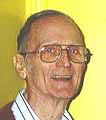 Paul Wilson, W4HHK
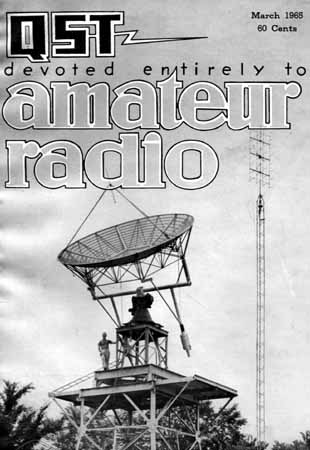
, appeared on the cover of the March 1965 QST with his 18-foot dish mounted on a 35-foot high platform |
A stalwart in the 144-MHz and Microwave Standings, Wilson remained active right up until his health deteriorated earlier this year. In early July, he completed his VUCC on 10 GHz. He celebrated his 75th birthday in September by making his first contact on 24 GHz.
"Paul's life should inspire every amateur to strive to always try something new in Amateur Radio, regardless of age or health," said ARRL Vice President Joel Harrison, W5ZN--a friend of Wilson's. "He has definitely been an example for me."
Noted VHF-UHFer Al Ward, W5LUA, called Wilson "a true VHF pioneer" and said he would be missed.
Wilson got his ham ticket in 1941 at the age of 16. While still in high school, he began experimenting on the old 2-1/2 meter band (112 MHz). After World War II, he rekindled his interest in VHF and UHF, becoming a major figure on the then-new 2-meter band.
During the 1950s, he got involved in meteor scatter propagation. In 1954, W4HHK and Tommy Thomas, W2UK in New Jersey sent and received reports via 2-meter meteor scatter over a 950-mile (1520 km) path--a first! W4HHK and W2UK won the ARRL Technical Merit Award for 1955.
Wilson took on the challenge of Earth-Moon-Earth propagation as well, and in 1961 he began work on an 18-foot dish. He was among those making their first 70-cm EME contacts in July 1965. From that frontier, he moved on to attempt 2304 MHz moonbounce, and he won the ARRL Technical Merit Award for 1969 for his work on that band. In 1970, W4HHK and W3GKP claimed a new record--the first 2304-MHz EME contact.
In 1968, Wilson used his 18-foot dish to monitor the Apollo X command module on 2.2 GHz as the astronauts orbited the moon. He received a NASA confirmation of his reports in the form of a photograph signed by all the astronauts on the mission.
Wilson retired in 1980 after 30 years as an engineer for TV station WMC in Memphis. His wife "DB"--to whom he was married for 54 years--is W4UDQ. His son, Steven, is N4HHK.
A staunch League supporter and ARRL Technical Adviser, Wilson was frequently in the pages of QST over the years--both as an author and as a subject. In his December 1999 QST "It Seems to Us . . ." editorial, ARRL Executive Vice President David Sumner, K1ZZ, singled out Wilson as an Amateur Radio hero for his pioneering accomplishments.
The Central States VHF Society awarded Wilson its Chambers Award in 1986 for "his continuing technical contributions to UHF, especially EME on 13cm."
Services were December 2 in Collierville.
SOLAR UPDATE
SEATTLE, WA, Dec 3, 1999--Sunspot numbers for November 25 through December 1 were 147, 143, 187, 173, 101, 127 and 119, with a mean of 185.4. Estimated planetary A indices for that same period were 18, 4, 3, 7, 4, 8 and 4, with a mean of 6.9. So while sunspot numbers were down, so was geomagnetic activity.
Solar activity is expected to rise over the next few days, with predicted solar flux for Friday through Sunday at 170, 180 and 190 and planetary A index at 5, 15 and 20. This does not look especially good for the ARRL 160-Meter Contest this weekend.
Solar flux should peak around 230 by December 9, then drop below 200 after December 18.
Next week's bulletin should have a listing for all recent solar flux numbers.
Amateur solar observer Tad Cook, K7VVV Seattle, Washington, provides this weekly report on solar conditions and propagation. This report also is available via W1AW every Friday, and an abbreviated version also appears in The ARRL Letter. Readers may contact the author via k7vvv@arrl.net.
IN BRIEF:
- This weekend on the radio:: The ARRL 160-Meter Contest (see November QST, page 105, for rules), the QRP ARCI Holiday Spirits Homebrew Sprint (CW), and the TOPS Activity 3.5 MHz CW Contest are the weekend of December 3-5. See December QST, page 88, for details. Just ahead: The ARRL 10-Meter Contest is the weekend of December 11-12. See November QST, page 105, for rules.
- Chod Harris reported on the mend: Bob Locher, W9KNI, reports that former ARRL HQ staffer and CQ DX columnist Chod Harris, WB2CHO/VP2ML, is "clearly on the mend" and expected to return home soon following a month-long hospital and rehabilitation unit stay following a heart attack. "He seems to be improving in leaps and bounds," Locher says, adding that Harris "is looking forward to a real life again, getting back on the air and on the Internet." Locher says Harris' spirits are high, but he has lost a lot of weight from being on a liquid diet for more than six weeks and is very weak.--Bob Locher, W9KNI
- Ham sats on the launch pad: Amateur Radio's newest satellites are on the launch pad awaiting liftoff December 8 from Vandenberg Air Force base in California. Preparations are going well, and all payloads have been encapsulated. The Joint Air Force-Weber State University Satellite--or JAWSAT--will serve as a bus for several deployable payloads. Deployable payloads aboard JAWSAT are the Orbiting Picosat Automatic Launcher--or OPAL--provided by Stanford University, the ASUSAT provided by Arizona State University, and the Optical Calibration Sphere experiment provided by the Air Force Research Laboratory and L'Garde, Inc. JAWSAT will have a 2-meter/70-cm repeater and packet store-and-forward capabilities. ASUSAT will contain amateur 9600-baud G3RUH-type packet hardware and a 2-meter/70-cm FM voice repeater. ASUSAT-1's downlink frequency is 436.700 MHz. OPAL will release three tiny picosats. One of them, StenSat--will have a crossband repeater aboard that will operate much like the popular AO-27 satellite.--SpaceNews; NASA
- New NCDXF/IARU beacon: The 17th beacon in the NCDXF/IARU Beacon Network came on the air from Novosibirsk, Russia, November 26 at 0945 UTC. The call sign is RR9O. Beacon operator Yuri Zaruba, UA9OBA, reports that this was the first radio beacon to be placed on the air in Russia, and the occasion got local and national TV coverage. The NCDXF/IARU beacons provide world-wide coverage and transmit in turn every three minutes on five different amateur radio bands at 14.100, 18.110, 21.150, 24.930, and 28.200 MHz. These beacons help HF radio users assess current ionospheric conditions. The entire system is designed, built and operated by volunteers. The final beacon will be in Hong Kong, China, with the call sign VR2HK. For more information, visit http://www.ncdxf.org .--Bob Fabry, N6EK
- CQ veterans! The Razorback Radio Club is seeking comments on several proposed rules for an annual Veterans Day QSO Party to be held each November starting next year. Comments are welcome at http://ourworld.compuserve.com/homepages/k5xs. For a copy of the proposed rules, write the Razorback Radio Club (K5HOG), 8437 Wesley Stinnett Blvd, Chesapeake Beach, MD 20732. Comments are requested by December 15, 1999.--Bernie Skoch, K5XS
- Ham Radio University 2000: Clubs in the New York-Long Island Section have organized Ham Radio University 2000, an educational Amateur Radio event, January 23, 2000. Spearheading the event is Great South Bay Amateur Radio Club president Phil Lewis N2MUN. Ham Radio University 2000 is not a hamfest or flea market but will focus on technical forums on all aspects of Amateur Radio and is solely for educational purposes. Forums will include such topics as license restructuring, antennas, DXing, contesting and purchasing Amateur Radio equipment. A complete list and more information is available at http://www.arrlhudson.org/nli/hru2000.htm or contact Phil Lewis, N2MUN, lewisp@hazeltine.com.--Diane Ortiz, K2DO
- Audio version of QST moves to cassette format: Starting in January 2000, the audio version of QST from the Library of Congress will move to audio cassette format. The audio version will continue to be offered free-of-charge to visually or physically handicapped readers in the US who are eligible for the Library of Congress audio/Braille magazine program. Call toll-free 800-424-8567.--Library of Congress
- SOWP high-speed code practice: Former ARRL Communications Manager George Hart, W1NJM, in Newington, Connecticut, regularly conducts high-speed code practice, sponsored by the Society of Wireless Pioneers, Thursdays at 0130 UTC on 3523 and/or 7023 kHz. Practice speeds are 20 to 65 WPM in various increments, decrements and sequences, as announced. Raymond Evans, K7HLR, in Clearfield, Utah, conducts two CW practice schedules daily on 7056 kHz at 1400 and 0000 UTC, November through March; 1300 and 2300 UTC April through November, with speeds from 5 to 40 WPM.
- 9N1MM donations sought: Donations of working amateur gear or money are being sought to set up a club station in Katmandu, Nepal, in memory of the late Father Marshall Moran, 9N1MM. Father Moran, a Jesuit Priest, spent 40 years in Nepal as a teacher and active ham, and was known worldwide. Charlie Harpole, K4VUD, is heading up the 9N1MM memorial club station drive. He reports that there are three newly licensed 9N hams with no prospects of getting on the air without assistance. He says preferred transceivers are smaller, newer radios such as the TS-50 or FT-757GX; cash donations will go toward accessories. Several pieces of gear already have been donated--including a beam from the Northern California DX Foundation. Donations go to Charlie Harpole, K4VUD, 3100 N Hwy 426, Geneva, FL 32732. For more information, e-mail him at k4vud@hotmail.com.