ARRL Audio News
| · | To subscribe, unsubscribe, or change your e-mail delivery address: see How to Get The ARRL Letter, below |
| · | Delivery problems (ARRL member direct delivery only!): letter-dlvy@arrl.org |
| · | Editorial questions or comments: Rick Lindquist, N1RL, rlindquist@arrl.org |
| · | ARRL Audio News: http://www.arrl.org/arrlletter/audio/ or call 860-594-0384 |
| · | The ARRLWeb Extra: http://www.arrl.org/members-only/extra |
EDITOR'S NOTE: Because of the Thanksgiving holiday, we're issuing combined editions of both The ARRL Letter and ARRL Audio News. The next editions will be distributed December 3, 1999. Late-breaking news will be available via The ARRLWeb Extra or W1AW bulletins. ARRL Headquarters will be closed Thanksgiving Day, Thursday, November 25, and Friday, November 26. We wish you and yours a safe and enjoyable holiday! --Rick Lindquist, N1RL
IN THIS EDITION:
- +ARRL Board members elected
- +Most hams not ULS-ready
- +FCC issues reminders for nets
- +Indian amateurs provide post-cyclone aid
- Goldwater estate for sale
- Navy towers toppled
- Solar update
- In Brief: This weekend on the radio; Yukon/NWT mult for phone Sweepstakes; ULS vanity report; Satellites, power grid face potential solar threat; Spectrum Protection Act update; Chod Harris, WB2CHO/VP2ML, suffers setback; Ham class grads reveal wide age spread; NNJ ARES works with Red Cross; Robert Hecksher Sr, W4CYU, SK; W4HA named to Eglin AFB post; VOA says "ooops!" Ham-congressman featured in Broadcasting & Cable
+Available on ARRL Audio News
ARRL BOARD MEMBERS ELECTED
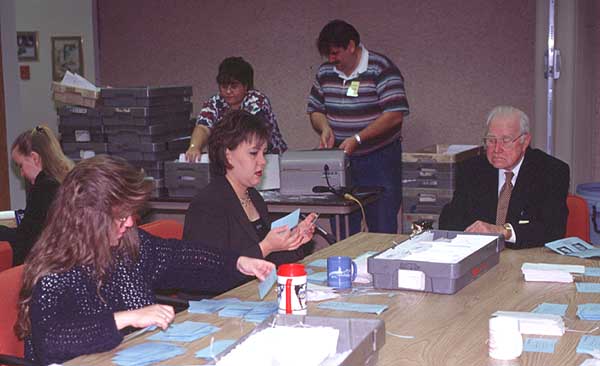 ARRL Headquarters staff members open and sort ballots for machine counting.
Monitoring the entire ballot-counting process was Central Director Ed Metzger, W9PRN. |
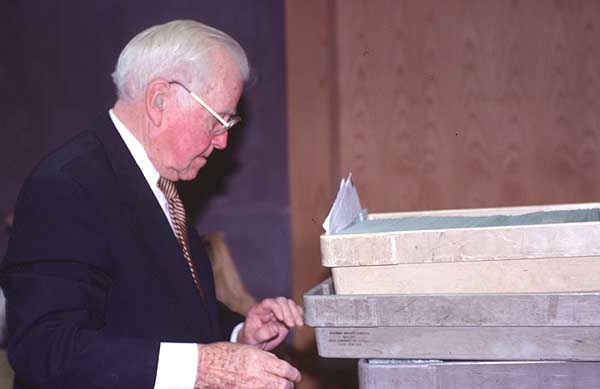
The ARRL Great Lakes Division will have a new Director and Vice Director in January, and there are new faces in division leadership positions in the Dakota, Midwest and Pacific divisions.
The ARRL Committee of Tellers for the election of Directors and Vice Directors for the 2000-2002 and 2000-2003 terms met at ARRL Headquarters today to open and tally ballots submitted by ARRL members in the affected divisions. Balloting for Director occurred in the Great Lakes and Midwest Divisions. Balloting for Vice Director took place in the Atlantic, Great Lakes, and Pacific Divisions.
In the Great Lakes Division George Race, WB8BGY, of Albion, Michigan, was the victor in a three-way race to again serve as Director. The tally showed Race--the current Great Lakes Vice Director--nosing out current Great Lakes Director Dave Coons, WT8W, by 101 votes--1700 to 1599. Challenger Murray Scott, KE8UM, garnered 1302 votes.
In 1995, Race--the Great Lakes Vice Director since 1990--assumed the Director's position when former Director Al Severson, AB8P, now a Silent Key, resigned. In 1997, Race was defeated for election to the Director's post by Joe Falcone, N8TI. Falcone resigned just three months into his term, elevating then-Vice Director Coons to Director. Race subsequently was named to again serve as Vice Director. Earlier this year he filed nomination papers seeking to regain the top job in the Division.
Gary Johnston, KI4LA, of Covington, Kentucky, will be the new Great Lakes Vice Director. He defeated Lawrence Solak, WD8MPV, 2498 to 2010. Race and Johnston will serve three-year terms.
In the Midwest Division Robert W. Walstrom, W0EJ, of Cedar Rapids, Iowa, defeated John Seals, WR0R, 2050 to 766, for a three-year term as Director. Walstrom--an ARRL Life Member--will replace retiring Director Lew Gordon, K4VX.
In the Atlantic Division, incumbent Vice Director Bernie Fuller, N3EFN, of Saegertown, Pennsylvania, beat back a challenge from John Buchanan, KW3X. The vote was 3047 to 2038. Fuller will serve a three-year term.
In the Pacific Division race for Vice Director, Robert Vallio, W6RGG, of Castro Valley, California, won a three-way race over Jettie Hill, W6RFF, and John Ronan, III, K3ZJJ. Vallio polled 1278 votes to 1186 for Hill and 1155 for Ronan. An ARRL Life Member, Vallio--who's currently East Bay Section Manager--will serve a two-year term.
Several candidates were unopposed and were declared elected. They include incumbent Directors Kay Craigie, WT3P (Atlantic), Rick Roderick, K5UR (Delta), and Frank Butler, W4RH (Southeastern) and incumbent Vice Directors Bruce Frahm, K0BJ (Midwest) and Evelyn Gauzens, W4WYR (Southeastern).
Incumbent Directors Tod Olson, K0TO (Dakota) and Brad Wyatt, K6WR (Pacific), also decided not to seek re-election. Incumbent Vice Directors Jay Bellows, K0QB (Dakota), and James Maxwell, W6CF (Pacific), will move up to Director in their respective divisions. Newcomer Twila Greenheck, N0JPH, of Shoreview, Minnesota, was unopposed to become the Dakota Division's new Vice Director.
Terms of office for all successful candidates begin at noon January 1, 2000.
No candidate was nominated for the Delta Division Vice Director position, now held by Henry Leggette, WD4Q. The ARRL Articles of Association provide that "Should the office of Vice Director be vacant, the vacancy shall be filled by appointment by the President."
VAST MAJORITY OF HAMS NOT ULS-READY
Even though registration has been available for approximately two years now, most Amateur Radio licensees have yet to register with the FCC's Universal Licensing System. The ULS Task Force reports that, as of mid-November, 682,212 amateurs still have not registered. This figure includes individuals whose licenses have lapsed but remain in the two-year grace period. The FCC recently said approximately 3% of US licensees had registered with the ULS.
The FCC deployed the ULS for the Amateur Service on August 16, 1999. Amateurs must be registered in the ULS in order to file applications with the FCC--including renewals, modifications, and vanity call sign requests.
Meanwhile, the latest "good news/bad news" scenario from the ULS could go something like this: "Dear Amateur: The good news is that we have granted your requested Group C vanity call sign which you sought 10 weeks ago when you were a General class licensee. The bad news is that when we granted your long-awaited vanity call, we also undid the Advanced and Extra class upgrades you accomplished while your vanity was pending. So, congratulations! You're a General once again."
The ULS Task Force says it recently discovered that the bug occurs when several applications are pending (eg, a vanity application and an upgrade application). The FCC is attempting to straighten out the unintended downgrades and says it will have the operator class of affected licensees corrected within a week.
FCC personnel are currently testing the processing for club, military recreation, and RACES applications and hopes to act on pending applications before the end of the month. Up until now, those applications have been filed on paper and still must be manually keystroked into the ULS prior to processing.
The ULS Task Force also wants amateur applicants to know that if they apply too early for license renewal, their applications will be dismissed. A license renewal must be filed no sooner than within 90 days of expiration, even if coupled with a license modification. This is only an issue for those filing paper applications; the electronic filing system will not let applicants file prematurely.
To register for the ULS, visit http://www.fcc.gov/wtb/uls and click on "TIN/Call Sign Registration". Paper registration also is possible. For more information, call toll-free 888-CALL FCC (225-5322).
FCC LETTER INCLUDES OPERATING REMINDERS FOR NETS
FCC Special Counsel for Amateur Radio Enforcement Riley Hollingsworth recently took advantage of an enforcement-related letter to issue some operating reminders for nets.
On November 3, Hollingsworth wrote Alan E. Strauss, WA4JTK, of Carol City, Florida, to follow up on earlier complaints about the "14.247 DX Group," for which Strauss serves as net control. The FCC had contacted Strauss earlier this year regarding complaints that the 14.247 DX Group monopolized that frequency and interfered with ongoing amateur communications. The November 3 letter included correspondence the FCC received on August 4 that Hollingsworth said conflicts with Strauss's explanation of interference alleged to have occurred to the net in July. Hollingsworth said the case will remain open, and the FCC will continue to monitor net operations.
Hollingsworth used the occasion of the Strauss letter to again point out that amateur frequencies are shared, and no net has a greater right than any other ham to a given frequency and cannot take over a frequency unless it is voluntarily relinquished.
If the frequency is not relinquished, Hollingsworth said, amateurs must exercise "good Amateur practice" in choosing another frequency that does not disrupt existing communications. "A net 'taking over' a frequency from existing legitimate communications or deliberately operating disruptively close to existing legitimate communications will be considered to be engaging in deliberate interference," he wrote.
Hollingsworth also told Strauss that the practice of "identifying only by the last two letters of an Amateur call sign is a violation of Part 97" of the FCC rules and that such practice "must not be condoned by your group." Some amateurs had construed the statement--widely reported elsewhere--as a tightening of FCC station identification enforcement policy. Hollingsworth says that's not the case.
"All we said was that if only the last two letters are given, it doesn't meet Part 97," he said. He pointed out that if a calling station using an abbreviated ID is never acknowledged and given a chance to give a complete call sign, a legal ID would be lacking for that communication. To be strictly legal, stations using a suffix-letter ID always must identify within the first 10 minutes of the communication (and each 10 minutes thereafter) with a complete call sign. Hollingsworth restated the requirements in a follow-up letter to Strauss on November 16.
Hollingsworth this week also reminded net control stations not to encourage rule violations by requiring check-ins to use two-letter IDs without allowing a legal ID at some point within the time limits of the rules.
INDIAN AMATEURS PROVIDE POST-CYCLONE AID
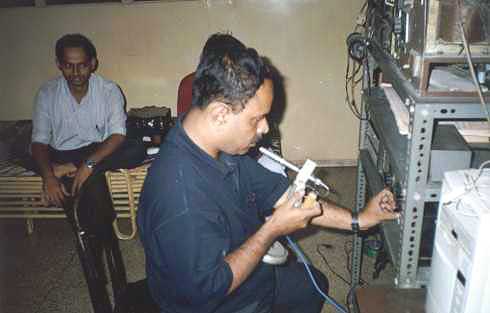 At the controls of the VU2KFR/VU2HFR Amateur Radio Control Room in Calcutta is Indranil Majumdar, VU2KFR. Left is Sanjeev, VU2TIL. [photo courtesy of Indranil Majumdar, VU2KFR]
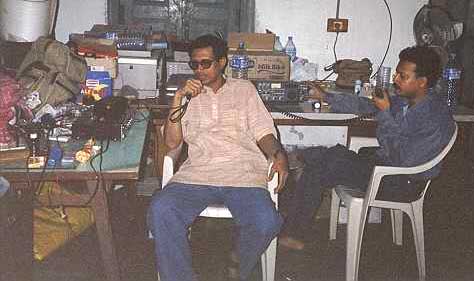
The Amateur Radio control center in the Jajpur District of Orissa: (l-r) VU2NKI operates on 2 meters while VU3BIS works the HF link. [photo courtesy of Indranil Majumdar, VU2KFR] |
Hams in India were able to play a critical role in providing emergency communication from the eastern state of Orissa, struck by a destructive "super cyclone" in late October. The storm resulted in tens of thousands of deaths, left many more homeless, and created food and water shortages. Troops have been sent into the affection regions, and the US has pledged $2.1 million in emergency food and shelter aid.
Calcutta VHF Amateur Radio Society Secretary Indranil Majumdar, VU2KFR, an ARRL member, reports teams of amateurs from all over India responded to the disaster. The Calcutta club set up an Amateur Radio Control Room at the shack he shares with his brother, Horey, VU2HFR, running a Drake TR4 transceiver into a three-element beam on 20 and 40 meters. At one point, a dozen Calcutta hams were staffing the facility around the clock.
"This is the first time the whole of India has to come to know and appreciate ham radio," VU2KFR said. He said ham radio provided the initial communication link between the stricken state and the rest of the country.
On November 7, a group of five Calcutta hams took off for the Jajpur District in Orissa in a Land Rover-type vehicle equipped with HF mobile equipment. "The communication was done from the mobile with a dipole fitted like an inverted Vee on the car roof," Majumdar said. The transceiver in the car was a 15-W homebrew SSB rig that the club had put together.
"The entire communication in the state is being maintained by hams--except for some satellite phones that are operating now and then and facing battery problems," Majumdar said. The disaster communications team has since returned from Orissa as telephone and satellite phone service became available.
Majumdar said the teams handled message traffic relating to emergency food, clothing, and medical needs, road conditions, and health-and-welfare. Similar fixed facilities were set up in other Indian cities--including New Delhi and Hyderabad--and linked via HF.
Majumdar says a group of hams from the National Institute of Amateur Radio in Hyderabad also went to Orissa and set up emergency control rooms in Bhubhaneswar, Jajpur and Paradip. Other stations subsequently were set up in other affected cities with VHF and HF capabilities. VU2KFR says VHF links were being used to handle regional traffic within and between states. There are no repeaters. The hams are using what he called "human relay."
Majumdar estimated that 50 hams in all were participating in the disaster communication effort using their own or borrowed equipment.
One Jajpur official praised the Amateur Radio efforts. In a letter to Calcutta VHF ARS President Dipak Mitra, VU2DPM, District Magistrate R. Balakrishnan said the radio links were helpful in monitoring the spread of disease and in damage assessment efforts. "I am of the view that the concept of ham radio should be popularized and more and more such groups need to be encouraged," he wrote.
GOLDWATER ESTATE FOR SALE
Want to buy a piece of Amateur Radio history? Unfortunately, the antennas and towers now are gone, but the home of the late Sen Barry Goldwater, K7UGA, now is on the market for $4.5 million. The 6300-square foot home in the exclusive enclave of Paradise Valley, Arizona, was visited by dozens of political luminaries and by every living president. Goldwater was Arizona's longtime US Senator and was the GOP's 1964 presidential candidate.
The home, on nearly four acres atop a hill, offers a panoramic view of the valley. The K7UGA ham shack--famous for conducting thousands of phone patches during the Vietnam War--has been disassembled and donated to the Arizona Historical Society for display as a museum exhibit.
Goldwater died May 29, 1998, and the massive antenna system was removed shortly thereafter as part of a prior arrangement with the Goldwaters' neighbors. Goldwater's widow, Susan, still lives in the house, which is said to be owned by a Goldwater family partnership.--thanks to George Chaet, W1RGH
NAVY TOWERS TOPPLED
A contractor used explosives November 13 to drop three 300-foot tall radio towers at the US Naval Academy in Annapolis, Maryland. The towers on Chesapeake Bay's Greenbury Point dated back to 1918 and had become a familiar sight to mariners and tourists. The US Naval Radio Station, Annapolis, was decommissioned in 1996. Plans to take down the towers generated a community debate between those who favored their elimination and those who wanted them preserved as historical artifacts. For many boaters, the towers have provided a navigational landmark.
The Navy made a bit of a show of the demolition with a band sounding colors and the raising of a US flag. On hand for the occasion were Navy dignitaries, members of the media, and local residents, including a few former radio station employees--among them Frank Gentges, K0BRA, who'd served in the 1960s and 1970s with the Naval Electronic Systems Command.
The demolition was the first of three planned for 13 of the Navy's 16 towers at the site of the former Naval Radio Station. An 800-foot tower will come down the weekend of November 20. Two smaller towers will be dismantled manually. Six 600-foot towers and one 1200-foot tower are scheduled to be dropped December 5. Three small towers will remain standing, at least for now. Naval Academy officials have said they will preserve the point as a nature and hiking refuge. --press reports
SOLAR UPDATE
Solar flux and sunspot numbers were up this week. Average solar flux was up almost 40 points from last week's average flux, and average sunspot numbers were up by almost 50 points. The most active geomagnetic day was Saturday, November 13, when the planetary A index was 31 and the K index rose as high as five.
This weekend for the ARRL November Sweepstakes (phone) expect a solar flux of 210, 200 and 200 on Friday through Sunday, and planetary A index of 20, 20 and 12 for the same three days. The absorption on Friday and Saturday could be a little rough for HF operators, but by Sunday it may die down.
After the weekend expect the solar flux to bottom out around 150 from November 26 until the end of the month, then rise above 200 around December 6. From November 29 to December 3 geomagnetic conditions should be stable, with another rough patch around December 4-6.
Sunspot numbers for November 11 through 17 were 340, 324, 251, 232, 213, 231 and 248 with a mean of 262.7. The 10.7 cm flux was 239.8, 231.9, 223.8, 218.8, 205.6, 233.4 and 221.3, with a mean of 224.9. The estimated planetary A indices were 23, 10, 31, 10, 6, 16 and 10, with a mean of 15.1.
IN BRIEF:
- This weekend on the radio: The ARRL November Sweepstakes (phone), the Sixth Annual North American Collegiate ARC Championship (phone), the Six-Meter Annual Winter DX Contest, the LI/NJ-QRP Doghouse Operation Sprint, and the LZ DX Contest (CW) are the weekend of November 20-21. See November QST, page 93, for details.
Just ahead: The CQ WW DX Contest (CW) is the weekend of November 27-28. See October QST, page 87, for details. The ARRL 160-Meter Contest, the QRP ARCI Holiday Spirits Homebrew Sprint (CW), and the TOPS Activity 3.5 MHz CW Contest are the weekend of December 3-5. See December QST, page 88, for details. - Yukon/NWT mult for phone Sweepstakes: Here's a chance to snag the typically rare YU/NWT multiplier for the phone Sweepstakes. To celebrate the fifth anniversary of the US Islands awards program, VE8JR will be active around 28.495 MHz from Vale Island, Northwest Territories. Operation will take place during the ARRL November Sweepstakes (SSB), November 20-22. After the contest, activity will shift to 17 meters from Northwest Territories and Alaska. QSL via KL7JR.
- ULS vanity report: The FCC reports it has processed vanity call sign applications received through September 22, 1999.
- Satellites, power grid face potential solar threat: Forget Y2K! Watch out for Ol' Sol! Increased solar activity due to the current sunspot cycle is expected to affect satellites on which US telecommunications customers depend, says National Oceanic and Atmospheric Administration Director D. James Baker. The solar maximum also could impact US power grids. Starting next year, space storms, radiation showers and effects on power grids are all expected during the upcoming maximum, which is expected to last about three years. NOAA officials said the storms alter the Earth's magnetic field and may send strong enough electrical charges that would overwhelm vulnerable power grids. The last cycle of geomagnetic storms occurred in the late 1980s and resulted in blackouts in Montreal, England and Scandinavia and damaged four Navy satellites. This round of activity is expected to have more dire consequences, Baker says, because customers are much more dependent now on satellite technology. In addition, there are many more satellites than there were a decade ago. Meanwhile, Amateur Radio operators have been looking forward to the solar maximum hoping for improved HF conditions and enhanced propagation on VHF and even UHF.--from press reports and The Hudson Loop
- Spectrum Protection Act update: ARRL Legislative and Public Affairs Manager Steve Mansfield, N1MZA, reports that the Spectrum Protection Act, HR 783, now has 126 cosponsors. Efforts are under way to line up a Senate companion bill for introduction after the first of the year.
- Chod Harris, WB2CHO/VP2ML, suffers setback: Former ARRL HQ staffer and CQ magazine DX columnist Charles J. "Chod" Harris, WB2CHO/VP2ML, is back in intensive care in a California hospital after suffering a heart attack in early November. Bob Locher, W9KNI, reports that Harris' condition deteriorated Thursday after he was moved out of intensive care on Tuesday following considerable improvement: "He is back in intensive care and right now is not doing very well. He is suffering from internal bleeding, and fighting a return of the pneumonia he had a week ago," Locher said. Flowers are not permitted in the intensive care unit. Friends may write Chod Harris, 3201 Franz Valley Rd, Santa Rosa, CA 95404.
- Ham class grads reveal wide age spread: A recent Newington (Connecticut) Amateur Radio League Amateur Radio licensing class taught by Ed Matthews, KC1JV, with help from Ted Ferreira, WA1NXC, resulted in 11 new Technicians and one new Tech Plus--who also passed the General written test. All but one of the class members say they're interested in learning the Morse code and attending a weekend General class. A brother and sister team from Massachusetts were aged 11 and 13 respectively; on the opposite end of the spectrum were a man and a woman aged 66 and 60 respectively. (Dan Miller, K3UFG, reports the two youngsters rode an hour each way to get to the ham class, held at ARRL HQ.)
- NNJ ARES works with Red Cross: During October, members of the West Essex (New Jersey) Amateur Radio Club installed a 2-meter J-Pole and seven-element beam for the Metropolitan New Jersey Red Cross Chapter radio systems used to establish direct communications with the lead chapter in Princeton. The club also relocated two scanner antennas and installed new 800-MHz antennas for the chapter's day-to-day communication. Members involved in the project included WEARC President and Essex County DEC Bob Marsh, KB2SGN; Arnold Knadle, N1JX; Dan Callaghan, KC2DLP; Mike Hartman, WA2QIC; Brian Keegan, KF2HC; and Bob Lange, N2NYR, along with Fred Buchner, KO2FB, the NNJ ARES Red Cross Liaison. As part of a NNJ ARES reorganization, each Red Cross chapter will have a designated Amateur Radio club to which it can turn for support.
- Robert Hecksher Sr, W4CYU, SK: Broadcaster and radio pioneer Robert Hecksher, W4CYU, of Ft Meyers, Florida, died November 4 after a long illness. He was 82. Hecksher put four Florida radio stations on the air during the 1950s and 1960s: WMYR in Fort Meyers--which he still owned at the time of his death--WHEW in West Palm Beach, WOWY in Clewiston, and WHEW-FM in Fort Meyers. Licensed around 1930, Hecksher enjoyed phone operation and building his own equipment. His wife, Kathleen says he enjoyed experimenting with antennas and remained active until becoming ill earlier this year. A civilian employee of the US Navy during World War II, Hecksher is said to have designed a radar antenna used by the Navy until fairly recently.
- W4HA named to Eglin AFB post: Steve Butler, W4HA, has been named chief of the Air Armament Center's Engineering Directorate at Eglin Air Force Base in Florida. Butler, who's the son of ARRL Southeastern Division Director Frank Butler, W4RH, had previously worked at Eglin before spending the last six years in a variety of military assignments. A Florida native, he holds a doctorate in aerospace engineering from the University of Florida. The Engineering Directorate oversees development of Air Force systems, which are tested at Eglin and other test sites prior to deployment. --thanks to Dwayne Sparks, AK4P
- VOA says "ooops!" The Voice of America says a problem at one of its transmitters apparently was responsible for causing a spurious signal to appear in the top end of the 20-meter amateur phone band. Several hams had reported hearing a broadcast signal on 14.340 MHz in recent weeks, a second harmonic of the 7.170 fundamental. Responding to one of those who complained directly, Dan Ferguson, K4VOA, thanked the listener and said the problem apparently was related to a faulty harmonic filter at a VOA transmitter in the Philippines. Ferguson said he contacted the station prior to its October 26 broadcast, and the station has switched to an alternate transmitter until repairs can be made.--thanks to Martin Potter, VE3OAT
- Ham-congressman featured in Broadcasting & Cable: US Rep Gregory P. Walden, WB7OCE, who represents Oregon's second Congressional district, was the featured "Fifth Estater" in the October 25, 1999, issue of Broadcasting & Cable magazine. A broadcaster, Walden, a Republican from Hood River, won his seat last year. He owns Columbia Gorge Broadcasting, a four-radio-station group. Coincidentally, the same issue of the magazine contains a lengthy obituary for Jean Shepherd, K2ORS, who died October 16.