ARRL Audio News
| · | To subscribe, unsubscribe, or change your e-mail delivery address: see How to Get The ARRL Letter, below |
| · | Delivery problems (ARRL member direct delivery only!): letter-dlvy@arrl.org |
| · | Editorial questions or comments: Rick Lindquist, N1RL, rlindquist@arrl.org |
| · | ARRL Audio News: http://www.arrl.org/arrlletter/audio/ or call 860-594-0384 |
| · | The ARRLWeb Extra: http://www.arrl.org/members-only/extra |
IN THIS EDITION:
- +Amateur restructuring details possible by year's end
- +Rosalie White, WA1STO, to head Field and Educational Services
- +FCC proposes Tucker call sign reduction plan
- +FCC reaffirms order to keep NC ham off HF
- +Frederick Oliver Hammond, VE3HC, SK
- +Hams will get to help NASA with space experiment
- Solar update
- In Brief; This weekend on the radio; New Section Managers appointed; Chod Harris, WB2CHO/VP2ML, improving; NNJ hams commended for hurricane efforts; Virginia hams honored for flood duty; W1AW to participate in meteor scatter/APRS experiment; NASA invites Leonid images; Colin C. Dumbrille, VE7NN/VP9C, SK; Douglas A. Blakeslee, N1RM, SK; FCC Amateur enforcement info; Peter Budnik, KB1HY, QSY; Help wanted--Direct Sales Representative; KLM antennas out of business; VC1A commemorates NATO anniversary
+Available on ARRL Audio News
AMATEUR RESTRUCTURING DETAILS POSSIBLE BY YEAR'S END
Knowledgeable sources in Washington say the amateur license restructuring issue has moved to the front burner at the FCC, and a Report and Order could be released before the end of 1999.
The Amateur Radio community has been awaiting license restructuring--known officially as the 1998 Biennial Regulatory Review of Part 97 (WT Docket 98-143)--for nearly one year now. While no one has mentioned a hard-and-fast date to wrap up the long-awaited proceeding, reports from several sources suggest that the R&O draft is in its final stages and could be complete within a month or so.
During a recent a visit to top FCC officials in Washington, League officials pressed again for early action on the license restructuring rulemaking. They were assured that the issue was not stalled and that the Wireless Telecommunications Bureau was "working very actively" to move restructuring along.
Whatever its final form--and no one has hinted at that--license restructuring poses significant implications for Amateur Radio and its future direction and growth. On August 10, 1998, the FCC proposed to phase out the Novice and Technician Plus licenses, leaving just four amateur license classes in place--Technician, General, Advanced, and Extra. The Commission also asked the amateur community to express its opinions on Morse code requirements for licensing and testing, but offered no specific recommendations.
At its July 1998 meeting, the ARRL Board of Directors--attempting to get the jump on restructuring--issued its own plan to restyle Amateur Radio. Among other details, the ARRL plan also calls for four license classes and for "refarming" Novice/Tech Plus subbands to provide additional spectrum for higher-class operators. Under the League plan, the Technician license remains unchanged, and the General becomes the entry-level ticket to HF operation. The ARRL proposed Morse code requirements of 5 WPM for General and 12 WPM for Advanced and Extra class.
The restructuring debate generated more than 2200 comments to the FCC, many of them from individual amateurs. Once the FCC approves the Report & Order, a Public Notice will be issued, and the actual R&O will be released probably within a few days.
ROSALIE WHITE, WA1STO, TO HEAD FIELD AND EDUCATIONAL SERVICES
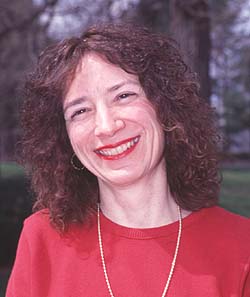
Rosalie White, WA1STO |
Rosalie White, WA1STO, has been named to head ARRL Field and Educational Services, effective November 11. The appointment, announced by ARRL Executive Vice President David Sumner, K1ZZ, fills the gap left by departing Field Services Manager Rick Palm, K1CE. Palm is going into semi-retirement in Florida, and November 10 was his last day at ARRL Headquarters.
White has been serving as ARRL Educational Services Manager since the Field Services and Educational Activities departments consolidated last January 4. She and Palm have co-managed the combined units since then. As Field and Educational Services Manager, White becomes the main contact person for section managers as well as representing the League to the outside agencies it serves and promoting and supporting the field organization. She'll also serve as the primary staff contact for Amateur Radio in space issues.
White stressed that Amateur Radio public service will continue to be a high priority under the new F&ES management regime, and supporting field volunteers in disaster response efforts will get top attention. "It's one of the most important aspects of Amateur Radio and one of the main reasons why we enjoy the myriad frequencies we've been allocated," she said.
Since the inception of the combined department last winter, White says she's been ramping up her knowledge of the "Field Services" side of the unit and familiarizing herself with the issues and personnel involved. This past weekend, she was on the road to support both halves of the house, meeting on the West Coast with the Enforcement Task Force then jetting to Texas to confer on matters related to Amateur Radio on the International Space Station program.
"We have a good team in place in the department that values customer service and is capable of serving a variety of needs across the broad spectrum of field volunteers," she said.
The 1995 Dayton Hamvention Amateur of the Year, White, 50, was first licensed as WN9FJT in 1970 in her native Indiana. She holds bachelors and masters degrees in education. White began her career at ARRL Headquarters in 1973, and in 1976, she became the first woman manager at ARRL Headquarters when she was tapped to head the new Club and Training Department. She left the HQ staff in 1979 but rejoined it nine years later as Educational Activities Department manager.
White says she particularly enjoys operating Maxim Memorial Station W1AW for Field Day and during contests, Kid's Day and School Club Roundup. A private pilot, White also enjoys hiking and canoeing.
FCC PROPOSES TUCKER CALL SIGN REDUCTION PLAN
The FCC has proposed consolidating the call sign holdings of California's Tucker family to reduce the overall number of call signs held by family members from 36 to 14.
In a letter November 3 to the Tucker family's attorney, FCC Special Counsel for Amateur Radio Enforcement Riley Hollingsworth outlined an FCC recommendation that would let individual members keep some of the call signs granted earliest. The plan would leave family patriarch Roy Tucker, N6TK, with three of seven call signs granted November 4, 1996, and Kathryn Tucker, AA6TK, Kent Tucker, AA6KT, and Eric Tucker, AA6ET, each with three of eight call signs granted to each November 4, 1996. Nancy Tucker, W5NAN, would be permitted to retain two club station call signs assigned to her January 9, 1998.
Hollingsworth said this week that the FCC's solution represented "an attempt to meet them at a reasonable halfway point to solve the problem."
In their response to an FCC inquiry this past summer, the Tuckers had proposed to consolidate the club call signs in a manner that would result in a total of 27 rather than 36 club signs granted to family members, the FCC said. In its November 3 letter the FCC noted that the Tucker family collectively received 31 club station call signs grants on the same day. "That, coupled with the information submitted that shows that family members appointed each other trustee in 29 instances, stretches the credibility of their claim that these are legitimate clubs," Hollingsworth wrote.
The FCC said the Tuckers, in their response to the FCC's inquiry this summer, failed to provide meeting times or dates, proposed meeting time or locations within the coming year, copies of meeting minutes, or organizational documents. The FCC said the Tuckers also declined to provide requested club membership information, offering instead an explanation for their refusal. According to the FCC, the Tuckers did not even provide the number of members for each club, but did claim to have organizational documents.
Hollingsworth says Tucker family members have vowed to demand a full hearing before an administrative law judge prior to any attempts by the FCC to revoke the club station grants at issue. He says the FCC is ready for that possibility. The FCC letter says that if the Tucker family does not respond within 20 days, the Commission will "adjust" the family's club station call sign holdings according to the plan outlined in the letter.
FCC REAFFIRMS ORDER TO KEEP NORTH CAROLINA HAM OFF HF
The FCC has reaffirmed its position that John A. Abernethy, K4OKA, of Hickory, North Carolina, will have to stay off the HF bands until January 22, 2000.
As a follow-up to a station visit last January and alleged malicious interference this past summer, FCC Special Counsel for Amateur Radio Enforcement Riley Hollingsworth notified Abernethy July 27 that the Commission was modifying his license to prohibit operation below 30 MHz for 180 days, effective immediately.
The FCC's July letter included a copy of a tape recording--supplied by complainants--of transmissions said to be of Abernethy's station on July 16. The FCC says the tape consists of deliberate interference on 75 meters and notes that Abernethy was warned about deliberate interference at the time his station was inspected.
Abernethy, 75, subsequently disputed the authenticity of the tape recordings and requested the modification be lifted or lessened. But Hollingsworth told Abernethy this month that the sanction stands.
"We will draw no conclusions from the tape recording, and even resolving the issue of the tape recording in your favor, we have no basis to rescind or change the modification of your license," Hollingsworth said in a November 3 letter to Abernethy.
FCC personnel inspected Abernethy's station January 21 and 22 in the wake of what Hollingsworth has called "longstanding complaints from other amateurs and from our field offices regarding the operation of your station." In particular, he said, the FCC had received "numerous complaints" about profanity, obscenity, deliberate interference, and failure to properly identify.
In his November 3 letter, Hollingsworth said the modification to take Abernethy off the HF bands for six months was based on findings made during the station inspections "including a tape recording that you had played over the air and which you showed to the Commission engineer." He suggested the FCC could have begun license revocation proceedings against K4OKA but decided on the modification instead.
Complaints to the FCC alleged that Abernethy had aired something called the "Porkbutt Song," the FCC said. The FCC says its High Frequency Direction Finding Center in Maryland tracked the transmissions of the "Porkbutt Song" to K4OKA. Abernethy "voluntarily destroyed the tape recording" while FCC personnel looked on, Hollingsworth said.
Hollingsworth reminded Abernethy that violation of the modification order will lead to revocation of his Amateur license. Abernethy may continue to operate on amateur frequencies above 30 MHz.
FREDERICK OLIVER HAMMOND, VE3HC, SK
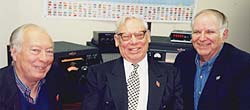
Left to right: IARU Region II President Tom Atkins, VE3CDM; Fred Hammond, VE3HC; and IARU President Larry Price, W4RA, at Fred Hammond's Museum of Radio in Guelph, Ontario, in 1997. |
Fred Hammond, VE3HC--considered by many to be the Grand Old Man of Canadian Amateur Radio--died November 7 in Guelph, Ontario. He was 86 and had been in failing health since suffering a stroke last year.
"Amateur Radio has lost one of its distinguished members and champions who will be sadly missed by his many friends everywhere," said IARU Region II President Tom Atkins, VE3CDM.
An amateur for more than 70 years, Hammond was elevated to the Canadian Amateur Radio Hall of Fame in 1996.
ARRL Executive Vice President David Sumner, K1ZZ, recalled Hammond as an enthusiastic and generous supporter of the ARRL. "Fred was one of our most loyal benefactors," he said. "Hammond Manufacturing Company cabinets grace W1AW and the ARRL Lab through his beneficence." The September 1995 issue of QST includes "Thrills, Butter Churns and Honeycombs: A Visit to The Hammond Museum of Radio," which depicts Hammond's collection of vintage amateur equipment, a favorite personal project. It reorganized and reopened October 2 under the direction of Hammond's son Bill (see "The New Hammond Museum" in AWA's The Old Timers Bulletin, November 1999, page 37--Ed).
The Kitchener-Waterloo Amateur Radio Club has posted additional information about Hammond at http://www.kwarc.org/fred/.
Services were November 11 in Guelph. Memorial donations to the St Joseph's Health Care Foundation, 50 Westmount St, Guelph, Ontario, the Foundation of Guelph General Hospital, or the charity of your choice are welcome. The families of Fred Hammond's sons William and Rob can be reached c/o Hammond Mfg Co Ltd, Edinburgh Rd, Guelph, ON, Canada.
HAMS WILL GET TO HELP NASA WITH SPACE EXPERIMENT
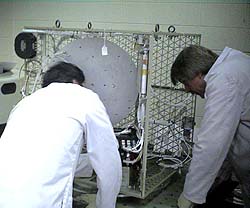
NASA and University of Alabama in Huntsville engineers integrate the PEST payload onto JAWSAT. [NASA/Marshall] |
If all goes well, Amateur Radio operators will get a chance to contribute to a NASA satellite project by recording the data.
The Plasma Experiment Satellite Test--or PEST--at NASA's Marshall Space Flight Center will ride on the Joint Air Force-Weber State University Satellite, or JAWSAT, according to project scientist Nobie Stone. The launch is set for no earlier than December 2. The primary payload will be the US Air Force Academy's Falconsat. JAWSAT will serve as a bus for several deployable payloads and the attached PEST experiment.
The telemetry stream from JAWSAT--which includes data from PEST--will be transmitted on amateur frequencies. "Hams will be able to obtain data that characterizes certain aspects of the ionosphere above the D, E, and F layers where most of their signals are reflected," said PEST Project Manager Fred Berry, WA4IWY. "We're going to publish the data format in terms that everyone can understand."
Data from PEST will be using either a G3RUH modem or a GMSK modem. Data rates should be as high as 38.4 kb/s. Data will be transmitted on 437.175 MHz or 2403.2 MHz. NASA will publish instructions for sending in data so the PEST team can use it.
"It's an experiment," Berry said. "We're hoping that high school and college kids will get involved and learn something about the ionosphere and radio propagation."
Deployable payloads aboard JAWSAT are the Orbiting Picosat Automatic Launcher--or OPAL-- and ASUSAT provided by Arizona State University. ASUSAT itself will contain amateur packet hardware and a 2-meter/70-cm FM voice repeater. OPAL will release three tiny picosats--one of them, StenSat--will have a crossband repeater aboard that will operate much like the popular AO-27 satellite.
After JAWSAT reaches its desired polar orbit at 700 km (420 mi) altitude, it will be about two weeks before PEST is first powered on. PEST will acquire data for at least a two-month period. For more information, visit http://science.nasa.gov/ newhome/headlines/ast04nov99_1.htm. --NASA Space Science News
SOLAR UPDATE
Both solar flux and sunspot numbers were up this week, with average sunspot numbers rising nearly 37 and average flux up by nearly 25.
Activity took a big jump in the past few days, with a sunspot number of 343 on Wednesday and solar flux at 248.5. Unfortunately for HF operators, this was accompanied by rising geomagnetic activity, so conditions have not been ideal.
What is generally bad for HF is not the same for 6 meters. While HF experienced high absorption, 6 meter operators were working DX. A number of reports were received this week from Midwest hams who worked South America and the Caribbean on 6 meters.
The predicted solar flux for Friday through Sunday is 242, 245 and 245, and the planetary A index forecast is for 18, 10 and 8. So while the solar flux should rise to high levels, the geomagnetic indices should drop.
Beyond the weekend look for a declining solar flux, but it should only bottom out around 160 for November 18-21, then rise to 170 around Thanksgiving, then drop to 145 at the end of the month. Disturbed geomagnetic days include November 19-20 and 24, and the few days following December 4.
Sunspot numbers for November 4 through 10 were 108, 153, 188, 185, 232, 288 and 343 with a mean of 213.9. The 10.7-cm flux was 147.5, 160.5, 150, 173.9, 191.9, 229.9 and 248.5, with a mean of 186. The estimated planetary A indices were 5, 4, 7, 24, 33, 25 and 12, with a mean of 15.7.
IN BRIEF:
- This weekend on the radio: The Worked All Europe Contest (RTTY), the Japan International DX Contest (SSB) and the OK/OM DX Contest are the weekend of November 13-14.
Just ahead: The ARRL November Sweepstakes (phone), the Sixth Annual North American Collegiate ARC Championship (phone), the Six-Meter Annual Winter DX Contest, the LI/NJ-QRP Doghouse Operation Sprint, and the LZ DX Contest (CW) are the weekend of November 20-21. Sweepstakes rules are in October QST, page 88. See November QST, page 93, for other contest details. - New Section Managers appointed: San Francisco and Northern New York have new SMs. Leonard Gwinn, WA6KLK, of Willits, California was appointed San Francisco Section Manager, effective November 10. He replaces John Wallack, W6TLK, who resigned. Gwinn's term of office ends September 30, 2001. Members may contact Gwinn at 2960 Blackhawk Dr, Willits, CA 95490-9704; tel 707-459-1871; e-mail wa6klk@arrl.org. Chuck Orem, KD2AJ, of Plattsburgh, New York, replaced Les Schmarder, WA2AEA, as Northern New York SM, effective November 11. Schmarder has resigned. Orem's term of office ends December 31, 2000. Members may contact him at 3981 State Route 22, Plattsburgh, NY 12901-5554; 518-563-6851; kd2aj@arrl.org.
- Chod Harris, WB2CHO/VP2ML, improving: Former ARRL HQ staffer and CQ magazine DX columnist Charles J. "Chod" Harris, WB2CHO/VP2ML, remains hospitalized but is said to be improving after suffering a heart attack in early November. Bob Locher, W9KNI, reports that Harris, 50, is now alert and responding. "Chod is still a very sick man and has a long road to recovery in front of him, but at least progress overall is in the right direction," Locher said. He says Harris has some internal bleeding, however, and this is an additional complication. "Chods family has requested that any friends capable of doing so please donate blood for Chod. His family will be grateful." Donors need only go to the nearest blood bank and donate blood, referencing Charles J. Harris, patient in Santa Rosa Memorial Hospital, Santa Rosa, California. Flowers are not permitted in the intensive care unit. Friends may write Chod Harris, 3201 Franz Valley Rd, Santa Rosa, CA 95404
- NNJ hams commended for hurricane efforts: Seven Amateur Radio operators from the Ramsey, New Jersey, Office of Emergency Management received Emergency Communications Commendations from ARRL Northern New Jersey Section Manager Jeff Friedman, K3JF, for their efforts during and following Hurricane Floyd. Recipients included: OEM Coordinator Michael Adams, KC2AHS; Deputy Coordinator Bruce Greenwood, KB2UJN; RACES Officer Louis Janicek, N2CYY; Deputy RACES Officer Herbert Van Den Houten, N2OPJ; Michael Greenshields, KC2EOY; Ernie Bruno, N2URU; and Matty Freidman, N2UCA. The hams not only operated under severe weather conditions during the storm but provided emergency communication for Bergen County during a three-day telephone service outage. The Ramsey Office of Emergency Management now has 21 active hams on its roster.--Michael Adams, KC2AHS
- Virginia hams honored for flood duty: Virginia RACES has received a Certificate of Appreciation from the Mayor and City Manager of the City of Franklin, Virginia, for the support amateurs provided during the Hurricane Floyd flooding. The presentation came November 6 during a Virginia ARES/RACES meeting in Hampton, Virginia. Visit http://38.202.19.207/Pages/Virginia_Statewide/ Frasnklin_Certificate/frasnklin_certificate.html. The certificate cites hams' "invaluable service" during the flooding. At one point, ham radio was the sole means of communication in and out of the city. --Frank Mackey, K4EC
- W1AW to participate in meteor scatter/APRS experiment: ARRL Maxim Memorial Station W1AW will participate for the first time in a meteor-scatter experiment by attempting to bounce APRS packets off the ionized particles resulting from the Leonids meteor shower. From 2100 UTC on November 12 through November 19, W1AW will operate WinAPRS-equipped stations on 6 and 2 meters. W1AW will monitor and beacon on 53.530 and 147.585 MHz continuously, transmitting its grid square. An article in November QST ("An Automated Meteor-Scatter Station" by Ev Tupis, W2EV) explains the experiment. QSLs will be available for all stations receiving W1AW's APRS beacons. An SASE is requested. A list of call signs of stations received at W1AW will be posted daily at http://www.arrl.org/announce/leonids_experiment.html.
- NASA invites Leonid images: In anticipation of higher than normal meteor activity during November's annual Leonid meteor shower, NASA has created an image library and invites amateur astronomers, photographers and individuals with imaging equipment to upload Leonid meteor photographs or images to the Near-Live Leonid Meteor Watch System. More information is at http://leonids.hq.nasa.gov/. --AMSAT News Service
- Colin C. Dumbrille, VE7NN/VP9C, SK: Former Canadian Amateur Radio League Vice Director Colin Dumbrille, VE7NN/VP9C (ex-VP9BK), of Maple Ridge, British Columbia, died July 29. He was 80. A life member of the ARRL, Dumbrille was first licensed at age 14 as VE2BK. In the mid-1960s, he opened a business in Bermuda and took up residence in Smith's Parish. He was active in the Bermuda Radio Society. He retired in 1988 and returned to Canada in 1997.--thanks to Vic Politi, W1NU
- Douglas A. Blakeslee, N1RM, SK: Former ARRL Technical Department staff member Doug Blakeslee, N1RM (ex-W1KLK), of Verona, Wisconsin, died November 4 after a short illness. He was 58. Blakeslee worked in the ARRL Technical Department from 1964 to 1972, and his byline appeared frequently in QST in those days. Services were November 10 in his native Connecticut.
- FCC Amateur enforcement info: The FCC Amateur Radio Enforcement Log, a digest of the latest FCC Amateur Radio enforcement news, now is available to all on ARRLWeb, http://www.arrl.org. From the ARRLWeb home page, click on "News." Then, under "Special Interest Topics," Click on "FCC Amateur Radio Enforcement Logs." This information may be republished without special permission, with credit to ARRL.
- Peter Budnik, KB1HY, QSY: Pete Budnik, KB1HY, departed ARRL Headquarters on November 9 to begin a new job. During his nearly eight years at HQ, Budnik has worked in the Membership Services (DXCC), Educational Activities and Circulation departments. He has capably assisted thousands of prospective hams as they've made their first contact with the ARRL (and, in some cases, with Amateur Radio). More recently, he provided customer service for Publication Sales and has represented the League at many national events.
- Help wanted--Direct Sales Representative: ARRL HQ seeks an Amateur Radio licensee with broad operating experience for customer service position. The successful candidate should have some familiarity with ARRL products and services. Good telephone skills and data entry experience are required. Responsibilities include high-volume telephone contact, written correspondence and miscellaneous administrative tasks. Salary to upper teens. No telephone calls. Forward resumes to Bob Boucher, c/o ARRL, 225 Main St, Newington, CT 06111 or via e-mail to rboucher@arrl.org. EOE
- KLM antennas out of business: KLM Antennas of Monroe, Washington, reportedly closed its doors as of October 31. Industry sources say that Bruce Scott will continue to sell parts--at least for the time being--by e-mail orders only to klm_antennas@msn.com. No other information is available at this time.
- VC1A commemorates NATO anniversary: Special event call sign VC1A as been authorized for use by the Nikola Tesla Radio Club until November 29, 1999, to commemorate the 50th Anniversary of NATO. --RAC