ARRL Audio News
| · | To subscribe, unsubscribe, or change your e-mail delivery address: see How to Get The ARRL Letter, below |
| · | Delivery problems (ARRL member direct delivery only!): letter-dlvy@arrl.org |
| · | Editorial questions or comments: Rick Lindquist, N1RL, rlindquist@arrl.org |
| · | ARRL Audio News: http://www.arrl.org/arrlletter/audio/ or call 860-594-0384 |
| · | The ARRLWeb Extra: http://www.arrl.org/members-only/extra |
IN THIS EDITION:
- +Vanity waiting game continues
- +New FCC bureaus phase in November 8
- +Conducted emission limits revised
- +FCC allocates 75 MHz for ITS
- +Amateur bequest seeds W1AW Fund
- AMSAT urges FCC to reject experimental application
- ARRL Honorary VP Charles G. Compton, W0AF, SK
- Solar update
- In Brief: This weekend on the radio; The role of VY0 in ARRL-sponsored contests; Hollingsworth reiterates pledge; AMSAT-NA Symposium audio; AMSAT issues alert; Former HQ staffer loses home to fire; QST Cover Plaque Award; OH2MCN licensing info pages moving; Midland recalls weather radios
+Available on ARRL Audio News
VANITY WAITING GAME CONTINUES
The long queue of vanity call sign applications got just a little bit shorter during the month of October, but vanity processing continues at near-glacial velocity. Since the Universal Licensing System was deployed for the Amateur Service on August 16, 1999, the FCC reports it has processed 10,878 amateur applications. Of that number, just over 1000 were requests for vanity call signs. To date, there have been 494 vanity grants and 525 dismissals.
The FCC didn't resume vanity processing at all until mid-September, and then only in comparatively small test batches. Things have speeded up considerably since then--approximately 150 vanity grants were issued in the past 10 days--but there's still a lot of catching up to do. So far, the FCC has only processed vanity applications received through August 17, and as of October 28, it had not completely checked the processing run of the previous evening. All vanity applications received after July 22 will be processed via the ULS.
"We regret that this process has been a slow one," the ULS Task Force is telling applicants who inquire. "However, the Commission feels that the integrity of the vanity call sign process is a major concern and requires extensive data control during the implementation of call sign assignment in the new ULS environment." The FCC says it will continue processing in a "verification mode," and will resume routine vanity processing once it has "ensured the integrity of the vanity program."
The ULS Task Force has offered some tips to those submitting vanity call sign requests via the ULS. Vanity applicants only must complete Schedule D for Form 605. When requesting a vanity call sign, applicants should answer "no" to Item 1 ("Is this a request to change a station call sign systematically?"). The Task Force concedes this might seem confusing or contradictory, but says the question only relates to a request for a "systematic" or "sequential" call sign and has nothing to do with vanity.
Item 2, Application Purpose, on Form 605 is another point of confusion. The FCC says vanity applications should indicate "MD" ("Modification") for this item. "This is not very clear in the instructions," a Task Force spokesperson allowed. Those filing to change name, address, telephone number, fax number, or e-mail address should indicate "AU" ("Administrative Update") in Item 2, the Task Force said. The main exception would be someone changing their address and also requesting a systematic, or sequential, call sign change--such as someone moving from one call district to another. In that case, the Task Force says, the applicant should indicate "MD" (for "Modification"), then check "yes" for Item 1 on Schedule D.
A ULS spokesperson remained optimistic that vanity processing would "move along faster in the next couple of weeks."
NEW ENFORCEMENT AND CONSUMER INFORMATION BUREAUS OFFICIAL
It's now official! The FCC will create two new bureaus--the Enforcement Bureau and the Consumer Information Bureau--effective November 8. FCC Chairman William Kennard made the announcement during testimony October 26 before the House Telecommunications Subcommittee on the FCC's Five-Year Strategic Plan.
"Our decision to establish bureaus devoted exclusively to enforcement and consumer information signals the enormous importance of these functions in our transition from an industry regulator to a market facilitator," Kennard said. "This reorganization is the first step in a larger effort to streamline and modernize the FCC."
As expected, FCC Deputy General Counsel David H. Solomon was named to head the Enforcement Bureau. The new bureau will consolidate enforcement functions--including amateur--and personnel from the Commission's existing Common Carrier, Mass Media, Wireless Telecommunications and Compliance and Information Bureaus. Solomon has been Deputy General Counsel since 1994.
Current FCC Legal Adviser for Enforcement Riley Hollingsworth, K4ZDH, says he hopes the reorganization eventually will permit him to increase the amount of time he's able to devote to Amateur Radio enforcement. Hollingsworth will get a new title as part of the reorganization: Special Counsel for Amateur Radio Enforcement.
In a surprise move, Kennard announced his intention to name Lorraine C. Miller to be Bureau Chief of the new Consumer Information Bureau. Miller now directs the Office of Congressional Relations at the Federal Trade Commission. Current Compliance and Information Bureau Chief Richard Lee had been expected to become the new CIB chief. Instead, Lee has been appointed Senior Director of Licensing Analysis in the Chairman's office. In that role, he'll advise the FCC on consolidating licensing functions across the agency.
The new CIB will consolidate the FCC's Gettysburg Call Center (to be renamed the Consumer Center) as well as staff from various bureaus who handle consumer complaints and public information requests.
Hollingsworth has agreed to be detailed from the new Enforcement Bureau to the new Consumer Information Bureau to handle the Consumer Center at Gettysburg after the new bureaus become effective November 8. The temporary duty will last four to six weeks. Hollingsworth says Amateur Radio enforcement will be his priority, and, by agreement between the two bureaus, amateur enforcement will continue at its present pace. Hollingsworth's current duties also include Land Mobile Service enforcement.
For more details on the reorganization plan, visit http://www.fcc.gov/Bureaus/Miscellaneous/News_Releases/1999/nrmc9072.html --FCC news release
FCC REVISES CONDUCTED EMISSION LIMITS
The FCC has gone along with recommendations from the ARRL and others to hold the line on conducted emissions below 30 MHz from unlicensed consumer electronic and industrial, scientific and medical devices operating under Parts 15 and 18 of the Commission's rules. The FCC has proposed new emission guidelines that are just slightly more stringent than the current FCC standards.
"We conclude that mandatory conducted emission limits continue to be necessary to control interference to communications services," the FCC said in a Notice of Proposed Rule Making in ET Docket 98-80, released October 18. The Commission announced plans to "harmonize" its conducted emission standards with international standards developed by the International Electrotechnical Commission, International Special Committee on Radio Interference--known as CISPR.
The CISPR emission limits for consumer equipment are "approximately 5 dB more stringent below 5 MHz and 1 dB more stringent above 5 MHz" than the existing standards, the FCC said. "We believe that these standards address some of the concerns expressed by ARRL" and others in response to last year's FCC Notice of Inquiry on the issue, the Commission commented.
The Commission said it was not persuaded by a National Association of Broadcasters' suggestion to impose much tighter standards--22 dB greater than present--to protect AM broadcasting.
Interfering devices include such common household appliances as computers, TV sets, and microwave ovens. Conducted emissions result from RF voltages imposed on the ac power line, which can, in turn, act as an antenna. In general, the FCC's current conducted emissions limit is 250 uV. Equipment manufacturers had argued to relax existing limits to keep down production costs, while the ARRL and others representing spectrum users had asserted that the existing limits were not tight enough. In response to the earlier NOI, the League had commented that the proliferation of Part 15 and 18 devices over the past decade had resulted in "a marked increase in RF noise from conducted emissions generally."
The FCC said it agrees that that standards on the amount of RF energy conducted onto the ac power lines "are required to control potential interference to users of the radio spectrum below 30 MHz." It also invited comments on expanding the frequency range of the conducted emission limits from the current 450 to 30 MHz to the 9 kHz to 30 MHz spelled out in the CISPR standards. The ARRL has proposed that the FCC allocate new LF amateur bands at 136 kHz and at 160 to 190 kHz.
Comments on the NPRM are due 75 days after its publication in The Federal Register, and reply comments are due 30 days later. A copy of the FCC's Notice of Proposed Rule Making in ET Docket 98-80 is available at http://www.arrl.org/announce/regulatory/et98-80/nprm.html.
FCC ALLOCATES 75 MHz AT 5.9 GHz FOR ITS
As expected, the FCC has allocated 75 MHz of spectrum in the vicinity of 5.9 GHz for use by so-called "Intelligent Transportation System" services aimed at improving highway safety. The co-primary allocation for Dedicated Short Range Communications systems at 5.850 to 5.925 GHz includes the upper portion of a secondary Amateur Service allocation. Hams share 5.650 to 5.925 GHz with government radars and nongovernment fixed satellite service uplinks. The FCC already has allocated 5.725-5.825 GHz for U-NII devices to provide short-range, high-speed wireless digital communication under Part 15.
In releasing its Report and Order in ET Docket 98-95 October 22, the FCC said the 5.850-5.925 GHz band would be devoted to a variety of Part 90 DSRC uses such as traffic light control, traffic monitoring, travelers' alerts, automatic toll collection and traffic congestion detection. Other proposed uses of ITS would include electronic inspection of moving trucks and emergency vehicle traffic signal preemption. The Commission said that amateur organizations and licensees "raised the majority of DSRC spectrum sharing concerns" in their comments on last year's Notice of Proposed Rulemaking on the issue.
In its September 1998 comments, the ARRL said the FCC was proposing too much spectrum at 5.9 GHz for DSRC deployment. The League had asked that the FCC compensate the Amateur Service by elevating remaining Amateur and Amateur Satellite allocations at 5.650 to 5.725 and 5.825 to 5.850 GHz to nongovernment primary "to insure against future preemption by nongovernment services with higher allocation status." The FCC Report and Order did not specifically address the ARRL's request for elevation to primary status, however.
In the R&O, the FCC said it was "sympathetic" with the League's concerns that the ITS and U-NII allocations could impact amateur use in the band but said hams have 275 MHz in the band and most ham use is for point-to-point networks. Given amateur radio's inherent frequency agility, the FCC said it believes "spectrum sharing between the amateur service point-to-point links and DSRC operations is viable." DSRC operations in the 5.850-5.925 GHz band "are unlikely to receive significant interference from or cause interference to amateur operations," the FCC said.
The FCC encouraged ITS entities to "informally notify the ARRL or the local amateur service community" of their intended operation. The FCC has proposed a maximum of 30 W EIRP for DSRC systems, but the rules will require ITS licensees to use the minimal power necessary.
The FCC says it will defer consideration of licensing and services rules and spectrum channelization plans to a later proceeding.
BEQUEST OF OHIO HAM SEEDS W1AW FUND
Thanks to the generosity and foresight of an Ohio ham, the Maxim Memorial Station W1AW will be able to make more definite plans to upgrade and improve station equipment and facilities. With a substantial bequest from the estate of the late Harold A. Jones, WB8AMI, the ARRL has chartered the W1AW Fund.
ARRL Chief Financial Officer Barry Shelley, N1VXY, says the W1AW Fund was created to ensure that Amateur Radio's flagship station will continue to serve future generations of amateurs. Shelley said that, through Jones' generous contribution, the W1AW Fund will help to provide ongoing resources to support day-to-day operations as well as ongoing maintenance and future improvements at W1AW.
A League member for more than 30 years, Jones, of Mason, Ohio, died in 1998 at the age of 74. Among the various bequests in his will was a provision that a percentage of the residual value of his estate would go to "the ARRL W1AW Equipment Fund." While there have been various fundraising efforts to support W1AW modernization over the years, there has not been a specific W1AW Fund for more than a decade.
Shelley invited other amateurs to follow Jones' lead in helping to provide for the future of Amateur Radio. "There are many ways to provide for charitable gifts, and choosing the right one should be done in conjunction with your attorney or financial advisor," Shelley said. "If you would like to consider a gift to the ARRL, we have information that will help you structure your gift and provide for the appropriate designation."
For more information, contact Barry J. Shelley, N1VXY, at ARRL, 225 Main St, Newington, CT 06111, via e-mail at gifts@arrl.org, or call 860-594-0212.
AMSAT URGES FCC TO REJECT 2.4 GHz EXPERIMENTAL APPLICATION
AMSAT has urged the FCC to reject Los Angeles County, California's application for an experimental license to develop a public safety video system on the 2.4 GHz band. The LA County proposal, filed August 9, seeks FCC approval to develop an experimental system using four 10-MHz channels to transmit video images from helicopter-borne cameras to five remote receiving sites with active tracking antennas.
The proposal targets the 2402-2448 MHz band. Amateurs have a primary domestic allocation at 2402-2417 MHz.
In comments filed October 22 with the FCC's Office of Engineering Technology AMSAT-NA President Keith Baker, KB1SF, said AMSAT views the experimental TV operation "with the greatest concern."
"AMSAT believes that any such grant would violate the spirit of Commission's own order granting amateurs primary status on much of the band in question," Baker said, "and could well disrupt amateur satellite and other amateur use of the band as well as jeopardizing its use by other existing occupants."
Baker urged the FCC to deny the experimental license application because it poses the potential for serious interference to current and future satellites and could limit the use of the pending Phase 3D amateur satellite. The Phase 3D satellite includes transmitters and receivers on 2.4 GHz. The satellite is expected to be launched sometime next year.
Baker also expressed concerns that a temporary experimental license could become a permanent fixture. The ARRL expressed similar objections to the proposal last month.
The decision to grant the proposed experimental license is up to the FCC Office of Engineering and Technology's Experimental Licensing Division.
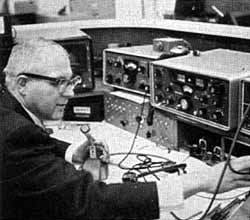
ARRL HONORARY VICE PRESIDENT CHARLES G. COMPTON, W0AF, SK
|
ARRL Headquarters has learned of the death August 16 of ARRL Honorary Vice President Charles G. Compton, W0AF (ex-W0BUO). He was 79. Compton had suffered a stroke a few years ago. He was a resident at a nursing home in Merritt Island, Florida, at the time of his death.
A Charter Life Member of the ARRL, Charlie Compton had served as Dakota Division Director from 1960 until 1970. He was ARRL First Vice President from 1970 until 1974. He also served as Dakota Division Vice Director from 1958 to 1959 and was a past president of the St Paul Radio Club.
An Arkansas native and Purdue University graduate in electrical engineering, Compton served in the US Merchant Marines during World War II. He was employed by 3M for several years and was a cofounder of Hutchinson Technology in Minnesota. He holds several US patents.
"He enjoyed being a ham operator," said his wife, Mary Winkelman-Compton. "He would often encourage young people to get involved." Besides his wife, two daughters survive. A memorial service was held August 19 in Florida.
SOLAR UPDATE
Solar sage Tad Cook, K7VVV, Seattle, Washington, reports: Solar flux and sunspot number averages were down a little this week, although the numbers were starting to spike up again around mid-week. Solar flux reached 197.3 on October 27, and sunspot numbers were up to 200. Too bad this was accompanied by high geomagnetic activity. The planetary A index was 87 on Friday, with K indices up to 8. This was a raging storm!
There has been a lot of anticipation for the CQ Worldwide DX Contest this weekend, and conditions could be a bit unsettled. The solar flux is expected to decrease over the next few days, with Friday through Sunday values at 175, 165 and 160. There is probably more interest in predicted geomagnetic values, since a geomagnetic storm is not much fun in an HF contest. The Fredericksburg middle latitude A index, which is close to the Boulder A index heard on WWV, is predicted to be 20, 15 and 15, for Friday through Sunday. The planetary A index is predicted to be 20, 20 and 15 for the same period.
After the weekend, solar flux is expected to bottom out around 135 early next week, then rise again to 200 a week later. The period around November 6-10 (during the ARRL November Sweepstakes) looks stormy, with A indices as high as 25.
Sunspot numbers for October 21 through 27 were 154, 153, 114, 130, 179, 200 and 193 with a mean of 160.4. The 10.7-cm flux was 158.5, 160.3, 164.5, 158.8, 179.2, 189.4 and 197.3, with a mean of 172.7. The estimated planetary A indices were 15, 87, 26, 23, 18, 9 and 17, with a mean of 27.9.
IN BRIEF:
- This weekend on the radio: The CQ WW DX Contest (SSB), the ARRL International EME Competition, and the Black Cat Halloween Party (see The ARRL Letter, Vol 18, No 42) are the weekend of October 30-31.
Just ahead: The ARRL November Sweepstakes (CW), the concurrent Sixth Annual North American Collegiate ARC Championship (CW), and the IPA Contest (SSB and CW) are the weekend of November 6-8. See October QST, page 86, and November QST, page 93, for details. - The role of VY0 in ARRL-sponsored contests: Nunavut Territory, VY0, was created in April 1999 from territories formerly part of the Northwest Territories. Within Canada, it remains a territory, not a new province. Effective January 1, 2000, Nunavut (abbreviated NU) will count as a new multiplier for contests that use political delineations--including the International DX Contest, the RTTY Round-Up and the 10 Meter Contest. In contests that use ARRL/RAC sections for scoring--including November Sweepstakes and the ARRL 160 Meter Contest--Nunavut counts for Northwest Territories/Yukon and is not a new multiplier. Field Day and the IARU HF World Championship also are not affected. For more information contact ARRL Contest Branch Manager Dan Henderson, N1ND, n1nd@arrl.org; 860-594-0232.
- Hollingsworth reiterates pledge: During the Southwestern Division Convention October 1-3, FCC Legal Adviser for Enforcement Riley Hollingsworth reiterated a pledge to undertake two amateur enforcement initiatives in the coming months: encroachment of unlicensed activity on 10 meters and improper or illegal marketing of HF amplifiers--especially those capable of 11-meter operation. He said that problems on VHF no longer would take a back seat to HF enforcement. He also advised attendees to adhere to the basis and purpose stated in Section 97.1 of the FCC rules. In response to a question during a convention forum, Hollingsworth clarified that jamming a station thought to be breaking the FCC rules on a repeater is never justifiable and always illegal. "We have never suggested--let alone authorized--jamming as a way to keep certain people off," he said.
- AMSAT-NA Symposium audio: Houston AMSAT Coordinator Bruce Paige, KK5DO, says audio of the recent 1999 AMSAT-NA Symposium now is available on the Houston AMSAT Net page, http://www.amsatnet.com. Click on "AMSAT Symposium Audio." If you were unable to attend or missed the live satellite feed, here's an opportunity to catch up with what you missed. Files are in RealAudio format.--Bruce Paige, KK5DO
- AMSAT issues alert: AMSAT 1999 Symposium Chairman Duane Naugle, KO6BT, has issued an alert to anyone who visited SeaWorld in San Diego on Monday October 11, 1999, following the 1999 AMSAT Symposium. Press reports say that an employee at the SeaWorld restaurant, Mama Stella's, exposed patrons to Hepatitis A on Monday October 11, 1999 between 10 AM and 4 PM. Local health authorities said that people who ate Caesar salad, watermelon, dinner salad or strawberries at Mama Stella's may have been exposed. Symptoms of the viral infection of the liver include abdominal discomfort, diarrhea, low-grade fever, loss of appetite, fatigue and dark urine. For more information, contact Jean Naugle, KC6QHT, 619-273-4088; ko6bt@amsat.org.--AMSAT-BBS and press reports
- Former HQ staffer loses home to fire: Former ARRL Contest Branch Manager Billy Lunt, KR1R, lost his home in Tyringham, Massachusetts, in a fire September 8. No one was injured, and damage was estimated at $100,000, according to the Tyringham Fire Department. It's believed the structure was uninsured. A fund has been established to assist Billy Lunt and his family. Donations made payable to "Tyringham Fire Department" may be mailed to The Willard Lunt Fund, PO Box 319, Tyringham, MA 01264. For more information, contact Molly Curtin-Schaefer at the town office, 413-243-1749.
- QST Cover Plaque Award: The winner of the October QST Cover Plaque Award is Eric P. Nichols, KL7AJ, for his article "The Smell of Radio." Congratulations, Eric!
- OH2MCN licensing info pages moving: The well-known licensing information pages by Veikko "Veke" Komppa, OH2MCN, are moving to a new server at http://www.qsl.net/oh2mcn/license.htm. The site contains detailed information on how to get an Amateur Radio license abroad. Information is coordinated with that offered by the ARRL at http://www.arrl.org/field/regulations/io/.
- Midland recalls weather radios: Midland Consumer Radio Inc reportedly has recalled 9000 incorrectly programmed weather radios. The Consumer Product Safety Commission says the error can cause users to miss important information about approaching severe weather, putting lives and property at risk. Only model 74-200 radios that have serial numbers beginning with 904 or 905 are being recalled. For more information, call Midland Consumer Radio, 877-302-1904.--from press reports