ARRL Audio News
| · | To subscribe, unsubscribe, or change your e-mail delivery address: see How to Get The ARRL Letter, below |
| · | Delivery problems (ARRL member direct delivery only!): letter-dlvy@arrl.org |
| · | Editorial questions or comments: Rick Lindquist, N1RL, rlindquist@arrl.org |
| · | ARRL Audio News: http://www.arrl.org/arrlletter/audio/ or call 860-594-0384 |
| · | The ARRLWeb Extra: http://www.arrl.org/members-only/extra |
IN THIS EDITION:
- +Vanity grants under ULS coming slowly
- +HF "Intruder" QSYs
- +Board approves new West Central Florida Section
- +Ham convicted of fraud in bogus equipment deals
- +K7IJ user suspended from VHF for 90 days
- DCC treads the cutting edge
- James L. Dionne, K1MEM, SK
- Solar update
- In Brief: This weekend on the radio; Marconi dedication special event; New Mexico stages Y2K SET; Red Cross requests ham assistance for second repeater system; Mississippi ham headed to court over phone RFI; Frank Koval, W8RSW, SK; Pennsylvania ham plate holders, you've got a friend in K3TX; SUNSAT Operating Award available; Fort Worth Amateur Radio SKYWARN team commended
+Available on ARRL Audio News
VANITY GRANTS UNDER ULS COMING SLOWLY; APPLICATIONS OFF
The FCC appears to have granted upwards of 90 vanity call signs since October 1, but vanity call sign processing under the new Universal Licensing System still is far from routine, and the number of applications seems to be down. No new vanity call signs have been granted since October 7, and the FCC's ULS Task Force says it does not plan to resume issuing vanity call signs until all the wrinkles have been worked out of the system.
"We don't want to go any further until we are comfortable with how the system is processing vanity," a spokesperson for the ULS Task Force said. The FCC had hoped to have routine vanity processing in place by October 1.
Only a tiny percentage of amateurs have even registered for the ULS. Registration now is a prerequisite to filing an FCC application on-line or on paper. The FCC says approximately 3% of the 740,000 amateurs in the FCC's database have registered for ULS--some 20,000 hams in all.
As of October 14, the FCC had processed vanity applications submitted through August 4. The ULS Task Force reports that it has identified a few programming problems that now are being worked on. "We also are investigating a few call signs that do not appear to be available and should be," the spokesperson said.
The number of vanity applications filed since just before the FCC deployed the ULS seems to have dropped sharply. In the pre-ULS era, it was not uncommon for the FCC to process more than 1000 vanity applications a month--most of them filed using the old electronic application on the Internet. Since the ULS went into effect for the Amateur Service in August however, it appears that only about half that many vanity applications have been filed.
The difficulty of filing an application for a vanity call sign or any other purpose has been a source of mounting frustration within the amateur community.
"The FCC really dropped the ball on this one," said Tony Whitmore, AB0IY, who is awaiting a vanity call sign grant. While the FCC's previous on-line applications were accessible via the Web, an application filed via the ULS requires a dial-up connection to the FCC's wide area network plus the use of a particular Web browser--Netscape ver 4.5 or higher, and preferably 4.61. Right now the ULS does not support the Mac platform.
Other hams have complained about having spent hours on-line either downloading copies of Netscape or attempting to configure, then use, the dial-up connection to file an application. The ULS Task Force has indicated that Web access is on the horizon, but it's not likely to happen until sometime later next year.
HF "INTRUDER" APPARENTLY BUZZES OFF
The loud 125-Hz buzz that plagued 80 and 75-meter operators for several weeks reportedly has moved outside the amateur bands. The ARRL Monitoring System had requested FCC assistance in tracking down the harmful interference, which has been audible primarily in the US Northeast.
According to a reliable source who did not wish to be identified, the transmissions heard on 3.5, 3.6 and 3.7 MHz emanated from high-power HF radar transmitters being operated by the Canadian military from Newfoundland. The operation reportedly had the blessing of Industry Canada--the Canadian equivalent of the FCC--and hams in Newfoundland also were said to have been informed.
The "buzz" is said to have come from two HF over-the-surface radar test stations in Newfoundland that have been conducting tests with the Canadian military. Those tests reportedly continue, but on other frequencies. The radars--with a bandwidth of approximately 20 kHz--are said to be used to detect vessels and icebergs. The tests reportedly are being done to determine the optimum frequency for coverage.
Amateur Radio concerns about the signal were relayed to those in charge of the military HF radar operation.
IARU Region 2 Monitoring System Coordinator Martin Potter, VE3OAT, has been unable so far to officially confirm the accounts but said it does appear that the signal is gone from 80 meters. Potter said that "while there are many buzzes and burps on our bands," the buzz on 80 has not been spotted in recent days. Potter says that since October 7, the distinctive signal has been on the air mostly on 3.3 MHz, twice on 3.2 MHz, and once on 4.1 MHz--simultaneous with 3.3 MHz "indicating more than one transmitter," he said.
Potter credited amateur complaints with prompting the move. "It seems likely that the volume of complaints and the high technical quality of many of the reports had a positive impact on the government and corporate officers who received them," he speculated.
Recent news reports concerning the 80-meter buzz generated a flurry of informal reports from hams in various parts of the US and at least one in Europe to ARRL Intruder Watch Coordinator Tom Hogerty, KC1J. Some said they'd heard the "buzz saw" on bands other than 80 meters, although the Newfoundland transmitters reportedly are not licensed to operate on frequencies higher than the vicinity of 80 meters.
The individual familiar with the Newfoundland experiments reported being told that there are a "significant" number of HF radars under development around the world and conceded that it's possible that hams are hearing similar signals from more than one of these other sources.
Additional reports and observations are welcome to ARRL Monitoring System Administrator Tom Hogerty, KC1J, thogerty@arrl.org.
NEW WEST CENTRAL FLORIDA SECTION EFFECTIVE JANUARY 15, 2000
Getting a clean sweep for the ARRL November Sweepstakes will get a little harder next year, but doing business with the ARRL promised to become a lot easier for some Florida hams starting January 15, 2000. The ARRL Board of Directors has voted to approve a resolution to create a new West Central Florida section. The vote was 14-0 with one abstention, ARRL Board Secretary David Sumner, K1ZZ, said.
The resolution approved called on ARRL Field Services Manager Rick Palm, K1CE, "to establish, at the earliest date consistent with a smooth transition, a West Central Florida section consisting of the counties of Charlotte, DeSoto, Hardee, Highlands, Hillsborough, Manatee, Pinellas, Polk, and Sarasota." After consulting with Southeastern Division Director Frank Butler, W4RH, Southern Florida Section Manager Phyllisan West, KA4FZI, and West Central Florida Section Committee Chairman Paul Toth, K2SEC, Palm said that January 15 was determined to be the best date to formally bring the new section into existence. A recommendation on the appointment of a section manager for the new section is pending.
The nine Southern Florida counties involved voted overwhelmingly in favor of creating the new ARRL section, which will become the 71st ARRL section. Ballots counted September 15 at ARRL Headquarters showed 920 ARRL members in the proposed new section favored the idea, while just 86 were opposed.
Filed last April, the proposal to create the West Central Florida Section was aimed at improving ARRL visibility and representation and services for members living in the affected counties. The proposed 8320 square-mile section is among the state's most densely populated and fast-growing, and the petitioners said the plan will provide "improved, localized support for League members on local and regional issues" as well as better coordination with clubs. A plan to attract more people into Amateur Radio and boost League membership through education and outreach accompanied the committee's request. The committee's Web site at http://www.qsl.net/wcfla/ contains the full text of the petition and additional information.
The January 15 implementation date means the new West Central Florida Section will not be a factor in any ARRL-sponsored contests until next year. The last new ARRL section created was Northern New York in 1996.
HAM CONVICTED OF FRAUD IN BOGUS EQUIPMENT OFFERINGS CASE
A Florida ham has been ordered to spend most of the next five years in prison after pleading no contest to fraud charges involving offers to sell amateur and vintage gear. Michael T. Kirby, W5JBV (ex-K4VFY), of Panama City, Florida, had been arrested August 20 for scheming to defraud using the US mails. Kirby has a history of arrests and convictions for allegedly accepting payments for equipment he never delivered.
Panama City Police Detective Robert Luther said that Kirby pled no contest September 30 in Bay County Florida 14th Judicial Court, "which means he puts himself on the mercy of the court," Luther explained. Kirby will get 41 days credit for time served in the Bay County Jail following his arrest.
Luther said Kirby's fraudulent dealings were extensive. He said that while Kirby actually received somewhat less than $20,000 in proceeds from his fraudulent dealings, "the attempted fraud is well greater than that."
The court required Kirby to make restitution "to as many victims as I can identify," Luther said. Some victims already have received refunds. Luther said those defrauded by Kirby who have not already received a refund or been in contact with authorities should send him "original proof" that fraud occurred. He said this means original documentation, letters, correspondence and similar material as well as the amount of money and the dates involved.
Those believing they were victimized by Kirby can e-mail Luther for more information at panamaone@aol.com or call him at 850-872-3129.
K7IJ USER LOSES VHF PRIVILEGES FOR 90 DAYS
The FCC has notified a San Francisco ham that it was modifying his license to prohibit operation above 30 MHz for 90 days. FCC Legal Adviser for Enforcement Riley Hollingsworth wrote General licensee Danny A. Kenwood, WA6CNQ, on October 6, 1999, citing "numerous complaints regarding profanity, obscenity, deliberate interference with the K7IJ repeater and failure to properly identify" during the week of August 29 and on September 6, 1999.
Hollingsworth told Kenwood that the FCC would not initiate license revocation proceedings unless it has evidence of continued violations. Kenwood has 30 days to protest the modification. Otherwise, the modification will expire January 5, 2000.
On July 19, the FCC had requested that Kenwood retake his General class examination elements under the supervision of FCC personnel before August 30, 1999. The FCC has the authority to readminister any examination element previously administered by Volunteer Examiners. Hollingsworth said the FCC subsequently determined that Kenwood originally had been tested through an FCC field office and not by Volunteer Examiners, exempting him from the retesting request.
DCC TREADS THE CUTTING EDGE
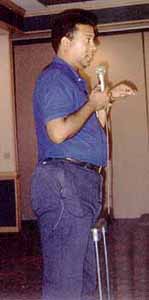 Dewayne Hendricks, WA8DZP, describes ultra wideband technology at the DCC.
[Stan Horzepa, WA1LOU]
Dewayne Hendricks, WA8DZP, describes ultra wideband technology at the DCC.
[Stan Horzepa, WA1LOU] |
The 18th ARRL-TAPR Digital Communications Conference recently in Phoenix offered a vision of Amateur Radio where individual ham bands are irrelevant and analog is an anachronism. Some 150 digital enthusiasts attended the sessions September 24-26.
The wave of the future could be ultra wide band, according to conference speaker (and an ARRL Pacific Division Assistant Director) Dewayne Hendricks, WA8DZP. Ultra wideband--or UWB--is related to new methods of spectrum sharing among large numbers of users. During a forum Hendricks described UWB as akin to a group of people sharing a large house rather than each owning smaller, separate houses. The FCC initiated a Notice of Inquiry last year seeking comment on UWB issues.
ARRL Southwest Division Vice Director Art Goddard, W6XD, says Hendricks' DCC presentation suggested that the notion of individual Amateur Radio bands could become irrelevant in a UWB era, where software-driven equipment and spectrum sharing protocols would determine what frequency or frequencies best suit the desired communication at that particular moment.
"Just think of the possibilities! No more need for 5-Band DXCC," Goddard extrapolated, somewhat tongue-in-cheek. "Every DX contact will be conducted on any or all available bands as selected by a protocol in your equipment. No need for the operator to fuss with the details."
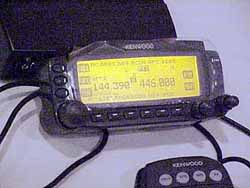 The faceplate of the prototype Kenwood APRS mobile transceiver on display at the ARRL-TAPR Digital Communications Conference last month in Phoenix.
[Photo by James Jefferson, KB0THN]
The faceplate of the prototype Kenwood APRS mobile transceiver on display at the ARRL-TAPR Digital Communications Conference last month in Phoenix.
[Photo by James Jefferson, KB0THN] |
On the hardware side, QST Digital Dimensions columnist Stan Horzepa, WA1LOU, reports that Kenwood stole the show by displaying a prototype of a VHF-UHF mobile transceiver with built-in APRS. The radio is similar in functionality to the TH-D7 hand-held Kenwood introduced at last year's DCC.
As in the past, this year's DCC saw the introduction of new and improved versions of APRS. Horzepa said that Rob Wittner, KZ5RW, demonstrated a work-in-progress version of APRS/CE for handheld computers running the Windows CE operating system.
For additional details about this year's DCC, see Horzepa's "Digital Dimensions" column in the December issue of QST. Audio from all the conference presentations may be heard at http://www.tapr.org/. The Conference Proceedings are available from the ARRL for $15. Order Item No 7679 online or call toll-free 888-277-5289.) Next year's DCC will be in Orlando, Florida. The date will be announced by year's end.
CQ WAZ AWARD MANAGER JAMES L. DIONNE, K1MEM, SK
CQ Worked All Zones Program Manager and well-known lowband DXer Jim Dionne, K1MEM, of Sudbury, Massachusetts, died October 12, 1999. He was 51 and had been in ill health for some time.
"We're saddened to report the death of still another CQ stalwart, Jim Dionne," said CQ Publisher Dick Ross, K2MGA. "Jim was one of those people who was content to toil quietly in the trenches in the service of others," he said. "Despite a lifetime of illnesses which would have stopped lesser people in their tracks, Jim drew joy from life itself, and found extreme satisfaction in being able to help people, particularly his fellow hams."
An ARRL Life Member, Dionne also belonged to the First-Class CW Operators Club (FOC) and the Yankee Clipper Contest Club and was a participant in several DXpeditions. He had been WAZ manager for about 15 years. Dionne's death was the second in the CQ Publishing family in recent months. CQ Editor Alan Dorhoffer, K2EEK, died July 19.
Top Band veteran Jeff Briggs, K1ZM, called Dionne "a fine DXer, contester and Top Band expert." Dionne held Top Band DXCC No 30, with more than 250 countries confirmed.
The ARRL's Dean Straw, N6BV, also was among those saddened at Dionne's passing. "Jim always exemplified the best of what this hobby represents: honesty and integrity, a ready willingness to help others, and great patience and courage in the face of a devastating illness," he said.
Survivors include his wife of 16 years, Genevieve, N1CPC. A memorial service was held October 15. Donations are welcome in Jim Dionne's name to the Kidney Transplant/Dialysis Association, Inc, PO Box 1362 GMF, Boston, MA 02205-1362.
SOLAR UPDATE
Solar soothsayer Tad Cook, K7VVV, Seattle, Washington, reports: Solar activity was up by quite a bit this week. Average solar flux values increased by nearly 30 points over last week, and average sunspot numbers were up by almost 80 points. The reporting week, which runs Thursday through Wednesday, began with a stable geomagnetic field and A indices in the single digits, but quickly changed after the weekend to storm conditions. The worst conditions were probably on Tuesday, October 12, when the planetary A index reached 34, and the highest planetary K index was 6. Of course it was worse in the higher latitudes, with the College A index from Alaska at 61 and K indices has high as 7.
The projected solar flux values for the next three days, Friday through Sunday, October 15-17, are 200 for each day, and the planetary A index is forecast at 25, 20 and 15. Solar flux is expected to drift lower after the weekend, reaching 150 around October 20 and a minimum of 125 from October 23-39. Predicted disturbed days, when the A index is 25 or more, are October 24 and 27 and November 6-8.
Sunspot numbers for October 7 through 13 were 184, 170, 235, 195, 163, 191 and 210, with a mean of 192.6. The 10.7-cm flux was 129.4, 151.2, 153.2, 160.5, 166.6, 183.6 and 191, with a mean of 162.2. The estimated planetary A indices were 6, 8, 6, 28, 23, 34 and 26, with a mean of 18.7.
In Brief:
- This weekend on the radio: The Jamboree on the Air (JOTA) is October 16-17. See September QST, page 49, for details. The RSGB 21/28 MHz Contest (CW), the JARTS WW RTTY Contest, the Illinois QSO Party, the Asia-Pacific Sprint (CW) and the Worked All Germany Contest are the weekend of October 16-17. Just ahead: The YLRL YL Anniversary Contest (SSB) is October 21-23. The Rhode Island QSO Party and the QRP ARCI Fall QSO Party (CW) are the weekend of October 23-24. See October QST, page 86, for details.
- Marconi dedication special event: To mark the occasion of the 125th anniversary of Guglielmo Marconi's birth, the Marconi Radio club will operate special event station W1AA/CC on 20, 17, 15, and 10-meter SSB, Friday, October 22, approximately 1400-2000 UTC, 14,280, 18,140, 21,280, and 28,480 kHz, from the vicinity of the former Marconi station at Cape Cod National Seashore (Marconi's original transatlantic transmission call sign in 1903 was "CC"). The Comitato Tricolore of New England will dedicate a monument that day (at 11:30 AM Eastern) to honor Marconi, and Marconi's daughter, Princess Elettra Marconi, is scheduled to be present. Princess Elettra will be presented a Plaque by the club making her an Honorary President of The Marconi Radio Club.--Whitey Doherty, K1VV
- New Mexico stages Y2K SET: The State of New Mexico has requested Amateur Radio Assistance during Y2K. On October 16, a statewide Simulated Emergency Test will be held, with ARES and RACES participation. This exercise begins with the New Mexico Breakfast Club Net at 0630 Mountain Time on 3939 kHz. Stations are requested to return at 1000 Mountain on 7245 kHz LSB. This net will include sending and receiving SET messages and SET procedures. Stations checking in will be asked if they have emergency power and how long could they operate without commercial power. Station with emergency power are urged to use it. The state of New Mexico's EOC will be participating in the SET. On October 20, the State of New Mexico Department of Public Safety will conduct a communication exercise on 7245 kHz. The New Mexico EOC in Santa Fe will be on the air all day and accept check ins from all New Mexico Amateurs and amateurs in adjacent areas. Times and details will be announced. These exercises are open to all New Mexico amateurs. Hams in adjacent states are welcome to participate. Local FM nets are invited to coordinate with the statewide HF net. For more information, contact ARES/RACES SET Project Officer J. Rick Sohl, KK5RIC, at 505-354-7031 or kk5ric@arrl.net.
- Red Cross requests ham assistance for second repeater system: North Carolina SM Reed Whitten, AB4W, reports that the American Red Cross has requested that North Carolina Amateur Radio Emergency Service investigate the possibility of providing a second nonamateur UHF repeater system in North Carolina to provide coverage in the Elizabeth City area. A UHF repeater system, designed and installed near Raleigh by North Carolina amateurs for the Red Cross, is providing coverage to the Red Cross's emergency response vehicles in Tarboro, Greenville, and Kinston in the wake of severe flooding in eastern North Carolina from Hurricane Floyd. Hams continue to provide backup communication for the Southern Baptist-Red Cross mass feeding efforts, which have provided nearly 1 million meals so far.--Reed Whitten, AB4W
- Mississippi ham headed to court over phone RFI: According to press reports, Bennie Stewart, KJ6TY, of Meridian, Mississippi, was arrested September 10 after neighbors complained to the Lauderdale County Sheriff's Department that his signal was interfering with their telephones. Stewart is headed to Justice Court October 26. He reportedly could get six months in jail. Mississippi state law prohibits intentional interference with telegraph or telephone lines. Stewart has maintained the state Justice Court has no jurisdiction.--thanks to Ray Brown, KB0STN
- Frank Koval, W8RSW, SK: Well known DXer and Honor Roll member Frank Koval, W8RSW, of Cincinnati, Ohio, died September 9 following a brief illness. He was 78. During his Amateur Radio career, Koval gained international fame as a contester, DXer and certificate chaser. His achievements--including a pioneering DXpedition to Navassa as KC4AF in 1958, certificate No 1 (CW) for the US Counties Award, and 5BDXCC--led to his election to the Greater Cincinnati Amateur Radio Association Hall of Fame. Koval was an ARRL member. Memorial donations are welcome to Vitas Hospice, 1132 W Kemper Rd, Cincinnati, OH 45240.--thanks to George Rizzi, W8GOC
- Pennsylvania ham plate holders, you've got a friend in K3TX: All standard blue-and-yellow Pennsylvania auto license plates--including amateur call sign plates--are being replaced soon at no cost. Pennsylvania's Department of Transportation wants all ham radio call sign plates to carry the "Amateur Radio" legend, but PennDOT's records do not always distinguish between call sign and vanity plates. If your Pennsylvania call sign plate carries an "Amateur Radio" or "Amateur Radio Operator" legend, you're OK. If your plate has no legend or a "You've Got A Friend in Pennsylvania" or "Keystone State" legend, PennDOT records do not show that the plate is a ham radio call sign tag. To make sure their new plates have the "Amateur Radio" legend, hams may contact Dave Heller, K3TX, who's volunteered to help fellow Pennsylvania hams get the right replacement tags. Hams may, of course, work through a local tag agent, but if you'd like his help, contact Dave Heller, K3TX, PO Box 224, Morrisville, PA 19067. He has no e-mail. Call 215-736-3333 or 215-946-1040, preferably late evenings. When writing, please enclose an SASE.
- SUNSAT Operating Award available: AMSAT in South Africa has introduced a SUNSAT Operating Award. There are three categories: Bronze for 25 contacts, silver for 50 contacts, and gold for 100 contacts. The objective is to work as many different call signs as possible. Only one contact per pass may be claimed for the award, and stations can only be worked once. SUNSAT's uplink is 436.291 MHz, ± 9 kHz Doppler shift; the downlink is 145.825 MHz. To claim the award applicants must submit a copy of their log, verified by the chairman of a local radio club or by two amateurs, to SA-AMSAT, PO Box 1842, Hillcrest 3650, South Africa. SWLs also may apply, and their logs must include the call signs of both stations monitored. The cost of the award is $5 or 5 IRCs to cover postage.--Hans van de Groenendaal, ZS5AKV, via SpaceNews
- Fort Worth Amateur Radio SKYWARN team commended: The Fort Worth, Texas, Amateur Radio SKYWARN Team has been awarded the National Weather Association's Walter J. Bennett Public Service Award. The presentation of the award will be at the NWA Awards Banquet October 20, in Biloxi, Mississippi. The award was based on the extra effort, hard work, and self-sacrificing attitude demonstrated by the past and present members of the team over the past 25 years.--Gerald Handley, W5DBY