ARRL Audio News
| · | To subscribe, unsubscribe, or change your e-mail delivery address: see How to Get The ARRL Letter, below |
| · | Delivery problems (ARRL member direct delivery only!): letter-dlvy@arrl.org |
| · | Editorial questions or comments: Rick Lindquist, N1RL, rlindquist@arrl.org |
| · | ARRL Audio News: http://www.arrl.org/arrlletter/audio/ or call 860-594-0384 |
| · | The ARRLWeb Extra: http://www.arrl.org/members-only/extra |
IN THIS EDITION:
- +AMSAT announces a Phase 3D launch agreement
- +FCC reorganization could enhance ham enforcement
- +Rick Palm, K1CE, to leave ARRL HQ staff
- +Buzzing intruder annoying 80-meter ops
- California 10-year old handles emergency call like a pro
- Solar update
- In Brief: This weekend on the radio; Ballots mailed in four ARRL Divisions; Gettysburg FCC office to get monitoring antenna; UALR call sign server goes dark; DXCC status for East Timor in abeyance; New Orleans DX convention QRT; N1IRZ goes QRO; SUNSAT SO-35 concludes weekend schedule; Ernest W. Pappenfus, K6EZ, SK
+Available on ARRL Audio News
PHASE 3D ACCEPTED FOR "FIRST SUITABLE" ARIANE 5 LAUNCH
 A conceptual model of Phase 3D in flight. [AMSAT-NA]
 |
AMSAT says the Phase 3D Amateur Radio satellite has been accepted as a payload for the "first suitable" Arianespace Ariane 5 vehicle launch. The announcement came today from Phase 3D Project Leader and AMSAT-Germany President Karl Meinzer, DJ4ZC, who said a launch opportunity could come during the first half of next year.
"As the primary agency responsible for securing a launch opportunity for Phase 3D, I am pleased to announce that AMSAT-Germany and Arianespace have now come to an agreement calling for the launch of P3D as a secondary payload aboard the 'first suitable' Ariane 5 flight," Meinzer said, adding that the Ariane 5 has been the primary launch vehicle from the very beginning of the project and the "unanimous choice" by AMSAT.
Specific details of the launch agreement--signed October 5--were not released. Timing of the announcement could not have been more propitious. The AMSAT-NA Symposium and Annual Meeting are being held this weekend in San Diego.
In San Diego for the gathering, AMSAT-NA President Keith Baker, KB1SF, said the news meant "lots of smiles around the conference room." Baker said he was pleased that AMSAT-DL's negotiations with Arianespace resulted in a launch contract for Phase 3D and was delighted that Phase 3D was again slated to fly on an Ariane vehicle. "Following the resounding success of Ariane Flight 503, the Ariane 5 has now proven itself to be a very capable launcher," he said.
Once it's in orbit, Baker said, "the Phase 3D satellite will not only help us usher in the new Millennium, it will also signal the dawn of a brand new era for Amateur Radio."
While both AMSAT presidents expressed optimism for an early launch of the satellite, Meinzer expressed caution that the wait for the "first suitable" flight could still turn out to be a long one. Meinzer explained that Ariane's launch manifests are continually being updated to accommodate market changes as well as the availability of other payloads. "One or more changes" to P3D's anticipated launch date as well as its specific Ariane 5 mission number "are a very real possibility before our satellite actually flies," he said
Baker emphasized today that Phase 3D is "a standby passenger in every sense of the word," so a specific launch date is "very uncertain" right now. Phase 3D is slated to be delivered to the Guiana Space Center in Kourou, French Guiana, later this month after one final "complete shakedown test" at the Integration Lab.
ARRL Executive Vice President David Sumner, K1ZZ, welcomed the AMSAT announcement. "Congratulations to AMSAT's Phase 3D team on moving another important step closer to launch," Sumner said. "For those who have been putting off getting their stations ready for Phase 3D, the time for procrastination is just about over!" The League has been a major contributor to the Phase 3D project.
The Phase 3D project has been an international effort that has worked with donated resources. In addition to AMSAT-DL and AMSAT-NA teams, AMSAT groups from Austria, Great Britain, Japan, Canada, Finland, Russia, Belgium, the Czech Republic, Slovenia, France, New Zealand and Hungary also have participated.
AMSAT says that while Phase 3D's primary focus is on improved worldwide satellite communication, the satellite also will have a very positive influence on the future of Amateur Radio. "Phase 3D will be Amateur Radio's premier vehicle to continue the quest for new communications technologies for generations yet unborn," the AMSAT announcement said.
FCC REORGANIZATION COULD MEAN BETTER HAM ENFORCEMENT
Congressional oversight committees this week approved funding to create two new FCC bureaus--Enforcement and Public Information, and Legal Adviser for Enforcement Riley Hollingsworth, K4ZDH, says Amateur Radio enforcement could improve under the new regime.
 FCC Chairman William Kennard. [FCC photo]
 |
Earlier this year, FCC Chairman William Kennard proposed the creation of the new bureaus as part of his "A New FCC for the 21st Century" initiative. Kennard told an audience at Georgetown University Law Center October 5 that the two new bureaus "will go into operation in the very near future."
Amateur Radio enforcement--now under Hollingsworth in the Compliance and Information Bureau--will be consolidated under the new Enforcement Bureau. Heading the Enforcement Bureau will be FCC Deputy General Counsel David Solomon. Hollingsworth will get a new title out of the deal. Once the new bureau is established--probably by month's end--he'll become Special Counsel for Amateur Radio Enforcement. Current Compliance and Information Bureau Chief Richard Lee has been tapped to head the new Public Information Bureau.
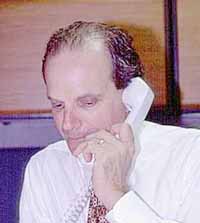 The FCC's Riley Hollingsworth, K4ZDH. [Rick Lindquist, N1RL]
 |
Hollingsworth reiterated that he anticipates no changes in either the direction or momentum of amateur enforcement under the new Enforcement Bureau regime. "If anything, it will enhance it," he said Wednesday, adding that he hopes to up the percentage of time he's able to devote to amateur enforcement as a result of the reorganization. Hollingsworth's current duties also include Land Mobile Service enforcement.
Hollingsworth also says he hopes to soon hand off management of the FCC National Call Center. In July, Hollingsworth was designated to temporarily take over the Call Center (888-CALL FCC) at the Commission's Gettysburg office while NCC Director Cynthia Jeffries was detailed to other duties involving the Y2K issue.
RICK PALM, K1CE, TO LEAVE ARRL HQ STAFF
 Rick Palm, K1CE.
 |
ARRL Field Services Manager Rick Palm, K1CE, will leave the Headquarters staff effective November 10. Palm and his wife Joanne, W1GUN, are moving to Florida to be closer to her family.
"I'm leaving League Headquarters with nothing but good feelings and memories," said Palm, who met his wife at the League in 1980 when she worked as a secretary in the former Communications Department.
Palm, 45, characterized his move south as "semi-retirement" and said he looks forward to continuing to serve the League as a volunteer.
A 20-year veteran staffer, Palm came aboard as a Membership Services Assistant in 1979, moving up the ranks of Assistant Manager and Deputy Manager before becoming Acting Manager of the old Membership Services Department. When the department was dissolved in 1985 as part of a sweeping HQ reorganization, Palm was tapped to head the new Field Services Department. That department merged with the Educational Activities Department early this year to became Field and Educational Services.
"It has been a privilege and a pleasure to serve the Field Organization of volunteers who perform the vast majority of the League's work," Palm said. "That work is performed on a daily and largely unsung basis with dedication and excellence."
Palm said his mission over the years has been to try to avoid the pitfall of the "ivory tower syndrome" and to empathize with the volunteer in the field in meeting his or her needs. "My goal has been to bring a good measure of respect for our volunteers by the rest of the ARRL, the amateur community at large and the public they serve," he added.
Before departing on November 10, Palm and Educational Services Manager Rosalie White, WA1STO, will make sure that everything is in place to ensure continuity of support for the Field Organization. White is a 17-year veteran of the Headquarters staff with a proven track record of working with ARRL volunteers and federal agencies, especially NASA on the SAREX and current International Space Station programs. In the late 1970s, she served as Club and Training Department Manager.
WHAT'S THE BUZZ?
Efforts are under way in the US and Canada to identify the source of what's being described as a loud and broad "125 Hz buzz" that's been showing up on the 80-meter band. The ARRL Monitoring System has requested FCC assistance in tracking down the harmful interference, which has been audible primarily in the US Northeast. The League also is working with Radio Amateurs of Canada. The annoying buzz frequently has been heard on or about 3.5 MHz. It's also been monitored in the vicinity of 3.6 and 3.7 MHz. Sometimes, it transmits for hours on end, other times for relatively brief periods of a few seconds or minutes.
|
Audible over a bandwidth of more than 30 kHz, the signal has become an increasing irritant to amateurs over the past few weeks. ARRL member Dave Bowker, K1FK, in extreme northern Maine reported hearing the signal in mid-September. "The interference is a square-wave modulated signal which totally destroys any communications possibilities ± 20 kHz either side of 3.500 MHz with its 'buzz saw' characteristics," he reported.
Bowker's direction-finding efforts determined the signal was coming from the north northeast "from over the polar region." At least some FCC staff members believe the signal originates in Canada. An FCC staff member said this week that the Commission has been investigating the emission "for a couple of weeks" as a result of a complaint from an aeronautical weather station that broadcasts at 3485 kHz. The staff member said the signal appeared to come from Newfoundland and said the FCC was in contact with its Canadian counterparts at Industry Canada.
There have been suggestions--unconfirmed--that the signal might be the result of a system being operated by the Canadian military. Military authorities North of the Border reportedly have said they will look into the complaint. Other as-yet-unconfirmed information suggests, however, that the signal was not of Canadian military origin at all nor even from Newfoundland but might be coming from Europe.
"There are certain risks in trying to DF any pulse signal that may not be transmitted mainly in the direction of the observer," says IARU Region 2 Monitoring System Coordinator Martin Potter, VE3OAT. Potter says bearings obtained may actually be on the "returned signal" from reflection and scatter points along the transmitted signal's path--either in the ionosphere or on the ground or ocean, or both. "So it may be premature to conclude that the transmitter is in Newfoundland, especially if reception is only by skywave, without taking special measures while obtaining a bearing," he said.
To add to the mystery, ARRL member Paul Veal, N0AH, in Wyoming--in a TowerTalk reflector posting earlier this month--reported the signal was appearing every morning at 1300 UTC on or about 3795 kHz. He said the signal appeared to coming from a northwesterly to southwesterly direction.
Additional reports and observations are welcome to ARRL Monitoring System Administrator Tom Hogerty, KC1J, thogerty@arrl.org.
RICKY TO THE RESCUE!
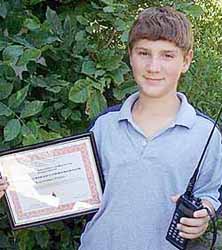 Ricky Rothbart, KF6VSH, with his H-T and ARRL commendation. [George Rothbart, KF6VSG]
 |
A 10-year-old California ham recently used ham radio to help save the life of an injured fellow amateur. As a result, Ricky Rothbart, KF6VSH, of San Rafael, California--who only got his Technician ticket in April--received a Public Service commendation from the ARRL. He also gained a new appreciation of Amateur Radio's emergency service potential.
On August 28, Ricky was in the family car heading home from a trip to LA. "Ricky was in the back seat absorbed in monitoring his favorite frequencies on his H-T," his dad, George Rothbart, KF6VSG, relates. "At about 6:10 PM, he suddenly said, 'Hey Dad, there's a guy on the radio who is bleeding all over the place and needs help!'."
It turned out the other ham had sliced his arm with plate glass and was bleeding profusely and asking on-the-air for medical help. The injured ham--Mike Lewis, KF6YDN--apparently was mobile in a remote area of Pittsburg, California, at the time and his cell phone was not working.
Ricky immediately replied, identifying himself and requesting the man's location and additional details. George Rothbart got on his cell phone, contacted a family member as Lewis had requested, then dialed 911. With Ricky working the emergency on his H-T--the Rothbarts were able to give the 911 dispatcher all the necessary information.
"By the time the emergency was over, three other hams had joined us on the frequency," George Rothbart said, "but it was Ricky that got the vital information to relay it to me in the front seat with the cell phone."
The Rothbarts never got to meet Lewis face-to-face. Attempts to contact Lewis by telephone were unsuccessful.
George Rothbart says that when he and his son were studying for their exams earlier this year, he'd told Ricky that someday he might be able to use his new skills to save property or life. While he hardly thought it possible then, he's now a firm believer. "I found that ham radio still works great, and through ham radio a 10-year old can make a difference," he said. Both George and Ricky Rothbart are ARRL members.
SOLAR UPDATE
Heliophile Tad Cook, Seattle, Washington, reports: Solar flux and sunspot numbers were up this week, with sunspot numbers almost double the week previous, but average solar flux up less than six points. Recent geomagnetic instability finally quieted down, and on Wednesday morning UTC (Tuesday night in North America) the K index was zero at the mid latitudes and the College Index from Alaska.
Solar flux has been falling the past few days, after peaking at 146.2 on Tuesday. The official daily numbers are always from the 2000 UTC reading at Penticton, British Columbia, but there are readings at 1700 and 2300 UTC as well. Following the 2000 UTC reading on Tuesday, the flux for each of the three daily readings, through 2000 UTC Thursday, were 146.7, 139.6, 133.6, 132.1, 131.7, and 129.4.
The projected flux values for the next seven days, Friday through Thursday, October 14 are 130, 135, 140, 145, 145, 150, and 150. The projected A indices for the same dates are 10, 15, 25, 30, 20, 15 and 15. Monday, October 11 looks like an unstable geomagnetic day. October 24 could be a bad day as well.
Sunspot numbers for September 30 through October 6 were 84, 67, 47, 117, 148, 160 and 176 with a mean of 114.1. The 10.7-cm flux was 124.8, 121.6, 126.3, 134.5, 144.4, 146.2 and 133.6, with a mean of 133.1. The estimated planetary A indices were 29, 11, 15, 10, 15, 16 and 6, with a mean of 14.6.
In Brief:
- This weekend on the radio: The YLRL YL Anniversary Contest (CW) continues through October 9; the Ten-Ten Day Sprint, the BARTG RTTY Sprint, the FISTS CW Fall Sprint, the Pennsylvania QSO Party, and the Two Meter Sidewinder Shootout are the weekend of October 9-10. Just ahead: Jamboree on the Air (JOTA) is October 16-17. See September QST, page 49, for details. The RSGB 21/28 MHz Contest (CW), the JARTS WW RTTY Contest, the Illinois QSO Party, the Asia-Pacific Sprint (CW) and the Worked All Germany Contest are the weekend of October 16-17. See October QST, page 86, for details.
- Ballots mailed in four ARRL Divisions: Ballots for ARRL Board elections have been mailed to ARRL full members as of September 10, 1999, in four ARRL divisions. Balloting for Director will occur in the Great Lakes and Midwest divisions. Balloting for Vice Director will occur in the Atlantic, Great Lakes, and Pacific divisions. The deadline for receipt of completed ballots is noon Friday, November 19, 1999. Any member in an affected division who is entitled to a ballot and who does not receive one by November 1 should request a duplicate ballot from the Secretary, ARRL, 225 Main St, Newington, CT 06111.
- Gettysburg FCC office to get monitoring antenna: In October, the Army Corps of Engineers will install an all-band delta loop antenna at the FCC's Gettysburg facility. Among other purposes, this system--at a height of 75 feet--will assist in real-time monitoring of the Amateur Radio Service and serve as a "force multiplier" for the High Frequency Direction Finding Center in Laurel, Maryland.--Riley Hollingsworth, K4ZDH
- UALR call sign server goes dark: The University of Arkansas at Little Rock (UALR) has shut down its Amateur Radio Callsign Lookup Page "for an indeterminate time" and probably for good. An announcement on the page (http://www.ualr.edu/~hamradio/callsign.html) cites the FCC's new database format and location--necessitated by the switch to the Universal Licensing System--as the main reason for the closure. The UALR site, instituted four years ago, was among the first--if not the first--Web-based call sign servers. Up-to-date FCC amateur licensee and call sign information now is available from the ARRL at http://www.arrl.org/fcc/fcclook.php3.
- DXCC status for East Timor in abeyance: Don't look for East Timor to attain DXCC status anytime very soon. While Indonesia has conceded peacekeeping duties to UN forces, Indonesia has yet to renounce its sovereignty over East Timor, formerly Portuguese Timor, CR8/CR10. Under DXCC rules, if and when East Timor is added to the DXCC list, old CR8/CR10 contacts will not be valid for East Timor for current DXCC applicants. (Only CR8/CR10 contacts made on or before September 14, 1976, count for Portuguese Timor.) It's also likely that another prefix would be assigned.
- New Orleans DX convention QRT: The New Orleans International DX Convention has called it quits after eight years. A message from Convention President Don Boudreau, W5FKX, said that after "several weeks of review and soul-searching," the convention's Board of Directors voted to dissolve the annual convention. Faced with a financial deficit and a flat attendance for the last several years, a majority of the Board reportedly no longer was willing or able to justify the extensive amount of work and effort that was required to maintain a quality program. "It was with great sadness that this final step was taken," said a statement from Boudreau. The Board extended its sincere thanks to the Convention's friends and supporters, as well as to all those who have attended over the last eight years. The last Convention was held the weekend of August 28-29.
- N1IRZ goes QRO: An interview about radio astronomy with Dave Finley, N1IRZ, is set to air this weekend on the Spanish National Radio's English-language shortwave service. Finley, of the National Radio Astronomy Observatory in Socorro, New Mexico, recently was interviewed by host Justin Coe for the service's Radio Waves program. Finley said the "probable" air date is Sunday, October 10 (Saturday evening/early Sunday morning in the US) on 15,385 kHz at 0000 and 0100 UTC and on 6055 kHz at 0500 UTC. "I hope this doesn't affect my credentials as a QRPer," Finley commented.--Dave Finley, N1IRZ
- SUNSAT SO-35 concludes weekend schedule: The South African SUNSAT satellite concludes its weekend operating schedule October 9 and 10. SUNSAT's FM uplink is on 436.291 MHz (+/- 9 kHz Doppler shift); downlink is on 145.825 MHz. Passes last about 15 minutes, and several are over the US. The tentative schedule (times in UTC): October 9, 1615-1630, 1750-1810 and 1934-1948; October 10, 1711-1730. The three successive passes October 9 over the US coincide with the AMSAT-NA Symposium and Annual Meeting in San Diego, California, that weekend. Reports are welcome to saamsat@intekom.co.za.--AMSAT News Service via Hans van de Groenendaal, ZS5AKV
- Ernest W. Pappenfus, K6EZ, SK: A major figure in the development of Collins Amateur Radio gear, Ernie Pappenfus, K6EZ (ex-W0SYF; WB6LOH), of Temecula, California, died August 14. He was 81. During his years at Collins in the 1940s, 1950s and 1960s, Pappenfus directed development of such products as the famous S-Line and the 30L-1. An ARRL member, Pappenfus co-authored the book Single Sideband Principles and Circuits, published in 1964, and wrote three articles for QST in the 1950s and 1960s.--thanks to Bob Sherman, ND6N/Golden Triangle ARC; Electric Radio