ARRL Audio News
| · | To subscribe, unsubscribe, or change your e-mail delivery address: see How to Get The ARRL Letter, below |
| · | Delivery problems (ARRL member direct delivery only!): letter-dlvy@arrl.org |
| · | Editorial questions or comments: Rick Lindquist, N1RL, rlindquist@arrl.org |
| · | ARRL Audio News: http://www.arrl.org/arrlletter/audio/ or call 860-594-0384 |
| · | The ARRLWeb Extra: http://www.arrl.org/members-only/extra |
IN THIS EDITION:
- +Carolina hams turned out in force for Floyd
- +FCC issues stern warning to New Mexico ham
- +IARU Administrative Council meets
- +National Weather Service bill creates storm cloud
- +Burrowing Owls 99: Hams sought to assist researchers
- League adopts Cabrillo file format for contests
- Solar update (unavailable this week due to technical difficulties)
- In Brief: This weekend on the radio; New Southern Florida Section Manager; New ARRL FCC license data search engine; Attention Texas hams! SUNSAT SO-35 announces operating schedule; Marconi birth anniversary event; WRTC 2000 contributions sought; Harold S. Burns, W1KVX, SK; Robert A. Cerasuolo, W6IJZ, SK; QST Cover Plaque Award; KD4WUJ is a winner; NFCC officers elected
+Available on ARRL Audio News
HAM RESPONSE TO CAROLINA FLOODING POSSIBLY LARGEST EVER
North Carolina Section Manager Reed Whitten, AB4W, says the Amateur Radio response in that state to Hurricane Floyd and the resulting flooding could be one for the record books. "This was the largest operation we have had in a number of years--possibly the largest ever," Whitten said this week. He also called it the "smoothest operation" in terms of amateur mobilization and coordination. At one point, upwards of 300 hams were involved in the flood response.In addition to their traditional role as communicators, hams applied their technical expertise to benefit the North Carolina flood recovery. Whitten said amateurs were instrumental in setting up a nonamateur UHF repeater system for the Red Cross. "Without Amateur Radio assistance," he said, "this system would not be in place."
Whitten credited North Carolina ARRL Technical Coordinator Danny Hampton, K4ITL, with helping to secure a repeater, a site, and installation services, as well as checking out available frequencies. The equipment was installed September 24 near Raleigh at no cost to the Red Cross. As part of the repeater effort, Sammy Simmons, KD4MJO, traveled 50 miles to Emporia, Virginia, to give a Red Cross radio technician the software necessary to program the Red Cross mobile radios.
"This system is providing mobile coverage into Raleigh, Goldsboro, Kinston, Greenville and Tarboro, North Carolina," Whitten said. "I think this is an excellent example of ARES operating in an appropriate role as communications consultants."
Additional rainfall this week did not generate renewed ARES/RACES callups nor any additional need for Amateur Radio volunteers, Whitten said. Salvation Army Tactical Emergency Radio Network operator James Proctor, KA4IZN, in New Bern, North Carolina, reported Thursday on the National SATERN network that conditions are deteriorating in North Carolina due to the rain and the "potential evaporation of volunteer interest," a SATERN report said.
At week's end, hams primarily were providing backup communication, and none remained stationed at county emergency operations centers, shelters or mass feeding units. "Although there are no longer several hundred amateurs spending long hours away from home, we still have a presence in the recovery operation," Whitten said. The nine Southern Baptist kitchens were using ham radio as their backup communication to the American Red Cross. Volunteers from North Carolina and other states remain available, if needed, he added.
The North Carolina traffic and ARES nets have resumed regular operating schedules. "We are having daily critiques on the Tar Heel Emergency Net on HF," Whitten said.
Whitten thanked all amateurs, emergency officials, and state government officials who have participated in the Hurricane Floyd response.
FCC ISSUES STERN WARNING TO NEW MEXICO HAM
The FCC has fired a warning shot over the bow of a New Mexico ham who has been the target of complaints. The Commission notified General licensee Sidney W. Mahan, K5BLB, of Estancia, New Mexico, on September 15 that if the complaints about his operation continue, the FCC intends to designate his station license for a revocation hearing and his operator license for suspension for the rest of the license term, which ends April 12, 2006.Last November 18, the FCC had sent Mahan a Warning Notice concerning his operation on 3.950 MHz that allegedly involved tapes played on the air as well as sound effects and deliberate interference to other operators.
"We continue to receive complaints and monitoring information on the operation of your station, particularly regarding profanity, obscenity, broadcasting extreme racial slurs, deliberate interference and failure to properly identify," said FCC Adviser for Enforcement Riley Hollingsworth in the most recent FCC communication. In particular, Hollingsworth said, the complaints concerned alleged interference by Mahan to "a net that attempts to operate around 3.950 MHz on Saturday evenings"--an apparent reference to The Liberty Net.
In his letter, Hollingsworth outlined and defined FCC prohibitions against the transmission of obscene or indecent material and advised Mahan that, for indecency purposes, the FCC treats amateur transmissions "the same as commercial broadcasts."
In addition to threatening to take K5BLB before an administrative law judge if the complaints continue, Hollingsworth said the FCC planned to forward tape recordings of K5BLB on August 13, 1999, on 3.950 MHz and would request "a full explanation for those radio transmissions." Mahan's reply, Hollingsworth said, "will be used to determine what action to take in this matter."
IARU ADMINISTRATIVE COUNCIL MEETS IN NORWAY
The International Amateur Radio Union Administrative Council has adopted an information paper for prospective owners and operators of amateur satellites. The Council said the document's purpose is "to reduce the possibility of inappropriate use of the Amateur-Satellite Service." The action came as the Council convened for the first time under the chairmanship of IARU President Larry Price, W4RA, September 26-28 in Lillehammer, Norway.The information paper--developed and adapted from material originally prepared by AMSAT-NA--cautions that the Amateur-Satellite Service is not intended for broadcasting, that communications be in plain language, and access remain open to all amateur licensees. IARU Secretary David Sumner, K1ZZ, said that while last April's Swatch "Beatnik" satellite situation did not prompt the adoption of the information paper, that type of proposed use would be an appropriate example. Last April, Swatch Watch announced plans to use a mini-satellite operating on 2 meters to transmit messages related to its campaign to establish the "Swatch Beat" as a new "global concept of time." Amateurs protested the Swatch plans because of their commercial connection, and the project was scrapped.
In other action, the Council resolved that the IARU and its member societies develop "appropriate responses" to what were termed "growing threats of interference from broadband telecommunications over unshielded power and telephone lines"--a technology sometimes called "PLT." The IARU will develop input to the International Telecommunication Union working party that's studying acceptable PLT radiation levels as well as techniques to measure and minimize their effects. A PLT project in the UK recently was abandoned, citing lack of commercial viability. But the pullback followed a strong stand taken by the UK Radiocommunications Agency on the need to protect HF frequencies from PLT interference.
The Council also prepared a draft recommendation defining the operational and technical qualifications to operate an Amateur Radio station. Those qualifications now are part of Article S25 of the international Radio Regulations. The draft does not specifically mention a Morse code requirement, but its 11 categories include "operating skills."
If a review of Article S25 of the international Radio Regulations ends up on the agenda for the next World Radiocommunication Conference after WRC-2000, the draft recommendation would form the basis for a submission to an appropriate ITU study group.
Price announced the signing of an operational agreement between the United Nations Office for the Coordination of Humanitarian Affairs and the International Secretariat of the IARU. The agreement calls for close cooperation on emergency communication issues. The Council also reviewed and approved an updated action plan for the development and support of Amateur Radio in Africa.
The Council reviewed and approved initial plans to celebrate the 75th anniversary of the founding of the IARU at the first part of its next meeting in Paris April 18-19, 2000. April 18, 2000, also is the 50th anniversary of the founding of IARU Region 1, and World Amateur Radio Day also will be celebrated that day as well. The second part of the next Council session will take place in Darwin, Australia, September 3-4, immediately following the IARU Region 3 Conference there.
NATIONAL WEATHER SERVICE BILL CREATES STORM CLOUD
A provision in a bill authorizing appropriations for the National Weather Service, the National Oceanic and Atmospheric Administration and other government weather services has raised fears that Amateur Radio-related activities such as SKYWARN may be endangered. The provision, Section 3(c) entitled "Competition with Private Sector", also has triggered concern on the part of some that the bill could reduce the government's ability to monitor and issue severe weather warnings. Some hams already have contacted their Senators requesting them to oppose the measure, HR-1553.
Section 3(c) says the NWS "shall not provide, or assist other entities to provide, a service if that service is currently provided or can be provided by commercial enterprise." There would be exceptions if the private sector were unwilling or unable to provide the service or if the service provides "vital weather warnings and forecasts for the protection of lives and property of the general public."
The provision is being championed by commercial weather services that provide fee-based "cloudy and warmer"-style and so-called "value-added" weather forecasts, primarily to commercial broadcasters. Some believe the bill could keep the NWS from providing needed weather information, including storm watches and warnings, storm tracking information, and other weather-related data to ARES/RACES organizations or to emergency management officials.
ARRL Legislative and Public Affairs Manager Steve Mansfield, N1MZA, says HR 1553, "generally can be construed as supporting the National Weather Service's role in the dissemination of severe weather warnings, because it specifically designates the service as the sole issuer of severe weather warnings." Mansfield notes, however, that NWS and NOAA authorizing legislation hasn't passed the Congress for six years.
Beyond that, the "private sector" provision in Section 3(c) has drawn fire from the White House, which has requested its removal. A Statement of Administration Policy notes that the provision "could create confusion about who is responsible for specific marine and aviation weather forecasts." Mansfield says that even if the bill does make it through Congress intact, he does not believe it will harm Amateur Radio's SKYWARN relationship with NWS.
HR 1553 has passed the House. Action is pending in the Senate Commerce, Science and Technology Committee, chaired by Sen John McCain.
BURROWING OWLS 99: HAMS SOUGHT TO ASSIST RESEARCHERS
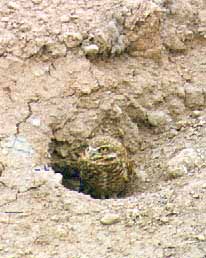 Standing guard: The rare and unusual burrowing owl--in its burrow.
[Joe Moell, K0OV]
Standing guard: The rare and unusual burrowing owl--in its burrow.
[Joe Moell, K0OV] |
If you live in the Central US from North Dakota to Texas and can receive 172 MHz signals, wildlife researchers need your help. For the second year, hams are helping to track the movements of endangered burrowing owls as they migrate southward from Canada. Scientists think that they fly all the way from Saskatchewan and Alberta to southern Texas and northern Mexico, but accurate data are scarce and difficult to obtain.
Unlike other owls, burrowing owls don't roost in trees. The nocturnal fowl prefer to roost in cavities on the ground in treeless grasslands.
The owls are on the move again, heading south for the winter. Biologists are asking for help from hams to track some newly tagged juvenile birds. "Perhaps this fall will bring the first recorded sighting in the US of a live Canadian-banded burrowing owl, and perhaps a ham will make it happen," said ARRL Amateur Radio Direction Finding Coordinator Joe Moell, K0OV.
Since the birds remain in or near underground burrows during the day, monitors are most likely to copy the short-pulsed signals during hours of darkness, when the birds are migrating and foraging. All that's needed is a scanner or an extended-range hand-held plus an outside antenna. Even better is direction-finding gear for 172 MHz. Last winter, Grier Garrick, KC5FJZ, of Rockport, Texas, was first to report a faint pulsed signal, probably from one of the radio-tagged owls. Unfortunately, the signal disappeared before the owl could be located.
For more information, check the burrowing owl page at http://members.aol.com/homingin/. The page contains the exact frequencies of all 48 tag transmitters plus photos, information on the expected migration path, and suggestions for simple monitoring and tracking gear.--Joe Moell, K0OV
ARRL ADOPTS CABRILLO FILE FORMAT FOR CONTESTS
The ARRL Contest Branch has announced that it's adopting a new standard electronic file format known as Cabrillo for all ARRL Contests. Starting with the 1999 ARRL November Sweepstakes, the Cabrillo V2.0 file format will be the standard file format at the ARRL for electronic submissions. Previously acceptable file formats for ARRL contests may be submitted during a one-year transition period, however.
Starting with entries for the November 2000 ARRL Sweepstakes, the Cabrillo format will be the only acceptable electronic file format for ARRL contests. Stations may still use text editors on their home PCs to generate the log files, but these "home-designed" files must meet the Cabrillo file format beginning with next year's November Sweepstakes submittals.
Adoption of the Cabrillo file format resulted from a joint effort by software developers and contest sponsors in response to the proliferation of file formats being submitted to various contest committees. The ARRL Contest Branch reports that several dozen different file formats were submitted in the 1999 ARRL 10-Meter Contest. "While most formats technically fit the requirements under the rules, almost all of the files required significant work by contest staff and volunteers in order to be processed," ARRL Contest Branch Manager Dan Henderson, N1ND, explained.
Henderson says noted contester Trey Garlough, N5KO, developed the Cabrillo format working with the developers of most major logging software and the sponsors of most major contests. "Major software developers have agreed to incorporate the Cabrillo format into new updates of the programs," Henderson said. He stressed that operators should contact various software developers and distributors for information on upgrades to their specific programs.
The Cabrillo format standardizes the QSO information that appears in each data column. Details on the format appear in the "General Rules for all ARRL Contests" in the November 1999 issue of QST. Specifications for the Cabrillo file format also are available on-line at http://www.kkn.net/~trey/cabrillo/. In addition to the file specifications, there are sample templates for various ARRL contests, a history of any modifications to the format, and some insight into the development of the Cabrillo file format..
For additional information on the technical specifics of the Cabrillo format, contact Trey Garlough, N5KO, trey@kkn.net. For more information on ARRL-sponsored contests contact ARRL Contest Manager Dan Henderson, N1ND, n1nd@arrl.org; 860-594-0232.
SOLAR UPDATE
The Solar Update from Tad Cook, K7VVV, is not available this week due to technical difficulties. The propagation bulletin will be distributed via W1AW and the ARRL bulletin server as soon as it is available.
In Brief:
- This weekend on the radio: The California QSO Party, the TARA PSK31 Rumble, the VK/ZL/Oceania Contest (SSB) and the RSGB 21/28 MHz Contest (SSB) are the weekend of October 2-3. Just ahead: The YLRL YL Anniversary Contest (CW) is October 7-9; the Ten-Ten Day Sprint, the BARTG RTTY Sprint, the FISTS CW Fall Sprint, the Pennsylvania QSO Party, and the Two Meter Sidewinder Shootout are the weekend of October 9-10. See October QST, page 86, for details.
- New Southern Florida Section Manager: Phyllisan West, KA4FZI, of Cape Coral is the new Southern Florida SM, effective September 30. She takes over from Kevin Bunin, K4PG, who has resigned. Bunin had served since October 1998. Members may contact West at 1410 Shelby Pkwy, Cape Coral, FL 33904; tel 941-574-3467; e-mail ka4fzi@aol.com.
- New ARRL FCC license data search engine: The ARRL has added a public page to search FCC license data. It's at http://www.arrl.org/fcc/fcclook.php3.
- Attention Texas hams! Drills will be held on HF October 7 and 21, 0001 to 2400 Central time both days, to help the Amateur Radio Emergency Service organize a pool of Amateur Radio operators to be available during emergencies in Texas. The drills will begin on 3.873 MHz at 0001 and switch to 7.285 at 0900, then back to 3.873 when the band starts to change. Technician class operators are invited to check into their local 2-meter nets and have the net manager forward the information to the appropriate Section Manager or to the HF Net. Participation from hams in every Texas county is invited regardless of RACES, ARES, club or group affiliation. Out-of-state hams are welcome to check in. Following the drills, the Texas Department of Public Safety's Division of Emergency Management will encourage all emergency management offices to contact Amateur Radio resources if state government HF radio resources are not available. Individual hams are encouraged to contact local emergency management officials to make them aware of their availability. Texas hams should contact their Section Manager with any questions.--Ray Taylor, N5NAV
- SUNSAT SO-35 announces operating schedule: The South African SUNSAT satellite is scheduled to operational on weekends only. SUNSAT's FM uplink is on 436.291 MHz (+/- 9 kHz Doppler shift); downlink is on 145.825 MHz. Passes last about 15 minutes, and several are over the US. Here's the tentative schedule (times in UTC): October 2, 1556-1613; October 3, 1515-1533; October 9, 1615-1630, 1750-1810 and 1934-1948; October 10, 1711-1730. The three successive passes October 9 over the US coincide with the AMSAT-NA Symposium and Annual Meeting in San Diego, California, that weekend. Reports are welcome to saamsat@intekom.co.za.--AMSAT News Service via Hans van de Groenendaal, ZS5AKV
- Marconi birth anniversary event: The Comitato Tricolore of New England will dedicate a monument October 22, 11:30 AM Eastern to honor Guglielmo Marconi in Wellfleet (Cape Cod), Massachusetts in the vicinity of the former Marconi station at Cape Cod National Seashore. Marconi's daughter Princess Elettra Marconi is scheduled to be present. The occasion marks the 125th anniversary of Marconi's birth. A gala paid-admission celebration is set for October 20 in Providence, Rhode Island. For more information, contact Comitato Tricolore, 215 Hanover St, Boston, MA 02113; 617-725-1073; fax 781-581-3216.
- WRTC 2000 contributions sought: Carl Cook, AI6V/P49V, has been tapped to head the World Radiosport Team Championship 2000 fundraising effort in the US. Cook is requesting monetary contributions on behalf of WRTC 2000 "to show the Slovenians the gratitude that we all feel toward them for undertaking such a monumental task" as WRTC 2000. "I think it is necessary for every one of us to contribute toward the immense cost of hosting WRTC 2000," he says. Donations in excess of $250 may be submitted via a directed contribution to the Northern California DX Foundation, earmarked "WRTC 2000" and sent to Bruce Butler, W6OSP, 4220 Chardonnay Ct, Napa, CA 94558. Smaller contributions or deductible business donations may be sent to Carl Cook, AI6V/P49V, 2191 Empire Ave, Brentwood, CA 94513.--Carl Cook AI6V/P49V
- Harold S. Burns, W1KVX, SK: Internationally recognized authority on magnetic compasses and applied electromagnetism Harold S. Burns, W1KVX, of East Falmouth, Massachusetts, died September 8, 1999, after a brief hospitalization. He was 81. During World War II Burns helped to develop aircraft radionavigation systems that evolved into the LORAN system. Later, he designed and patented an electromagnetic compass system--the first to offer a digital readout and encoding of compass heading to permit interconnection with autopilot, radar and course recorder systems. Among other inventions, Burns developed an electrical surgical knife that enabled surgeons to cauterize precisely at the site of an incision. He also experimented in acoustics and developed a stereo speaker system utilizing tuned resonating chambers. Memorial donations are welcome to the H.S. Burns Scholarship Fund, c/o Plymouth Savings Bank, 117 Main St, Falmouth, MA 02540.--Jeff Kaufmann
- Robert A. Cerasuolo, W6IJZ, SK: West Coast VHFer newsletter founder and editor Robert A. Cerasuolo, W6IJZ (ex-WA6IJZ), of Sun Valley, Arizona, died September 21 as a result of a stroke. He was 66. Cerasuolo was very active for many years on VHF. He was an ARRL Life Member.--Pat Coker, N6RMJ
- QST Cover Plaque Award: The winner of the September QST Cover Plaque Award was Bob Larkin, W7PUA, for his contribution, "The DSP-10: An All-Mode 2-Meter Transceiver Using a DSP IF and PC-Controlled Front Panel." Congratulations, Bob!
- KD4WUJ is a winner: At the Country Music Association awards September 22, Vince Gill and Patty Loveless, KD4WUJ, won Vocal Event of the Year for their duet "My Kind of Woman/My Kind of Man." Loveless, now on tour, was a no-show at the awards. Filling in was Dolly Parton (who hails from Ten-Tec country).
- NFCC officers elected: The National Frequency Coordinators' Board has announced its election of officers to serve through August 31, 2000. NFCC President: Owen Wormser, K6LEW; NFCC Vice President: Clay Freinwald, K7CR; NFCC Secretary: Dick Isely, W9GIG; NFCC Treasurer: Dave Shiplett, AC4MU; NFCB Chairman: Owen Wormser, K6LEW; NFCB Vice Chairman: Clay Freinwald, K7CR.--Dick Isely, W9GIG