ARRL Audio News
| · | To subscribe, unsubscribe, or change your e-mail delivery address: see How to Get The ARRL Letter, below |
| · | Delivery problems (ARRL member direct delivery only!): letter-dlvy@arrl.org |
| · | Editorial questions or comments: Rick Lindquist, N1RL, rlindquist@arrl.org |
| · | ARRL Audio News: http://www.arrl.org/arrlletter/audio/ or call 860-594-0384 |
| · | The ARRLWeb Extra: http://www.arrl.org/members-only/extra |
IN THIS EDITION:
- +Vanity processing inches forward
- +ARES/RACES continue flood response
- +FCC dismisses applications in exam audit case
- +League opposes LA 2.4 GHz application
- +Professional Media Award deadline looms
- Harvard's W1AF marks 90 years
- Solar update
- In Brief; This weekend on the radio; Taiwan hams seek clear frequency for earthquake traffic; Ham radio may have TV role; AMSAT-NA directors elected; 9M2MAZ named UN Director for Outer Space Affairs; Hiram L. "Hi" Kennicott, W9RBD, SK; Y2K preparedness net forms; ULS "Year 2000" Survey optional; Handy beam headings from the Web
+Available on ARRL Audio News
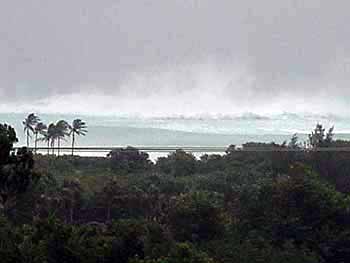 Hurricane Gert generated some heavy surf along the Bermuda shoreline. [Photo by Antony Siese, VP9HK]
 |
Amateur Radio Emergency Service and Radio Amateur Civil Emergency Service groups in North Carolina and Virginia continue efforts to respond to flooding resulting from Hurricane Floyd. Some parts of the region received additional rain this week as a result of Hurricane Gert.
North Carolina suffered its worst flooding disaster ever due to Hurricane Floyd. "As far as I can tell, we're still on the uphill slope," North Carolina Section Manager Reed Whitten, AB4W, said this week. "There's no reason to believe things will get better soon." Whitten estimated that upwards of 300 amateurs statewide are actively involved in the Hurricane Floyd response. Whitten said hams are staffing EOCs and shelters, handling traffic, and acting as net control stations, as well as supporting outside relief efforts by the Red Cross, the Salvation Army, and others.
"Amateur Radio Emergency Service/RACES is providing backup communications between the eight Southern Baptist Convention mobile kitchens and the American Red Cross to support their joint feeding efforts," Whitten said Thursday. He said the Red Cross also enlisted Amateur Radio technical assistance in locating a site for and installing a Red Cross UHF repeater system. "This system, using Red Cross equipment, should be operational early next week," Whitten said.
The American Red Cross currently is housing some 6000 people in 65 shelters in North Carolina, and hams also are providing communication for evacuees. The Salvation Army is operating mobile feeding units and one shelter.
Relief operators continue to be scheduled to travel into hard-hit Edgecombe County. Amateur Radio operators also are providing communication for the State Emergency Operation Center in Raleigh and in Pitt, Edgecombe, Craven, Hertford and other counties. Amateurs from North and South Carolina have traveled to the affected area to assist.
Most of the problems result from flooding of the Tar, Neuse, Cape Fear, and Lumber, rivers in eastern North Carolina. The town of Tarboro was completely cut off by the flooding of the Tar River, and relief workers have had to be transported in and out via helicopter.
While most amateur traffic is being handled on VHF and UHF, the statewide Tar Heel Emergency Net on HF is operating from 8 AM until midnight to support state and county operations. Whitten has requested that the FCC rescind the voluntary communications emergency for 3923 and 7232 kHz in North Carolina.
To the north, Virginia Section Manager Lynn Gahagan, AF4CD, reports the City of Franklin--near the North Carolina border--has experienced its worst flooding ever with the downtown area and businesses under more than 12 feet of water. Nearly all traffic going in and out of Franklin--including police and fire communication--is being handled by ham radio. He said hams were using VHF and repeaters for the most part, and he predicted telephone service could be out for another couple of weeks or more.
ARES/RACES officials in North Carolina and Virginia have requested that prospective volunteers first sign up with ARES officials. In North Carolina, contact SM Reed Whitten, AB4W, at ab4w@arrl.org. In Virginia, contact SM Lynn Gahagan, AF4CD, at 757-545-1290, or the Virginia Department of Emergency Services at vaeoc@w4za.ampr.org. In no case should volunteers in either state attempt to travel to stricken areas without being specifically requested to do so.
Elsewhere, the Southern Florida ARES Net activated on HF as Tropical Storm Harvey brushed Southern Florida Monday and Tuesday. Assistant SEC and Net Manager Jim Goldsberry, KD4GR, reports more than 400 people took advantage of Red Cross shelters in Pinellas County overnight. Other shelters were open in Lee and Polk counties. The EOC was staffed in Highlands County.
The Hurricane Watch Net activated this week for Hurricane Gert. Net Control Station Mike Pilgrim, K5MP, said Hurricane Gert passed to the east of Bermuda leaving only minor damage. The Net closed after it became clear that Tropical Storm Harvey had ceased to be a threat.
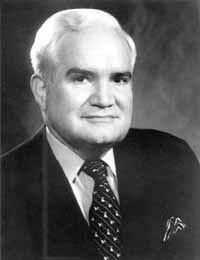 Bill Leonard, W2SKE
 |
Friday, October 1, is the deadline for entries in ARRL's professional media award. Previously announced as the Golden Antenna Award, the official name was changed to honor the late Bill Leonard, W2SKE, a former President of CBS News. This award will go to a professional journalist--or group--for outstanding coverage of Amateur Radio in TV, radio, print or multimedia. The winner will receive an engraved plaque and $500.
In Amateur Radio circles, Bill Leonard is remembered for his 1958 contribution to Sports Illustrated, "The Battle of the Hams," which describes the "sport of DXing." In November of 1996, Leonard was inducted into the Broadcasting and Cable Hall of Fame. Leonard became a Silent Key in 1994.
"We feel that Bill's impressive news career and dedication to Amateur Radio makes him the perfect namesake for this award program," said Dave Bell, W6AQ, Chairman of ARRL's Public Relations Committee. Members of the PR Committee will judge the entries and select this year's winner.
For more information about the Bill Leonard, W2SKE, Professional Media Award, including rules for entry and nomination forms, contact ARRL Media Relations Manager Jennifer Hagy, N1TDY, 860-594-0328; jhagy@arrl.org.
HARVARD'S W1AF: 90 YEARS OLD AND STILL GOING STRONG
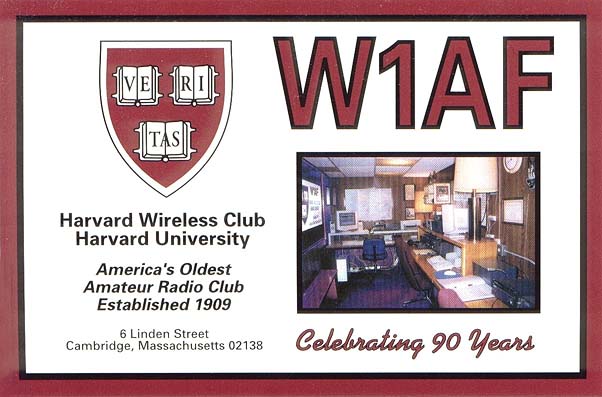
The Harvard Wireless Club celebrates its claimed status as the oldest Amateur Radio club in the US with a special event operation on the weekend of October 2-3. During the club's 90th anniversary observance, members will attempt to work as many stations as possible around the world.
The Harvard Wireless Club--an ARRL-affiliated club--dates its origin to early 1909, when it was founded by Prof George W. Pierce. First known as the Radio Society of the Institute for Geographic Exploration at Harvard, the club assumed its current name the following year. The W1AF call sign dates back to the early 1920s. Frank Wright, N3OQB, is the current club president.
This year's 90th anniversary special event October 2 and 3will include operation from three HF positions and one VHF position. W1AF will be on the air each day from 1200 to 0000 UTC--24 hours in all. HF SSB frequencies include 3890, 7270, 14,270, 21,370 and 28,390 kHz. HF CW will be 35 kHz up from the lower band edges. On VHF, look for W1AF on 50.150, 144.200 and 432.150 MHz SSB.
A special 90th anniversary QSL card will be available for stations working W1AF during the special event. QSL to Harvard Wireless Club, W1AF, Harvard University, 6 Linden St, Cambridge, MA 02138. For more information, contact the club at w1af@harvard.edu. The club's Web site is at http://www.hcs.harvard.edu/~w1af/.
SOLAR UPDATE
Solar soothsayer Tad Cook, K7VVV, Seattle, Washington, reports: This week was a big disappointment for HF radio enthusiasts. Last week's bulletin, ARLP038, stated that on Thursday, September 23, the solar flux should be around 220. This was the date of the autumnal equinox, generally a peak time for HF propagation. Unfortunately the sunspots never materialized, and the solar flux for the day was more than 80 points lower than predicted.
Not only have solar flux and sunspot numbers been lower than expected, but geomagnetic disturbances were prevalent as well. Wednesday, September 22, was the most active period, when the planetary A index was 37.
What's next? Currently the flux is around 137 as this is being written on September 23, and the predicted values for the weekend of September 24-26 are 135, 135 and 130. Predicted planetary A index is 15, 12 and 10.
Beyond the weekend the best guess is for solar flux to go below 130 after September 27 and bottom out around 110 on October 5. Flux values are not expected to rise above the current level until October 11, and peak around 160 by mid-month.
Active geomagnetic conditions could reappear around October 4 and again around October 9 and 10.
Despite the disappointing numbers, the author of this bulletin has had fun this week on HF mobile. Abandoning the usual 17 meter operation, 10 and 15 meters were tried, and consistent contacts with loud signals from Japan during the afternoon commute were made after 2300 UTC above 21.3 MHz SSB.
Sunspot numbers for September 16 through 22 were 153, 144, 152, 113, 78, 82 and 103 with a mean of 117.9. The 10.7-cm flux was 158.2, 157.5, 151.6, 149.3, 145, 146.8 and 140.4, with a mean of 149.8. The estimated planetary A indices were 32, 15, 16, 10, 10, 10 and 37, with a mean of 18.6.
In Brief: