ARRL Audio News
| · | To subscribe, unsubscribe, or change your e-mail delivery address: see How to Get The ARRL Letter, below |
| · | Delivery problems (ARRL member direct delivery only!): letter-dlvy@arrl.org |
| · | Editorial questions or comments: Rick Lindquist, N1RL, rlindquist@arrl.org |
| · | ARRL Audio News: http://www.arrl.org/arrlletter/audio/ or call 860-594-0384 |
| · | The ARRLWeb Extra: http://www.arrl.org/members-only/extra |
IN THIS EDITION:
- +Hams support Hurricane Floyd response
- +FCC eyes enhanced 10-meter enforcement
- +ARISS initial hardware flight delayed
- +Balloting favors new West Central Florida Section
- +World Amateur Radio Day celebrates digital technology
- Solar update
- In Brief: This weekend on the radio; Spectrum bill tops 100 cosponsors; eHam.net is hacked; WM7D.net opens ULS query site; ARRL Southwestern Division offers three-in-one; Bookmark this site! Ohio award to honor Allan Severson, AB8P; QST Cover Plaque Award; 1999 Handbook sold out!
+Available on ARRL Audio News
HAMS HELP EAST COAST TO WEATHER THE STORM
Ham radio volunteers along the East Coast from Florida through the New England States put their personal lives on hold for several days this week to volunteer for Hurricane Floyd duty. The huge storm, which sparked the largest mass evacuation in US history, caused a cascading series of Amateur Radio Emergency Service and Radio Amateur Civil Emergency Service activations, starting in Florida and moving steadily northward. After sweeping ashore early Thursday, the by then fast-moving storm pushed past New Jersey and New York into New England and began to dissipate. The storm cleanup and recovery have begun.The Hurricane Watch Net on 14.325 MHz was activated last weekend and remained on the air much of the week, gathering storm-related weather data as the storm passed over the Bahamas and made its way to the US shoreline. Information gathered on the net is funneled to forecasters via W4EHW at the National Hurricane Center. Net participants also were among the first to alert the rest of the world to initial damage reports from the battered islands. Many SKYWARN nets also tracked the storm's progress for regional forecasters and kept an eye out for possible tornado activity.
The Bahamas may have borne the brunt of Hurricane Floyd. Marty Brown, KF4TRG/C6A in Green Turtle Cay described extensive property damage to the Hurricane Watch Net. Operating from batteries Wednesday, she said there was significant tree damage in many areas, as well as roofs blown off, boat docks severely damaged, and power and telephone lines down. Brown collected reports from other hams via marine radio nets in the islands, including a report from Man o' War Cay that some two dozen vessels were aground there. Road damage--some severe--also was reported. Damage in the Abacos islands was said to be substantial.
"Oh, man, what a day!" Brown said as she took a moment to catch her breath.
Hurricane Watch Net participants and controllers were hampered by less than ideal propagation. Several other Bahamian stations also passed along damage reports. Nets in the Bahamas were handling emergency and health-and-welfare traffic on 40 meters. A health-and-welfare net has been established on 14.262 MHz as well.
In Florida and Georgia, many of the ARES members activated were assigned to handle communication duties at shelters housing the thousands of evacuees ordered out of coastal counties deemed most likely to be affected by Floyd. Dozens of ARES and RACES teams throughout Florida and Georgia were pressed into service to provide shelter communications and to staff emergency operation centers and assist outside relief agencies such as the Red Cross and the Salvation Army.
"Luckily, Hurricane Floyd realized Georgia was very well prepared for his arrival, [so he] turned and remained far enough offshore to cause no significant damage to Georgia," said Georgia SEC Tom Rogers, KR4OL.
As the storm progressed, ARES and RACES activated regional nets on HF and, in some cases, VHF. The FCC declared voluntary communications emergencies for HF and some VHF repeater frequencies in several East Coast states. A voluntary communications emergency remained in effect at week's end for 3923 and 7232 kHz, plus or minus 3 kHz, in North Carolina, which suffered a lot of flooding in the eastern one-third of the state. All other declared voluntary communications emergencies have been rescinded.
Georgia ARES not only made use of HF nets but of the Internet. "The Georgia ARES Reflector was a key tool in the dissemination of factual information and pre-planning instructions," said SEC Rogers. "Not every operator in the ARES program has HF capabilities."
North Carolina still is reeling from the storm's effects, and the state has been declared a disaster area. At week's end the Red Cross still had more than 200 shelters open in North Carolina. At one point, some 41,000 people took refuge in North Carolina shelters. More than 620,000 residents were without power. North Carolina Section Manager Reed Whitten, AB4W, said that he was glad that the storm did not plow further into North Carolina than it did. Fifty one counties had activated their local EOCs due to Hurricane Floyd.
Storm-related stories are likely to be the order of the day during the Virginia State Convention in Virginia Beach September 18 and 19. The hamfest will proceed as scheduled, despite flooding and wind damage, compliments of Hurricane Floyd. Virginia's Tidewater area already was a bit waterlogged from the effects of Hurricane Dennis earlier in the month. As did other states, Virginia suffered flooding and power outages, along with some downed trees. The City of Portsmouth was without water due to a pumping station failure in Suffolk, where the reservoir is located. Virginia SM Lynn Gahagan, AF4CD, repots the water outage caused the failure of a water-cooled generator at the Portsmouth EOC, which took down communication there. Some parts of Virginia experienced 100 MPH winds.
Downgraded Thursday to a tropical storm, Floyd continued to move rapidly toward the northeast. High winds, heavy surf and higher-than-normal tides were reported along the coastline from New York's Long Island and northward into Connecticut, Rhode Island, and Massachusetts. Heavy rain generated by the storm caused some local flooding. Downed trees and tree limbs and some power outages were reported in New England. Among other activities, hams in New England staffed weather-spotting nets on VHF to keep abreast of the storm's progress and any substantial damage or difficulties.
Hurricane Gert, still in the Atlantic, was not believed to pose a threat to the US, but could be a potential threat to Bermuda.
FCC SETS SIGHTS ON BEEFED-UP 10-METER ENFORCEMENT
The FCC's Legal Adviser for Enforcement Riley Hollingsworth says hams can expect more rigorous enforcement on 10 meter issues next year. Over the Labor Day weekend, Hollingsworth told visitors to the Shelby Hamfest in North Carolina that the next area of enforcement would be the encroachment of unlicensed individuals into the 10-meter band and a crackdown on illegal RF amplifiers. His announcement drew loud applause from the Shelby crowd. Hollingsworth elaborated on the comments this week in an interview concerning this and other enforcement issues."We're coming on to ten months of rejuvenated amateur enforcement now, and two issues are clear--two areas we need to really crank up on next year," Hollingsworth said. "One is the incursion into 10 meters by unlicensed operators--CBers and so forth. The other is sales of illegal equipment on the Internet and at hamfests."
At Shelby, Hollingsworth told the crowd that he'd spotted more illegal equipment at Shelby that he'd seen last May at the Dayton Hamvention. At the Hamvention, FCC Field Office personnel from Detroit warned several vendors about potential violations involving RF amplifiers.
The Shelby Hamfest, held at the Cleveland County Fairgrounds, is best known for is flea market, not for its forums, but Hollingsworth still managed to draw a standing-room-only crowd for his Sunday morning presentation. After addressing the overflow forum audience, Shelby Hamfest organizers hastily scheduled a second forum and rearranged the room to gain more seating. Hollingsworth was scheduled to appear at the Virginia State Convention in Virginia Beach September 18-19.
Hollingsworth says his recent enforcement initiative aimed at call sign hoarders has met with some success. "I appreciate the people who have come in on their own and either turned in or trimmed down the number of club call signs that they had," he said this week. During a two-week period in late August, Hollingsworth said 43 call signs voluntarily were turned back to the FCC without any prompting.
Hollingsworth says he's received replies from all of the letters the FCC has sent to multiple call sign holders, including members of the Tucker family in La Mirada, California. On June 30, the FCC requested that family patriarch Roy T. Tucker, N6TK, and other licensees in the Tucker family provide justification in writing for the two dozen or so club call signs held by various family members.
"I have about a half a dozen cases in the hopper," Hollingsworth said of the call sign inquiries initiative, but added that he's deferring judgment on whether the message has gotten across to the amateur community. "I would like to think so," he said, "but I won't know until I've seen these responses." His stack includes replies from the Tucker family, who have hired an attorney to handle the FCC inquiry.
Hollingsworth says he's optimistic that an anticipated FCC internal reorganization that will create a new Enforcement Bureau will occur no later than the end of the year but could be as early as October 1--the start of the new federal fiscal year. Hollingsworth has assured that the change will have no effect on Amateur Radio enforcement efforts.--John Kanode, N4MM, provided some information for this report
ARISS INITIAL HARDWARE FLIGHT DELAYED
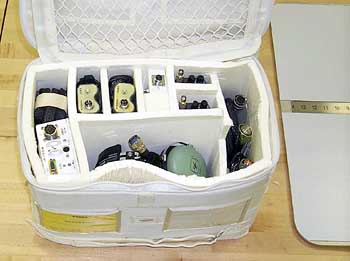 The ARISS initial amateur gear in a NASA "soft stow" bag. The bag protects the gear during flight and transfer from the shuttle to the ISS. [NASA photo]
 |
The recent grounding of the US space shuttle fleet will delay launch of the initial station hardware for Amateur Radio on the International Space Station. But pre-launch processing of Amateur Radio equipment bound for the ISS remains on schedule. The gear had been scheduled to launch in December aboard STS-101. With the shuttle launch hiatus, it now won't go up at least until late January and probably not until February.
NASA managers said this week that additional delays could result from the effects of Hurricane Floyd.
NASA grounded the shuttles to allow a detailed inspection of electrical wiring on the entire shuttle fleet. The inspections come in the wake of problems during the July launch of the shuttle Columbia, when astronauts and ground controllers struggled with power failures in computers controlling two of the orbiter's three main engines. According to news accounts, the shuttle was one short circuit away from an emergency abort.
An electrical problem later in the same mission initially caused a Space Amateur Radio EXperiment school contact to be rescheduled. A orbiter power outlet subsequently was determined to be faulty.
So far, inspectors have found dozens of electrical defects on shuttles Endeavour and Discovery. Comprehensive inspections of Columbia--the oldest orbiter--and Atlantis--the one that will carry the initial ham gear to the ISS--get under way later this month, NASA says. "They have found about 64 problems among the four orbiters," said SAREX Principal Investigator Matt Bordelon, KC5BTL. With a scheduled Leonids meteor shower hiatus and holiday breaks already factored in, STS-101 won't go until January 22 at the very earliest, Bordelon said.
"We delivered our internal amateur hardware back in July, so nothing changes there," he said. The ARISS antenna hardware is due for fall delivery to be stowed aboard STS-101 for flight. "It's about a month or two delay," he said of the STS-101 launch. "I would expect it probably would not be launched until February."
On the other hand, "everything is pretty much on schedule as far as the ham radio hardware is concerned," Bordelon said. "There is no impact to our schedule. We're just moving along."
For more information on ARISS, visit http://garc.gsfc.nasa.gov/~ariss/ariss.html.
BALLOTING FAVORS NEW WEST CENTRAL FLORIDA SECTION
ARRL members in nine Southern Florida counties have voted overwhelmingly in favor of creating a new ARRL West Central Florida Section. Ballots counted September 15 at ARRL Headquarters showed 920 members favoring the idea--proposed by the West Central Florida Section Committee--and 86 opposed. A county-by-county breakdown of the vote indicates that a majority of ARRL members who cast ballots in each county voted for the proposal. The counties involved are Charlotte, DeSoto, Hardee, Highlands, Hillsborough, Manatee, Pinellas, Polk and Sarasota.ARRL Executive Vice President David Sumner, K1ZZ, says the next step is for the ARRL Board of Directors to review the entire file and to vote to approve or disapprove the proposal. No timetable has been established for completion of the Board's review. The ARRL Board has the final say on whether the new section will be created.
The petitioners were gleeful at the news. "The Committee is thrilled and elated with the vote of the membership," said Committee Chairman Paul Toth, K2SEC. "This victory puts us one vote away from having this new section." The petition was filed with the ARRL last April.
ARRL By-laws provide that a new section may be created from one or more existing sections. The most recent new ARRL section created was Northern New York in 1996. At present, there are 70 ARRL sections.
The West Central Florida Section Committee Web site is at http://www.qsl.net/wcfla.
WORLD AMATEUR RADIO DAY CELEBRATES DIGITAL SUCCESS
World Amateur Radio Day is observed each year by the International Amateur Radio Union. The theme of this year's event on Saturday, September 18--Celebrating Success in Amateur Digital Communication--highlights the impressive contributions by the world's 2.7 million radio amateurs to progress in digital radiocommunication. The IARU is a worldwide federation of national Amateur Radio organizations representing radio amateurs in 150 countries, and is a Sector Member of the International Telecommunication Union.Radio amateurs began experimenting with packet radio more than 20 years ago. A number of different ways of sending digital data by radio were tried before a protocol known as AX.25 was devised. By the mid-1980s, long before its popularization in commercial and government services, packet radio had become a mainstay of Amateur Radio communication.
More recently, amateurs have developed and introduced to the world a number of improved systems for transmitting digital data reliably on HF. HF communication depends on the ionosphere, which is in a state of constant and sometimes very rapid change. Sending error-free digital signals through the HF environment, where noise and distortion are nearly always present, is a significant engineering challenge. Digital modes developed by amateurs, including PACTOR, CLOVER, G-TOR, PACTOR II, and PSK31, are recognized as having contributed enormously to the HF communications art.
Radio amateurs commonly use what they have learned through their avocation in contributing to other telecommunications services. The broadcasting, mobile, and satellite services, to name but a few, would be far less advanced were it not for the skills of radio amateurs who happen also to be radio professionals.
Next year's World Amateur Radio Day--April 18, 2000--marks the 75th anniversary of the founding of the IARU in Paris on that date in 1925.--IARU
SOLAR UPDATE
Sun watcher Tad Cook, K7VVV, Seattle, Washington, reports: Solar flux and sunspot numbers were up this week. Average solar flux rose about 10 points and average sunspot numbers were up almost 33 points when compared to the week previous. Next week is important because Thursday is the autumnal equinox, which is generally a good time for HF propagation. Solar flux is expected to rise over the week, peaking around 220 on Thursday, when the hours of darkness are equal in the southern and northern hemispheres. After September 26 flux values should drop below 200, down to 140 by the end of the month, and fall to a minimum around 105 on October 5.For this weekend, look for the Friday through Sunday solar flux to be 160, 165 and 170, and planetary A index to drop from 25 to 20 to 12. The A index has been high this week, which has not been good for HF conditions. The worst day was Monday, when the A index registered a very stormy 38. The K index was consistently 4 and 5 throughout the day. Wednesday and Thursday were also bad, with an A index of 32 and planetary K index as high as 7. On Thursday the College A index in Alaska was 63. Alaskan HF operators were probably able to hear very little, although VHF fans outside of the higher latitudes likely had fun.
All of these disruptions were caused by a series of solar flares and coronal holes, throwing proton energy that disrupts the ionosphere and bends the earth's magnetic field. Geomagnetic conditions are not expected to really settle down until after October 1, when the A index should stay below 10. Sunspot region 8674 is rotating into view, and could produce more flares and coronal holes.
Sunspot numbers for September 9 through 15 were 113, 107, 145, 126, 183, 158 and 155 with a mean of 141. The 10.7 cm flux was 106.5, 122, 122.5, 140.8, 154.6, 156.4 and 154.9, with a mean of 136.8. The estimated planetary A indices were 8, 15, 10, 26, 38, 23 and 32, with a mean of 21.7.
In Brief:
- This weekend on the radio: YLRL Howdy Days and the QCWA QSO Party are September 17-19; the ARRL 10 GHz and Up Cumulative Contest, the Air Force Anniversary QSO Party, the Washington State Salmon Run, the Scandinavian Activity Contest (CW), and the Tennessee QSO Party are September 18-20. Just ahead: The Scandinavian Activity Contest (SSB), the CQ/RJ WW RTTY Contest, the Heart of Dixie QSO Party, and the VHF/UHF Fall Sprints are the weekend of September 25-26. See September QST, page 105, for details.
- Spectrum bill tops 100 cosponsors: ARRL Legislative and Public Affairs Manager Steve Mansfield, N1MZA, reports that more than 100 Members of Congress have agreed to be cosponsors for HR-783, the Amateur Radio Spectrum Protection Act. Four more signed aboard following the August recess, raising the total number of cosponsors to 106.
- eHam.net is hacked: The new eHam.net Amateur Radio site (http://www.eham.net) reports that it was the victim of hackers the weekend of September 10-12. eHam.net's Bill Fisher, W4AN, says hackers apparently from Southeast Asia were using the eHam.net server in an effort to break into government agency sites in the US. As a result, eHam.net began receiving phone calls from the US Defense Department, NASA, and other government agencies on September 10. "A quick look at our server revealed that we had indeed been hacked and that someone was running a process on our machine that was trying to gain information about computers in a lot of different government and university computer systems," Fisher said. He said eHam.net removed the program and attempted to close loopholes, but September 11, the intruders deleted all of the files on the eHam.net system. eHam.net says it has beefed up security, and expects no further problems.--eHam.net
- WM7D.net opens ULS query site: The WM7D.net call sign server has opened a ULS query site that includes licensee information updated daily (except weekends) from the FCC. The site is operational but in the testing stages. The new URL is http://www.wm7d.net/fcc_uls/ulsquery.html.--Mark Downing, WM7D
- ARRL Southwestern Division offers three-in-one: Hams in the League's Southwestern Division have three major ham radio events right at their doorstep this fall. The circuit starts with the ARRL-TAPR Digital Communications Conference September 24-26 in Phoenix, Arizona, followed by the Southwestern Division Convention aboard the Queen Mary at Long Beach, California, October 1-3 (the FCC's Riley Hollingsworth, K4ZDH, is the featured speaker), and wrapping up with AMSAT-NA's 17th Space Symposium and AMSAT-NA Annual Meeting, October 7-10 in San Diego, California.
- Bookmark this site! The ARRL Technical Information Service has completely revamped its Web site, http://www.arrl.org/tis/. The older text-only screens have been brought into the 21st Century with a complete facelift. Among other things, users will find help in answering that age-old question: "What radio should I buy?" The new TIS Pages offer technical information on a variety of subjects that you can read or download. These include references, downloadable QST articles, Web links and more, on dozens of topics of interest to hams. New topics will be added on an ongoing basis. The TIS Find search engine accesses a database of more than 2000 companies that offer ham radio-related products and services. A bibliographies database provides lists of articles from many Amateur Radio and related publications, and plans call for this to be improved with the addition of an interactive keyword search engine. The QST Product Review List offers a list of product reviews going back to 1970. ARRL members may read or download product review columns going back to 1980.
- Ohio award to honor Allan Severson, AB8P: Ohio's Ham of the Year Award is being renamed to honor former ARRL Great Lakes Director Allan Severson, AB8P. The award now will be known as the "Allan Severson, AB8P, Memorial Award." Severson, who served as Great Lakes Director from 1990 until 1995, died in September 1997. Each award certificate will carry the inscription: "Allan's dedication and enthusiasm for Amateur Radio inspired a whole generation of Ohio Section Leadership." Ohio Section Manager Joe Phillips, K8QOE, said the award will not be presented this year to avoid detracting from the name change.--Joe Phillips, K8QOE
- QST Cover Plaque Award: The winner of the QST Cover Plaque Award for August was Jay Dyer, W8JAY, for his contribution "A Digital DXpedition to China and Mongolia." Congratulations, Jay!
- 1999 Handbook sold out! The ARRL has sold out of copies of the 1999 Handbook for Radio Amateurs (Item 1816) and has stopped taking orders for this item. It's possible that some retailers continue to have copies for sale, however. The 1999 Handbook CD-ROM continues to be available from ARRL HQ. The 2000 edition of the Handbook will be available in mid-October, but orders are being taken now for later delivery. The 2000 Handbook (77th edition) is item 1832. It's $32 (plus shipping/handling). To order, visit the ARRLWeb catalog or call toll-free 888-277-5289.