ARRL Audio News
| · | To subscribe, unsubscribe, or change your e-mail delivery address: see How to Get The ARRL Letter, below |
| · | Delivery problems (ARRL member direct delivery only!): letter-dlvy@arrl.org |
| · | Editorial questions or comments: Rick Lindquist, N1RL, rlindquist@arrl.org |
| · | ARRL Audio News: http://www.arrl.org/arrlletter/audio/ or call 860-594-0384 |
| · | The ARRLWeb Extra: http://www.arrl.org/members-only/extra |
IN THIS EDITION:
- +W3CI trades fine for suspension
- +FCC relaxes spread spectrum rules
- +Task Force seeks future technology proposals
- +eHam.net site now open
- K2A Klondike expedition is QRV
- W2VU named CQ editor
- Solar update
- In Brief: This weekend on the radio; Vanity fee reminder; ARRL offers Handbook Collector's Edition for 2000; Field Day, VHF Party logs listed; Web call sign servers may not be up-to-date yet; Help Wanted--Assistant Contest Manager; Free logger; AMSAT-NA lists Symposium topics; STENSAT to launch QRZ announces on-line practice exams
+Available on ARRL Audio News
W3CI TRADES FINE FOR LONG-TERM SUSPENSION
Facing a hefty fine in a malicious interference case, Amateur Extra licensee Kornwell H. Chan, W3CI, of Dresher, Pennsylvania, has cut a deal with the FCC to suspend his license for four years, effective immediately, in exchange for not having to pay up.
Earlier this year, Chan and Technician licensee Michael E. Gallagher, KB1DTA (ex-KB3DHX), of W Concord, Massachusetts, each received $7500 fines from the FCC in connection with malicious interference to the Phil-Mont Mobile Radio Club VHF and UHF repeaters. Following up on complaints from the Phil-Mont club, FCC personnel monitored interfering signals which included transmissions of classical music and a person talking with a disguised voice. In February, FCC personnel using direction-finding gear tracked the signal to a vehicle occupied by Chan and Gallagher and equipped with amateur gear.
Chan subsequently negotiated with the FCC to give up his Extra ticket until 2003 instead of paying the $7500 fine if there are no violations of the suspension agreement. FCC Legal Adviser for Enforcement Riley Hollingsworth, K4ZDH, told the ARRL that Chan "was cooperative and helped the Commission with information regarding the jamming." Under the agreement, Chans license will be suspended until September 1, 2003.
In a letter this week, Hollingsworth reminded Chan that, during the suspension, he would have no authority to operate Amateur Radio equipment and will have to be on his best behavior. Specifically, he cautioned Chan about any efforts at retaliating against those who had complained about his radio operation in the first place. Hollingsworth cautioned Chan that "any such incidents of retaliation for which you are directly or indirectly responsible will nullify this agreement, and will jeopardize your Amateur Radio license."
No similar deal is in the works for Gallagher. The FCC had cited Chan and Gallagher for failing to operate "in accordance with good amateur practice," failing to identify as required, transmitting music on amateur frequencies, and willfully impeding legitimate amateur communications.
FCC RELAXES RULES FOR SPREAD SPECTRUM
The FCC has relaxed rules governing the use of spread spectrum techniques by radio amateurs and opened the door to the possibility of international spread spectrum communication. The Report and Order in WT Docket 97-12 adopted August 31 concludes a proceeding that originated with an ARRL petition in December 1995 and has been pending since 1997.
The FCC adopted rules that will allow Amateur Radio stations to transmit additional spread spectrum emission types. Once the new rules become effective November 1, hams will be able to use techniques other than frequency hopping and direct sequence spreading. In addition, the new FCC rules will permit US hams to use spread spectrum techniques to communicate with amateurs in other countries that permit SS. Spread spectrum communication has been limited to stations within FCC jurisdiction.
The new rules require that spread spectrum stations running more than 1 W incorporate automatic transmitter power control. Amateur stations using SS are restricted to a maximum power of 100 W.
The Commission also amended the rules to eliminate what it called "now-unnecessary record keeping and station identification requirements" that apply only to stations using spread spectrum. The FCC agreed to let SS stations identify themselves using conventions developed by the Amateur Radio community.
Roanoke Division Vice Director Dennis Bodson, W4PWF, who has followed the Leagues Spread Spectrum initiative through from start to finish was pleased with the outcome of the proceeding. "Im very happy," he said. "The League got everything it wanted and more--all of which, I believe, will help to promote this mode on the amateur bands." Bodson served as the ARRL Board liaison with the Future Systems Committee and chaired the Ad Hoc Committee on Spread Spectrum, which was instrumental in developing the Leagues stance on Spread Spectrum.
Stations employing spread spectrum techniques will remain secondary to--and must accept all interference from--stations employing other authorized modes. The FCC declined to authorize the use of spread spectrum techniques on additional bands or frequencies.
A copy of the FCCs complete Report and Order is available at http://www.arrl.org/announce/regulatory/wt97-12.
ARRL TASK FORCE SEEKS PROPOSALS FOR FUTURE TECHNOLOGY
The ARRL Technology Task Force wants to hear from hams with ideas and proposals for new technology to carry Amateur Radio into the next century. The ARRL Board of Directors created the Task Force and the companion Technology Working Group last January, and ARRL President Rod Stafford, W6ROD, has appointed a number of leading amateurs to serve on both panels. The Task Force and the Working Group will work hand-in-hand to identify, evaluate, and promote the most promising 21st Century technologies for Amateur Radio.
The Task Force consists of members of the ARRL Board family and the Headquarters staff. Chairing the Task Force is ARRL First Vice President Steve Mendelsohn, W2ML. Other TTF members are Roanoke Vice Director Dennis Bodson, W4PWF; Hudson Director Frank Fallon, N2FF; New England Director Tom Frenaye, K1KI; Southwestern Vice Director Art Goddard, W6XD; Pacific Director-elect (and current Vice Director) Jim Maxwell, W6CF; International Affairs Vice President Larry Price, W4RA; and Rocky Mountain Director Walt Stinson, W0CP.
The Technology Working Group will evaluate technical proposals and make recommendations to the Technology Task Force, which, in turn, will make specific policy proposals to the ARRL Board of Directors.
The Working Group is an expert panel selected from among League members representing a broad spectrum of Amateur Radio interests and activities. Chairing the Working Group is CQ Editor Rich Moseson, W2VU. Other members are AMSAT-NA President Keith Baker, KB1SF; Peter Coffee, AC6EN; Mike Cook, AF9Y; Gene McGahey, NR0NR; ARRL Technical Relations Manager Paul Rinaldo, W4RI; Dennis Silage, K3DS, and QEX Editor Doug Smith, KF6DX.
ARRL Laboratory Supervisor Ed Hare, W1RFI, will serve as ARRL HQ staff liaison to both committees.
The Task Force invites information and concepts on a wide range of technologies with the potential to improve Amateur Radio and to promote what the FCC calls "continuation and extension of the amateurs proven ability to contribute to the advancement of the radio art." The Task Force invites the submission of ideas and proposals from all parts of the amateur community, and will use the input to help formulate League policy recommendations on a wide range of technical issues.
Amateurs are invited to complete the form on ARRLWeb at http://www.arrl.org/news/ttf/, send e-mail to the Task Force at ttfinput@arrl.org, or offer your ideas by mail to the ARRL Technology Task Force, c/o Ed Hare, W1RFI, 225 Main St, Newington, CT 06111. Suggestions are requested by November 30, 1999.
AMATEUR RADIO "COMMUNITY SITE" eHAM.NET IS ON-LINE
Dubbed an Amateur Radio "community site," eHam.net debuted September 2 at http://www.eHam.net. "eHam.net can best be described as a community of ham radio operators from all over the world," said Bill Fisher, W4AN, one of the amateurs behind the new site. He says the site is--among other things--aimed at giving hams a place to share ideas through a chat program, as well as to contribute news, buy and sell, take practice exams, see equipment reviews, and get propagation information and DX spots.
eHam.net includes a call sign server. Users will be able to add an e-mail address, Web site address, personal biography, and picture. Search tools will allow users to find community members with the same ham radio interests. The site also includes an unlimited number of real-time chat rooms.
eHam.net also offers free ads to buy, sell or swap on-line. The eHam.net "Detective" search tool lets users find ham radio information on the Web. "We have indexed all of the archived mailing lists at contesting.com, qth.net, and others to provide you with one place to search for answers to your questions," Fisher said.
The site also lets users view DX spots from all over the world and locate QSL managers quickly. A "Friends Remembered" department lets hams post reminiscences of Silent Keys. The site also includes various Amateur Radio-related links. The site includes news items from the ARRL and other sources.
In addition to Fisher, others behind eHam.net include Randy Thompson, K5ZD, Garth Hitchens, KG7GA, and Trey Garlough, N5KO.
K2A KLONDIKE TO ARCTIC SPECIAL EVENT IS QRV
Ever daydream about taking part in a DXpedition to the Yukon? Jim Wilmerding, W2EMT, of Northeast Harbor, Maine, and his son Andrew did something about it, and right now are retracing the Gold Rush routes. From their Land Rover, they are making regular radio schedules with hams--and especially with any teachers who have interested students.
Jim Wilmerding is using the special event call sign K2A, which stands for "Klondike to Alaska" He hopes to use 7.250, 14.300, 14.313, 17.150, 21.350, 24.950 and 28.350 MHz, conditions permitting. Andrews two Labrador retrievers, Rufus and Cleo, ride along in the back of the Land Rover and serve as the trip mascots and guides that students can follow.
The DXpedition got started on its trek September 4 and the Wilmerdings planned to meet up with many other Land Rover drivers in Washington September 9. The trek, sponsored by the Border-to-Border Expedition Society, continues until September 17. The Border-to-Border Expedition Society is an organization of Land Rover owners founded last year to drive a 2300-mile mainly off-road trip from British Columbia to Mexico in 10 days. Twenty-seven vehicles made the trip to celebrate the 50th anniversary of Land Rover.
Jim Wilmerding, W2EMT, an ARRL-registered schoolteacher (and an emergency medical technician), helped design special lesson plans for teachers and students. The Land Rover will make stops at schools in the Northwest Territories, the Yukon and Alaska. Check http://www.lab-rover.com/B2B-EDUK2Aradiopage.html to register (free) for the plans, and to find out how to set up ham radio schedules or contact him at w2emt@arrl.net.
"We look forward to having you along for the ride, so get your bags packed and climb in!" Jim Wilmerding said. "We hope youll have as much fun as we will."--Rosalie White, WA1STO
W2VU NAMED EDITOR OF CQ
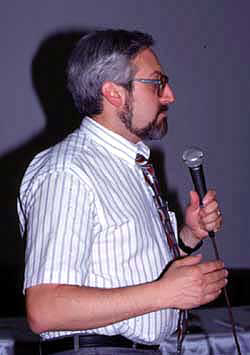 New CQ Editor Rich Moseson, W2VU, speaking at a forum last May at the Dayton Hamvention. |
Since joining CQ Communications in 1992, Moseson has been involved in numerous projects, including creation of CQs Amateur Radio videotape series, management of CQs 50th anniversary issue, development of the magazines various Web sites, and--most recently--the launch of CQ VHF in 1996.
An Amateur Extra class licensee, Moseson has been an amateur since 1970. He is active on a variety of modes and bands on HF, VHF, and UHF.
CQ has been in publication since 1945. Moseson said one immediate change would be to actively solicit feature articles on all aspects of Amateur Radio from all segments of the amateur community.
SOLAR UPDATE
Solar observer Tad Cook, K7VVV, Seattle, Washington, reports: Solar flux numbers were disappointing this week: Levels have not been this low since April. Solar flux dropped to 106.8 on September 8, and the average flux for the week was down over 80 points from last week. Solar flux is expected to stay low for the next few days, with levels at 105, 100 and 100 for September 10-12. Planetary A indices of 15, 15 and 12 are predicted for the same period, so geomagnetic conditions should be unsettled as well.
Solar flux should be back to 140 by September 16, 170 around September 18, and over 200 around September 20. Flux is expected to peak at 220 from September 22-24. The most unsettled geomagnetic conditions are expected around September 15-16 and 26-27.
Sunspot numbers for September 2 through 8 were 134, 116, 103, 101, 81, 111 and 111, with a mean of 108.1. The 10.7-cm flux was 156.5, 139.3, 131.2, 121.8, 118.5, 112.4 and 106.8, with a mean of 126.6. The estimated planetary A indices were 11, 18, 15, 8, 6, 17 and 9, with a mean of 12.
IN BRIEF:
- This weekend on the radio: The ARRL September VHF QSO Party, the Worked All Europe Contest (SSB), and the North American Sprint (SSB) are the weekend of September 11-12. NOTE: The Illinois QSO Party dates are listed incorrectly in September QST and elsewhere. The Illinois QSO Party is October 16-17. Just ahead: YLRL Howdy Days and the QCWA QSO Party are September 17-19; the ARRL 10 GHz and Up Cumulative Contest, the Air Force Anniversary QSO Party, the Washington State Salmon Run, the Scandinavian Activity Contest (CW), and the Tennessee QSO Party are September 18-20. See September QST, page 105, for details.
- Vanity fee reminder: The fee to apply for a vanity call sign increases to $14, effective Tuesday, September 14. Issuance of vanity call signs has been disrupted by deployment of the Universal Licensing System. The FCC has not announced when it expects vanity call sign processing to resume.
- ARRL offers Handbook Collector's Edition for 2000: The ARRL Board of Directors has commissioned a limited-run collector's edition of the 2000 ARRL Handbook for Radio Amateurs. This is a casebound (hardcover) edition with leather on the outside and gold-foil lettering. Those ordering by October 31--the deadline for holiday orders--can have their copies personalized with name and call sign, also in gold foil lettering, on the cover. Orders received by October 31 should be delivered in early December. The text of the book is exactly the same as the regular edition. No more than 2000 will be made. Each book will be sequentially issued and numbered. The ARRL Handbook 2000--Collector's Edition is $75 (plus shipping and handling). Order item 1859. Visit ARRLWeb, www.arrl.org/catalog/1859/, or call toll-free 888-277-5289, Monday through Friday from 8 AM to 8 PM Eastern Time.
- Field Day, VHF Party logs listed: ARRL Contest Branch Manager Dan Henderson, N1ND, says a list of logs received for both the June VHF QSO Party and ARRL Field Day has been posted on the Contest Web page at http://www.arrl.org/contests/claimed/. A similar list is posted as soon as possible after every contest. In case of discrepancies or missing logs, contact Henderson at n1nd@arrl.org.
Web call sign servers may not be up-to-date yet: Many of the popular Web call sign servers have not been updated for more than a month now, a result of problems encountered during deployment of the Universal Licensing System. Last week, after a few false starts, the FCC resumed posting the necessary update files, but because of a new file specification, the various call sign servers likely will have to modify the program routines they use to grab the data each day from the FCCs server before they can update their servers. There have been problems with the FCC update and ZIP files for the week of September 6. As of September 9, QRZ.com had been updated at least once since early August. The WM7D.net, UALR, and Buckmaster call sign servers had not been updated. (WM7D.net soon will open a new site at http://www.wm7d.net/fcc_uls/ulsquery.html. The old database will remain active for a while but no longer will be updated.) The FCC Transaction Search on ARRLWeb was being upgraded and was unavailable. Although its not nearly as convenient to use as the typical Web call sign server, applicants can obtain current license information from the ULS, http://www.fcc.gov/wtb/uls, by clicking on "License Search." To confirm license class and reveal additional data, users must click on the pulldown menu labeled "License Options" on the bottom of the screen and click on "Amateur Administration."
- Help Wanted--Assistant Contest Manager: The ARRL seeks a licensed Amateur Radio operator for the position of Assistant Contest Manager. Duties include accurate data entry, preparing and verifying contest results for publication, and the preparing mailings and shipping packages. Familiarity with Excel, Access and Word 97 is helpful. Applicants must posses the ability to work independently. Apply in writing to American Radio Relay League, Contest Department, 225 Main St, Newington, CT 06111. No telephone calls, please. The ARRL is an Equal Opportunity Employer.
- Free logger: At a price all hams will love, Bob Furzer, K4CY, has made his logging software--appropriately dubbed Logger--available free to the general amateur population. Its a Windows 95/98-based program, and it supports full ADIF imports and exports. It also includes PSK-31 software. Version 6.07 now is available. To obtain a copy, visit http://www.guam.net/pub/midxa and click on "Logger" on the main page. Jim Kehler, KH2D, has offered to assist Logger users in converting their old logs into ADIF format. Contact him at kh2d@kuentos.guam.net.
- AMSAT-NA lists Symposium topics: AMSAT-NA has announced the presentation topics for its 17th Space Symposium and AMSAT-NA Annual Meeting October 8-11 in San Diego. Symposium Chair Duane Naugle, KO6BT, says presentation topics will include Design and Implementation of an Automated Satellite Gateway System, Apogee (constant time-of-day) Orbits for Amateur Radio Satellites, Point-to-Point Protocol for Satellite Communications, A Patch Antenna For UHF, OPAL and Emerald--First Generation Micro-satellites, ASUSat1 Satellite Profile, JAWSAT Satellite Profile, Amateur Radio on the ISS, and Phase-3D Update. More details are available on the AMSAT-NA Web site, http://www.amsat.org. The last day registrations can be accepted is September 23; after that, registration will be accepted at the door only. Call Martha Saragovitz, 301-589-6062, for more information.--AMSAT News Service
- STENSAT to launch: Stanford Universitys OPAL--Orbiting Picosatellite Automated Launcher--experiment is scheduled for launch October 4. The experiment includes the small (12 cubic inch) StenSat Amateur Radio picosatellite. The package is a crossband repeater that will operate much like the popular AO-27 satellite. StenSat will uplink on 145.840 MHz and downlink on 436.625 MHz. The spacecrafts designers are looking for volunteers to monitor and help control the picosatellite. They are especially interested in getting AX.25 telemetry reports in the hours and days following launch. Interested hams should contact Hank Heidt, N4AFL, hheidt@erols.com, to be added to the StenSat mailing list. For more information, visit http://www.erols.com/hheidt.--Space News/ANS
- QRZ announces on-line practice exams: QRZ has announced that free, online practice amateur exams for all license classes now are available at http://www.qrz.com. The exams include instant scoring and all images and diagrams from current VEC question pools.--Fred Lloyd, AA7BQ