ARRL Audio News
| · | To subscribe, unsubscribe, or change your e-mail delivery address: see How to Get The ARRL Letter, below |
| · | Delivery problems (ARRL member direct delivery only!): letter-dlvy@arrl.org |
| · | Editorial questions or comments: Rick Lindquist, N1RL, rlindquist@arrl.org |
| · | ARRL Audio News: http://www.arrl.org/arrlletter/audio/ or call 860-594-0384 |
| · | The ARRLWeb Extra: http://www.arrl.org/members-only/extra |
IN THIS EDITION:
- +FCC tackles application backlog
- +Turkish hams provide post-earthquake communication
- +Hams were ready for Bret
- +Digital confab set for September
- +ARISS antennas headed for testing
- P3D completes vibe testing
- Section manager election results
- Solar update
- In Brief: This weekend on the radio; Correction; Zorro turns in his ticket; World Amateur Radio Day--present and future; ARRLWeb offers on-line hamfest calendar; Michigan convention cancelled; A new record? Sweden cuts top code speed, license classes; UK moves to 12.5 kHz spacing on 2-meter FM; Scandinavian Activity Contest info correction
+Available on ARRL Audio News
FCC TACKLES VEC APPLICATION BACKLOG
The VEC application logjam has broken! As the transition to the new Universal Licensing System completed its second week, the FCC notified Volunteer Examiner Coordinators to forward their backlog of new and upgrade Amateur Radio applications. Since the ULS went on-line August 16, the FCC had been accepting and processing only a handful of the many Amateur Radio new and upgrade applications. The ULS Task Force had expected to be able to attack the VEC application logjam last week.
ARRL-VEC Manager Bart Jahnke, W9JJ, said that data for 200 exam sessions--more than 550 applications in all, some dating back as early as August 7--were submitted for FCC processing August 26. Jahnke said another two dozen or so sessions representing an additional 75 applications were being prepared for transmittal to the FCC. Since the advent of ULS, the ARRL-VEC was only able to transmit 119 applications from 32 exam sessions. The FCC has already processed 113 of those applications. Not all VECs are set up to file under the new system.
Apologizing for the problems and pleading for patience, the FCC says the Universal Licensing System "is currently operating" and that "performance problems with ULS have been repaired," although some amateurs still report occasional difficulty accessing the system. The FCC said the ULS will be down for a system upgrade from Friday, August 27 at 5 PM Eastern until Monday, August 30 at 8 AM Eastern. The FCC plans to deploy the ULS for the Microwave Service on August 30.
Meanwhile, call sign servers such as UALR, WM7D.net, and QRZ.com, and the FCC Transaction Search on ARRLWeb have not been able to update their licensee data because the FCC has yet to post the necessary ZIP file. The ULS Task Force said last week that it anticipated ZIP file posting to become "routine" by this week, but it did not happen. The ULS Task Force said this week that it hopes to post a ZIP file update on August 30 and daily thereafter. The ZIP file is used by on-line call sign servers as well as by Volunteer Examiner Coordinators to keep track of FCC license grants.
While it's been deploying the ULS for the Amateur Service, the FCC has not processed any vanity call sign applications, although the ULS will accept vanity applications for filing and has inaugurated on-line fee payment by credit card. The last vanity call sign processing run was August 4. The ULS Task Force said it's "undetermined" when vanity processing will resume.
In the meantime, amateurs wanting to check on the status of applications filed via the ULS can do so via the ULS home page, http://www.fcc.gov/wtb/uls. Clicking on "Application Search" or "License Search" and plugging in the applicable call sign should yield the desired information.
Once the ULS is working as planned, automated acceptance and processing of electronically filed applications--including vanity--is supposed to occur nightly each business day. The built-in lag of at least 10 days between vanity applications and grants will remain, the ULS Task Force says.
To date, it appears that upwards of 15,000 amateurs already have registered in the ULS. The FCC encourages all licensees to register now, even if they have no immediate need to file an amateur application. On-line registration is available on the ULS home page, http://www.fcc.gov/wtb/uls/. This site includes complete registration and connection instructions.
Amateurs having ULS problems or questions should contact the FCC's ULS Technical Support staff at 202-414-1250 or ulscomm@fcc.gov.
HAM RADIO PROVIDING POST-EARTHQUAKE COMMUNICATION LINKS
Within the first hour of the devastating earthquake August 17 in Turkey, members of the Amateur Radio Emergency Service organized by TRAC, the Turkish Amateur Radio Society, began providing emergency communication. "The first three days following the quake all communication needs were met by radio amateurs," TRAC Secretary Yuksel Hak, TA1BY, reported this week. Hak said telephone and other communication networks had collapsed, either due to power failures or from too much traffic.
The quake in Western Turkey lasted 48 seconds and measured 7.4 on the Richter scale. The death toll to date is 13,000, but it's expected to rise much higher. The earthquake also affected a very large area involving several provinces and towns.
Turkish Prime Minister Bulent Ecevit told CNN that rescue and recovery efforts were hampered by lost communications and limited transportation. "Telecommunications were completely cut off for at least two days in the three provinces which are badly hit," the prime minister said.
Hak said local ARES branches in provinces in the disaster area used both HF and VHF to provide or assist with continuous communication between local crisis desks and the capital city of Ankara. TRAC's Hakan Guner, TA2LJ, said hams used HF mobiles during the initial response, then established local communication by setting up a few VHF repeaters. Guner also cited an urgent need for additional equipment, especially VHF and UHF hand-helds and mobile gear.
Hak said the common frequencies used by ham radio also helped to tie together the incompatible radio systems used by various governmental organizations. "TV networks, daily newspapers and magazines all appreciated the support given by the hams," he said. "This proved the important role of Amateur Radio service in case of disasters."
In the US, the Salvation Army's SATERN is continuing its Amateur Radio efforts to assist in the wake of the earthquake disaster, despite poor propagation to that part of the world and a lack of Turkish stations. The Salvation Army says the SATERN net will continue daily at 1400 UTC on 14.265 MHz in conjunction with various efforts via the Internet.
HAMS WERE READY FOR BRET
Hams in Texas report they were ready and waiting for the storm, which came ashore in sparsely populated Kenedy County. Subsequently, some areas received up to 20 inches of rain, and flooding resulted. Hams also were on the lookout for tornadoes spawned by the storm.
"Amateur Radio and ARES performed efficiently this weekend dealing with Hurricane Bret, and it was a pleasure to see the cooperation between various Amateur groups," said Bexar County EC Neil Martin, WA5FSR. But South Texas Section Manager Ray Taylor, N5NAV, reports that not all amateurs were willing to yield the designated emergency and health-and-welfare traffic frequencies on HF. The FCC cancelled the voluntary communications emergency August 25. It had been declared over the weekend to facilitate Hurricane Bret emergency and health and welfare traffic in South Texas.
Taylor reports emergency nets received interference--some of it apparently deliberate--through the period that the storm threatened South Texas. "I just don't understand the mentality of a ham operator who would QRM an emergency net," Taylor said. At one point, Taylor said the net asked a group on 3875 kHz if it would move up at least 1 kHz to give the net some room, but the other operators refused to budge. The response was, "Bret's not bothering us. You move," Taylor said.
Taylor said the QRM ceased shortly after the net was closed. The FCC was notified of the interference problem.
Martin says support communication began mid-afternoon Saturday for the Red Cross when W5SC was activated at the American Red Cross Chapter in San Antonio. "Over the next 18 hours or so activity was limited as Bret was forecast to impact near Brownsville and we normally don't receive many evacuees from that area," he said.
That changed on Sunday, when--after a revised forecast--the storm was predicted to come ashore near Corpus Christi. "We began to see a very rapid increase in the number of evacuees arriving in San Antonio," Martin said. "We eventually had eight Red Cross shelters in operation with a census of just over 2000 persons." Hams were stationed at the shelters. The following day when the all-clear went out for coastal areas, the shelters emptied rapidly, Martin said, and nets were secured.
"All of these Amateurs deserve the congratulations of the amateur community for their cooperative spirit and a job well done," Martin concluded. South Texas hams monitoring the path of Hurricane Bret also received high praise for their efforts on behalf of the Hurricane Watch Net from Net Manager Jerry Herman, N3BDW. Herman expressed his appreciation in a note to Taylor. The Net had activated over the weekend as the storm approached and funneled Amateur Radio reports to the National Hurricane Center's W4EHW.
"All South Texas hams should be proud of the job they did as the storm approached," Herman said.
Herman activated the Hurricane Watch Net August 26 as Hurricane Dennis approached the Bahamas. The storm was being considered a potential threat to the Carolina coastline.
DIGITAL COMMUNICATIONS CONFERENCE SET FOR SEPTEMBER
The 18th Annual ARRL and TAPR Digital Communications Conference gets under way in just a few weeks, but Conference Manager Steve Stroh, N8GNJ, is already champing at the bit.
"It is the most fun conference that I go to--bar none," Stroh says. The "DCC" as it's called is being held Friday through Sunday, September 24-26, 1999, in Phoenix, Arizona. Tucson Amateur Packet Radio's Greg Jones, WD5IVD, will chair this year's event. For the second year, the Tokyo Packet Radio Users Group will serve as international co-host for the conference.
The DCC offers an international forum for beginners and veterans in digital communications, networking, and related technologies to meet, publish their work, and present new ideas and techniques for discussion. Presenters and attendees have the opportunity to exchange ideas and learn about recent hardware and software advances, theories, experimental results, and practical applications.
For most who attend, the DCC is where they learn about the cutting-edge technological topics facing communications in general and Amateur Radio in particular. "It is what I term the research and development conference for Amateur Radio digital communications," Stroh says. "There's an awful lot of discussion on the leading-edge topics of Amateur Radio," Stroh says, pointing out that the DCC is where he got his baptism in spread spectrum technology. Other topics that often come up include the Automatic Position Reporting System--APRS--as well as digital networking and HF digital communication.
For full information on the conference and accommodations, contact Tucson Amateur Packet Radio, 8987-309 E Tanque Verde Rd #337, Tucson, AZ 85749-9399; tel 940-383-0000, fax 940-566-2544; tapr@tapr.org; http://www.tapr.org/dcc. Registration before September 1 is $42. Late registration or at the door is $47. Conference registration includes Conference Proceedings, Saturday sessions/meetings, and lunch. The Saturday banquet is $22.
As Steve Stroh puts it: "In a word, it's fun, it's a lot of fun."
ARISS ANTENNAS HEADED FOR PRE-FLIGHT PROCESSING
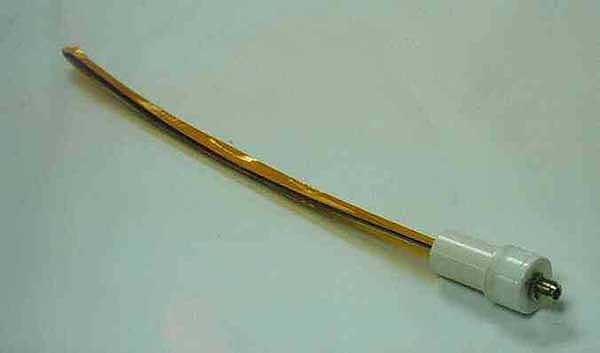 The so-called "carpenter's tape" antenna--this one is for VHF/UHF use. [Photos courtesy of ARISS] |
Antenna hardware key to the Amateur Radio on the International Space Station program is on its way to the ARISS flight processing facility at NASA Goddard Space Flight Center in Maryland. NASA's SAREX Principal Investigator Matt Bordelon, KC5BTL, says that once all the equipment is in hand, the various antenna system components will be integrated, then undergo flight qualification testing.
The ARISS Italian team has built and shipped L/S-band antennas, diplexers, and radomes which comprise part of the four antenna system packages to be deployed on the ISS later this year. Each antenna system consists of either a VHF/UHF or HF tape antenna, L/S-band antenna, diplexer, mounting plate, mounting clamp, and antenna cable.
While Amateur Radio from space in the past has been confined to VHF and UHF, Bordelon says the ARISS program calls for eventually providing HF capability from the ISS--although that won't happen for at least two or three years from now, when a permanent amateur station is installed aboard the ISS.
"We haven't done HF before from the shuttle or Mir," he said. "A lot of hams have really wanted us to go in that direction." Running HF gear from the space shuttle was deemed impractical because the SAREX program depended on a window antenna. Things will be different with the four, externally mounted antennas on the ISS Service Module, however. Bordelon says that one of the four antenna systems will utilize an HF "carpenter's tape" antenna in place of the VHF/UHF "tape" to provide access to 10, 15 and 20 meters from the ISS.
"We wanted to address some of the interest from the Astronaut Office and from amateurs in the US and Russia concerning HF by providing capabilities on 10, 15, and 20 meters," he said. "It's always been of great interest how those bands would perform from a manned spacecraft."
Bordelon said the ARISS HF antenna will look very similar to the VHF/UHF antenna. "It looks like a carpenter's measuring tape," he said. The HF antenna, still in the design stages, likely will be about 2.5 meters long. HF gear is not scheduled to go aboard the ISS for several more years.
The ARISS flat-spiral, dual-use microwave antennas will provide access to the 1.2 GHz and 2.4 GHz amateur bands, as well as, reception of GPS and to receive video signals for space walks.
The antenna systems, scheduled for delivery aboard shuttle mission STS-101 this December, will make use of four Russian-provided bulkhead feedthroughs on the Service Module, set for launch in November. Astronauts aboard the ISS will connect the initial ARISS radio transceivers and associated hardware to the new antenna systems. The initial ham gear--primarily Ericsson commercial-grade handheld transceivers--will support amateur operation from the ISS on voice and AFSK packet on 2 meters and 70 cm.
For more information on ARISS, visit http://garc.gsfc.nasa.gov/~ariss/ariss.html.
PHASE 3D SATELLITE COMPLETES VIBRATION TESTING
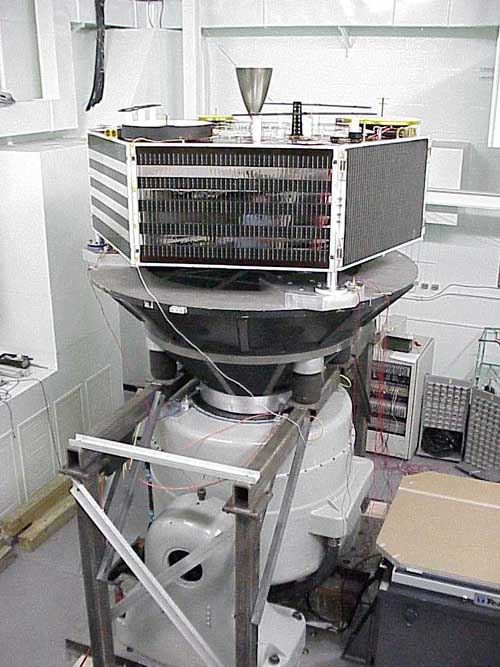 Phase 3D on the vertical "shake table" at Goddard. [Courtesy of Lou McFadin, W5DID] |
The Phase 3D team apparently got the "Good Vibrations" it was hoping for when the next-generation Amateur Radio satellite underwent vibration testing earlier this month at NASA's Goddard Space Flight Center. "P3D performed very well in the vibration testing," said AMSAT Phase 3D Lab and Integration Manager Lou McFadin, W5DID. "This is another milestone on P3D's journey to flight."
Now back at the Integration Lab in Orlando, Florida, P3D was to be carefully examined to verify that all systems were still functional and ready for flight, McFadin said.
The Phase 3D satellite arrived at Goddard earlier this month but had to cool its heels while NASA was preoccupied with higher-priority projects including the Hubble Space Telescope repairs and the Earth Orbiter-1 satellite.
The spacecraft was subjected to a preselected vibration scenario in each of the three axes. The testing was intended to simulate the vibrations the satellite will encounter during launch. Last fall, the satellite successfully completed thermal-vacuum testing, enduring nearly a week in a vacuum and alternately warming and freezing in a test chamber at the Orbital Sciences Corporation test facility in Germantown, Maryland.
Once it's checked out at Orlando, P3D will be shipped to the as-yet unnamed launch site. Work continues on preparing the space frame and ground support equipment for shipment once the launch is announced.
For more information and photos, visit http://www.clark.net/pub/tac/p3d.htm and http://www.amsat.org/amsat/sats/phase3d.html
SECTION MANAGER ELECTION RESULTS
Incumbent Wyoming Section Manager Robert W. Williams, N7LKH, has won election to a second term. Williams outpolled Jerry Pyle, WB7S, 91 to 83 in ballots counted August 24 at ARRL Headquarters. Williams has been Section Manager since April 1997.
Incumbent Section Manager candidates in nine other ARRL sections ran unopposed and were declared elected: In the Eastern Washington Section, Kyle Pugh, KA7CSP; in the Western Washington Section, Harry Lewis, W7JWJ; in the Sacramento Valley Section, Jettie Hill, W6RFF; in the San Francisco Section, John Wallack, W6TLK; in the West Virginia Section, O. N. "Olie" Rinehart, WD8V; in the Colorado Section, Tim Armagost, WB0TUB; in the Georgia Section, Sandy Donahue, W4RU; in the Los Angeles Section, Phineas Icenbice, Jr., W6BF; and in the South Texas Section, E. Ray Taylor, N5NAV.
The term of office for all candidates begins October 1, 1999.
SOLAR UPDATE
Solar seer Tad Cook, K7VVV, Seattle, Washington, reports: All solar indices were up this week, but so were geomagnetic numbers. This meant that although there was more ionizing radiation from the sun to produce a reflective ionosphere for HF signals, proton activity from flares and coronal holes kept conditions unstable.
Sunspot number averages for this week were up over 20 points compared to last week, and solar flux averages were up by over 43 points. The only really quiet day in terms of geomagnetic stability was August 21, when the planetary A index was below 10 and the K index over most periods was only 2. The worst days were August 20 and 23, when the A index was 33, and the K index was 6.
Unsettled conditions are forecast for the next few weeks. There are frequent periods when the A index should be above 10, and around September 12-16 an A index of 20 is predicted. We have been in a period of rising solar flux, and the values for August 27-29 are forecast at 220, 215 and 215. Flux values should stay above 200 through the end of August, then drop to below 170 around September 3. Solar flux should bottom out around 125 on September 9 or 10, then rise up above 170 by September 18. Of course conditions could get better if new sunspots rotate into view.
Sunspot numbers for August 19 through 25 were 68, 65, 79, 78, 110, 103 and 127, with a mean of 90. The 10.7-cm flux was 134.7, 151.6, 161.2, 172.7, 187.5, 202 and 208.4, with a mean of 174. The estimated planetary A indices were 22, 33, 6, 11, 33, 29 and 8, with a mean of 20.3.
IN BRIEF:
- This weekend on the radio: The TOEC WW Grid Contest (CW), the SCC RTTY Championship, the South Dakota, Hawaii, and Ohio QSO parties, and the BUBBA Summer QRP Sprint are the weekend of August 28-29. See August QST, page 91, for details.
Just ahead: The Hiram Percy Maxim Birthday (HPM/130) Event is September 2-11 (see September QST, p 48 or The ARRLWeb Extra news page). Also: the North American Sprint (CW), the All-Asian DX Contest (phone), the CCCC PSK31 Contest, and the Labor Day CW Sprint are the weekend of September 4-5 (Labor Day weekend). See September QST, page 105, for details. - Correction: The Colorado 14er event will be on Sunday, August 29, 9 AM-12 noon MDT (1500-1800 UTC). The time was listed incorrectly in The ARRL Letter, Vol 18, No 33. --thanks to Burness Ansell, KI0AR
- Zorro Turns in his Ticket: The Daily DX reports that DXpeditioner Yasuo "Zorro" Miyazawa, JH1AJT, voluntarily surrendered his Amateur Radio station license to authorities last May. The DX newsletter, edited by Bernie McClenny, W3UR, cited a telephone conversation with the Kanto Bureau of Telecommunications in Tokyo, Japan, as the source of its report in last Friday's edition. Miyazawa was scheduled to receive the DXer of the Year Award at the New Orleans International DX Convention August 28. On June 16, the Asahi Shimbun newspaper had reported that Miyazawa and another Japanese amateur were arrested after allegedly obtaining an operator license under false identification. Over the years, Miyazawa has been to many DX spots throughout Asia, Africa and the Pacific Ocean including 7O1A, XW30/XW30A, A51/JH1AJT, XU1A, XW8KPL, E31A, among others.--The Daily DX
- World Amateur Radio Day--present and future: World Amateur Radio Day is September 18, 1999--the last time that World Amateur Radio Day will be celebrated in September. This year's theme is "Celebrating success in amateur digital communication." Starting in 2000, the day will be marked on the anniversary of the International Amateur Radio Union, April 18.--IARU
- ARRLWeb offers on-line hamfest calendar: Need to know when and where the next hamfest or convention is? Visit the new ARRL Hamfest and Convention Database at http://www.arrl.org/hamfests.html. You can search for hamfests and conventions by state, by ARRL division or section, or--if you're not sure just where it is or what it's called--by using a word or phrase in the event's name. The Hamfest and Convention Database can narrow your search to a particular month and year if you wish. It also lets you scroll the entire hamfest schedule in chronological order. Check it out! Sponsors are requested to send hamfest or convention information to Gail Iannone, giannone@arrl.org or call 860-594-0262.
- Michigan convention cancelled: The ARRL Michigan State Convention, set for September 24-26 in Flint, has been cancelled due to a variety of difficulties encountered in making arrangements for the event. For more information, contact Val Rose, N8EXV, n8exv@yahoo.com.
- A new record? Paul Lieb, KH6HME, in BK29go (Mauna Loa volcano) reports working Clint Walker, W1LP/mm in DL51ce on 144 MHz SSB to claim a new world distance record of 4754 km (2954 miles). Signals reportedly peaked S1. An unsuccessful attempt was made on 432 MHz. W1LP had been hearing beacons for several hours prior to the contact. QST World Above 50 MHz Editor Emil Pocock, W3EP, explains that there is nothing official about DX records. "The recent contact between W1LP/mm and KH6HME is probably the longest two-way 144-MHz contact via tropospheric ducting anywhere in the world," he said. "This is a notable accomplishment.".--Chip Angle, N6CA
- Sweden cuts top code speed, license classes: Sweden has cut its Morse code speed requirement from 12 to 5 WPM and reduced the number of license classes from four to two. The Class 1 license offers all Swedish amateur privileges and requires a 5 WPM CW test, while the Class 2 ticket is a no-code license for VHF/UHF operation only. In addition, Sweden reportedly has a new three-year nonrenewable "study license" that offers full--and unsupervised--VHF/UHF privileges.--W5YI Report; Newsline
- UK moves to 12.5 kHz spacing on 2-meter FM: The United Kingdom will move from 25 kHz to 12.5 kHz channel spacing on 2 meters starting January 1, 2000, much in the same manner that the US went from 30-kHz to 15-kHz spacing years ago. Systems will have until mid-year to get into compliance. New technical and operational specifications for amateur repeater stations are being worked out between the RSGB Repeater Management Committee and the Radiocommunications Agency. The RSGB says the change will allow planning for new repeaters with improved coverage and eliminate some of the co-channel interference occasionally suffered in parts of the country. Eventually all 2-meter repeaters in ITU Region I will conform to the 12.5-kHz standard. The same change is under consideration for 70-cm repeaters as well.--RSGB; Newsline
- Scandinavian Activity Contest info correction: The event times for the Scandinavian Activity Contest listed in September QST are incorrect. This year, the SAC is only a 24-hour contest. It will run from 1200 UTC Saturday to 1200 UTC Sunday (CW: September 18-19; SSB: September 25-26).--Joe Stepansky, KQ3F