ARRL Audio News
| · | To subscribe, unsubscribe, or change your e-mail delivery address: see How to Get The ARRL Letter, below |
| · | Delivery problems (ARRL member direct delivery only!): letter-dlvy@arrl.org |
| · | Editorial questions or comments: Rick Lindquist, N1RL, rlindquist@arrl.org |
| · | ARRL Audio News: http://www.arrl.org/arrlletter/audio/ or call 860-594-0384 |
| · | The ARRLWeb Extra: http://www.arrl.org/members-only/extra |
IN THIS EDITION:
- +Goldwater station headed for museum
- +Phase 3D to undergo vibration testing
- +FCC takes Carolina ham off HF
- +NASA invites hams, SWLs to monitor eclipse propagation
- International Humanitarian Award nominations open
- HU4U DXpedition has humanitarian angle
- Dick Baldwin, W1RU, named IARU president emeritus
- Solar update
- In Brief: This weekend on the radio; Vanity update; Clarification; UK now issuing M5-prefix call signs; No ITU charges for ham satellites; ARRL/TAPR Digital Conference reminder; Amateurs assist Tour de Wyoming; C-W Crystals orders returned; Ham dies attempting to aid accident victim; N6XMW confirmed as federal judge; Friedrichshafen draws 18,000
+Available on ARRL Audio News
GOLDWATER HAM STATION TO BECOME MUSEUM EXHIBIT
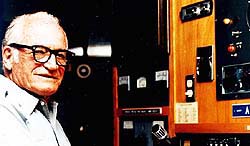
The late Sen Barry Goldwater, K7UGA, at the mike of his famous ham station. |
The well-known ham station of the late Sen Barry Goldwater, K7UGA, is being donated to the Arizona Historical Society for display as a museum exhibit. The Society plans to set up the massive station console and equipment "as the late Senator used it," said Reba Wells Grandrud, director of the Society's Central Arizona Division.
Grandrud said that current plans call for the K7UGA station equipment and console to be moved from the Goldwater home in Paradise Valley, Arizona, and reassembled at the Society's museum in Papago Park in Tempe sometime during the next year. Details are still being worked out.
"We're just delighted," Grandrud said. "We felt it was very appropriate to have this here."
Goldwater's station and massive antenna system were used to complete thousands of phone patch messages for troops during the Vietnam War. The antennas have been dismantled and sold, and will not be a part of the museum exhibit.
The museum intends to display the station intact and hopes to recreate the look and feel of the original Goldwater ham shack through the use of digital photographic techniques. "Our plan is probably to recreate a room just as he had it," including all of Goldwater's photographs and other memorabilia, Grandrud said. While it's unlikely the station itself would be operational, she said the museum might "simulate" an operating setup for the sake of visitors.
Goldwater died May 29, 1998. Grandrud said she approached Goldwater's widow, Susan, about having the museum--a state agency--acquire the K7UGA station for display.
Grandrud could not say if the exhibit would be a permanent one but said Goldwater's station would be maintained as part of the museum's collection. "We're stewards of the public heritage," she said. "It will be valued highly."
PHASE 3D SATELLITE TO UNDERGO VIBRATION TESTING
![Integration Lab Manager Lou McFadin, W5DID, stands next to the Phase 3D satellite--under wraps, and awaiting its turn for vibration testing at the large RF chamber clean room at Goddard Space Flight Center. [Courtesy of Lou McFadin, W5DID]](/img/newsletter/pre2000/b_080699.jpg)
Integration Lab Manager Lou McFadin, W5DID, stands next to the Phase 3D satellite--under wraps, and awaiting its turn for vibration testing at the large RF chamber clean room at Goddard Space Flight Center. [Courtesy of Lou McFadin, W5DID] |
The Phase 3D team is hoping for some "Good Vibrations" when the next-generation Amateur Radio satellite undergoes vibration testing at NASA's Goddard Space Flight Center in Maryland. AMSAT Phase 3D Lab and Integration Manager Lou McFadin, W5DID, says the schedule is uncertain, but the testing could happen as soon as next week.
"NASA has projects which are higher in priority than P3D," McFadin said. "They are feverishly working on Hubble Space Telescope repairs and the Earth Orbiter-1 satellite."
AMSAT's Frank Bauer, KA3HDO, explains that the testing is intended to simulate the launch vibration environment. "If all the vehicle hardware passes--that is, all the mechanical hardware remains intact and the electronics operate after the testing--then the spacecraft is ready for launch," said. Testing will take a day or two.
Once vibration testing is complete, the satellite will be returned to the Integration Lab in Orlando, Florida, for some verification testing "to make sure the vibe test didn't break anything," McFadin said. After that, P3D will be shipped to the as-yet unnamed launch site. Work continues on preparing the space frame and ground support equipment for shipment once the launch is announced.
AMSAT has been hoping for a launch opportunity as early as this fall. AMSAT has declined to name the launch agency or vehicle, and AMSAT-NA officials have cautioned that the October date is very tentative and just the opening of a launch window.
For more information and photos, visit http://www.clark.net/pub/tac/p3d.htm and http://www.amsat.org/amsat/sats/phase3d.html
FCC TAKES NORTH CAROLINA HAM OFF HF FOR SIX MONTHS
The FCC says that John Abernethy, K4OKA, of Hickory, North Carolina, will have to restrict his hamming to the VHF and UHF bands for the next six months. Unless he appeals the action, Abernethy may not get back on HF until January 22, 2000.
As a follow-up to a station visit in January and alleged malicious interference earlier this month, FCC Attorney Riley Hollingsworth, K4ZDH, notified Abernethy July 27 that the Commission was modifying his license to prohibit operation below 30 MHz for 180 days, effective immediately.
The FCC letter included a copy of a tape recording--supplied by complainants--of transmissions said to be of Abernethy's station on July 16. Hollingsworth's letter described the tape as "consisting of deliberate interference on 3.965 MHz" and noted that Abernethy had been warned about deliberate interference at the time his station was inspected.
Abernethy has 30 days to protest the sanction.
FCC personnel inspected Abernethy's station January 21 and 22 in the wake of what Hollingsworth called "longstanding complaints from other amateurs and from our field offices." In particular, he said, the FCC had received "numerous complaints" about profanity, obscenity, deliberate interference, and failure to properly identify.
Other complaints to the FCC alleged that Abernethy had aired something called the "Porkbutt Song," the letter said, "for the purpose of harassment or deliberate interference." The FCC's High Frequency Direction Finding Center in Maryland tracked the transmissions of the "Porkbutt Song" to K4OKA, Hollingsworth said in his letter.
The FCC letter also said the Commission had received complaints that Abernethy had used AM and upper sideband on 75 "for the purpose of interference to communications on or near 3894.5 kHz.
The FCC has no plans to start revocation proceedings against Abernethy, Hollingsworth said, "unless we have evidence of continued violations" of the type described in the July 27 letter.
HAMS, SWLS INVITED TO MONITOR PROPAGATION DURING ECLIPSE
NASA is inviting Amateur Radio operators and shortwave listeners to monitor radio propagation during the total solar eclipse August 11 and to report their findings. As hams and SWLs know, many shortwave radio stations that are undetectable during daylight hours easy to pick up at night. Scientists expect nighttime conditions to be manifested as the eclipse crosses Earth's surface next Wednesday--creating an "audio eclipse."
The August 11 eclipse will be the last total solar eclipse of the 20th century. The trajectory of the moon's shadow will carry it across central Europe, Turkey, the Middle East, Pakistan and India.
As the path of totality slices through Earth's atmosphere, ions and electrons in the vicinity of the shadow will begin to recombine. The reflecting F layer may not be greatly affected, but ionization in the attenuating D layer could vanish. Shortwave radio stations that were restricted in range to sites in Europe just moments earlier may be able to skip over the horizon and be heard on the other side of the Atlantic.
NASA says that since England and Middle Europe offer unpredictable visual conditions, the "audio eclipse" may prove the most reliable observation, particularly when heard from thousands of miles away.
The eclipse will begin over Europe around 1010 UTC when it is still dark over most of North America. Thus, when the daytime ionosphere begins to diminish over Europe, there is a good chance that European shortwave broadcast stations will be able to propagate great distances into the Western Hemisphere. NASA suggests experimenting with different stations at frequencies between 5 and 15 MHz that are favorable for probing changes in the D layer. The best ones for eclipse listening will be transmitters that can be heard at night, but not at all during the day.
NASA requests that participating listeners report the time, station frequency and signal strength as displayed on the receiver's S meter at night and during the local time of the eclipse for a week centered on August 11. Send logs, any audio recordings, and your position (latitude and longitude) to Marshall Space Flight Center's Eclipse mailbox, eclipse@msfc.nasa.gov. The data will be analyzed to help determine ionospheric properties.
For additional details, visit the Science@NASA site, http://science.nasa.gov/newhome/headlines/ast04aug99_1.htm. For more information about the August 11, 1999, solar eclipse, visit http://sunearth.gsfc.nasa.gov/eclipse/eclipse.html.
The Royal Belgium Amateur Radio Society (UBA) is mounting a similar program aimed at European amateurs. The UBA has set up a program with the Royal Belgian Meteorological Institute and invites all radio amateurs in Western Europe--especially those located not too far from the total-eclipse corridor--to join in. Amateurs are invited to record variations in signal strength during the eclipse period on different HF and LF frequencies. After the eclipse the results of the signal strength measurements and the ionospheric sounding will be compared. Beacons on 40 and 80 meters will be set up August 7-11 inside the 100% eclipse corridor on or about 3522.5 kHz (alternate frequencies, 3536.5, and 3541.5 kHz) and 7012.5 kHz, (alternate frequencies 7016.5 and 7020.5 kHz).
For more information, visit http://www.uba.be/ or contact ON4UN, john.devoldere@village.uunet.be; ON7PC, ON7PC@euronet.be, or ON1KSZ, on1ksz@win.be.--Science@NASA; UBA
INTERNATIONAL HUMANITARIAN AWARD NOMINATIONS OPEN
Nominations are open for the 1999 ARRL International Humanitarian Award. The award is dedicated to those amateurs who, through Amateur Radio, are devoted to promoting the welfare of mankind. The prize goes each year to truly outstanding Amateur Radio operators in areas of international humanitarianism and the furtherance of peace.
Any radio amateur or group of amateurs worldwide who has provided extraordinary service through their Amateur Radio skills for the benefit of others in times of crisis or disaster is qualified to receive the award.
The ARRL International Humanitarian Award recognizes the hobby's international communication role and that hams regularly help people in need throughout the world. Amateur Radio is one of the few media where average people throughout the world can meet to talk to each other and spread goodwill across otherwise impenetrable political boundaries. The Award is intended to promote positive efforts toward international understanding and peaceful communication.
The award recipient is selected by a committee appointed by the League's President. The committee will accept nominations from a licensed radio amateur, governmental or any other organization that has received the benefits of the radio amateur's extraordinary service. Nominations must include a summary of the nominee's actions that qualify the recipient for the award and statements from at least two references-including names and addresses-for verification.
All nominations and supporting materials for the 1999 award must be submitted in writing in English to ARRL International Humanitarian Award, 225 Main St, Newington, CT 06111 USA. Nominations must be received by December 31, 1999. In the event that no nominations are received, the committee itself may determine possible recipients or decide to make no award.
The 1998 award went to the Radio Amateur du Quebec Inc, for its efforts during a devastating ice storm. For details, see June 1998 QST, page 58.--Rick Palm, K1CE
SPECIAL HU4U DXPEDITION SET FROM EL SALVADOR
Operators from Spain and El Salvador join forces August 16-23 as HU4U. This special operation is part of a cooperative campaign organized by URE, the IARU Spanish Radioamateurs Association, to rebuild the digital network in El Salvador that was damaged by Hurricane Mitch. The URE is attempting to establish a new paradigm, turning its DXpedition operations into opportunities for international cooperation and humanitarian service.
The El Salvador project follows on the heels of the 1998 TJ2RSF operation where URE and Radio Amateurs Without Frontiers installed a VHF communications network for missionaries serving in Cameroon. The operators from Spain plan to transport PCs, transceivers, antennas and other necessary equipment and leave behind a working packet system.
Project sponsors include the government of La Rioja province, the URLR (the La Rioja Radiomateurs Association), Radioamateurs Without Frontiers (RSF), and the URE Foundation, marking its 50th anniversary this year. The HU4U operating frequencies are 1845, 3795, 7065, 14195, 18145, 21295, 24945 and 28495 SSB; 1833, 3503, 7003, 10103, 14023, 18073, 21023, 24893 and 28023 CW and 7034, 10114, 14084, 18094, 21084, 24924 and 28184 RTTY. QSL cards via EA4URE.--thanks to Chuck Hutchinson, K8CH
RICHARD L. BALDWIN, W1RU, NAMED IARU PRESIDENT EMERITUS
The Administrative Council of the International Amateur Radio Union has voted unanimously to adopt a resolution conferring the title of President Emeritus upon Richard L. Baldwin, W1RU. Voting by mail was completed on July 14.
The resolution reads:
Whereas, the service of Richard L. Baldwin, W1RU, to organized amateur radio spans more than a half-century, and
Whereas, he served for six years as Secretary of the IARU, from 1976 to 1982, and played a vital role in the success enjoyed by the Amateur and Amateur-Satellite Services at the 1979 ITU World Administrative Radio Conference, and
Whereas, he also served for 17 years as President of the IARU, from 1982 to 1999, and led the development and adoption of a new IARU Constitution and a general strengthening of the IARU as the spokesman for amateur radio at the ITU and in regional telecommunications organizations, and
Whereas, as principal instructor of the Amateur Radio Administration Course he brought a greater understanding of the value of amateur radio to hundreds of telecommunications administrators throughout the world, be it
Resolved by the IARU Administrative Council that Richard L. Baldwin, W1RU, in recognition of his outstanding contributions and exemplary leadership of the world's 2.7 million radio amateurs, is hereby and with immediate effect named President Emeritus of the IARU.
"It has been an honor and a privilege to have been associated with IARU for so many years and I am delighted to learn that the connection continues," Baldwin said. "I am ready to continue providing whatever aid in support of IARU goals that may be appropriate, remembering of course that whatever may have been accomplished in the past was the result of superb teamwork on the part of a number of enthusiastic and devoted people."
Baldwin has been invited to attend the IARU Region 1 Conference in Lillehammer, Norway, in September as a guest of the Region.--IARU press release
SOLAR UPDATE
Helio-honcho Tad Cook, K7VVV, Seattle, Washington, reports: Solar flux and sunspot numbers increased again last week, with average sunspot numbers up over 52 points to 219.3 and average solar flux up over 27 points to 206.9. The solar flux of 216.3 on August 1 is a new high for the current cycle, besting the June 30, 1999 record of 209.5 by almost 7 points. The last time solar flux was higher was in cycle 22, when the February 29, 1992 number was 218. To see recent trends graphically, Visit http://www.wm7d.net/hamradio/solar/ or http://www.dxlc.com/solar/.
If it weren't for a major geomagnetic storm, this activity would mean better propagation on the high end of the HF bands. Friday, July 30, was a really rough day geomagnetically, with a planetary A index of 36. But this made things interesting for VHF operators who took advantage of an aurora.
For this weekend, look for a solar flux of 170, 165 and 160 for August 6-8, and moderate geomagnetic conditions with a planetary A index of 10, 8 and 8.
Beyond the weekend, look for a solar flux below 10 by August 10, with the current numbers bottoming out around 135 August 11-14. Flux values should be up to 150 again around August 18, 170 by August 21, and 200 around August 25-29.
Watch for disturbed geomagnetic conditions returning around August 18.
Sunspot numbers for July 29 through August 4 were 226, 218, 220, 267, 210, 217 and 177 with a mean of 219.3. The 10.7-cm flux was 202.4, 205.9, 200.6, 216.3, 212.5, 210.7 and 200.1, with a mean of 206.9. The estimated planetary A indices were 10, 36, 21, 9, 9, 8 and 11, with a mean of 14.9.
In Brief:
- This weekend on the radio: The ARRL UHF Contest, the North American QSO Party (CW), the Ten-Ten International Net Summer Phone Contest, and the Boulder Amateur Radio Club Kid's Day event are the weekend of August 7-8. Just ahead: The Worked All Europe DX Contest (CW) and the Maryland-DC QSO Party are the weekend of August 14-15. See August QST, page 91, for details.
- Vanity update: The FCC in Gettysburg reports it has processed vanity call sign applications received through July 16. On July 27, the FCC issued 100 grants. Another 134 applications landed in the work-in-process (WIPs) stack. On August 2, the FCC issued 151 grants. Another 151 applications landed in the work-in-process (WIPs) stack. The fee to apply for an Amateur Radio vanity call sign increases from $13 to $14 effective Tuesday, September 14, 1999 (not September 10 as earlier reported--Ed).--FCC
- Clarification: The Yonkers (New York) Amateur Radio Club advises that the May 2, 1999, Volunteer Examination session now being audited by the FCC (see "FCC Audits New York Examination Session," The ARRL Letter, Vol 18, No 30) was not the VE session the YARC sponsored on the same day at another location.
- UK now issuing M5-prefix call signs: On August 2, the Radiocommunications Agency in the United Kingdom began issuing M5-prefix call signs to new "Full A/B" licensees. The RA says the new license class is "part of the long term restructuring of the Amateur Radio License" in the UK. The RA and the RSGB anticipate the international requirement to demonstrate Morse proficiency for HF access will be dropped following the 2002/2003 World Radiocommunication Conference. "The introduction of the Class A/B License is an interim measure in preparation for moving toward a more incentive-based licensing system," an RA press release said, adding that further changes to the license already are under consideration. Applicants for the new license, announced last May, must pass the written Class A or Class B examination plus a 5 WPM Morse code test. Full A/B licensees have full privileges above 30 MHz and full frequency and mode privileges on HF with a maximum output power of 100 W. The RA also has expanded the privileges for Novice licensees in the UK, adding mode privileges in wider HF segments and 2-meter operation and 10 W maximum output. For more information, visit http://www.open.gov.uk/radiocom/.
- No ITU charges for ham satellites: Amateur Radio satellites have been exempted from having to pay satellite filing fees to the International Telecommunication Union. The ITU requires that all satellite frequency and orbit information be filed and used to process the filings free of charge. But the ITU Plenipotentiary Conference last fall in Minneapolis resolved that cost recovery for satellite network filings, including coordination requests, be implemented as soon as possible. In response to a request from the International Amateur Radio Union, the ITU Council recently agreed to exempt the Amateur-Satellite Service "from any charges." Fees for applicable services are effective for applications received by the ITU Radiocommunication Bureau after November 7, 1998. Each ITU member state gets one free listing a year.--ITU, IARU
- ARRL/TAPR Digital Conference reminder: The 1999 ARRL and TAPR Digital Communications Conference will be held September 24-26, 1999 in Phoenix, Arizona--just minutes away from the Phoenix Sky Harbor International Airport. For more information, visit http://www.tapr.org/~wd5ivd.--Greg Jones, WD5IVD
- Amateurs assist Tour de Wyoming: Although probably not as widely reported as the recent Tour de France, amateurs in Wyoming were busy this past week, providing communication for the Tour de Wyoming bicycle ride. ARRL Wyoming Section Manager John Williams, W7LKH, and his wife Mary, KF7MC, managed the volunteer effort. According to Mike Reed, N7ZEF, hams patrolled the routes and kept track of all riders and reported injuries and mechanical problems. The 400-mile trek started July 25 in Dubois, proceeded through Lander, Jeffrey City, Rawlins, and Baggs, and ended in Laramie on July 30. Mobile units were used to track the 100 riders each day. Communication was maintained on 75 meters, 2 meters, and 70 cm.--This Week in Amateur Radio
- C-W Crystals orders returned: C-W Crystals of Nevada, Missouri, has closed its doors and may be sold following the sudden death of its proprietor, John Morris, N0ACS. Morris was 59. In the meantime, Morris' long-time companion, Marilyn Selvey, KB0RTO, reports that she has returned all orders and refunded all money. She reports that Morris did not have crystals in stock and processed orders as they arrived, so she is unable to fill any orders.--Marilyn Selvey, KB0RTO
- Ham dies attempting to aid accident victim: Raymond J. Feeley, K1CSB, of Southampton, Massachusetts, died in the early morning hours of August 2 while trying to help a motorist who had struck a utility pole. He was 58. According to reports, Feeley came in contact with a live electrical line and was electrocuted while responding to the driver's cries for help.--information via Larry Krainson, WB1DBY
- N6XMW confirmed as federal judge: Congratulations to League member and Extra licensee William H. Alsup, N6XMW, who has been confirmed by the US Senate as the newest judge on the US District Court for the Northern District of California. Alsup, 54, began his career by clerking for US Supreme Court Justice William O. Douglas and later became a trial attorney.--thanks to Phil Kane, K2ASP
- Friedrichshafen draws 18,000: The recent Ham Radio/Hamtronic international Amateur Radio show in Friedrichshafen, Germany, attracted 18,000 visitors from around the world. The annual show is the largest of its type in Europe. The 25th Ham Radio/Hamtronic will take place June 22-24, 2000 at Friedrichshafen.--Messe Friedrichshafen press release