ARRL Audio News
| · | To subscribe, unsubscribe, or change your e-mail delivery address: see How to Get The ARRL Letter, below |
| · | Delivery problems (ARRL member direct delivery only!): letter-dlvy@arrl.org |
| · | Editorial questions or comments: Rick Lindquist, N1RL, rlindquist@arrl.org |
| · | ARRL Audio News: http://www.arrl.org/arrlletter/audio/ or call 860-594-0384 |
| · | The ARRLWeb Extra: http://www.arrl.org/members-only/extra |
IN THIS EDITION:
- +Easy overseas operation now a reality for US hams
- +Black Hills hams handle double whammy
- +Next SAREX mission could fly July 22
- +Kid's Day is June 19
- States recognize Amateur Radio's contributions
- Good morning, Starshine!
- ARDF Team USA issues last call
- Solar update
- In Brief: This weekend on the radio; Vanity update; New EMA SM; Robert A. Payne, K1BFG, SK; KC5QNJ wins competition scholarship; Special UK prefixes in effect
EASY OPERATION OVERSEAS NOW A REALITY FOR US HAMS
Operating in most of Europe and in some South American countries just got much easier for US hams. The FCC has implemented the European Conference of Postal and Telecommunications Administrations (CEPT) Recommendation T/R 61-01 that eliminates the need to obtain a special license or permit for US hams wishing to operate for brief visits to most European countries. In addition, the ARRL has begun issuing International Amateur Radio Permits to simplify operation by US hams in certain South American countries.
The FCC put the final pieces of the CEPT arrangement into place June 7 by issuing a Public Notice in English, German, and French that spells out the basic information about Amateur Radio operation in CEPT countries. To operate in a CEPT country, US hams only need a copy of the Notice, their original Amateur Radio document, and proof of US citizenship.
US hams holding any license class but Novice are eligible to operate in CEPT countries. A US citizen with a Technician ticket may be authorized privileges equivalent to a CEPT Class 2 (ie, VHF-only) license, while a US citizen holding a higher class license may be authorized CEPT Class 1 (ie, all amateur and amateur-satellite) privileges.
The authorization is for use of a portable or mobile station only, including stations set up at hotels or a camping site. Authorization is also granted for US hams to operate the stations of permanent licensees in host countries. The use of Amateur Radio aboard an aircraft is not allowed, however. To identify while overseas, US stations will use their assigned call signs preceded by the CEPT call sign prefix for the country or territory visited.
US stations operating in other countries must abide by the provisions of the ITU Radio Regulations as well as CEPT Recommendation T/R 61-01 and the regulations of the host country. This means that US operators planning to operate in other countries must become familiar with that country's regulations and frequency allocations, paying special attention to regional differences.
Participating CEPT countries as of June 7 include Austria, Belgium, Bosnia-Herzegovina, Bulgaria, Croatia, Cyprus, Czech Republic, Denmark, Estonia, Finland, France, Germany, Hungary, Iceland, Ireland, Italy, Latvia, Liechtenstein, Lithuania, Luxembourg, Monaco, Netherlands, Norway, Portugal, Romania, Slovak Republic, Slovenia, Spain, Sweden, Switzerland, Turkey, and the United Kingdom. For updates, visit the ERO Web site, http://www.ero.dk and click on "Implementation," then "Decision/Recommendation," then "T/R-61-01".
The ARRL has begun issuing the International Amateur Radio Permit (IARP) that allows US amateurs to operate from Argentina, Brazil, Peru, Uruguay, and Venezuela without having to obtain a special license (the US and Canada also are CITEL signatories). The IARP is valid in any country that is a signatory to the CITEL Amateur Convention.
The Class 1 IARP--available to Tech Plus and higher class licensees--requires knowledge of Morse code and carries all operating privileges. The Class 2 IARP--equivalent to the US Technician ticket--does not require knowledge of Morse code and carries all privileges above 30 MHz. An IARP is not a license, but it certifies the existence of a license. There's a $10 application fee to obtain an IARP from the ARRL.
Complete information on CEPT and IARP operation, including an IARP application form and a copy of the FCC Public Notice on CEPT, is available from the International Operating page on ARRLWeb, http://www.arrl.org/field/regulations/io/.
Earlier this year, the FCC simplified operation in the US by hams from other countries. Alien visitors to the US holding an amateur license issued by their home country may operate here without submitting any FCC paperwork--provided there's a reciprocal operating agreement in effect between the two countries.
The new procedures affect operation only in participating CEPT (European) and CITEL (Central and South American) countries. They do not change the procedures for US hams wishing to operate overseas in countries that are not CEPT participants or CITEL Amateur Convention signatories. Information on operation from these countries also is available on the pages of ARRLWeb.
BLACK HILLS HAMS HANDLE DOUBLE WHAMMY
![ARES Coordinator Don Sanders, W0KTL, sets up an emergency base station at the Pine Ridge Red Cross headquarters. [Trina Blanks, KB0TYW]](/img/newsletter/pre2000/a_061199.jpg) ARES Coordinator Don Sanders, W0KTL, sets up an emergency base station at the Pine Ridge Red Cross headquarters. [Trina Blanks, KB0TYW] |
Friday, June 4, was not a good day in the Northern Black Hills region of South Dakota. For starters, sometime before noon a critical fiber optic link was severed as a result of a construction mishap. That took out telephone service--including 911 and cellular--for all of two counties and part of a third. The outage also prompted a call for communications assistance to area amateurs from the Red Cross. The City of Lead Emergency Operations Center, home of the Northern Hills Amateur Radio Club's KC0BXH, remained fully activated during the entire 19-hour telephone blackout. Hams handled health and welfare traffic, emergency dispatching and coordination, among other traffic.
"In recent years there has been an over-reliance on hard-wired communication systems and cell phones," Lead's Certified Emergency Manager Jerome Harvey, N0ZBR, told the Black Hills Pioneer newspaper. Area hams, Harvey said, "are the 'go-to' folks when all the latest technology bites the dust."
Tim Eggers of the City of Lead Fire Department said the telephone outage affected all of Lawrence and Pennington counties and part of Meade County.
As if that weren't enough for one day, severe storms led to activation of a SKYWARN net that afternoon. Weather spotters provided quick information about threats to the Lead-Deadwood area. And, later that same day, a tornado struck the Pine Ridge Indian Reservation-Oglala, disrupting telephone service there for an extended period. The storm left one person dead and many injured, in addition to damaging homes. Hams, under the leadership of ARES volunteer Don Sanders, W0KTL, established a base station at Red Cross headquarters in Pine Ridge and helped to coordinate the Red Cross emergency rescue and response effort.
"Basically, they didn't have much of any communication there at all," Sanders said. Hams accompanied Red Cross workers to visit homes in the sparsely populated area and report to Red Cross Headquarters on what they found. Sanders said two teams of three hams spent two days in Oglala. Some local hams continue to support the effort.
The response team sent by ARES to assist in Oglala, included personnel cross-trained in Amateur Radio communication, severe weather operations, CPR, first aid, and disaster operations. Physician William Schnurr, KI0OZ, reportedly found himself in the middle of trying to provide critical medical care to those injured in Oglala and using his radio skills to attempt to coordinate ambulance response to the disaster area.
Three repeaters owned by the Black Hills Amateur Radio Club, W0BLK, were among those pressed into emergency service for the occasion. All operation took place on VHF.
ARES member Jamie Tollefson, N0PFS, told the Pioneer that heavy rains earlier in the week contributed to the problems for hams involved in emergency response and damage assessment activities following the tornadoes in Oglala. "They had six inches of rain in the last two days, so just getting around is very difficult as much of the damage took place in very rural areas," Tollefson told reporter Scott Randolph. "A lot of the roads are either washed out or barely passable due to the precipitation."
Operating from the Lead EOC, ARES tied information together from around the Northern Hills area mitigating the lack of phone communication. In all, 15 hams participated in the emergency response. ARES personnel logged approximately 190 duty hours--an estimated contribution to the local community of just under $50,000 in equipment and manpower costs.
"It all kinda came off at one time," Sanders said. "We were pretty busy."--from Northern Hills ARC reports and a Black Hills Pioneer article by Scott Randolph, used with permission
NEXT SAREX MISSION COULD FLY JULY 22
The next Space Amateur Radio EXperiment mission--and the only one scheduled for 1999--could launch July 22 aboard shuttle Columbia mission STS-93. However, that date is said to be still "under review." Officially, NASA says that STS-93, which will carry the Chandra Observatory into orbit, will go up "no earlier than July 20." It has been delayed several times already.
The STS-93 Mission Commander is Eileen M. Collins, KD5EDS. Also aboard will be Mission Specialist Michel Tognini, KD5EJZ, and Mission Specialist Catherine G. Coleman, KC5ZTH. Students at five schools--in Texas, Rhode Island, Virginia, and Florida--are on the list to talk to the STS-93 crew via Amateur Radio. Voice and packet radio operations are scheduled for this mission. The list of schools includes Awty International School, Houston, Texas; Buzz Aldrin Elementary School, Reston, Virginia; Ponagansett Middle School, North Scituate, Rhode Island; Memorial Middle School, Pharr, Texas; and Osceola Elementary School, Ormond Beach, Florida.
In the meantime, the Amateur Radio on the International Space Station (ARISS) team is busying itself with the development and qualification of hardware for the ISS. ARISS is expected to deliver the initial station hardware to the ISS in July for launch aboard shuttle mission STS-101 in December. The hardware package--basically dualband H-Ts and associated antenna systems--is being assembled and qualified by a multinational team with members from Russia, Italy, Germany and the US. More sophisticated transportable ham gear will be delivered to the ISS in late 2000 or early 2001. A rack-mounted permanent station is expected to be launched in 2003 or 2004.
The ISS initial station could be on the air as early as December, and regular operation is expected in March of next year--a little more than nine months away!--some information from SpaceNews via Frank Bauer, KA3HDO
KID'S DAY SHOWS OFF HAM RADIO TO NEXT GENERATION
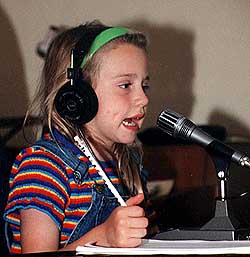 Karin Greene, daughter of Clarke Greene, K1JX, in Middletown, Connecticut, really gets into Kid's Day. Maybe some of the headphone manufacturers will soon start experimenting with sales of colorful headphones just for kids! |
If you've ever said we need to get more young people into ham radio, Kid's Day presents ample opportunity to put your words into action. Just ask some young people to spent at least 15 minutes in your ham shack on Kid's Day--June 19--talking to other youngsters who've been invited to do the same thing. It's easy! It doesn't require much time, and you don't have to learn anything new.
Kid's Day was started by "Tree" Tyree, N6TR, under the auspices of the Boring Amateur Radio Club in Oregon. N6TR asked the ARRL to assist with sponsorship.
During a January running of Kid's Day, more than 400 youngsters took part (see June QST, page 32). It's a fun on-the-air event that's grown tremendously popular in the past few years. The friendly ragchew-type exchange includes name, age, location and favorite color. But, kids can ask whatever questions they think of. You just have to act as the control op, make sure you or they ID at the proper time, and be sure to observe third-party traffic restrictions when making DX QSOs. Another possibility is to invite a young person who is already licensed but might not have a good station set up yet.
Some of those planning to be Kid's Day participants this year have shared their ideas. Members of the Green River Valley Amateur Radio Society, in Bettendorf, Iowa, plan to set up a station at the Bettendorf Family Museum of Arts & Sciences for Kid's Day. They'll hand out certificates to every local youth who gets on the air.
Ham volunteers at Kopernik Observatory, in Vestal, New York, are inviting area youths to visit on Kid's Day, and will operate through the satellites, listening for other youngsters on-the-air.
Worldradio Editor Rick McCusker, WF6O, of Sacramento, California, has printed flyers about Kid's Day and distributed them in his neighborhood. If enough kids respond, he plans to throw a barbecue to feed them when they stop by to make QSOs.
Ric Painter, WO4O, in Tennessee, had a similar notion. He says his son and daughter--aged 14 and 12 respectively--and one of his neighbor's kids have participated in past Kid's Day events from his station. He's planning to invite a church youth group for pizza, soda, and ice cream--plus a chance "to step up to the golden microphone for the Kid's Day Radio Party!"
Kid's Day is June 19, 1800-2400 UTC. Suggested event frequencies are 14,270 to 14,300 kHz and 28,350 to 28,400 kHz. For more details about Kid's Day, visit http://www.jzap.com/k7rat/.
SEVERAL STATES RECOGNIZE AMATEUR RADIO'S CONTRIBUTIONS
Governors in several states have signed proclamations to recognize the contributions of Amateur Radio during the month of June.
Colorado's chief executive, Gov Bill Owens, recently proclaimed June 26 as "Amateur Radio Day" to coincide with Field Day. Vermont and Nevada have declared the last week of the month as Amateur Radio Week, while Pennsylvania, New York and New Jersey have set aside the entire month of June to honor Amateur Radio operators.
New York's Amateur Radio Month proclamation, signed by Gov George Pataki--a former amateur (he's ex-K2ZCZ)--cites Amateur Radio operators as being "on alert for any emergency, local or worldwide, and practice their communications skills during the American Radio Relay League's Field Day exercise."
Nevada declared its Amateur Radio Week "in honor of the many volunteers who generously donate their time and equipment to provide invaluable assistance during an emergency situation."
During its Amateur Radio Month, New Jersey recognizes "the far-reaching technological and service achievements of Amateur Radio operators."
All of the proclamations mention Field Day, and some cite the Amateur Radio Emergency Service and Radio Amateur Civil Emergency Service as well as the public service contributions by amateurs. Field Day this year is June 26-27.
GOOD MORNING, STARSHINE!
NASA's Pat Kilroy, WD8LAQ, and other Goddard Space Flight Center Starshine employees and Naval Research Lab Project Starshine members got a chance to visually spot the Starshine satellite shortly after it was released June 5 by the shuttle Discovery. Armed with some International Space Station sighting predictions he'd worked up, Kilroy and others gazed skyward from a Goddard parking lot in the early morning hours. "Patience and persistence paid off," he said. The group saw Discovery first. Then, within a few degrees of the shuttle, "we observed a star flash from out of nowhere that got as bright as Venus is just after sunset. Starshine sighted!"
The mirror-covered satellite--which resembles a 1970s disco ball--is designed to catch the sun's light and reflect it to Earth. The satellite's 900 mirrors were polished by students. NASA has estimated that as many as 25,000 youngsters in elementary through high school will plot the satellite's orbit and use their observations as part of their science and mathematics studies, as part of Project Starshine.
Hams are being asked to help out with Project Starshine. Students will need to record the exact time they see the satellite and measure the satellite's right ascension and declination. They will have to use stopwatches synchronized with international time signals--radio stations WWV in Colorado and WWVH in Honolulu.
Since most students don't own shortwave receivers, Project Starshine Director Gil Moore, N7YTK, has asked hams across the US offer their help with this volunteer, non-governmental project. Start by clicking on "Participating Schools" on Project Starshine's Web site, http://www.azinet.com/starshine/index.html. Then, call a school to volunteer your services. Moore also suggests that schools find local hams to call--so you could be asked to help.
ARDF TEAM USA ISSUES FINAL CALL FOR PARTICIPANTS
ARRL ARDF Coordinator Joe Moell, K0OV, says time is running short to join Team USA and participate in the first IARU Region 2 Amateur Radio Direction Finding Championships this August. "Foxhunters of all ages are needed to fill the team rosters and represent the US in friendly competition in a field of ARDF contesters from all three IARU regions," he said.
The big event is August 9-14 in Portland, Oregon. The competition will be part of the sixth biennial Friendship Radiosports Games and is sponsored by the Friendship Amateur Radio Society. Countries expect to send ARDF teams include Russia, Ukraine, France, Sweden, Norway, Kazakhstan, Japan, and China.
Moell says this will mark the first time that hams from so many countries will gather for a radiosport activity on US soil. The Team USA roster already has 14 members. "Some of them are serious runners, but most are just hams with an interest in transmitter hunting and enough stamina to spend two hours in the woods doing it," he says.
Since no transmitting is involved on the part of the contestants, a ham radio license is not a requirement for participation in ARDF.
Application forms for Team USA should be filed by June 15. For a form and more information, visit the Team USA page of the Homing In Web site, http://www.homingin.com. If you prefer, send Moell an e-mail message, and he'll reply with a blank form and answer any questions about Team USA. Send inquiries to TeamUSA@homingin.com.
ARDF chat sessions on 75 and 40 meters will begin Friday, June 11, and continue each Tuesday and Friday for as long as there is interest. Nets on 7165 kHz are at 0330 and 0430 UTC; nets on 3830 kHz are at 0400 and 0500 UTC.
SOLAR UPDATE
Sun watcher Tad Cook, K7VVV, Seattle, Washington, reports: Average sunspot numbers were way up this past week, rising over 38 points compared to last week. Average solar flux was up about four points. You can see a good general trend in rising indices at http://www.dxlc.com/solar/.
There has been a general downward trend in solar flux and sunspot numbers since the beginning of the year, but the monthly averages have recovered. The average solar flux for December through April was 150.1, 140.6, 141.9, 126.3 and 117.2, but in May it rose to 148.4. Average sunspot numbers for the same period were 81.9, 62.4, 66.1, 69.1 and 63.9, and for May it rose to 106.3.
For this weekend, June 11-13, the predicted solar flux is 165, 160 and 160. The expected planetary A index for those days is 10, 12 and 8.
Beyond this weekend the flux will probably dip down, then rise above 160 again around June 27. Recurring coronal holes will probably cause a moderate rise in geomagnetic activity this Saturday, and again around June 14 and 21.
Sunspot numbers for June 3 through 9 were 176, 209, 233, 238, 198, 192 and 204, with a mean of 207.1. The 10.7-cm flux was 173.5, 170.9, 164, 167.9, 157.7, 156.5 and 165.2, with a mean of 165.1. The estimated planetary A indices were 8, 8, 4, 4, 4, 15 and 13, with a mean of 8.
In Brief:
- This weekend on the radio: The ARRL June VHF QSO Party, the TOEC WW Grid Contest, the ANARTS WW RTTY/Digital Contest, and the Portugal Day DX Contest are June 12-14. Also,. Just ahead: The Kid's Day Operating Event (see above), All-Asia DX Contest (CW), the SMIRK QSO Party, and the West Virginia QSO Party are the weekend of June 10-20. Field Day is June 26-27. See June QST, pages 97-98, for details.
- Vanity update: The FCC in Gettysburg reports it has processed vanity call sign applications received through May 17. On June 2, the FCC issued 167 grants. Another 215 applications landed in the work-in-process (WIPs) stack.--FCC
- New EMA SM: The Eastern Massachusetts Section has a new section manager. He's Joel M. Magid, WU1F, of Groton. Magid replaces Larry Ober, W1MW, who stepped down due to personal and business schedule conflicts. The change was effective June 2.
- Robert A. Payne, K1BFG, SK: Retired Air Force Brig Gen Robert A. Payne, K1BFG, formerly of Suffield, Connecticut, died April 30. He was 82. A B-17 bomber pilot during World War II, Payne was shot down over Germany and spent two years as a prisoner of war. He later received the Air Medal, the Purple Heart, and other honors. Payne later served as base commander at Westover Air Force Base in Massachusetts in 1974. He later was employed in the Connecticut Department of Education as an education specialist. He was a member of the ARRL, QCWA, and several local clubs.--thanks to Mike Ludkiewicz, W1DGJ
- KC5QNJ wins competition scholarship: Justin L. Williams, KC5QNJ, of Amarillo, Texas, recently came in first in the electronics skills competition in the Texas VICA Skills Championship Competition in Corpus Christi. In addition to a gold medal and a trophy, Williams, 18, won an estimated $16,000 scholarship to attend the University of Texas in Dallas. The national competition will be in Kansas City, Missouri, in June. "This is huge," an obviously enthusiastic Williams said in an Internet posting. During the competition, Williams had to breadboard a digital to analog converter and troubleshoot electronic systems. A final phase--a soldering project--involved building, calibrating, and testing a kit (a multipurpose function generator). Congratulations!
- Special UK prefixes in effect: In recognition of the elections in Scotland and Wales in May and the convening of the new Scottish Parliament and Welsh Assembly in July, the UK has instituted special prefixes for use by Scottish and Welsh amateurs through July 31. In Scotland, GM stations may use the 2S, and MM prefixes may use 2A. Those with Novice call signs may use 2T. In Wales, GW stations may use 2C, MW stations may use 2X, and Welsh Novices may use 2Y. Until now, the "2" prefix has been used for UK Novice licensees only.--RSGB