ARRL Audio News
| · | To subscribe, unsubscribe, or change your e-mail delivery address: see How to Get The ARRL Letter, below |
| · | Delivery problems (ARRL member direct delivery only!): letter-dlvy@arrl.org |
| · | Editorial questions or comments: Rick Lindquist, N1RL, rlindquist@arrl.org |
| · | ARRL Audio News: http://www.arrl.org/arrlletter/audio/ or call 860-594-0384 |
| · | The ARRLWeb Extra: http://www.arrl.org/members-only/extra |
NOTE: Because the Dayton Hamvention begins Friday, May 14, this week's editions of The ARRL Letter and ARRL Audio News are being posted Wednesday, May 12. The solar/propagation bulletin will be transmitted Friday by W1AW and also will be available on ARRLWeb. See you in Dayton!--Rick Lindquist, N1RL
IN THIS EDITION:
- +League to celebrate 85th year!
- +ARRL name change could be on paper only
- +ARISS reports progress on ham antennas for space
- +Some Sweeps scores subject to adjustment
- +Texas "antenna bill" signed into law
- IARU conveys greetings on World Telecommunication Day
- Dayton!
- Armed Forces Day special event
- RAC treasurer resigns
- In Brief: This weekend on the radio; Vanity update; Spectrum Protection bill collects cosponsors; SAREX mission delayed again; Reminder--ARRL Outgoing QSL Service fees have changed; UoSAT-12 gets OSCAR designation
+Available on ARRL Audio News
ARRL TO CELEBRATE 85TH ANNIVERSARY ON THE AIR
The ARRL celebrates its 85th anniversary May 18, 1999. To mark the event, Maxim Memorial Station W1AW will operate as special event station W1AW/85 during the week of May 17-23. Some W1AW/85 operation will include PSK31. The American Radio Relay League was founded in 1914 by Hiram Percy Maxim, later 1AW, and Clarence Tuska, later 1AY.
It was Maxim's desire to send an inquiry about a hard-to-get receiving tube--a deForest audion--from Hartford, Connecticut, to Springfield, Massachusetts, that served as the catalyst for the League's birth in 1914. After conditions prevented him from working Springfield directly, he arranged with a station between the two cities to relay his message. Initially working with Tuska through the Radio Club of Hartford--which had voted to take over development of a national "relay" organization--Maxim's vision for the League became reality in May of that year. Initial dues were free. By late summer, more than 200 "relay stations" had been appointed across the US, although the first edition of QST--16 pages in all--did not appear until December 1915.
"Our celebration of the League's 85th anniversary would please our founders in two ways," said ARRL Executive Vice President David Sumner, K1ZZ. "First, we are celebrating with on-the-air activity--the organization, promotion, and protection of which was why they went to the trouble of creating the League in the first place. Second, just as they did in the exciting early years, we are looking forward by emphasizing new methods of radio communication."
By coincidence, the League's anniversary celebration begins on World Telecommunication Day, May 17 (see below).
ARRL President Rod Stafford, W6ROD, encouraged participation from all segments of the Amateur Radio community. "We hope everyone, member and nonmember alike, will join in celebrating the League's first 85 years and the beginning of the next 85," he said.
Volunteer staff members will handle on-the-air duties at W1AW/85, which will take place before and after regular daily W1AW transmissions. Plans call for W1AW/85 to operate 160-10 meters plus 6 and 2 meters and 70 cm, 25 kHz inside subbands on CW, plus SSB, RTTY, PSK31, SSTV, satellite, Novice bands, etc. Additionally, W1AW/85 will transmit bulletins using PSK31 as a secondary digital mode (time permitting) for the last digital bulletin of each day that week.
A special QSL will be available. Make ARRL's 85th anniversary special by working W1AW/85!--thanks to Joe Carcia, NJ1Q
ARRL NAME CHANGE COULD BE ON PAPER ONLY
In lieu of a legal name change, the ARRL Executive Committee will recommend to the Board of Directors to emphasize the abbreviation "ARRL" in conjunction with the tag line "The National Association for Amateur Radio." The action came at the Committee's meeting May 1 in Irving, Texas. The move, if accepted by the full Board, would not actually change the name of the organization, but the "ARRL" moniker and tag line would appear on all League correspondence and publications instead of the full name.
The EC also recommended putting off further discussion of a name change at least until the January 2000 board meeting. At that time, the Board is scheduled to receive a report from League Executive Vice President David Sumner on planning for Amateur Radio in 2010 and beyond.
At its January meeting, the Board tasked the Executive Committee to develop a name change proposal for consideration at the Board's July meeting. The recommendation to emphasize the "ARRL" abbreviation and new tag line followed a discussion of various alternatives. Hudson Division Director and EC member Frank Fallon, N2FF, stressed that the organization's name should make its purposes and objectives clear to outsiders.
In other Committee actions, the EC voted to reaffirm the League's position that the FCC continue to issue a paper license document to amateur licensees. The Committee also was advised that the League will not seek FCC reconsideration of its petition to expand the special events call sign program. The FCC turned down the request last month but invited the League to revisit the issue later.
ARISS READIES HAM ANTENNAS FOR SPACE
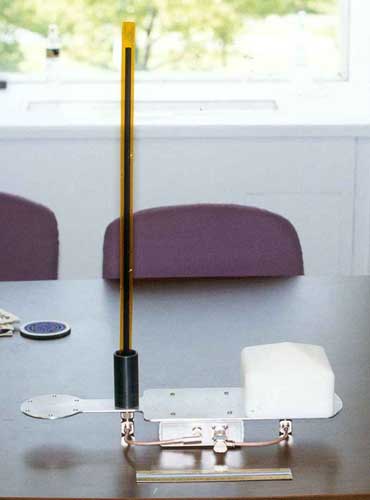 The VHF/UHF antenna (left) and the microwave antenna (right) mockup on the mounting plate. The diplexer is beneath the plate. An antenna similar to the VHF/UHF antenna, but longer, will be used for HF operation.
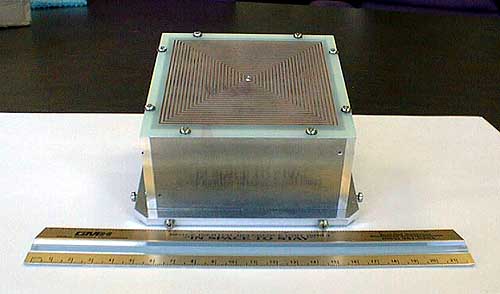
The proposed ARISS microwave antenna. |
There's been recent forward progress in activities to establish a permanent Amateur Radio presence in space aboard the International Space Station. Training models--or "mockups"--have been prepared of the antennas that eventually will be deployed for Amateur Radio on the International Space Station, and pattern testing is under way on some antenna systems. Four flight antenna systems are being developed to support Amateur Radio operation from the ISS on 20, 15, 10, and 2 meters, plus 70 cm, L-band and S-band.
"The ARISS international team has made tremendous progress on the design, development and flight qualification of an antenna system," ARISS Administrative Chairman Frank Bauer, KA3HDO, said this week.
The antenna system being developed for ISS includes a dualband VHF/UHF antenna, a multiband microwave antenna, and a diplexer mounted on a plate that attaches to an extra vehicular activity handrail clamping device. These four antenna systems will attach to four bulkhead Service Module feedthroughs, made available to the ARISS international team through the efforts of Sergej Sambourov, RV3DR. Russian space officials said this week that Russia will not pull out of its ISS commitments because of that country's opposition to the NATO campaign in Yugoslavia.
The VHF/UHF and HF antennas were developed by the ARISS team members in the US. They use a flexible measuring tape covered with yellow Kapton as the driven element. A large circular piece of Delrin provides a solid mounting interface and houses the connector and attachment hardware. The design is very robust and has no sharp edges. The microwave antenna system, developed by the Italian ARISS team, will support L-band and S-band operation.
The microwave antenna design chosen by the ARISS team is a flat spiral antenna. This dual-use antenna--intended for ham operations as well as NASA/Energia use--also enables the ISS crew to transmit and receive local video during space walks. A diplexer, designed and developed by the Italian team, provides an efficient split in radio signals between the lower frequency (HF/VHF/UHF) antenna and the microwave antenna. The antennas, diplexer, EVA "clothespin-type" handrail clamp, and the various coaxial cable connections will be integrated in the US on an antenna system plate developed by the US team, Bauer said.
The four antenna systems being developed for flight will be installed around the perimeter of the Russian developed Service Module, which will serve as an orbiting outpost for the ISS crew. A "high fidelity" EVA mockup developed by the AMSAT-NA/Goddard Amateur Radio Club team in Washington, DC, has been delivered to Matt Bordelon, KC5BTL, in Houston for evaluation by the NASA Johnson Space Center EVA engineers.
The microwave antenna system is currently undergoing a series of antenna pattern measurements at the NASA Goddard Space Flight Center in Greenbelt, Maryland. Former US astronaut and AMSAT member Ron Parise, WA4SIR, is leading a team of hams from Goddard's Microwave Branch in the test activity. Once antenna testing is completed, the Italian team, led by Fabrizio Bernadini, I0QIT, will move ahead with the final flight antenna fabrication. All Amateur Radio initial station hardware is slated for launch on the STS-101 mission.
SOME SWEEPSTAKES CW SCORES SUBJECT TO FURTHER ADJUSTMENT
The actual scores of ARRL November Sweepstakes CW entries from amateurs who used zero-land call signs will be lower than the figures set to appear in June's QST. While nearly all logs eventually are subject to some downward adjustment in score from the "raw" score submitted, this did not happen for entrants who used tenth-district call signs. ARRL Contest Manager Dan Henderson, N1ND, says the problem stemmed from a data-handling problem following electronic log checking.
"Last November's Sweepstakes entries were given the most careful scrutiny in many years, thanks in large part to the efforts of off-site volunteers," he said. The downward adjustment from the raw score is a result of computerized cross-checking, he explained.
"Nobody's perfect," Henderson said. In this case, that apparently cuts both ways.
For the 1998 event, a problem was detected when transferring the checked-log database of phone entries into the main contest database. Because of a mismatch in the characters used for "zero" in two data bases--the one generated by our off-site volunteers and the one maintained here in Newington--entries from zero-land call signs were not corrected as they should have been. "In a contest as competitive as the CW SS--perhaps the closest thing to a horse race that we sponsor--this has the effect of overstating their positions relative to other entrants," Henderson said.
Unfortunately, the problem was not discovered until the June issue of QST already was at the printer's.
Henderson said the problem "should have been detected and corrected here, but it wasn't--at least, not in time for the CW results." It was detected during the importing of data for the phone Sweepstakes database, however, so phone results were not affected.
The Contest Branch plans to publish the corrected CW Top 10 box and changes in any of the section winners from the 1998 November Sweepstakes in the July QST, along with complete results for the Sweepstakes phone weekend. A complete list of corrected line scores also will be posted on the Contest Branch Web site. In addition, all awards, plaques and certificates for section winners will be verified in advance, based on the adjusted scores.
"We regret this data management error," Henderson said, emphasizing that the error was "in no way related to the hard work done by the volunteer log checkers nor to the principal author of the Sweepstakes writeup."
For more information, contact the ARRL Contest Branch, conwww.arrl.org; 860-594-0232.
TEXAS ANTENNA BILL SIGNED INTO LAW
Months of hard work by amateurs in the Lone Star State paid off Monday when Texas Gov George W. Bush signed into law a bill to incorporate the limited federal preemption, PRB-1, into state law.
The new law, which becomes effective upon the Governor's signature, amends the Local Government Code in Texas to prevent local jurisdictions from enacting or enforcing ordinances that fail to comply with PRB-1. The bill further would require ordinances dealing with Amateur Radio antenna placement, screening, or height based on health, safety or aesthetics to "reasonably accommodate amateur communications" and "represent the minimal practicable regulation to accomplish the municipality's or county's legitimate purpose."
Because of an amendment added during the legislative process, the new Texas law does not prohibit localities from taking action to protect historic or architectural districts.
HB 1345 was introduced in March by State Rep Patricia Gray at the request of Karl Silverman, N0WWK, president of the Johnson Space Center Amateur Radio Club. Silverman became the prime mover behind HB 1345, often exhorting Texas hams via e-mail to appear for hearings or to write lawmakers and the governor to support the measure.
Silverman was ecstatic about the outcome. "The most difficult part of the legislative process was the coordination, as the process went much faster than anyone could have possibly anticipated," he said, conceding some difficulty in getting hams to write in support. "People just don't realize how much power they have when they do write," he said.
Hams in several other states also are contemplating measures to incorporate PRB-1 into their states' laws. A PRB-1 measure already has been introduced into the Maine legislature.
IARU CONVEYS GREETINGS ON WORLD TELECOMMUNICATION DAY
International Amateur Radio Union Secretary David Sumner, K1ZZ, has conveyed World Telecommunication Day "greetings and congratulations" to the International Telecommunication Union, on behalf of the world's nearly 3 million radio amateurs. World Telecommunication Day is May 17.
"This years theme, Electronic Commerce, reminds us of how dramatically the world of telecommunications and the ITU itself have changed in the past decade," Sumner said in a letter to ITU Secretary-General Yoshi Utsumi. But he added that there must always be a place for those "whose interest in radio communication is noncommercial." Sumner pointed out that hams "have contributed significantly to the technical advances that make electronic commerce possible."
"The knowledge and skills that one develops in the pursuit of an avocation can be enormously beneficial to one's employer and to society as a whole," Sumner concluded.
DAYTON!
The first person to operate Amateur Radio from space--Owen Garriott, W5LFL, rocker Joe Walsh, WB6ACU, FCC amateur enforcer Riley Hollingsworth, K4ZDH, and former NBC reporter and producer Roy Neal, K6DUE, will be among those heading for the Dayton Hamvention this weekend.
Former astronaut Garriott will be a guest of the SAREX Working Group. He'll speak at the AMSAT Forum on Saturday morning and the Youth Forum on Saturday afternoon, among others. In November 1983, Garriott was launched into space aboard the shuttle Columbia during the STS-9 mission. Thousands of hams heard W5LFL on 2 meters, and hundreds worked him.
Walsh and his band will entertain at the Hamvention 1999 banquet Saturday evening. The Richens/Timm Irish Dancers will open for Walsh, former lead guitarist for the Eagles and a member of The James Gang.
Hollingsworth, the FCC's top Amateur Radio enforcer, will put in appearances to address enforcement issues at FCC forums on Friday and Sunday. He'll also address the 3865 Drake and Antique Radio Tube Net Group forum Saturday morning.
Neal will be a special guest at the ARRL Media Relations Forum Saturday afternoon. This year's forum will consist of two-parts: "Ham Radio is Better than Ever"--a "reinvention" of ham radio and the message you're sending to the press, with an emphasis on reaching out to youth, and "Interactive hour" that gives participants a chance to share their PR programs and challenges with those on hand. Door prizes will be awarded.
Also Saturday afternoon, Amateur Radio Newsline will sponsor a "live-to-the-Internet" discussion of Amateur Radio in the year 2000 and beyond. Moderators are Bill Pasternak, WA6ITF, and Joe Schroeder, W9JUV. Speakers include ARRL First Vice President Steve Mendelsohn, W2ML, CQ VHF Editor Rich Moseson, W2VU, Gordon West, WB6NOA, Roy Neal, K6DUE, and others.
League President Rod Stafford, W6ROD, will be among those addressing the ARRL Forum Sunday morning. He'll be joined by ARRL Executive Vice President David Sumner, K1ZZ, and Great Lakes Director Dave Coons, WT8W.
Elsewhere, AMSAT-DL (Germany) President and Phase 3D Project Leader Karl Meinzer, DJ4ZC, will discuss the Phase 3D spacecraft status and launch prospects during the AMSAT forum at the Dayton Hamvention Saturday morning.
This year's Dayton Hamvention 1999 Amateur of the Year is Kenneth M. Miller, K6IR, cited for "leadership, vision and dedication exhibited during his nearly 60 years of continuous involvement in Amateur Radio." The Hamvention's Technical Excellence award goes to Alfonso R. Torres, KP4AQI, and the Special Achievement Award winner was Paul D. Lieb, KH6HME. The awards will be presented at the Hamvention banquet.
The QRP community will sponsor its annual Four Days in May activity at the Days Inn Dayton--South. It features an all-day technical seminar Thursday, May 13 and a display and building competition Saturday evening. Friday is vendor night.
A Dayton Hamvention special event station, W8BI, will be on the air--all bands--Friday through Sunday during business hours. QSL cards for certificates require a 9x12 sase to W8BI/8, PO Box 44, Dayton, OH 45401. Guest ops are welcome. The station will be in the flea market area. Alinco is sponsoring the station this year.
ARMED FORCES DAY AMATEUR COMMUNICATIONS TESTS
The Department of Defense Armed Forces and US Coast Guard will cosponsor the 50th annual Amateur Radio communications tests in celebration of Armed Forces Day, Saturday, May 15. The celebration features the traditional military-to-amateur crossband communications test and message receiving test. This is one of the only exceptions to the FCC's prohibition on contacting nonamateur stations.
Military-to-amateur cross band operations will take place from 1300 UTC May 15 until 1300 UTC May 16, 1999. All modes will be included. Some stations may not operate the entire period, depending on propagation and manning. Participating military stations will transmit on selected military frequencies--many of them adjacent to amateur bands--and listen for Amateur Radio stations in the nearest amateur band. Military operators will announce the specific amateur band frequency being monitored. Contact may last no longer than three minutes. Military stations will send QSL cards for contacts.
Special commemorative certificates will be awarded to anyone who receives and accurately copies the Armed Forces Day digital message from the Secretary of Defense.
Digital modes message broadcast will be May 16 (RTTY, 100 wpm, narrow shift) and May 17 (PACTOR and AMTOR). A 10-minute call for tuning purposes will precede each broadcast. Transcripts of the RTTY, PACTOR, or AMTOR receiving test should be submitted "as received." No attempt should be made to correct possible transmission errors. On the paper containing the test message, include the time, frequency and call sign of the military station copied, including name, call sign, and address (including ZIP code) of individual submitting the entry. Ensure this information is placed.
Details on Armed Forces Day are available in the May 1999 issue of QST, page 97. Disregard the information on AIR-2.
RADIO AMATEURS OF CANADA TREASURER RESIGNS
Radio Amateurs of Canada Treasurer John Watson, VE3GTX, has become the latest to resign from the RAC Executive. Watson's resignation comes just a week after RAC's president and secretary stepped down for unrelated reasons. The announcement of Watson's resignation came today from RAC Acting President Doug Leach, VE3XK. As with Doherty's resignation, no reason was given for Watson's departure.
Watson had served since January 1, 1999. He was appointed by former RAC President Patrick Doherty, VE3PD, and he assisted Doherty in implementing cost-cutting measures designed to address a decline in RAC membership and revenues in 1998. Watson also developed a detailed budget for 1999.
"Following a significant loss in 1998, the RAC financial situation is turning around, after a low at yearend," Leach said.
On May 1, RAC Secretary Joe MacPherson, VE1CH, stepped down citing the pressure of new outside responsibilities.
There are approximately 45,000 amateurs in Canada. All RAC Executive officers serve as volunteers.
IN BRIEF:
- This weekend on the radio: Armed Forces Day (see above) and the EU Spring Sprint are May 15.
Just ahead: The Major Six Club Contest and the Texas QSO Party are the weekend of May 21-23. See May QST, page 89, for details. - Vanity update: The FCC in Gettysburg reports it has processed vanity call sign applications received through April 16. On May 5, the FCC issued 186 grants. Another 173 applications landed in the work-in-process (WIPs) stack.--FCC
- Spectrum Protection bill collects cosponsors: ARRL Legislative and Public Affairs Manager Steve Mansfield, N1MZA, reports that as of May 7, there were 49 cosponsors on HR 783, The Amateur Radio Spectrum Protection Act. Recent cosponsors include Rep Tom Davis of Virginia, the Republican Congressional Campaign Committee chairman.
- SAREX mission delayed again: The next Space Amateur Radio EXperiment shuttle flight has again been delayed. The flight will carry the Chandra X-ray Observatory. NASA has decided to postpone mating the observatory with its inertial upper stage (IUS) pending additional progress in the US Air Force investigation into problems with the April 9 launch of a Department of Defense satellite. The launch had been set for July 9. The specific impact on the launch date is not yet known. NASA says it will not launch Chandra on shuttle mission STS-93 "until the situation is fully understood." The IUS is a two-stage solid rocket that will help propel the Chandra observatory from a low-Earth orbit to its operating altitude nearly one-third of the way to the moon. The STS-93 mission is the only SAREX opportunity scheduled for 1999.--NASA
- Reminder--ARRL Outgoing QSL Service fees have changed: League members are reminded that the ARRL Outgoing QSL Service fee schedule was revised effective January 1, 1999. The current fees are $6 per pound (or portion of a pound), $1 for 10 cards, $2 for 11-20 cards, and $3 for 21-30 cards. Packages accompanied by the incorrect fee will be processed, but senders will be billed for the additional fee.Priority will be given to packages with the correct fee enclosed. Other packages will be handled as time permits. For more information, contact Martin Cook, N1FOC, 860-594-0274; buro@arrl.org.
- UoSAT-12 gets OSCAR designation: Amateur Radio's newest satellite, UoSAT-12, has received an OSCAR designation from AMSAT. UoSAT-12 now also may be referred to as OSCAR-36 or UO-36. The satellite soon will complete its first full month in orbit. The assignment of consecutive OSCAR numbers to new Amateur Radio spacecraft is a tradition that dates from the launch of the very first ham satellite, OSCAR-1. The satellite remains in very good health. Planning is under way to open UoSAT-12's transponders for general amateur use.--AMSAT News Service