ARRL Audio News
| · | To subscribe, unsubscribe, or change your e-mail delivery address: see How to Get The ARRL Letter, below |
| · | Delivery problems (ARRL member direct delivery only!): letter-dlvy@arrl.org |
| · | Editorial questions or comments: Rick Lindquist, N1RL, rlindquist@arrl.org |
| · | ARRL Audio News: http://www.arrl.org/arrlletter/audio/ or call 860-594-0384 |
| · | The ARRLWeb Extra: http://www.arrl.org/members-only/extra |
IN THIS EDITION:
- +North Korea activated briefly on HF
- +1999 Field Day brings rule change, new pin
- +UoSAT-12 up and running
- +Riley Hollingsworth surprises hams at NAB
- +Texas PRB-1 bill clears state senate
- Special events set for International Marconi Day
- K1ZZ subs for W5ZN at SVHFS confab
- Barbara Ann Edwards, KC4PBB, SK
- Solar update
- In Brief: This weekend on the radio; E-mail forwarding service now available for ARRL affiliated clubs; FAR solicits scholarship applicants; FCC's Riley Hollingsworth QRV on HF; Tom Clark, W3IWI, recovering
+Available on ARRL Audio News
OH2BH BRIEFLY ACTIVATES NORTH KOREA
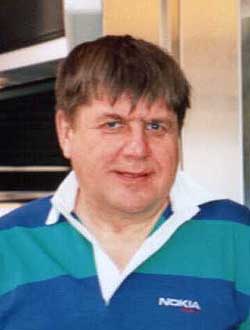
Martti Laine, OH2BH |
Renowned DXer Martti Laine, OH2BH, who first activated North Korea in 1995, briefly appeared on the air early April 21 from North Korea signing P51BH. According to the ARRL DXCC Desk, Laine showed up on 20-meter CW around 0530 UTC, then shifted to 14.195 SSB at around 0640 UTC and later to 21.295 on SSB. The short operation ended just before 0800 UTC.
"Countless DXers have been eagerly waiting for activation of North Korea," said Laine in a press statement. "This country is the rarest of them all--for good reason." North Korea remains isolated from the rest of the world, and visits are allowed only for special purposes. Transmitting by radio from North Korea has been, and still is, a highly sensitive issue, he added.
Laine's visit--his sixth to North Korea--was not intended to be a full-blown DXpedition, however, but another in a series of what he calls "DX missionary efforts." The objective was introduce the concept of Amateur Radio to those who have the power to decide its future in North Korea.
"It was a preliminary exercise," said DX Advisory Committee Chairman Wayne Mills, N7NG. "The on-air operation was a bonus." Mills said the trip was intended primarily to pave the way for future amateur operation from North Korea, and things went as well or even better than expected. "It fulfilled all expectations," Mills said.
The ham gear Laine used will remain in North Korea. "The antennas were left right there together with the Yaesu FT-847 equipment," Laine said in a posting to DX reflectors after he'd returned to Beijing. "It is just a matter of switching the power on--when the time is ripe--to allow North Korea to join the ranks of Amateur Radio."
During his brief stint from P5, Laine made 263 contacts, working mostly Europe and Japan, as well as 9K2HN and some West Coast US stations. He made only a handful of P5 contacts in 1995.
The DXCC Desk advises those who might have missed this short opportunity to not worry. "Intermediate steps of this kind are always needed, and, at best, they may lead to more activations," said ARRL Membership Services Manager Bill Kennamer, K5FUV.
Several minutes of audio from the P51BH operation may be heard on 9K2HN's home page, http://www.qsl.net/9k2hn.
Laine says documentation for the P51BH operation will be sent to the ARRL shortly, and QSL cards will be released from his OH2BH Finland address "as soon as possible."
1999 FIELD DAY BRINGS RULE CHANGE, NEW PIN
Participants in ARRL Field Day--the most popular annual operating event in the US and Canada--will encounter one significant change in rules for this year's event, June 26-27. Those using batteries to power their equipment now will be able to charge them while in use. The change affects all entry classes except Class D (home stations using commercial power; home stations using emergency power, including rechargeable batteries, should enter in Class E). In the past, only Class C (mobile) stations could charge batteries while in use. As previously, batteries must be charged from a power source independent of the commercial mains.
For the first time, the ARRL is making available annual Field Day pins to show your participation in the 1999 event. You don't have to make a minimum number of contacts or achieve a particular score level. You just have to participate!
Pins are $5 each. Field Day groups are advised to collect the money for the pins and send a single order stating the number of pins needed to ARRL Contest Branch, ATTN: Field Day Pins, 225 Main St, Newington, CT 06111. The League will ship the pins back to the club for distribution.
The first "International Field Day" was held June 10-11, 1933, billed as "just a test of portable equipment" for US and Canadian amateurs, according to former ARRL Communications Manager George Hart, W1NJM. Hart says then-Communications Manager Ed Handy, W1BDI, came up with the idea of Field Day, which now is in its 66th year. It was not until the second annual Field Day, in 1934, that Handy's Field Day writeup in QST raised the aspect of emergency preparedness.
Entries for Field Day 1999 must be postmarked by July 27, 1999. No late entries can be accepted. Participants should read the General Rules for ALL ARRL Contests (see http://www.arrl.org/contests/ announcements/99/rules-all.html), which include submission guidelines. All Field Day should include a Summary Sheet and Dupe Sheet as well as supporting information for publicity, bonus point, and other information the rules require.
Field Day groups and participants are invited to submit their entries electronically via e-mail. As the rules state, the subject line should include the call sign used, the contest name and entry class. Send electronic entries to FieldDay@arrl.org. Paper entries go to Field Day Entries, ARRL, 225 Main St, Newington, CT 06111.
For the complete 1999 Field Day rules, visit http://www.arrl.org/contests/ announcements/99/rules-fd.html or see the May 1999 issue of QST.
UoSAT-12 LAUNCHED AND FUNCTIONING
The latest Amateur Radio satellite, UoSAT-12, was successfully launched April 21 just before 0500 UTC from the Baikonur Cosmodrome in Kazakhstan aboard a converted Soviet SS-18 ICBM. This marked the first time a Russian missile designed for war had been converted to peaceful purposes to carry a commercial satellite into space. Under the terms of the START arms reduction treaty, the former Soviet Union's entire arsenal of SS-18 Satans must be destroyed or used for peaceful purposes.
The satellite was successfully switched on at around 1800 UTC and copied on the 2230 UTC pass in Japan by Kazu Sakamoto, JJ1WTK. The downlink is 9600 baud FSK and can be copied on 437.400MHz.
The satellite is considerably larger than UO-22 or TO-31, and carries a propulsion system for orbital housekeeping experiments. UoSAT-12 carries a number of imaging payloads (with an up to 10-meter image resolution) along with digital store-and-forward communications on VHF and UHF. Mode L/S transponders will also be supported with a high-speed digital downlink.--Bruce Paige, KK5DO, with thanks to the University of Surrey and Chris Jackson, G7UPN
RILEY HOLLINGSWORTH PUTS IN SURPRISE NAB APPEARANCE
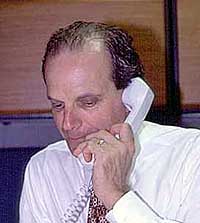
Amateur Radio rules enforcer Riley Hollingsworth, K4ZDH, got thunderous applause from those attending an Amateur Radio reception April 21 at the National Association of Broadcasters convention in Las Vegas. The annual get-together for hams drew upwards of 1000 people.
Hollingsworth's boss, FCC Compliance and Information Bureau Chief Richard D. Lee, was introduced by Ed Williams, W8APE, after Lee said he wanted to talk to the group. He, in turn, introduced FCC Compliance Division Chief Pamera Hairston and two staffers from the FCC's Los Angeles Field Office.
Lee then sprang the surprise. Last year, Lee said, he'd promised the FCC would do Amateur Radio enforcement. This year, the FCC had Riley Hollingsworth, K4ZDH, doing a great job.
"When I turned Riley loose, I said, 'look, you're going to be going all over the place. How can I get in touch with you?'" Lee recalled. "And he said, 'Boss, I'm like Batman, it's real simple. All you have to do is call out K4ZDH, Riley, are you around. and I'll show up, I'll be there.'"
So Lee gave it a try. "K4ZDH, Riley, are you around?" After a pause, from the back of the room Hollingsworth piped up, "Here I am," and came forward to address the gathering.
And the crowd, as they say, went wild.
Hollingsworth credited both Lee and Hairston for setting the events in motion to secure better Amateur Radio enforcement. "Pam and Rich went to the chairman [William Kennard] last October and asked for amateur enforcement," he said. "At the time they went and asked for it, they were totally loaded up with pirate broadcaster cases, and the last thing they needed was more work."
But Hollingsworth said Lee, a former Marine, was serious about enforcement and, like the Marines, wants it done right. "They not only want all fronts covered, but they want them at the same time," he said.
As Hollingsworth prepared to leave the podium, Lee got the last laugh by quipping, "So, are we going to take this opportunity to retest everybody?"
The NAB convention wrapped up April 22.--thanks to Brad Wyatt, K6WR, and Amateur Radio Newsline's Bill Pasternak, WA6ITF
PRB-1 BILL CLEARS TEXAS SENATE
The Texas Senate has approved the Amateur Radio "tower bill," and the measure appears headed for passage. The measure passed its second and third readings Monday, April 19. It now goes back to the House because of a minor change in an amendment first made on the House side.
The Texas bill, HB-1345, would incorporate the essence of the limited federal preemption, PRB-1, into state law. The measure would amend the Local Government Code in Texas to prevent local jurisdictions from enacting or enforcing ordinances that fail to comply with PRB-1. The bill further would require ordinances dealing with Amateur Radio antenna placement, screening, or height based on health, safety or aesthetics to "reasonably accommodate amateur communications" and "represent the minimal practicable regulation to accomplish the municipality's or county's legitimate purpose."
Johnson Space Center Amateur Radio Club President Karl Silverman, N0WWK, who's been a prime mover behind the bill says that, because the Senate made only a change to an amended portion of the House bill, it will not have to be heard by the full House. Instead, the bill's sponsor, Rep Patricia Gray, just has to agree to the change.
After that, the Speaker of the House will send the measure to Gov George W. Bush's office for signing. "So, by the end of this week, the bill should be headed to the Governor's office," Silverman said.
A similar measure has been inching its way through the Maine legislature.
SPECIAL EVENTS SET FOR INTERNATIONAL MARCONI DAY APRIL 24
Hams at various locations will stage special event operations to commemorate International Marconi Day on April 24, 1999. The annual event--held on the Saturday nearest to Marconi's April 25 birthday--will include operation on HF from the Cape Cod, Massachusetts, Marconi transmitting station site in Wellfleet by the Marconi Radio Club, W1AA.
Marconi also used several New Jersey sites to introduce wireless. 100 years ago, the first practical radio transmissions in America took place between Twin Lights in Highlands, New Jersey, ships in New York Harbor, and the New York Herald newspaper. On International Marconi Day, the Ocean-Monmouth Amateur Radio Club, N2MO, will operate on 20 meters from Marconi's former receiver site at Wall, New Jersey. The Marconi Chapter of the QCWA will operate from the MARS station at Ft Monmouth in Eatontown, New Jersey using WA2GM. The Morristown Amateur Radio Club, W2YD, will operate from Historic Speedwell Village, Morristown, New Jersey, where the telegraph and Morse code Marconi used were developed. Another station, WJ2DX, will be on the air from Somerville, New Jersey. The Mid-Island Amateur Radio Club on Long Island, New York, will mark the occasion by operating as W2M on 10, 15, and 20 meters, SSB and CW.
In all, some 60 stations in the US and elsewhere are expected to mount special event operations to mark International Marconi Day. Guglielmo Marconi, the man credited with inventing practical wireless, was born in 1874. He died in 1937.
SUMNER PINCH HITS FOR HARRISON AT SVHFS CONFERENCE
ARRL Executive Vice President David Sumner, K1ZZ, was a last-minute replacement for ARRL Vice President Joel Harrison, W5ZN, as banquet speaker at the third annual Southeastern VHF Society conference, April 9-10 in Marietta, Georgia. After Harrison had to be hospitalized to treat a bronchial ailment, Georgia Section Manager Sandy Donahue, W4RU, recruited Sumner to take his place.
The threat to amateur access in the VHF through microwave bands and the need for current amateurs to welcome new licensees into the hobby were Sumner's twin themes. Donahue reports that Sumner offered a spirited outline of the continuous threats VHFers face from commercial interests. The audience, fresh from two intense days of talks and demonstrations on a diverse subject list of interest to the VHF community, also was urged to make life easier for new hams. "All too often, a new ham will go to his local club meeting and be totally ignored by the other club members," Sumner said. "Such a new ham will sit politely, listen to what happens at the club meeting, and leave with the impression that hams are unfriendly. Nothing could be further from the truth, but the first impression is not very positive." He urged hams to make every new amateur feel welcome.
Some 100 hams attended the two-day conference, which included competitions in antenna gain and noise figure measurements. The Society presented the K4UHF award to Steve Kostro, N2CEI, of Down East Microwave, for his years of contributions to the VHF community.--Sandy Donahue, W4RU
BARBARA ANN EDWARDS, KC4PBB, SK
An Atlanta teacher who used Amateur Radio in her classroom and helped to license some 130 youngsters has died. Barbara Ann Edwards, KC4PBB, died March 14 as a result of complications from kidney failure. She was 58.
A ham for about 10 years, Edwards taught social studies and English at Renfroe Middle School in Decatur, Georgia, where she founded the Ham Radio Club. An ARRL registered teacher, she worked with Atlanta Radio Club volunteers to help interested students pass their ham radio exams and made a station available in her classroom for students to use. Edwards was involved in one Space Amateur Radio EXperiment (SAREX) contact during a shuttle Endeavour flight in March 1995.
An article in the August 1990 QST, "Hams Without Fail" describes Edwards' early efforts to incorporate a Novice class into her gifted classes at Renfroe. ARRL Educational Services Manager Rosalie White, WA1STO, was among those mourning Edwards' passing. "Barbara was one of those enthusiastic teachers who cared enough to study and learn innovative things that would cause her students to love science and technology," White said. "She'll be missed."--thanks to Bill Ronay, KM4LS, and Rosalie White, WA1STO
SOLAR UPDATE
Solar savant Tad Cook, K7VVV, Seattle, Washington, reports: This was another down week for sunspots and solar flux, although with the flares and associated geomagnetic activity, we can't say that solar activity was down. On April 17 the planetary A index reached 47 with the K index as high as 7, an indication of a severe geomagnetic storm. This was caused by a coronal mass ejection, another name for a solar flare. Conditions were again unsettled to minor storm a few days later when the planetary A index was 21.
With all of the recent mail expressing fear that this cycle has already peaked, I decided to check with a forecaster at the NOAA Space Environment Center in Colorado. They are still sticking with their forecast made last year, that the peak of cycle 23 is probably a year from now, or perhaps it will peak at the end of 2000. When looking at past solar cycles, we are often observing smoothed numbers, and in fact there are often periods before a cycle reaches a peak when there will be a lull in activity. There is also a possibility that this cycle could be like cycle 22, which had a broad double peak. Also, while radio amateurs often hope for high solar activity, most of the individuals and organizations contacting the Space Environment Center with concerns about solar activity do not. These are the folks who are working with satellites, power distribution systems and pipelines, and worry about the sun bombarding the earth with energy during high flare activity.
Look for a flat solar flux this week, with the numbers remaining around 105. The planetary A index for the weekend, April 23-25, should be 7, 7 and 10. Don't expect the solar flux to increase until after the end of April, with 130 by May 2, 140 by May 4, but then drifting back to 120 by May 12. Of course, as always, these projections are only based upon activity seen during the last rotation of the sun, so new sunspots could appear and liven things up.
Sunspot numbers for April 15 through 21 were 95, 87, 99, 98, 90, 79, and 79, with a mean of 89.6. The 10.7-cm flux was 121.8, 122.9, 115.7, 112.8, 110, 104.8, and 103.4, with a mean of 113.1. The estimated planetary A indices were 4, 14, 47, 6, 13, 21, and 12, with a mean of 16.7.
IN BRIEF:
- This weekend on the radio: The DXYL-NAYL Contest (SSB), the Six Meter Sprint, the Florida, Nebraska, and Ontario QSO parties, the Helvetia Contest, and QRP to the Field are April 23-25. See April QST, page 100, for details.
Just ahead: The North American High Speed Meteor Scatter Contest, the ARI International DX Contest, the Connecticut and Massachusetts QSO parties, the Danish SSTV Contest, MARAC County Hunters Contest, Ten-Ten International Net Spring CW QSO Party, and the US IPA Contest are May 1-2. See May QST, page 89, for details. - E-mail forwarding service now available for ARRL affiliated clubs: Effective immediately, clubs affiliated with the ARRL can sign up for the League's new e-mail Forwarding Service. The forwarding--or alias--service is available at no additional charge for ARRL affiliated clubs. It will provide clubs with a uniform "call sign@arrl.net" e-mail address that remains the same even if the user changes e-mail service providers. To sign up: (1) Send an e-mail (no text required) to subscribe@arrl.net. In return, you'll get a form to complete; (2) Send the completed form to clubregistration@arrl.net. That will send the form to ARRL HQ for processing. Your club's alias will be available within a day or so after you send it. To change your club's address, simply repeat this two-step procedure. The service does not affect usability of your original e-mail address. If your club does not have a club call sign, the system will generate an address based on the club's initials and a random three-digit number. Address comments regarding this service to clubs@arrl.org.
- FAR solicits scholarship applicants: The Foundation for Amateur Radio, a nonprofit organization headquartered in Washington, DC, and affiliated with the ARRL, plans to administer 66 scholarships to assist students who are also Amateur Radio operators, for the 1999-2000 academic year. FAR is composed of more than 75 local Amateur Radio clubs. It fully funds 10 of these scholarships with the income from grants and its annual hamfest. The remaining 56 are administered by the Foundation without cost to donors. Licensed radio amateurs may compete for these awards if they plan to pursue a fulltime course of studies beyond high school and are enrolled in or have been accepted for enrollment at an accredited university, college or technical school. For more information and an application form, send a letter or QSL card postmarked prior to April 30, 1999, to FAR Scholarships, PO Box 831, Riverdale, MD 20738. Visit the new FAR Web site at http://www.amateurradio-far.org/. --AMSAT News Service via Pat Kilroy, WD8LAQ
- FCC's Riley Hollingsworth QRV on HF: The FCC's top amateur enforcer, Riley Hollingsworth, K4ZDH, reports he's got a new HF rig and an auto-tune amplifier plus some new antennas at his Gettysburg, Pennsylvania, QTH and he's already been making the rounds of the HF bands, primarily on SSB. (He says he still has his old reliable Drake gear, too.) Hollingsworth said he expects to soon have HF receiving capability at his office to keep tabs on amateur activity directly. He's also been making the rounds of amateur clubs in various parts of the US as his schedule permits. He recently challenged ham club members in his native South Carolina to each get one new person into the hobby.
- Tom Clark, W3IWI, recovering: AMSAT-NA Board of Directors member Tom Clark, W3IWI, is recovering from heart bypass surgery he underwent April 15 at Johns Hopkins University Hospital in Baltimore, Maryland. Get well wishes may be sent to tac@clark.net or 6388 Guilford Rd, Clarksville, MD 21029.--Martha Saragovitz via SpaceNews