ARRL Audio News
| · | To subscribe, unsubscribe, or change your e-mail delivery address: see How to Get The ARRL Letter, below |
| · | Delivery problems (ARRL member direct delivery only!): letter-dlvy@arrl.org |
| · | Editorial questions or comments: Rick Lindquist, N1RL, rlindquist@arrl.org |
| · | ARRL Audio News: http://www.arrl.org/arrlletter/audio/ or call 860-594-0384 |
| · | The ARRLWeb Extra: http://www.arrl.org/members-only/extra |
IN THIS EDITION:
- +Swatch to go forward with "Beatnik mission"
- +FCC official acknowledges OOs really are "Official"
- +FCC beefs up scanner rules
- +ARRL membership on the rise again!
- +ARDF Team USA wants you!
- +AES founder Terry Sterman, W9DIA, SK
- Solar update
- In Brief: This weekend on the radio; Vanity update; ARRL at NAB; Broadcast station fined for 160-meter spurious; California's call sign recalled; Cordless phone inventor, N9LC, SK; Thai ham radio pioneer HS1AAM, SK
+Available on ARRL Audio News
SWATCH INSISTS "BEATNIK" MESSAGES "NOT ADVERTISING"
The CEO of the Swatch Group Ltd says messages to be transmitted on 2 meters by the soon-to-be-launched Sputnik-99 satellite are "not advertising" but part of the watchmaker's campaign to institute the "Swatch beat" as an international unit of time measurement. Replying to the League's suggestion to scrap the launch, Swatch Group CEO Nicolas E. Hayek said if anyone profits from the so-called "Beatnik mission" satellite, it will be the Amateur Radio community "who will gain much more recognition worldwide for their important work."
On April 7, League Executive Vice President David Sumner, K1ZZ, suggested that Swatch cancel the launch of the so-called "Beatnik" satellite and use a commercial satellite for its project instead. "The Amateur Radio community must stand against the 'Beatnik' satellite because it represents such an undesirable precedent," Sumner said. He cited international regulations defining the Amateur Service as one engaged in by "duly authorized persons interested in radio technique solely with a personal aim and without pecuniary interest."
In his faxed reply April 8, Hayek indicated the company planned to go ahead with the mission, despite the League's entreaty and numerous complaints from within the amateur community. He said the more than 400 messages programmed into the mini-Sputnik are not to advertise the company's products but to promote the company's concept to "improve time coordination in a separate and new way between all parts on Earth"--something, he said, that should interest hams.
An increasing number of voices within the amateur community have been raised in protest against plans for the "Beatnik mission." Rob Carlson, KC2AEI, has opened a "Swatch Protest and Boycott" site on the Internet at http://wmbc.umbc.edu/rob/swatch-protest/ to collect opinions and as a clearing house for information on the topic.
Acknowledging "negative reactions from a few radio amateurs regarding the Swatch beatnik satellite project," Hayek said Swatch has received many more positive ones from "other interested users." Some of the e-mail messages are posted on the company's Web site, http://www.swatch.com/beatnik/frameset.html. Swatch also has opened an e-mail comment box on its Web site to gather opinions on "Should we send your messages into space?"
Swatch solicited more than 5000 messages via its Web site, including voice and text files, for possible transmission on the new satellite. Messages selected for use were supposed to include a reference to the "beat" theme.
Hayek said he planned to again review with Swatch management "what can be possibly done without jeopardizing the aims of the mission" while also not offending amateurs, and invited continuing dialogue with the League. Sumner expressed disappointment that Swatch has not yet decided to change course, but he welcomed the opportunity for further dialogue.
AMSAT-France, which contracted with AMSAT-Russia to build the electronics for the soon-to-be-launched mini-Sputnik, has since distanced itself from the project and apologized for its involvement. AMSAT-Russia President Eugene Labutin, RA3APR, also has apologized, saying the arrangements with Swatch were made without AMSAT-Russia's knowledge.
The new Sputnik-99 satellite arrived on Mir aboard a Progress rocket April 4 and is tentatively set for launch April 16 during a space walk by the Russian Mir crew. It will carry a 100-mW transmitter and transmit on or about 145.815 MHz. The satellite will have an approximately 30-day life span.
FCC OFFICIAL ACKNOWLEDGES OOs REALLY ARE "OFFICIAL"
The FCC's top amateur enforcer, Riley Hollingsworth, K4ZDH, says that hams who receive notices from ARRL Official Observers should take them seriously or take the consequences. "Failure to take the notices seriously and to take corrective action where possible will not be tolerated by the Commission," Hollingsworth said in an enforcement-related letter to a South Carolina amateur. "The volunteer work of these Official Observers is a critical element of the Commission's enforcement program," he said, adding that failure to act on an OO notice could lead to fines and other sanctions.
Hollingsworth's comments were contained in an April 7 station-inspection follow-up letter to Richard Whiten, WB2OTK, of Easely, South Carolina. Hollingsworth and an FCC engineering team visited Whiten's station on January 22 after what Hollingsworth called "longstanding complaints" about the operation of Whiten's station. Whiten reportedly cooperated in the station inspection. According to the FCC letter, the Commission has received "numerous complaints" about Whiten "regarding profanity, obscenity, broadcasting extreme racial slurs, deliberate interference and failure to properly identify." Hollingsworth also said he'd heard complaints that Whiten had played recordings over the air "for the purpose of harassment or deliberate interference."
Hollingsworth noted that Whiten had "apparently ignored notices from Official Observers," and pointed out that the volunteer OOs work "in accordance with an agreement between the Commission and the ARRL and in accordance with our statutory authority."
"One thing I have really picked up as I travel around to groups is the frustration of the OOs," Hollingsworth told the League this week. "We're going to correct that, pure and simple."
In his letter, he told Whiten that, although the FCC considers hams to be self-policing, "the success of that regulatory approach depends upon the adherence to notices of possible improper operation from other licensed amateurs who are recognized Official Observers." The FCC asked Whiten to list all notices from OOs he has received since the start of his license term on September 27, 1994, and any corrective actions taken in response.
The FCC also set aside a February 10, 1999, grant of the vanity call sign W2OTK to Whiten and said his license expiration date remains October 15, 2001.
Hollingsworth also took advantage of the opportunity provided by his letter to Whiten to spell out the FCC's position on obscene and indecent Amateur Radio transmissions. "Obscene speech is not protected by the First Amendment and cannot be broadcast at any time," he advised. Indecent speech also is not protected between 6 AM and 10 PM, in accordance with the so-called "safe harbor" policy the FCC uses with commercial broadcasters.
Hollingsworth said that while FCC personnel did not notice any technical violations during their January inspection, they did have "serious concerns" about a linear amplifier under construction that was capable of greater than legal output. Hollingsworth asked Whiten to provide details of the amplifier and how it's been used.
Hollingsworth also told Whiten he would be forwarding, under separate cover, tape recordings made of Whiten's transmissions last November on 20 meters. "You will be requested to provide a full explanation for those radio transmissions," he wrote.
"No decisions have been made yet in this case," Hollingsworth told the League. "We're still seeking information."
FCC ISSUES STRENGTHENED SCANNER RECEIVER RULES
The FCC has amended its rules to strengthen existing prohibitions on scanning receivers that can receive cellular telephone transmissions. While the new rules contain specific exemptions for the Amateur Service, they will have important ramifications for the manufacture of new Amateur Radio equipment that scans frequencies outside the ham bands.
The new rules--released March 31 in a Report and Order--broaden the definition of a scanning receiver to include receivers that automatically switch among two or more frequencies between 30 and 960 MHz that can stop at and receive a detected signal. Still exempted are receivers designed solely for operation as a part of a licensed station. In response to an ARRL request, the FCC clarified that the rules do not apply to Amateur Service receivers unless they cover frequencies outside the ham bands.
The FCC also widened its definition of "test equipment" exempted from the cellular reception restriction. The adopted definition defines test equipment by function, rather than by end user as proposed, thus permitting sale to the general public.
Receivers that allow reception of cellular frequencies because of their poor image response would be illegal under the new rules. As it proposed, the Commission adopted a 38 dB rejection standard for signals in the cellular bands "for any frequency to which the receiver can be tuned."
The FCC abandoned a proposal to require manufacturers to limit reception of cellular service frequencies by "direct pickup" through the cabinet. The FCC also backed away from a proposal that could have required epoxy potting and nonremovable components to prevent scanner modification. The League had argued that this could raise the cost of buying and repairing equipment and could preclude ham gear modification for CAP and MARS or for experimental purposes.
The FCC adopted a more generalized requirement that receivers be designed so that tuning, control circuits, and filtering be inaccessible, and that any attempted modifications render the receiver inoperative.
The new FCC rules also prohibit modification of scanning receivers as a business or on an ongoing basis "regardless of the date of manufacture or number of units modified." The Commission also said modification of any scanning receiver is prohibited and invalidates the equipment authorization. New, permanent labels on scanning receivers also will be required.
Kits for scanning receivers would be treated the same as assembled equipment. The League plans to look closely at this provision to make sure it will not prevent amateur manufacturers from producing legitimate transverting equipment.
The new rules become effective due 30 days after their publication in The Federal Register, but the FCC said it will include "transitional provisions" in its rules. A copy of the Report and Order is available on the ARRL Web site at http://www.arrl.org/announce/et98-RandO.html
ARRL MEMBERSHIP ON THE RISE AGAIN!
ARRL membership increased by 1327 during the first quarter of 1999, to a total of 163,953. Improved renewal rates and an increase in new memberships both contributed to the first sustained membership growth since the first quarter of 1997.
"The effects of the 1997 dues increase are now behind us," said Executive Vice President David Sumner, K1ZZ. "Also, new members and old agree that the new Web-based membership benefits have enhanced the value of belonging to the League." More than 47,500 members have registered to use the ARRL Members Only Web Site in just seven months, earning this new membership benefit a popularity ranking that is second only to QST magazine. Among other things, the Members Only site offers access to the League's on-line news and features magazine, The ARRLWeb Extra, as well as QST product reviews, search capability of QST and QEX, and the ability to sign up to receive The ARRL Letter and W1AW bulletins. The site also offers early access to contest results, plus propagation charts and DXCC listings.
"The support of our members is very important to the success of the League, and is deeply appreciated," Sumner added. "At a time when many organizations are having problems attracting and retaining members, it is nice to be able to report that we seem to be bucking the trend."
ARDF TEAM USA WANTS YOU!
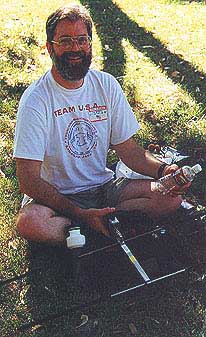
Team USA Captain Dale Hunt, WB6BYU, takes a break after a practice session last year in California. Hunt was among those competing at the ARDF World Championships last September in Hungary. |
Applications from competitors now are being accepted for the first major Amateur Radio direction finding event on US soil. ARRL ARDF Coordinator Joe Moell, K0OV reports that preparations are in full swing for the first International Amateur Radio Union Region 2 ARDF Championships in August. The competition will be part of the sixth biennial Friendship Radiosports Games held in Portland, Oregon, and sponsored by the Friendship Amateur Radio Society.
Those selected for Team USA 1999 will vie for medals against foxtailers from Canada, Russia, and Japan, and possibly other countries. Practice and training events are held August 9 and 10, followed the next two days by the official 2-meter and 80-meter competitions. A closing banquet will be held August 13.
"You don't have to be an athlete or a marathoner," Moell says. He says the median times for the 2-meter hunt at the last World Championships in Hungary ranged from 75 to 95 minutes in the five age/gender divisions. Most ARDF Team USA members also are hams, but an Amateur Radio ticket is not mandatory. "Let others in your family try out your ARDF equipment as you practice," Moell recommends. "Maybe they will decide to join in the fun."
To learn more or to obtain an application form for Team USA, visit Moell's Web site, http://members.aol.com/homingin/. Applicants should return completed forms via e-mail to homingin@aol.com.
AES FOUNDER TERRY J. STERMAN, W9DIA, SK
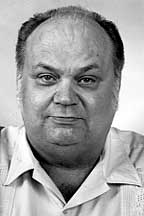
Terry Sterman, W9DIA. [Courtesy of Ray Grenier/AES] |
Terry Sterman, W9DIA, the man who founded Amateur Electronic Supply as a teenager in the 1950s, has died. He was 60 and had been in ill health for several years. Press reports say Sterman, who lived alone, died March 30 following a fire in his Northwest Milwaukee home.
First licensed in 1953, Sterman got into the Amateur Radio business as a teenager working in his father's TV and electronics parts store, Harris Radio Corporation, in his home town of Fond du Lac, Wisconsin. He went on to have a substantial impact on the ham radio marketplace. He founded Amateur Electronic Supply in 1957, when he was just 18 and still attending Milwaukee School of Engineering and commuting weekends to work at his father's store.
Sterman had suffered from serious health problems since 1988, according to his long-time friend and associate Ray Grenier, K9KHW, who had worked with Sterman at AES from the early years. AES changed hands January 1, 1998. The new owner is Amateur Electronic Supply LLC, headed by Phil Majerus, a prominent Wisconsin businessman.
Survivors include Sterman's wife, Elin, as well as a daughter and a brother. Services were April 2.
SOLAR UPDATE
Solar savant Tad Cook, K7VVV, Seattle, Washington, reports: Solar activity perked up a little bit this week, with average solar flux rising almost 15 points to 118.9 and average sunspot numbers up over 40 points to 89.6. The reporting week (Thursday through Wednesday) began with unsettled geomagnetic conditions, and a planetary A index of 14. One year ago the average sunspot numbers were 89.4, about what they were this week, and average solar flux was 121.8, 10 points higher than this week.
K6UJ wrote to ask about A and K indices and what they mean. This is a frequently asked question. The K index is updated every three hours, and you can hear the latest number on WWV at 18 minutes after the hour, or hear it any time by telephone at 303-497-3235. The K index is a measure of geomagnetic instability, and the higher the number, the greater is the absorption of radio signals, especially over polar paths. A one point change in K is a big change. Every day there is a new A index, and it is based on the K index for the previous 24 hours. A one point change in the K index results in a large change in the A index.
If the K index is 0 for all eight reporting periods in a day, then the A index is 0. If the K is 1, the A is 3; if the K is 2, the A is 7; if K is 3, the A is 15; if K is 4, the A is 27; if K is 5, the A is 48, and so on. If the K is 9 for 24 hours, the A is 400.
For April 9-11, look for a solar flux of 140, 139 and 135, with a planetary A index of 10, 10 and 8. Look for the solar flux to drop below 130 after April 15, below 120 a few days later, bottoming out below 115 from April 23-25. It should rise above 120 after April 29, and to 130 by May 4. Look for active geomagnetic conditions around April 25, continuing with unsettled conditions through May 1.
Sunspot numbers for April 1 through 7 were 59, 50, 77, 90, 111, 119, and 121, with a mean of 89.6. The 10.7-cm flux was 103, 99.5, 102.7, 115.9, 132.6, 137.4, and 141.4, with a mean of 118.9. The estimated planetary A indices were 14, 10, 8, 13, 11, 9, and 9, with a mean of 10.6.
IN BRIEF:
- This weekend on the radio: The Japan International DX Contest CW, the Elettra Marconi Contest, the His Majesty the King of Spain Contest, and the QRP ARCI Spring QSO Party (CW) are the weekend of April 9-11. The VHF/UHF Spring Sprints are April 12.
Just ahead: the DXYL-NAYL Contest (CW), the Holyland DX Contest, and the Michigan QSO Party are April 16-18. See April QST, page 100, for details. - Vanity update: The FCC in Gettysburg reports it has processed vanity call sign applications received through March 11. On March 31, the FCC issued 115 grants. Another 128 applications landed in the work-in-process (WIPs) stack.--FCC
- ARRL at NAB: The ARRL will have a booth at the National Association of Broadcasters (NAB) annual convention April 17-22 in Las Vegas (exhibits open April 19). Heading up the volunteer staffing effort for the second year is Bill Cornelius, KC7GHX, of Henderson, Nevada. The NAB has donated the booth space for use by the League; volunteers will be hams from the Vegas area. The booth will offer copies of public service announcements, copies of QST, publication catalogs, ARRL membership applications and a variety of other handouts. In addition, the ARRL will provide copies of The ARRL Handbook for Radio Amateurs and The ARRL Antenna Book as prizes during a reception for hams attending the convention. The annual ham radio reception will be held Wednesday, April 21, 6-8 PM at the Hilton ballroom C. Last year, more than 600 hams turned out for the event. Steve Scott, KD8S, of KVWB TV in Las Vegas invites hams to use the Las Vegas Radio Amateur Club repeaters at 146.94 MHz (100 Hz CTCSS will be turned off) and 449.700 MHz. "Local broadcasters, Society of Broadcast Engineers Chapter 128, and club members will monitor the repeaters and provide assistance as needed during the convention," Scott says. General ham radio information is available on the 146.73 MHz "QST machine" at DTMF 5; ARRL Audio News is available at DTMF 7. For more information, contact Steve Scott, 702-382-2121; e-mail kd8s@skylink.net; http://www.lvrac.org.
- Broadcast station fined for 160-meter spurious: An AM station in Florida was fined $7000 by the FCC for various technical violations including radiating an excessive signal on 1909 kHz--in the JA DX window. WINV in Inverness also was cited for EAS deficiencies and for not having its public file available. Well-known Georgia Top Band operator Tom Rauch, W8JI, had noticed the spurious on 1909 and contacted the station. "After four unsuccessful attempts to get them to correct the problem, their switchboard operator said, 'If we are bothering you way up in Georgia, why don't you just call the FCC and quit calling us?'" Rauch reported. "Just to be helpful, I did exactly what she asked!" Rauch said it took the FCC just a week to visit the station following his complaint. "It's great to see the FCC is back in business!" he said.
- Californian's call sign recalled: The FCC has told Brian L. Meader, KF6EMA, of Fremont, California, that he must give up his call sign and begin using KF6VLC instead. That's because the Commission's Licensing Branch inadvertently issued Meader one of the EMA-suffix call signs reserved for use by the Federal Emergency Management Agency. The FCC's notice March 26 gave Meader two weeks to protest the change and show it's not in the public interest. The EMA-suffix call signs are used by FEMA "to develop and implement plans and programs of disaster preparedness."
- Cordless phone inventor, N9LC, SK: George H. Sweigert, N9LC, of Fort Wayne, Indiana, died February 23. He was 79. First licensed as W8ZIS, Sweigert was a World War II veteran. Sweigert received a patent for the invention of the cordless telephone in 1969. He was employed at Magnavox Electronics, ITT Technical Institute and the Indiana Vocational Technical College. He was also active in Air Force MARS. His wife, Katherine "Kay" Sweigert, two daughters, and four sons are among his survivors.--Kay Sweigert
- Thai ham radio pioneer HS1AAM, SK: Radio Amateur Society of Thailand Secretary Ajarn Chamlon Chuathai, HS1AAM, died March 16. He was 69. A former RAST vice president, "Cham" had served as a Society officer for 12 years and had played an active role in persuading Thai authorities to legalize Amateur Radio and draw up regulations that became law in 1987. He also represented Thailand at IARU and other international conferences. A retired Thai Navy officer, he was an enthusiastic proponent of CW and convinced the Thai government to set aside a 2-meter FM channel for CW instruction. He is credited with having trained many Thai hams and organized many Amateur Radio events in his country. In addition, he founded the Thailand-Malaysia 40-Meter net. He also led several IOTA DXpeditions. RAST held a service March 21.--thanks to Daily DX, Fred Laun, K3ZO, and others