ARRL Audio News
| · | To subscribe, unsubscribe, or change your e-mail delivery address: see How to Get The ARRL Letter, below |
| · | Delivery problems (ARRL member direct delivery only!): letter-dlvy@arrl.org |
| · | Editorial questions or comments: Rick Lindquist, N1RL, rlindquist@arrl.org |
| · | ARRL Audio News: http://www.arrl.org/arrlletter/audio/ or call 860-594-0384 |
| · | The ARRLWeb Extra: http://www.arrl.org/members-only/extra |
IN THIS EDITION:
- +FCC says Delaware ham must retest or lose ticket
- +FCC takes NJ ham off HF for six months
- +DXers clamor for E44DX
- +Arkansas hams take stock after tornadoes
- Salvation Army continues Colombia earthquake aid
- Hams fill Texas communication gap
- Solar update
- In Brief: This weekend on the radio; Guides on the Air event; September VHF QSO Party open to club competition; SUNSAT launch scrubbed yet again!; QST Cover Plaque Award; Wisconsin Amateur Radio Operator Recognition Day; Check out the "new" QEX; ADI sponsors ham radio testing site
+Available on ARRL Audio News
FCC SAYS DELAWARE HAM MUST RETEST OR LOSE TICKET
The FCC has notified a Delaware ham that she must take her Amateur Radio examinations again or lose her license. The FCC's Riley Hollingsworth, K4ZDH, says "questions were raised" about how Sheila Bowden, N3QQS, of Millsboro, upgraded to Extra, and said the FCC is requesting that Bowden start from scratch and retake "all the elements." Bowden was notified February 16 in a letter from Hollingsworth.The FCC has the authority under Part 97 to re-administer exam elements previously administered by VEs. The FCC may administer the exam itself or designate a VEC or VE to administer the retesting session--typically employing a VEC that's different from the initial testing session.
The FCC told Bowden that she must retake the Amateur Extra Class examination series at an ARRL/VEC session before March 19 or lose her license. "You will be granted an Amateur Radio license consistent with any elements that you pass upon re-examination," Hollingsworth's letter said.
Hollingsworth said the FCC plans to call in "25 to 50 more" amateur licensees for retesting in the near future. Those individuals have not yet been notified, however. In all of those cases, Hollingsworth said, the FCC has reason to suspect the integrity of the examination process.
"The ham community needs to have a sense of confidence in the examination system," Hollingsworth said, adding that enforcement must not focus solely on operating violations. "This is a critical link in the chain."
Last month, the FCC dismissed the Extra class license formerly held by Bowden's husband, Wayne, after the Commission discovered "irregularities in the administration of the examination by the Volunteer Examiners." Wayne Bowden, formerly AA3RT, took the complete Amateur Radio examination series at an October 4 W5YI-VEC session. He had not held an amateur license before then.
The FCC is continuing its probe into alleged testing irregularities at Pennsylvania W5YI-VEC sessions October 4 and 6, including allegations that examinees might have been coached or given test answers.
FCC SUSPENDS JERSEY HAM'S HF PRIVILEGES
The FCC has suspended for six months the HF privileges of a New Jersey ham. The FCC notified Walter P. Miller Jr., W2YEE, of Edison, New Jersey, that his privileges to operate below 30 MHz were being suspended for 180 days.The license-modification letter February 16 from the FCC's Riley Hollingsworth, K4ZDH, came in the wake of an earlier warning letter to W2YEE. Hollingsworth alleged that W2YEE's 75-meter operation on the evening of February 4 was contrary to the Amateur Service Rules. Hollingsworth said Miller violated Section 97.1, basis and purpose of Amateur Radio; Section 97.101(a), good engineering and good amateur practice; and Section 97.119, identification requirements. The alleged operation took place on 3901 and 3950 kHz, the FCC said.
"Specifically, you were apparently broadcasting and talking to no particular station for several hours, during which time you prevented the use of the frequencies by others and maliciously interfered with other stations attempting to use the frequencies," Hollingsworth wrote. He said the Commission also had information indicating similar behavior occurred the next evening on 75.
"Such operation endangers the basis and purpose of Amateur Radio as a service, degrades it for other licensed operators and cannot be tolerated," Hollingsworth wrote.
Section 97.1 Basis and purpose, of the rules discusses the public service value of Amateur Radio, as well as its contribution to advancing the state of the art; expanding the reservoir of trained operators, technicians and technical experts; and enhancing international goodwill. Hollingsworth is on record linking certain types of on-air behavior with a negative perception of Amateur Radio in other countries.
A warning letter had gone out to Miller January 8 regarding similar operation. The FCC informed Miller at that time that he faced license revocation and fines.
Hollingsworth told Miller that the FCC was modifying his Amateur Radio license to prohibit HF operation for 180 days from February 16, the date of the modification notice. Miller has 30 days to formally protest the modification. If he does not protest it, the modification order expires August 16.
DXers CLAMOR FOR E44DX
The DX community wasted no time in mounting a full-blown DXpedition to the newly minted DXCC entity of Palestine. The E44DX operation commenced February 16 at approximately 1200 UTC, shortly after the call sign was released to the Palestine Wireless Society by the Palestinian National Authority's Ministry of Posts and Telecommunications (MPT). During its first 48 hours, E44DX racked up more than 10,000 contacts. The team also got to meet Palestinian leader Yasser Arafat, who expressed his support for ham radio and sent his regards to the worldwide amateur community.After the DXpedition ends, the E44DX call sign will be assigned to the newly formed Palestinian Amateur Wireless Society. Arrangements are being made to leave equipment behind for the new club station, assuring continued Amateur Radio activity from E4.
Led by Martti Laine, OH2BH, the international team includes QST DX Editor Bernie McClenny, W3UR, as well as Pekka Kolehmainen, OH1RY, and Pekka Holstila, OH2TA. They are working in cooperation with Ali Yashruti, E44A (formerly ZC6A) and Sami, E44B (formerly ZC6B), using two stations from the Palestine Hotel equipped with Yaesu FT-1000MPs and FET amplifiers. Antennas are dipoles and verticals.
Initial operation was on SSB only, concentrating on 3795, 14,195, and 21,295 kHz, but the team took to 40-meter CW early on February 18 and planned to concentrate on 40 CW for the next night as well. The team has been using 7005 or 7010 and listening up--sometimes way up. Some stations reported success only after several hours of calling. E44DX was to be active all day February 19 on 15-meter CW as well. The DXpedition also got on 40 SSB (7061 kHz) early on February 18, working many US stations.
Before concluding the DXpedition February 23, the team will provide additional bands when the current activity begins to thin. Frequencies will be announced later. Totten said the team decided to not participate in this weekend's ARRL International DX CW Contest. During openings to North America, E44DX will focus on SSB, particularly 20 and 15, as well as CW on 30, 17, and 12 meters. Right now, E44DX has been running on reduced power (400 W or less) for the most part, Totten says, due to an interference problem with the hotel telephones.
Totten is setting up a "simple" E44DX "DXpedition to Gaza City, Palestine" Web site at http://www.n4gn.com/e44dx/.
Almost a week before E44DX was even authorized, some stations reported working a station identifying as "E4DX" on 40-meter CW. That station appears to have been a pirate.
Palestine formally will be added to the ARRL DXCC List effective October 1, 1999, but contacts made with E4 stations after February 1, will count toward DXCC. QSLs for E44DX go to OH2BN.--thanks to Tim Totten, N4GN
ARKANSAS HAMS TAKE STOCK OF TORNADO RESPONSE
Members of the North Central Arkansas Amateur Radio Service recently took stock of Amateur Radio's performance when tornadoes struck January 21. For the most part, the club was pleased with its response. "For the first 24 hours, we were it," Arkansas Section Manager Roger Gray, N5QS, said of Amateur Radio's communication system. Gray, who lives in the stricken area, proposed constructing a permanent emergency net control site in the center of White County. At present, various net control stations operate out of their homes. But in the recent weather disaster, some net control stations were forced to evacuate and leave the air.After the tornadoes--upwards of three dozen in all--hit the White County area, hams who had been serving as weather spotters moved into the disaster recovery phase. Eight people died in Arkansas, and many others were injured. Damage in the stricken area was widespread. Ham stations were established at two Red Cross shelters and at the police station in the badly damaged town of Beebe. Salvation Army teams from Little Rock and Jonesboro integrated ham gear into their feeding stations in Beebe and McRae. "Over the course of the net, the stations handled untold numbers of Red Cross messages and probably 50 to 100 health-and-welfare messages," Gray said.
Gray himself got climbing duty when a group of amateurs made repairs January 24 to the Beebe Ambulance base station antenna, located atop a water tower. Hams also worked with cleanup crews. Formal nets ended on January 27.
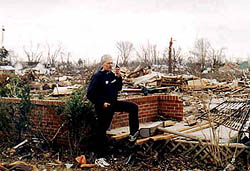 Charles Moore, W5IIE, passes health-and-welfare traffic to the Red Cross shelter in Beebe, Arkansas. |
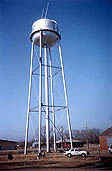 Arkansas Section Manager Roger Gray, N5QS, (visible on nearest tower leg, just above upper reinforcement) climbs the Beebe, Arkansas, water tower to repair the ambulance antenna, 150 feet in the air. |
"The hams of this area have been great and bounced right back," Gray said. Hams even managed to participate in the School Club Roundup February 8-13 from the McRae High School gymnasium. "Almost every student we talked to remembered one of their teachers [Larry Sicks, AC5AV, a math teacher at the school] sitting in the lobby all day talking on the radio, and it gave them another perspective of our hobby."
Among Gray's "lessons learned" was a suggestion to get local or state governments to issue standardize IDs to those needing access to affected areas, such as ARES/RACES members. He also advises hams to carry a copy of their Amateur Radio license when on emergency or disaster duty.
A newspaper story on ham radio's role in the storm and the club's evaluation appeared February 10 in the Searcy Daily Citizen.
SALVATION ARMY CONTINUES COLOMBIA EARTHQUAKE RECOVERY
Three Salvation Army disaster relief teams are helping residents of Armenia and Pereira, Colombia, to recover from the massive earthquake that shook the area last month. According to the Salvation Army Team Emergency Radio Network (SATERN) immediate aid, including meals, vaccinations and clothing, has been provided through a Salvation Army base camp. Salvation Army personnel are networking with other agencies in the region. At the latest count, almost 17,000 people have received assistance from The Salvation Army. A SATERN net on 14.265 MHz has been helping with inquiries about victims.Casualty figures indicate that the number of dead has risen to 950, and the number of injured has increased to nearly 4,000. Up to 95% of homes were damaged in the city of Armenia, 80% in the municipalities of Barcelona, Calarc and la Tebaida, and 50% in the center of the city of Pereira. The nearest Salvation Army facility is in the town of Ibague, which has suffered less damage.
According to UN and US reports, the security situation is now under control and the rescue phase has officially ended. An estimated 65% of Armenia's population now has normal access to water supply, and 80 percent have electricity. The Salvation Army and several other relief groups have been assigned to assist in census work to discover the most pressing needs.
Food distribution will continue. Reconstruction, sanitation, health and water needs persist and will particularly affect the most vulnerable. There is a great need for psycho-social recovery, especially for children.--Mike Gelski, KB0PVD/SATERN
HAMS FILL TEXAS COMMUNICATION GAP
Red Cross and local emergency officials in East Texas benefited from ham radio in late January during flooding along the Sabine River. The flood gates at the Toledo Bend Reservoir had to be opened under emergency conditions January 29 after heavy rains the previous week north of the lake. The next day, the area downstream of the Toledo Bend Dam--slightly east of the town of Burkeville, Texas, was declared a disaster location. The Red Cross headquarters in Orange, Texas, was notified that many families living below the dam were forced to evacuate due to rising water in the Sabine River.When the Red Cross mobile units arrived on scene January 31, however, they found that their cell phones and VHF radios would not function, causing a major disruption in the provision of food, blankets, and other disaster aid.
Red Cross Manager Tom Martin contacted ARES DEC J. R. Aaron, K5SUB, for help in setting up emergency communication from the affected flood area to the Orange Red Cross headquarters. Aaron then contacted Gene Vanscoy, KA5VMF, Dick Porter, KK5GV, Bill Lexa, WA5LFS, and Paul Clark, W5UHG in the Orange area to assist in relaying information via HF from the affected area to the Red Cross HQ in Orange.
In turn, K5SUB contacted Newton County EC Garland Meredith, K5VY, to activate the Newton County mobile EOC, KD5GBG. The mobile unit arrived at the Red Cross location below the Toledo Bend Dam power generating facility around noon. W5UHG, KA5VMF and KK5GV established HF and VHF links. WA5LFS, manned the HF equipment at the Orange Red Cross headquarters. In all, hams handled 28 formal and 41 informal messages.
Nearly 150 people were evacuated. Authorities reported no serious injures, no fatalities and no one reported missing in the Burkeville area. The relief effort wrapped up February 1.--Garland Meredith, K5VY
SOLAR UPDATE
Sun watcher Tad Cook, K7VVV, Seattle, Washington, reports: Solar activity took a great leap forward this week. The solar flux on February 14 was 204.6, which is the highest it has been since April 19, 1992, when it was 205.7 The Valentine's Day sunspot number of 211 was the highest since July 12, 1992, when it was 215. Both of these earlier readings were from the down side of the previous solar cycle. Average solar flux for the week was up nearly 72 points compared to last week, and average sunspot numbers increased by almost 120. As a result of higher solar activity, conditions on the higher end of the HF spectrum were much improved.A major geomagnetic storm at 0250 UTC on February 18, put an end to the "sunny" outlook. The resulting planetary A index for the day was 54. The high-latitude A index was 89, and the associated K indices went as high as 8, which is extremely disturbed. The should result in auroral displays. The predicted A index is 30 for February 19, 15 for February 20, and 10 for February 21. This does not bode well for the ARRL International CW DX Contest this weekend, although by Sunday conditions probably will have recovered.
A look at recent solar images shows quite a few pox on ol' Sol. Check out some recent solar images at http://www.sec.noaa.gov/solar_images/ImageIndex.cgi. Click on any small image to make it larger. For a more dramatic presentation, see the animated solar rotation at http://spaceweather.com/java/solar-anim.html.
For Friday through Sunday, look for solar flux values of 160, 155, and 150. Expect the solar flux to continue down to around 135 on Monday, 125 on Tuesday, then below 120 around February 27, 110 around March 1 and 2, and bottoming out for the short term at 105 from March 3-5. Based on the current 27.5 day solar rotation, solar flux should rise again, going above 150 after March 9, 170 after March 11, and hit below 200 before mid-month. Unsettled to active geomagnetic conditions are forecast for March 10-12.
Sunspot numbers for February 11 through 17 were 84, 165, 199, 211, 167, 176, and 135, with a mean of 162.4. The 10.7-cm flux was 163.5, 188.4, 198.4, 204.6, 190.1, 191.8, and 189.8, with a mean of 189.5. The estimated planetary A indices were 16, 21, 7, 9, 13, 4, and 16, with a mean of 12.3.
In Brief:
- This weekend on the radio: The ARRL International DX Contest (CW) is this weekend (see QST, Dec 1998, p 97 for complete details). Also, listen up for the Guides on the Air (GOTA) event. Just ahead: the CQ WW 160-Meter SSB Contest, the REF French Contest (SSB), the UBA Contest (CW), the YL International QSO Party (SSB), the RSGB 7-MHz Contest, the CQC Winter QRP QSO Party, and the North Carolina QSO Party are the weekend of February 26-28 (see QST, Feb 1999, p 92 for more information).
- Guides on the Air event: You can help young women to learn about Amateur Radio by participating in the Guides on the Air (GOTA) event, February 20-21. Although this event originated in Canada, it is spreading to the US. Invite a few Girl Scouts, or the whole troop to your shack that weekend. GOTA stations will be using all HF bands plus 2 meters, on frequencies that end in "33" and "88." US Girl Scouts who participate may earn the Ham Radio patch. For information on obtaining these patches, contact Arline Berry, W1LIO, 6 Causeway Ln, Medfield, MA 02052; w1lio@juno.com.
- September VHF QSO Party open to club competition: The ARRL September VHF QSO Party has been added to the list of Affiliated Club Competition contests. This change becomes effective with the 1999 September VHF QSO Party. The September VHF QSO Party now joins the January VHF Sweepstakes as a VHF/UHF Affiliated Club Competition event. As an Affiliated Club Competition event, the leading clubs in the Unlimited, Medium and Local categories win a coveted ARRL gavel, signifying the club's accomplishment. Guidelines and rules for ARRL Affiliated Club Competition are found at the Contest Branch Home Page as well as in the "General Rules for All ARRL Contests" in the November 1998 issue of QST. The ARRL also sponsors the June VHF QSO Party, the August UHF Contest, the two 10 GHz and Up Weekends, and the annual EME Competition.
- SUNSAT launch scrubbed yet again! The launch of a Delta II rocket carrying the SUNSAT, ARGOS, and OERSTED satellites was called off for the ninth time Saturday, February 13, 1999, due to an unexplained glitch that appeared in the telemetry readout of a critical airborne power supply's voltage. Delta II launch team member Eric Lemmon, WB6FLY, notes that this is the second launch delay caused by a hardware problem; the other scrubs all were related to unacceptable high-altitude winds. "We have a recovery plan to change out the suspect packages and launch on the morning of Monday, February 22," Lemmon said. The Delta II has been on the launch pad for more than a month now.
- QST Cover Plaque Award: Larry Tyree, N6TR, received the January QST Cover Plaque Award for his article, "Kid's Day!" Congratulations, Tree!
- Wisconsin Amateur Radio Operator Recognition Day: April 22 will be Amateur Radio Operator Recognition Day in Wisconsin. A proclamation has been approved, and there will be a ceremony in March for Gov Tommy Thompson to officially sign the proclamation. The ceremony, recognizing Amateur Radio's role in emergency preparedness and response, will be in conjunction with the Tornado Awareness Week proclamation.--thanks to Mack Brophy, N9NTB and Jim Romelfanger, K9ZZ
- Check out the "new" QEX: Can't get enough technical articles and challenging projects? Check out the new QEX! If you would like more technical articles and challenging projects, look for them in QEX. This bimonthly publication (64 pages) offers you more than four times the technical content of a single QST. Ham radio technical experimentation is alive in QEX. In the March/April issue you'll find: vertical antennas--modeling and building a quarter-wave on 160 meters; Remote base operation; homebrewing dream station; better filters for QRP rigs; killer front end; propagation from the edge; 6-meter power; power for MOSFETs, and much more. Visit the QEX home page to see.
- ADI sponsors ham radio testing site: Premier Communications, which makes ADI and Pryme products, has debuted its HamTest.com Web site to help ham radio neophytes study for their Amateur Radio examinations. The site, http://www.hamtest.com, provides simulated tests, access to all question pools, and a link to the ARRL/VEC home page and the database of upcoming test sessions. Help is available by posting a request in the interactive user forum. Advice from experienced hams is available in the "Elmers Chat Room." Use of advanced features requires a Java-enhanced browser. The site materials are available free to all. For more information, send e-mail to elmer@hamtest.com. The ADI/Pryme site is at http://www.adi-radio.com.--ADI news release