ARRL Audio News
| · | To subscribe, unsubscribe, or change your e-mail delivery address: see How to Get The ARRL Letter, below |
| · | Delivery problems (ARRL member direct delivery only!): letter-dlvy@arrl.org |
| · | Editorial questions or comments: Rick Lindquist, N1RL, rlindquist@arrl.org |
| · | ARRL Audio News: http://www.arrl.org/arrlletter/audio/ or call 860-594-0384 |
| · | The ARRLWeb Extra: http://www.arrl.org/members-only/extra |
IN THIS EDITION:
- +Northwest Director Mary Lou Brown, NM7N, SK
- +League files "restructuring" comments with FCC
- +FCC pulls General upgrade
- +Section Manager election results
- +US signs disaster mitigation accord
- SAREX marks 15 years
- TMSAT-1 now available
- Alvin H. Battison, W2IEG, SK
- Solar update
- In Brief: This weekend on the radio; DC multiplier in the ARRL 10-Meter Contest; Vanity update; FCC issues warning on tower lighting; NLI amateurs rally for tower exemption; Alien hunters, hams join forces
+ Available on ARRL Audio News
NORTHWESTERN DIVISION DIRECTOR MARY LOU BROWN, NM7N, SK
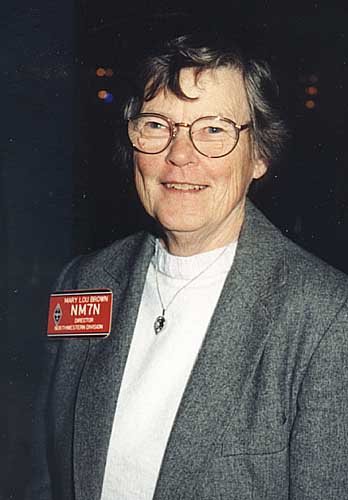
Mary Lou Brown, NM7N |
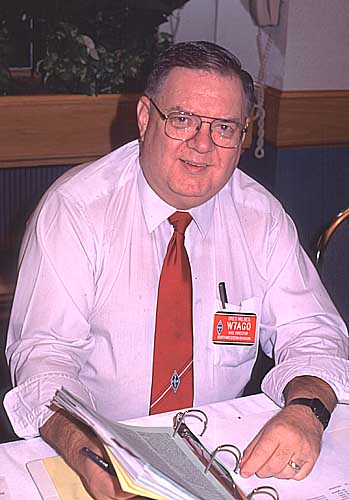 Greg Milnes, W7AGQ [Photos by Rick Palm, K1CE] |
DXpedition member Nick Hacko, VK2ICV, called Brown was "the most-liked person" on the DXpedition. "Although I knew Mary Lou for only a few days, it was very clear to me and to the other Lord Howe operators that she was an exceptional person," he said in an Internet posting after learning of her death. He said Brown helped out with all phases of the operation and deserved "a lot of credit for helping the rest of us get a great lot of enjoyment out of our trip."
Brown has been the ARRL Northwestern Division Director since 1995 and was a vice director from 1990 through 1994. She also served as a member of the ARRL Executive Committee.
ARRL Executive Vice President David Sumner, K1ZZ, said Brown was held "in the highest possible esteem" by her peers on the ARRL Board. He noted that Brown was elected to the Executive Committee after just one year as a director, and was re-elected twice. "Her enthusiasm for Amateur Radio extended beyond organizational affairs to on-the-air operating, especially operating with friends," he said. "Anyone who was fortunate enough to able to call Mary Lou their friend--and their numbers are legion, all over the world--knows the true meaning of friendship."
Brown received her doctorate from Columbia University. Before retiring to Washington, she taught physical education at the University of California at Berkeley and served a department chairperson.
Funeral arrangements are incomplete.
Northwestern Division Vice Director Greg Milnes, W7AGQ, accedes to the position of Director. Milnes also was just re-elected to a new two-year term. The vacancy in the position of Vice Director will be filled in due course by appointment by President Rod Stafford, W6ROD.
LEAGUE FILES "RESTRUCTURING" COMMENTS WITH FCC
The ARRL has filed formal comments in response to the FCC's proposed streamlining of the Amateur Radio rules. The League delivered its comments to the FCC December 1, the final day for comments in the FCC's Notice of Proposed Rulemaking in WT Docket 98-143.
The League's filing promotes the ARRL Board of Directors' restructuring positions, adopted last July and fine-tuned at a special meeting in October. It also takes the FCC to task on a few points. The ARRL said the FCC's NPRM failed to contain "a comprehensive license restructuring proposal or even an overall review of license restructuring" and generally "missed the mark."
The League called on the FCC to adopt the ARRL Board's restructuring plans as the centerpiece of its streamlining efforts. Among other things, the League plan calls for eliminating the Novice and Tech Plus licenses to reduce the number of license classes from six to four. The ARRL plan automatically upgrades current Novice and Tech Plus licensees to General. The General license would become the entry-level ticket to HF. Existing Novice and Tech Plus HF CW bands would be "refarmed" to provide additional phone spectrum for General, Advanced, and Extra class licensees.
The FCC also proposed a four-tier license structure, eliminating the Novice ticket and melding existing Technician and Tech Plus licensees into a common database while allowing current Novices and Tech Pluses to retain their current operating privileges. The ARRL said the FCC was on "the right track" in proposing to eliminate the Novice ticket. But the League said its "instant upgrade" plan for Novice and Tech Plus operators is a better approach because it permits "refarming" the underutilized Novice HF subbands. The League called refarming "critical to any comprehensive license restructuring proposal."
The FCC's NPRM sought comments on the issue of Morse code testing and requirements but offered no specific proposals. The ARRL called for a reduction in the number of Morse code examination tiers from three to two--5 and 12 WPM--and changes in the written examinations to make them more relevant and with greater emphasis on current operating practices and newer digital technologies. The League also recommended that the number of written exam questions "increase incrementally" for all license classes above Technician.
The League said that Morse code should not be overemphasized in the licensing process, but should be continued as a licensing requirement above the entry level. It has proposed that General class applicants pass a 5 WPM code test, while Advanced and Extra applicants pass the 12 WPM code test. Subsequent to release of its original restructuring plan, the ARRL Board also decided to ask the FCC to permit Technician operators to use Morse code on the General class HF CW segments without passing a specific code examination.
The ARRL said acknowledged abuses of the CW disability exemption process were an enforcement, not a testing, issue. For those claiming a disability waiver for the higher-speed CW test, the League urged testing accommodations as a preferable alternative. The League also urged an end to multiple-choice CW exams and rules specifying that a passing grade for a Morse examination be either 70 percent correct answers to 10 fill-in questions or one minute out of five of solid copy.
The League also praised the "new dawn" in amateur enforcement undertaken within the Compliance and Information Bureau by Riley Hollingsworth, K4ZDH. The ARRL suggested that it would be "reasonable to withhold any further [rulemaking] action on amateur enforcement" for now and let the CIB continue its work.
The ARRL's comments stressed the value of increasing participation in the hobby and making it available to more people. "By increased participation, Amateur Radio can provide even more service to the United States than it does currently, with a simpler licensing structure," the League asserted.
A complete copy of the ARRL's comments in WT Docket 98-143 is available on ARRLWeb at http://www.arrl.org/news/restructuring/ (see "ARRL's Comments to the FCC on WT Docket 98-143"). Reply comments on the FCC's rulemaking proposals are due January 15, 1999. The FCC is not expected to take action on restructuring at least until sometime next spring.
FCC PULLS GENERAL UPGRADE
The FCC has pulled back a General Class upgrade from a Kentucky ham because it says the Physician's Certification used to obtain a Morse code testing waiver "is not a valid document." The FCC notified Richard C. Lalone II, KC5GAX, of Fort Campbell, Kentucky, of its action by certified mail November 18. But the Commission stopped short of revoking his license or levying a fine.
An FCC official said that Lalone upgraded at a test session in January 1997. "The doctor's certificate was apparently forged," he said. "The doctor confirmed that he didn't sign it. It wasn't the VEC's fault." The FCC official said Lalone had "let it slip" to another amateur that the certificate was forged and that Lalone failed to answer correspondence from the FCC inquiring into the matter.
A former Texas resident, Lalone, 34, has been told he may no longer operate under General class privileges, his amateur privileges have been returned to Tech Plus, and he has been issued a new license document. The FCC said Lalone's privileges reverted to Tech Plus as of November 23.
The FCC advised Lalone that while it was not pursuing a fine at this time, he could run into problems later if he decides to renew his ticket or to upgrade. At that point, the Commission said, it might later decide to designate the issue for a hearing before an administrative law judge, "in order for the Commission to determine what, if any, enforcement action should be taken and what action to take on the application."
SECTION MANAGER ELECTION RESULTS
Ballots have been counted in contested section manager races, and Missouri has a new section manager. Charles Boyd, KE0K, edged out John Seals, WR0R, 579 to 508 votes, to replace Roger Volk, K0GOB, as Missouri SM. Volk decided not to run for another term. The only other contested race was in the Southern New Jersey section, where incumbent Jean Priestley, KA2YKN, defeated T. J. "Skip" Arey, N2EI, 463 to 243.
Candidates in six other sections ran unopposed and were declared elected. They are Lawrence Ober, W1MW, Eastern Massachusetts; Bill McCollum, KE0XQ, Nebraska; George Tranos, N2GA, New York/Long Island; Leslie Schmarder, WA2AEA, Northern New York; Leslie Shattuck Sr, K4NK, South Carolina; William Edgar, N3LLR, Western Pennsylvania
All elected candidates take office January 1, 1999.
US SIGNS TAMPERE DISASTER MITIGATION CONVENTION
The US joined other governments November 18 at UN Headquarters in signing the Tampere Convention. The international agreement calls on the signing parties to cooperate among themselves and with other organizations "to facilitate the use of telecommunication resources for disaster mitigation and relief."
Thirty-three other countries already have signed the Convention, negotiated in June in Tampere, Finland, at the urging of the humanitarian relief community.
The Tampere Convention will help expedite the movement of telecommunications personnel and equipment into disaster-stricken areas such Honduras and Sudan. US National Coordinator for Tampere Larry Roeder called the accord "a practical instrument for the provision of emergency telecommunications resources." Roeder, a US State Department policy advisor, was chief of the US delegation to the June Intergovernmental Conference on Emergency Telecommunications, which hammered out the Convention.
Signatories to the Tampere Convention agree to end excessive import duties and to minimize administrative and political barriers that could prevent or delay the swift provision across national borders of emergency telecommunications used to locate disaster victims or assisting in transporting food, medicine and supplies. For the first time, signatories also agree to protect relief workers engaging in emergency telecommunications, and their equipment.
For more information and a complete copy of the Convention, see the US government's Tampere Web site, http://www.state.gov/www/issues/relief/tpere1.html.
SAREX MARKS 15th ANNIVERSARY
The Space Amateur Radio EXperiment--or SAREX--program marked its 15th anniversary November 28. On that day in 1983, US astronaut Owen Garriott, W5LFL, was launched into space aboard the shuttle Columbia during the STS-9 mission. "He brought along the first Amateur Radio station on a crew-tended space vehicle," said NASA's Frank H. Bauer, KA3HDO. Bauer is the AMSAT-NA vice president for human spaceflight programs and a member of the SAREX Working Group. Thousands of hams heard W5LFL on 2 meters, and hundreds worked him.
Among those who heard Garriott's Amateur Radio transmissions from space were youngsters at Avery Street School in South Windsor, Connecticut. Lance Collister, WA1JXN (now W7GJ), of Montana is credited with being the first amateur to work an astronaut in orbit.
In addition to random contacts, SAREX has permitted youngsters and youth in classrooms around the world to speak directly with astronauts in space for the first time. Since the inception of SAREX in 1983, Amateur Radio has flown aboard 23 NASA shuttle missions as well as aboard the Russian Mir space station. Students were able to talk directly with astronauts on many of those space flights. The next scheduled SAREX mission is expected to take place next spring.
SAREX is a joint venture of the ARRL, AMSAT-NA, and NASA. ARRL Educational Activities Department Manager Rosalie White, WA1STO, coordinates the SAREX school QSO schedule at ARRL HQ. "SAREX is a very bright star in the Amateur Radio horizon--for schoolchildren, for individual hams and for communities," she said. "It is an activity that the astronauts tremendously enjoy, because it sparks children's interest in exciting scientific fields, including our great hobby, Amateur Radio."
For more information on the SAREX program, contact Jean Wolfgang, WB3IOS, at ARRL HQ, jwolfgang@arrl.org.
TMSAT-1 NOW AVAILABLE FOR AMATEUR USE
TMSAT-1 (TO-31) now is available for general amateur use. The satellite opened for business the weekend of November 28. The move allows Amateur Radio operators to use the store-and-forward communications transponder on the spacecraft and to download the high-resolution multispectral Earth images taken by the satellite.
Ground station op Chris Jackson, G7UPN/ZL2TPO expressed the hope that ground operators will take advantage of downloading the high resolution multispectral images available from TO-31 "and keep other traffic to a minimum." Due to current limitations with on-board memory, images will only be available on the satellite for a couple of days after they are taken. If other files (especially large files) are uploaded to the satellite, this will ultimately increase the amount of time taken to download images and they may therefore be deleted before they are completed.
Jackson says transmitter problems continue, however, and the downlink is not currently operating over most areas. Amateurs in Europe and Southeast Asia will find the downlink on most of the time, and it will remain on for between 15 and 30 minutes, depending on the operation of the transmitter. Work and testing continue to improve this situation.
During some of these tests, access may be limited to command stations only. Jackson requests that hams not attempt to access the satellite if the BBS indicates it is "SHUT."
The TO-31 downlink frequency is 436.925 MHz, 9600 baud FSK. The uplink frequency is 145.925 MHz, 9600 baud FSK. The BBS call sign is TMSAT1-12; the broadcast call sign is TMSAT1-11.--Chris Jackson, G7UPN/ZL2TPO via AMSAT News Service
ALVIN H. BATTISON, W2IEG, SK
ARRL Western New York Assistant Section Manager and former Vermont SCM Al Battison, W2IEG (ex-W1GNF), of Vestal, New York, died November 19. He was 81. A Dartmouth alumnus and World War II veteran, Battison was a life member of the ARRL. He also belonged to the Antique Wireless Association, the IEEE and the QCWA. As Section Communications Manger for Vermont in the 1930s, Battison provided vital leadership during severe flooding on the Connecticut River. A civil aviator and antique car buff, Battison was more recently known throughout the section for his presentations on radio-controlled sailplanes and early aviation.--Bill Thompson, W2MTA
SOLAR UPDATE
Solar savant Tad Cook, K7VVV Seattle, Washington, reports: HF radio conditions were good over the past week, with moderate geomagnetic conditions and a rising solar flux. Sunspot averages for the week were more than double the week before, and average solar flux was up over 30 points. The high point for the week was on November 29, when solar flux reached 167.8--the highest its been since the beginning of September. Average solar flux for the previous 90 days was 131 and 132, and solar flux was above this level on every day, indicating an upward trend.
Now that November has passed, we can see that solar activity is back up, after a dip in October. Monthly average solar flux for June through November was 108.5, 114.1, 136, 137.7, 117.3 and 138.8.
For December 5-7, look for a solar flux of 150, 148 and 148 with a planetary A index around 10 for all days. After the weekend, solar flux should dip just below 130 around December 9, then bounce around between 130 and 135 until December 17. From December 18 until December 27 flux values should rise to around 150.
N7SO writes to remind us of the NASA Space Weather Bureau Web site at http://www.spaceweather.com, sponsored by Marshall Space Sciences Lab. It contains a lot of data on current conditions as well as a great 10-day animation of the sun at http://www.spaceweather.com/java/solar-anim.html. Don't miss the current image of the aurora updated every seven minutes, as well as information on solar flares.
Sunspot numbers for November 19 through 25 were 57, 58, 55, 56, 56, 74, and 102, with a mean of 65.4. The 10.7-cm flux was 117.9, 121.5, 121.2, 126.1, 129.9, 140.2, and 149.5, with a mean of 129.5. The estimated planetary A indices were 7, 12, 7, 7, 10, 12, and 9, with a mean of 9.1.
Sunspot numbers for November 26 through December 2 were 132, 121, 110, 126, 186, 153, and 144, with a mean of 138.9. The 10.7-cm flux was 156.4, 158.9, 164.8, 167.8, 163.4, 162.7, and 151.7, with a mean of 160.8. The estimated planetary A indices were 11, 8, 5, 6, 13, 13 and 4, with a mean of 8.6.
In Brief:
- This weekend on the radio: The ARRL 160-Meter Contest, the QRP ARCI Holiday Spirits Homebrew Sprint, and the TOPS Activity 3.5 MHz CW Contest are on tap for this weekend.
Just ahead: The ARRL 10-Meter Contest and the Great Colorado Snowshoe Run are the weekend of December 12-13. - DC multiplier in the ARRL 10-Meter Contest: Thanks to the hospitality of the Voice of America Amateur Radio Club, the Potomac Valley Radio Club (PVRC) will activate K3VOA for the District of Columbia (DC) multiplier in the ARRL 10-Meter Contest, December 12-13. The multi-operator team will be active on both CW and SSB. Contest QSLs only go to W3LEO. Include an SASE.--W3LEO
- Vanity update: The FCC in Gettysburg reports it has processed vanity call sign applications received through November 5. In the latest run, the FCC granted 210 applications. Another 266 hit the work-in-process, or WIPs, stack for further processing.
- FCC issues warning on tower lighting: The Federal Communications Commission has warned owners of antenna structures to comply strictly with FCC antenna tower lighting and marking rules. The warning followed a recent nighttime incident in Texas where a helicopter ambulance nearly hit an unlighted radio tower. The FCC notes that tenant licensees, such as repeater owners, are secondarily responsible for tower lighting. The FCC will hold a public forum December 7, 2-4:30 PM ET (with live audio available on the Internet at http://www.fcc.gov/realaudio/) to examine the Year 2000 (Y2K) impact on tower lighting and lighting equipment. Forum materials will be posted to the FCC Y2K site, http://www.fcc.gov/year2000.--FCC
- NLI amateurs rally for tower exemption: The Peconic Amateur Radio Club marshaled support from the Long Island, New York, amateur community to respond November 10 at a meeting of the Southold Town Board to rewrite a local antenna law. Before the meeting, Don Fisher, N2QHV, distributed to Town Board members copies of PRB-1 and a statement of the amateurs' concerns about the inclusion of "all towers" in a rewrite of the antenna law. Nearly 40 people participated in an impressive march on Town Hall. The Suffolk County ARES/RACES meeting was relocated to Southold so that hams from other towns on Long Island were able to express their concern and support. ARRL Hudson Division Director Frank Fallon, N2FF, attended to speak on PRB-1. Ralph Williams, N3VT, gave testimony as an antenna expert and member of the Historical Landmark Preservation Board. Fisher reminded the Town Board of Amateur Radio's mission of support to the town in times of emergency, the hobby's noncommercial status, and the protection given to amateur radio by PRB-1. As a result, the Southold Town Board was favorably influenced to place a specific exemption in the law for amateur radio towers.--Roberta Keis, N2RBU, via The Hudson Loop
- Alien hunters, hams join forces: The SETI League, which supports a privatized search for extraterrestrial intelligence--has announced its affiliation with the Central States VHF Society. Plans were formalized at the annual Central States VHF Conference this past summer for each organizations to join the other as a member society. The two organizations each have several hundred members. Central States Board Chairman Gerald Handley, WA5DBY, called it "a logical affiliation." He said the groups hope to collaborate in "applying the very latest in radio technique to the challenge of interstellar communications." SETI League Executive Director Paul Shuch, N6TX, has served two terms on the Central States board and has been a regular speaker at the society's annual conference for the past 15 years. For more information, see http://www.setileague.org.--The SETI League