ARRL Audio News
| · | To subscribe, unsubscribe, or change your e-mail delivery address: see How to Get The ARRL Letter, below |
| · | Delivery problems (ARRL member direct delivery only!): letter-dlvy@arrl.org |
| · | Editorial questions or comments: Rick Lindquist, N1RL, rlindquist@arrl.org |
| · | ARRL Audio News: http://www.arrl.org/arrlletter/audio/ or call 860-594-0384 |
| · | The ARRLWeb Extra: http://www.arrl.org/members-only/extra |
IN THIS EDITION:
- +FCC levies big fine on NJ ham
- +New mini-Sputnik launched
- +ARRL ham gear arrives in Honduras
- +Leonid shower could be big this year
- +FCC shuts down HF pirates
- Drake ends factory service for older gear
- Solar update
- Clark Magness, NI1U, SK
- In Brief: This weekend on the radio; Vanity update; Product review archive expanded; Happy Birthday, Mir! Hiram BBS, on-line service accounts terminated; Florida public service conference set; QST Cover Plaque Award
+ Available on ARRL Audio News
FCC LEVIES HEFTY FINE ON JERSEY HAM
The FCC has levied a $7500 fine on a New Jersey ham who interfered with a net operation on 40 meter SSB. James C. Thompson, KA2YBP, of Waretown also was ordered off 40 meters until further notice after the October 18 incident. The case against Thompson, 58, stemmed from interference complaints from other amateurs, including the Association of North American Radio Clubs (ANARC), which conducts a Sunday morning net on 7240 kHz.
The FCC charged Thompson with illegally retransmitting programs from a Standard Broadcast (AM) station on 40 meters and willfully interfering with the net. The FCC also said Thompson failed to properly identify.
The FCC issued an Official Notice of Violation October 21. In replying to the NOV, Thompson admitted the violations, the FCC said November 9. "Applying the Forfeiture Policy Statement and statutory factors to the instant case, we have determined that a monetary forfeiture in the amount of $7,500 is warranted," the FCC's notice said. Thompson has 30 days to pay the fine or appeal it.
The Thompson case marked the Commission's first amateur enforcement action since the FCC announced it would consolidate amateur enforcement within the Compliance and Information Bureau. The CIB's legal advisor for enforcement, Riley Hollingsworth, K4ZDH, says he's spoken with nearly 100 individuals about enforcement complaints or issues since the FCC's latest enforcement initiative began. The FCC expects additional amateur enforcement cases to develop as a result of calls to the Amateur Enforcement Line, 202-418-1184.
NEW MINI-SPUTNIK LAUNCHED FROM MIR
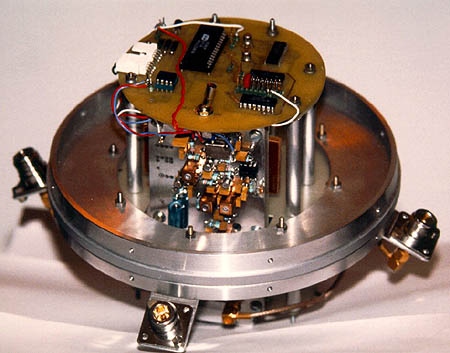
The Sputnik 41 transmitter (bottom) and digital voice module (top), designed by F6FAO. [Photos by Gerard Auvray, F6FAO] |
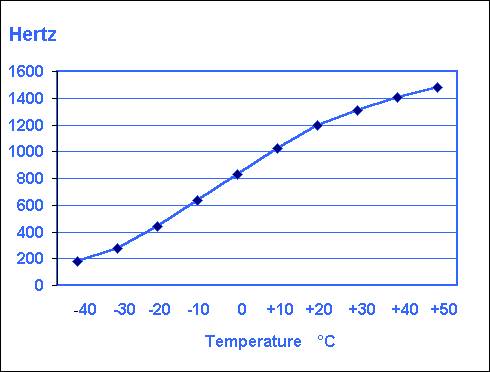
Chart showing relationship between Sputnik 41 beacon tone and internal temperature. |
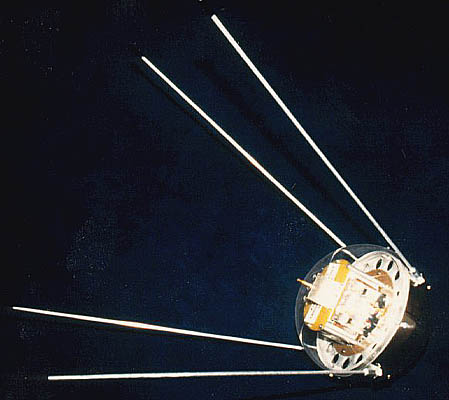
Russian cosmonauts launched a second mini-Sputnik satellite November 10 during a spacewalk from the Mir space station. The launch of Sputnik 41--also being called RS-18--comes just over a year after the launch of Sputnik 40, which commemorated the launch of the first artificial Earth satellite by the USSR in 1957.
Among the first in the US to report hearing the new satellite was Ken Carlstrom, N1WED, in New Hampshire. He reported hearing Sputnik 41 from approximately 0604 to 0609 UTC November 11 on 145.8145 MHz.
The newest Sputnik was tossed by hand at the start of the spacewalk by cosmonauts Gennady Padalka and Sergei Avdeyev. According to an AP report, Padalka told Avdeyev to "toss it gently toward the moon."
Sputnik 41, which arrived on Mir aboard a Progress supply rocket late last month, was financed by the Aeroclub de France to mark its centennial. Two Sputnik 40 models were transported to Mir last year, but only one was launched. The other remains aboard the space station.
Like its predecessor, Sputnik 41 is just under 8 inches in diameter and weighs almost 9 pounds. It carries a 200 mW transmitter that transmits on or about 145.812 MHz (± 5 kHz and Doppler shift). The spacecraft has no solar cells. Its expected operational lifetime is approximately 30 days.
Sputnik 41 broadcasts pre-recorded voice greetings in three languages, French, English, and Russian. The Russian-accented English greetings say "1998 was the International Year of Air and Space" and "International Space School Sputnik Program." The French and Russian messages convey the same greetings. The new spacecraft provides a "bip-bip" beacon. The frequency of the audio tone indicates the satellite's internal temperature (see chart). The tone is transmitted every 90 seconds.
Sputnik 41 reception reports go to AMSAT-France, QSL Spoutnik 41, 14 bis rue des Gourlis, F-92500 Rueil-Malmaison, FRANCE. The 1998 International Year of Air and Space page is at http://www.ccr.jussieu.fr/physio/Satedu/sputnik41.html.
ARRL HAM GEAR ARRIVES IN HONDURAS
Portable and mobile VHF transceivers shipped by the ARRL last week have arrived in flood-stricken Honduras to help in the ongoing relief effort.
"Thank you for all your support and help on this great ordeal our country has been forced to undertake," said Omar Paredes, HR1OP, in an e-mail message November 11 to ARRL Headquarters. Paredes is secretary of the Club de Radio Aficionados Central de Honduras (CRACH) in Tegucigalpa, which accepted the equipment.
Hams in Honduras who still have operational stations or gear have been using Amateur Radio to maintain communication, since telephone service is erratic or out completely. "We are working very hard trying to provide communication within our country as well as with families abroad that need to know about their relatives," Paredes said. Stations in Honduras have been operating off batteries or from gasoline generators.
The League also sent a 2-meter repeater, diplexer and antenna to a club in La Ceiba to restore communication between the mainland and the islands of Roatan and Guanaja. The equipment is part of the League's disaster communications inventory, and some of it has seen service in other weather disasters.
Relief agencies from the US and elsewhere are undertaking massive efforts to feed, clothe, and shelter the thousands of flood victims, and some agencies have been making use of Amateur Radio for communication. The storm left more than 10,000 dead and one million homeless in Honduras, Nicaragua, Costa Rica and Guatemala. The storm left the communications and public utilities infrastructure in shambles.
The Salvation Army Team Emergency Radio Network (SATERN) continues to operate on HF. The Amateur Radio net is providing an information service to help families search for missing relatives, relaying information between Central and North America. SATERN also is handling logistical and emergency needs traffic. The disaster has revived the phone patch in this Internet era. "Since my involvement, I've handled about 10 phone patches between the folks in Honduras and various places from Maine to Washington state," said Harry Bryant, AA2WN, in New Jersey, who's been active on SATERN. Charles Lassiter, KD5AHW, in Texas, reports he and Bob Sanford, KC5SMC, have been relaying traffic to and from the Mercy Ships/Mercy Ministries in Tyler, Texas, to their orphanage and mission in Honduras.
Individuals in the US with relatives in the affected area may submit a health-and-welfare inquiry via e-mail to SATERN to be relayed via Amateur Radio. Requests should include the name(s) of the person(s) being inquired about; their last known address; your name, address, and telephone number; and your e-mail address. Send your inquiry to qnwa4bzy@mindspring.com. A form also is available on the SATERN Web site at http://www.angelfire.com/il/satern411/emailfrm.html.
The FCC declared the SATERN 14.265 MHz frequency off-limits to hams who are not involved in handling emergency traffic. The mandatory communications emergency was declared to support the Central America disaster relief effort. Under the order, amateurs are required to refrain from using 14.265 MHz (plus or minus 3 kHz) unless they are taking part in the handling of emergency traffic. The order remains in effect until rescinded.
LEONID SHOWER: THIS COULD BE THE BIG YEAR
The impending Leonid shower on November 17 has generated both interest and concern within the Amateur Radio community. Leonids get their name from the constellation Leo, which appears to be their source in the sky. The meteors originate from debris and dust in the wake of the comet Tempel-Tuttle. They show up on the same day every year, and approximately every 33 years, the shower can reach storm proportions.
The last major storm spectacle was in 1966, when upwards of 150,000 meteors per hour blazed through Earth's atmosphere. This year--number 32 of that cycle--could be the big one, some experts believe, with the Leonid shower producing as many as 100,000 meteors per hour as Earth passes through the orbiting meteor stream. The shower--or storm--creates a bonanza of VHF meteor-scatter propagation for amateurs, especially on 2 meters. It also presents an interesting sky show. But because of the predicted intensity of this year's Leonid shower, some are worried that satellites might be at risk.
During their recent spacewalk, the cosmonauts aboard the Russian Mir space station attached a meteorite trap on the spacecraft to collect data on the Leonid storm. While it's not believed that the storm will threaten Mir, the cosmonauts will board the Soyuz escape capsule during its peak, just to play it safe. Some communication satellites and even the Hubble Space Telescope will be positioned to minimize any potential effects from impact.
NASA scientists will conduct unprecedented, detailed aircraft and ground measurements of the Leonid meteor storm. A main focus of the NASA investigation is to learn the composition of the debris and what happens to it when it enters Earth's atmosphere. NASA's goal is to understand how extraterrestrial materials may have helped to create the necessary conditions for life on Earth.
Meteors and meteorites enter Earth's atmosphere all the time. An average observer might spot a couple of dozen of them with the naked eye on any given evening. Increasing the number to the proportions of the expected November 17 shower does raise the statistical possibility that a chunk of space debris could strike and damage a satellite, "which is something of a possibility at all times anyway," says ARRL Technical Information Service Coordinator George Beloin, WA1PIX. Only a small particle could cause damage to a satellite.
North American viewing opportunities are not optimal this year, since our side of Earth likely will be in daylight when it passes through the meteor stream. The best viewing sites will be in China and Southeast Asia. In any location, the best viewing should be from around 1 AM local time until dawn, after Leo has risen in the eastern sky. The actual "peak" of the shower or storm lasts only a few hours, experts say, and predictions vary widely.
For more information, see "The Coming Meteor Storm," QST, October 1997, page 98, http://www.skypub.com/sights/meteors/leonids/98preview.html, and http://www-space.arc.nasa.gov/~leonid/. --thanks to NASA
FCC SHUTS DOWN FOUR HF PIRATES
The FCC has shut down four unauthorized HF broadcasters in Massachusetts, Illinois, Texas, and California. The stations all transmitted on 6955 kHz. Two of the operators are radio amateurs, according to an FCC spokesperson, who said the ham licenses "are definitely in jeopardy." The two hams were identified as 41-year-old Richard F. Jurrens, KC5RGK, a Technician licensee who lives in Katy, Texas, and 46-year-old Henry Lee "Hank" Landsberg, WB6MEU, an Advanced class licensee who lives in Sierra Madre, California. The names of the others cited were being withheld pending further official action.
In making the busts, the FCC's Columbia, Maryland, Operations Center coordinated and provided information to FCC agents from the Boston, Chicago, Houston and Los Angeles offices. FCC inspectors from those offices then performed on-site visits to the unauthorized stations.
With the exception of certain low-power Part 15 devices, broadcasting on the HF bands is not authorized without a station license. Under the Communications Act, violators may be subject to penalties up to $11,000 and the equipment used may be seized and forfeited by court order. Unlicensed operators also face criminal fines of up to $100,000 and/or imprisonment for up to one year, or both, for a first time offense.
DRAKE ENDS FACTORY SERVICE FOR OLDER GEAR
R. L. Drake Company has announced it no longer will provide factory service for most of its older Amateur Radio and marine equipment. The list includes much--but not all--of the popular 4-Line equipment.
Veteran Drake Service Manager Bill Frost, WD8DFP, says it's getting harder to get parts for the older Drake units. "The big switches, you can't buy those things anymore," he said this week. "The big electrolytics are not available."
Frost, who's been with Drake for 32 years, said his department has "reached a point where we cannot service the older products in the manner to which our customers have become accustomed." Technicians familiar with the older, mostly tube-type gear also are in short supply these days. "Our technical expertise on the older equipment has gradually been diminished by the loss of long-time employees due to retirement," Frost said. He also said the cost of repairs can easily exceed the cost of the equipment.
The company has posted a list on its Web site at http://www.rldrake.com/tech/Outofservice.html of items that it no longer can service. The list includes The R-4 and R-4A receivers, the popular T-4X, XB, and XC HF transmitters, and the TR-3 and TR-4 transceivers, as well as most of the power supplies for those units, the SSR-1 receiver, and the TR-22, 22C and TR-33C 2-meter transceivers. Items on the list and sent to Drake for repair will be returned to the sender unrepaired accompanied by a bill for shipping, handling, and applicable COD fees.
Frost said Drake is still servicing "to an extent" the R-4B and R-4C receivers as well as the TR-5 and TR-7 transceivers. The company also still will provide factory repair service for the L-4, L-4B and L-7 linear amplifiers.
Drake says its supply of unique parts is limited, but it still might be able to supply individual owners with needed parts for do-it-yourself repairs. Frost encouraged Drake owners to call or write if they have any questions about repair or service of a particular piece of equipment--even if it's already on the list.
Call Frost at 513-746-4556 or e-mail him at Bill_Frost@rldrake.com. Frost's mailing address is Bill Frost, R.L. Drake Co, Service Dept, 230 Industrial Dr, Franklin, OH 45005.
SOLAR UPDATE
Sun watcher Tad Cook, K7VVV, Seattle, Washington, reports: Solar activity was much higher over the past week. Average sunspot numbers jumped almost 34 points to 118.6, and average solar flux was up about 25 points to 151.2. The average for solar flux for the 90 days prior to this week was 131.3, and flux values were above this level on every day of this week, which is a good sign of an upward trend.
The most active day was November 9, when the solar flux was above 160. Unfortunately for HF operators this was also the second of two days of geomagnetic storms, with the planetary A index at 68 on November 8 and 78 on November 9. The high latitude A index was 130 on November 9. So, it was a weekend of uneven conditions for the ARRL November Sweepstakes.
These conditions, which meant poor propagation on HF, produced some interesting effects on VHF. W1JJM in Rhode Island reported working CX8BE in Uruguay on 6 meters, and W1LP in Massachusetts heard a beacon from Malawi on 6 as well. W1LP also reported a whole list of stations around North America worked via aurora on 2-meter CW.
For November 13-15, solar activity is expected to retreat a little, with the solar flux on Friday through Sunday forecast at 140, 140 and 138. The planetary A index over the same three days is predicted to be 15, 20 and 10. Solar flux is expected to dip below 130 after November 18, and bottom out around 120 from November 20 through 24. Flux values should rise above 130 after November 27, and peak below 150 around December 1 and 2. Geomagnetic conditions are expected to be unstable until November 18. This is all based on activity during the previous solar rotation, and new active areas on the sun could appear at any time.
Look for the big Leonid meteor storm on November 17. This should be a peak year in the Leonid 33-year cycle, but the best viewing will be over Northern Asia.
Sunspot numbers for November 5 through November 11 were 137, 142, 144, 137, 107, 81, and 82, with a mean of 118.6. The 10.7-cm flux was 152.7, 140.9, 148.5, 152.7, 162.4, 153.8, and 147.1, with a mean of 151.2. The estimated planetary A indices were 9, 22, 25, 68, 78, 6, and 4, with a mean of 30.3.
CLARK MAGNESS, NI1U, SK
Clark Magness, NI1U, of Guilford, Connecticut, died November 7 after a long illness. He was 47. Magness had served as Connecticut SEC since 1991 and had been an ARRL member for 16 years. " He was a dedicated ARRL volunteer who did a lot to develop the ARES program here in the state," said ARRL Field Services Manager Rick Palm, K1CE. Connecticut Section Manager Betsey Doane, K1EIC, expressed her sadness at Magness' passing. "His life was certainly a wonderful gift to all of us," she said.
IN BRIEF:
- This weekend on the radio: The Japan International DX Contest (SSB) is November 13-15 (contrary to the announcement in November QST). The Worked All Europe Contest (RTTY), the OK/OM DX Contest, and the Peace Country Amateur Radio Club QRS Contest are November 14-15.
Just ahead: The ARRL November Sweepstakes (SSB) along with the North American Collegiate ARC Championship (SSB; see SS rule 6, October QST, page 118) are November 21-22. - Vanity update: The FCC in Gettysburg reports that vanity call sign applications received through October 22 have been processed. In the latest run, November 12, 119 hams got a new call sign. Applications from another 149 hit the work-in-process (WIPs) stack, however. The FCC says it received 1412 vanity applications during October, down only slightly from September when the fee dropped to $13. More than 80% of applications filed in recent months have been electronic. Over the more than two-year life of the current vanity call sign program, the FCC has received more than 36,250 applications for new call signs. One available estimate suggests that between one-half and two-thirds of those applications resulted in a new call sign.
- Product review archive expanded: The QST Product Review columns for the 1980-1989 decade have now been added to those available on the ARRL Members Only Web Site archive. Files are in Adobe Portable Document Format (.pdf). Viewing past Product Review columns requires Adobe Acrobat, which can be downloaded free of charge.
- Happy Birthday, Mir! The Russian Mir space station celebrates its 10th birthday this month. Mir, which has been home to several Amateur Radio operators over the years, including several US astronauts, began functioning November 6, 1988. Over the intervening years, more than 60 cosmonauts and astronauts aboard Mir have made thousands of radio contacts with earthbound hams. A message from Sergei Sambourov, RV3DR, chief of the Cosmonaut Amateur Radio Department, expressed thanks to all who promoted and participated in ham radio communication with Mir. QSLs for R0MIR or R0MIR-1 go to Dave Larsen, N6CO, PO Box 1501, Pine Grove, CA 95665. Requests should be accompanied by a business-sized self-addressed, stamped envelope with appropriate return IRC(s) or postage.--MIREX
- Hiram BBS, on-line service accounts terminated: Effective January 1, the ARRL will terminate the Hiram Bulletin Board System (860-594-0306) because of declining use. Effective immediately, the ARRL has canceled its on-line service accounts with Compuserve and America Online. These services were deemed no longer necessary because of the availability of the now-expanded ARRLWeb, http://www.arrl.org/ and e-mail service. Members wishing to contact ARRL Headquarters via e-mail should direct correspondence to hq@arrl.org. Individual staff members may be contacted directly by using either <call sign>@arrl.org (ie, n1rl@arrl.org) or <initial+last name>@arrl.org (ie, rlindquist@arrl.org).
- Florida public service conference set: The ARRL Florida Regional Public Service Conference is Saturday, November 21, 1-5 PM, in conjunction with the ARRL Southern Florida Section convention (see November QST, page 94) at the Florida State Fairgrounds Expo Hall, Interstate 4 and US Route 301, Tampa. The main conference objective is to identify specific telecommunication needs of served agencies and the corresponding ARES capabilities over the next three to five years.--Rick Palm, K1CE
- QST Cover Plaque Award: The QST Cover Plaque Award winner for October was John A. Hansen, W2FS, for his article "Using PIC Microcontrollers in Amateur Radio Projects." Congratulations, John!