ARRL Audio News
| · | To subscribe, unsubscribe, or change your e-mail delivery address: see How to Get The ARRL Letter, below |
| · | Delivery problems (ARRL member direct delivery only!): letter-dlvy@arrl.org |
| · | Editorial questions or comments: Rick Lindquist, N1RL, rlindquist@arrl.org |
| · | ARRL Audio News: http://www.arrl.org/arrlletter/audio/ or call 860-594-0384 |
| · | The ARRLWeb Extra: http://www.arrl.org/members-only/extra |
IN THIS EDITION:
- +Hams face off against Georges
- +FCC adopts ULS
- +No enforcement this year for SS band-change rule
- +Lower vanity fee boosts applications
- +IOY: It's easier than ever!
- JOTA is October 17-18
- New ARRL youth site opens
- Solar update
- In Brief: This weekend on the radio; IARU Region 2 Conference special event; Correction; 1998 "Pack Rat" Conference; QST Cover Plaque Award; Newest Edition of The FCC Rule Book; Mir packet frequency; Michigan club aids bicycle tour; W0SL to appear in CNN series; Zack Lau continues to improve
+ Available on ARRL Audio News
GEORGES PASSES OVER FLORIDA KEYS TO GULF
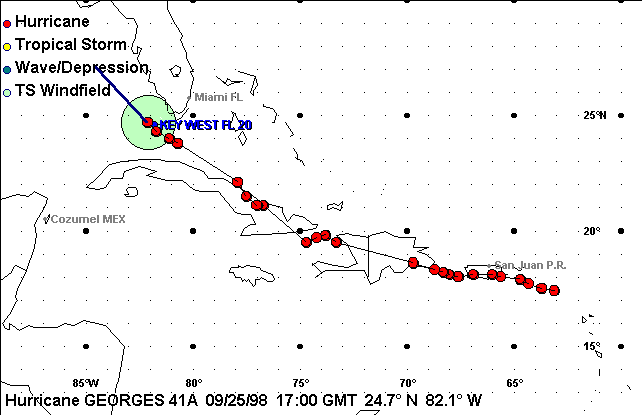 Hurricane Georges position as of September 25, 1998, 1700GMT. |
Southern Florida Assistant SEC Jim Goldsberry, KD4GR, scheduled morning and evening sessions of the Southern Florida ARES Net on 3940 kHz. Arrangements were being made September 25 to possibly declare a communications emergency. Southern Florida Section Emergency Coordinator Manny Papandreas, W4SS, said SKYWARN nets were ready on both Florida coasts to track any tornadoes Georges might generate.
In Broward County, ARES and RACES members were ready to assist at shelters and provide communication for local EOCs. Hams also coordinated with the Red Cross. Hams also were reported in active preparations in other coastal counties. But Georges was pretty much of a bust in the Ft Lauderdale area, reports League member Charlie Geib, N4AV. While the storm generated lots of rain and wind squalls, he said damage there appeared to be minimal.
Since Georges arrived in the Caribbean, the Hurricane Watch Net has run continuously on 14.325 MHz to coordinate storm reports with W4EHW at the National Hurricane Center. The Friendly Caribus Net on 14.283 MHz has been handling health and welfare traffic. Hurricane Watch Net Manager Jerry Herman, N3BDW, says the net got good reports from Caribbean hams, including Cuba's Arnie Coro, CO2KK. "Arnie, was passing radar data and observations that the Hurricane Center was not getting from official sources," he said. (Arnie Coro, CO2KK, also was interviewed by CBS Radio about the storm situation in Cuba.)
Oscar Morales, CO2OJ, reports the storm took out power and telephone service in some provinces. "More than 200 hams worked with the Civil Defense authorities all around the island and played an important role in communications during the disaster," he said. Morales said he was gratified at the level of cooperation among hams in working together to exchange information on the storm. "I'm really proud of being a ham radio operator!" he said.
Hams in Puerto Rico are assisting in the aftermath of Hurricane Georges, which inflicted heavy damage in parts of the Commonwealth earlier this week. "Hams have made a difference here," reports Rafael Medina, NP3HA, in Guaynabo. Medina used a local UHF repeater to contact another ham with HF capabilities who, in turn, contacted Medina's relatives to inform them his family was okay. With widespread telephone outages, Medina says ham radio is being used to keep contact with the center of the island to gather information and needs from the counties there.
Medina said government agencies, including police and medical services, took advantage of communication capabilities provided by ham repeaters that remained up. Power was knocked out over much of Puerto Rico, and telephone service remained spotty at week's end. Water service also was disrupted over much of the island. According to Internet reports, Hurricane Georges took out five ham radio towers at the QTH of well-known contester Pedro Piza, NP4A.
Tens of thousands of Caribbean residents took refuge in shelters. Even so, more than 200 deaths were reported throughout the Caribbean, many of them in the Dominican Republic and Haiti.
In the Netherlands Antilles, Don McGehee, PJ8DM, reported a 175 MPH wind gust on Saba when the storm passed over. Both Saba and St Eustatius were hit very hard by the hurricane, but there were no casualties. Power and telephone service are out over much of the Netherlands Antilles. "The only communication with the outside world is via radio," said Jacobo Oduber, P43P. He said the Aruba ARES repeater was being used to maintain communication among St Maarten, Saba, and St Eustatius. Some damage was reported in the British Virgin Islands, but the US Virgin Islands reportedly suffered only minimal damage. Virgin Islands Section Manager John Ellis, NP2B, said power was knocked out, and long-distance phone service went down. "We passed about 100 messages to the states," he said. Phone service to St. Thomas, St. Croix and St. John was fully restored by week's end, but phone circuits remained busy.
Virginia ARES was activated to provide communication support for American Red Cross Headquarters near Washington, DC. As part of the callup, hams monitored various emergency nets and reported relevant information through Virginia ARES to the Red Cross. The Red Cross used the information to plan its disaster response.
The Red Cross lifted its normal 48-hour moratorium on health-and-welfare inquiries for immediate family only on Puerto Rico, St Thomas/St John, and St Croix on September 24. Inquiries must be submitted on ARC Form 2079 (rev. 8/95). Forms should be faxed to 800-782-7060.
FCC ADOPTS UNIVERSAL LICENSING SYSTEM
Amateurs can say good-bye to the FCC Form 610 series in a few months. The FCC has adopted its long-proposed Universal Licensing System, which replaces Form 610 with a new, electronic Form 605, the Quick-Form Application for Authorization in the Ship, Aircraft, Amateur, Restricted and Commercial Operator, and General Mobile Radio Services. Applicants may continue to use the old forms for six months after the new rules go into effect, however.
The FCC also adopted proposals to permit automatic reciprocal licensing of foreign hams wishing to operate in the US, pursuant to recent international reciprocal operating agreements.
The FCC said the ULS will "fundamentally change" the way the Commission receives and processes wireless applications and makes licensee information available to the public. The rules adopted September 17 will--in the FCC's words--"consolidate, revise, and streamline" license application procedures for radio services under the Wireless Telecommunications Bureau. The FCC last November began initial collection of licensee data to populate the ULS. Using the ULS, applicants and licensees will be able to file, modify, and renew electronically. Access to the ULS is via http://www.fcc.gov/wtb/uls/.
When the FCC first aired its ULS plan, some licensees expressed concerns because ULS registration would require applicants to provide a Taxpayer Identification Number, typically a Social Security Number. In its public notice, the FCC assured that "all TIN information will be kept confidential."
The FCC's action consolidates 40 existing forms into four ULS application forms, including the new Form 605. Electronic filing in the ULS will not yet be mandatory for individual amateurs. Hams will have the option of filing electronically or on paper. However, electronic filing via the ULS will be required for Volunteer Examiner Coordinators in the Amateur Service. Mandatory electronic filing requirements go into effect July 1, 1999 or six months after the use of ULS in a particular service--whichever is later.
An official Report and Order detailing the FCC's actions is expected to be released soon. The FCC's Public Notice is available on the FCC Web site at http://www.fcc.gov/Bureaus/Wireless /News_Releases/1998/nrwl8040.html.
SWEEPS BAND CHANGE RULE WON'T BE ENFORCED THIS YEAR
The ARRL Contest Department will not enforce a new general band-change rule for the 1998 ARRL November Sweepstakes because of what it called "widespread confusion" within the contesting community. The General Rules for All ARRL Contests, published in the December 1997 QST, limit multioperator Sweepstakes entrants to no more than six band changes per hour, a change from previous years. As defined by Sweepstakes rules, even some solo operators must enter in the multiop category. "If you use packet, you go immediately to multiop class," said ARRL Membership Services Manager Bill Kennamer, K5FUV. The Sweepstakes rules only allow one transmitted signal at any given time.
While the General Rules were included by reference in the 1998 ARRL November Sweepstakes Rules in the October 1998 QST, the announcement did not emphasize the change. As a result, Kennamer says the League will not enforce the six-band-changes-per-hour rule this year.
"Because of the change in the way the rules are published, and because we feel that all participants may not have been fully informed about the differences between the multioperator category of the past and the current rule, for this year only, the band change limitation will not be enforced," Kennamer said. But, he added, "unless something changes, we'll enforce it next year."
Single ops who do not use packet spotting networks in their quest for a clean sweep will not be affected by the rules change, Kennamer said.
For further information Contact Bill Kennamer, K5FUV, e-mail bkennamer@arrl.org.
LOWER VANITY FEE BOOSTS APPLICATIONS
According to FCC numbers out of Gettysburg earlier this month, the new, lower vanity call sign application fee induced an additional spurt of applications from the typically thrifty ham radio community. The FCC reports getting 281 applications on September 14, the first day of the new $13 fee, and another 78 applications the next day.
That's in sharp contrast to the 130 or so applications received between August 25 and September 2. In fact, during all of August, the FCC received just shy of 600 vanity applications.
IOY: IT'S EASIER THAN EVER!
Nominations for the Instructor of the Year awards are due to section managers by January 31. Now, it's easier than ever to nominate an exceptional ham radio instructor, teacher or recruiter to receive one of the four annual awards! The ARRL Educational Activities Department has revised the forms. Questions now are easier to answer, to the point, and ask exactly what the impartial officials need to know to make a selection. Each award nomination requires endorsements and testimonials from others, and new forms in the package take the guesswork out of what to write.
Of the four annual awards, two are for instructors. One recognizes paid instructors, such as those teaching through adult education, while the other recognizes an unpaid volunteer instructor. A third award recognizes a teacher who incorporates ham radio into a school curriculum. The fourth award goes to a person who has gone the extra mile to introduce people to Amateur Radio.
To get nomination forms, visit the Educational Activities Department Web site, http://www.arrl.org/ead/award/application.html or contact Jean Wolfgang, tel 860-594-0200; e-mail jwolfgang@arrl.org.
Award winners receive a handsome plaque and recognition for their time and effort in service to the ham radio community. Runners-up get a certificate.
JAMBOREE ON THE AIR '98 IS OCTOBER 17-18
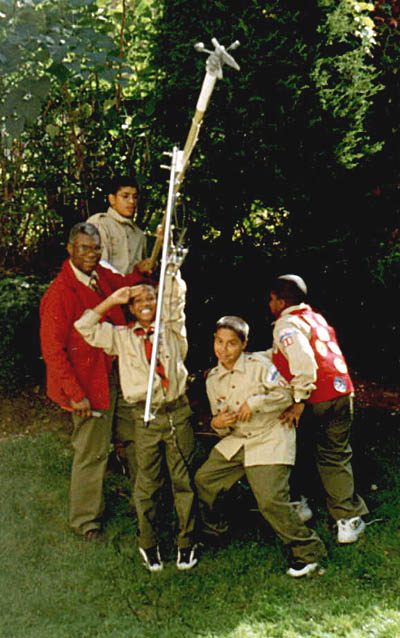 In the Bronx, New York, Cubmaster Lloyd Ferrell, KB2LWR (left) helps his Cub Scout Pack 808 crew--which was not above a little horseplay--prepare to put up a VHF antenna for the 1997 JOTA. | 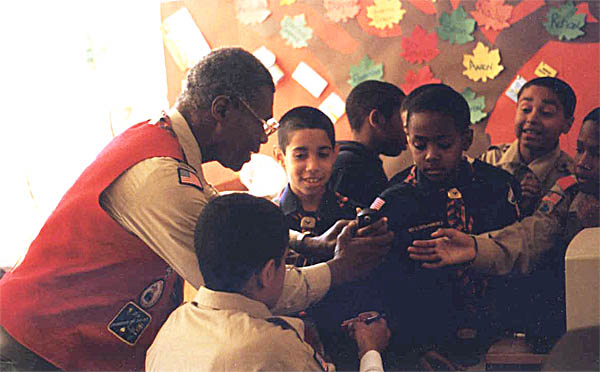 At KB2LWR, Cubmaster Ferrell shows an enthusiastic Scout group how to operate the two-meter radio during the 1997 JOTA. |
On the third weekend of October, more than 400,000 Scouts around the world are expected to get together on the air during the 41st international Jamboree On The Air (JOTA). The annual event gives ham radio veterans a chance to plant the seed of ham radio in the minds of Scouts gathered at stations set up in fields, parks, mountaintops, or even at the veteran op's own shack, to participate.
Remember your first ham radio contact? Experienced hams can give that feeling to future ham radio operators during JOTA by showing Scouts the fun they could have if they embark on a "hobby of a lifetime." JOTA runs from Saturday, October 17, at 0001 local time to Sunday, October 18, at 2359 local time. This means activity continues from Friday to Monday, because of the time differences. During JOTA, participating Scouts not only get a chance to talk to other Scouts in their community or state, but they might even be able to chat with Scouts in different countries!
The radio station of the World Scout Bureau, HB9S, will be on the air from Geneva, Switzerland. HB9S will operate almost continuously, but will take breaks during the night in Europe. Groups can contact the station via packet at HB9S@HB9IAP or via e-mail to Station Manager Yves Margot, jota@world.scout.org. Operators at HB9S say they will do the best they can to make contact with Scout stations worldwide and speak to scouts in as many languages as possible.
JOTA can be a club activity or an individual project. Individual hams who want to get involved should make arrangements with Scout leaders a few weeks in advance (to get contact information, call the local Scout office and make yourself available to your local Cub Scout Pack, Girl or Boy Scout Troop or Explorers). The ARRL Educational Activities Department offers a JOTA information package on the ARRLWeb at http://www.arrl.org/ead/jota.html.
JOTA can sometimes be an outdoors activity like Field Day. The occasion gives veteran hams a chance to set up antennas and demonstrate different modes of radio communication, including packet, RTTY, SSTV, and HF digital modes, as well as voice.
JOTA activity on HF will center around 3740 or 3940, 7290, 14290, 18140, 21360, 24960, and 28990 kHz on SSB or 3590, 7030, 14070, 18080, 21140, 24910, and 28190 kHz on CW. For more JOTA information, see http://www.scout.org/jota/. -- Jean Wolfgang, WB3IOS; Frank Krizan, KR1ZAN
NEW ARRL SITE PROVIDES YOUTH WITH A PLACE TO MEET
A new page on ARRLWeb aims to take advantage of youth interests in computers and the Internet to offer younger hams a place to get together online to arrange on-the-air schedules. Amateur Radio youth groups can just visit the Youth Skeds Database at http://www.arrl.org/ead/youthskeds/ and make skeds with other schools or young people's groups. The ARRL Educational Activities Department credits Phil Downes, N1IFP, for coming up with the idea. Regardless of age, grade level, school or group affiliation, youngsters worldwide can register at this site. This adds them to the list of groups wishing to get acquainted with others via Amateur Radio.
"The purpose of this particular ARRLWeb page is to answer a growing need, thanks to the wide Amateur Radio interest on the Internet," said ARRL Educational Activities Correspondent Dan Miller, K3UFG. "This is a meeting place for youth groups wishing to interact, and contact each other via Amateur Radio. This can be schools at any level, or scouts, or CAP, or any youth auxiliary club."
At the Youth Skeds home page, entering a state (without entering a city) makes it possible to scan a statewide list of groups who have registered. Or you can pinpoint an area by entering a city and state.
"This is a brand new service of the ARRL and is available to all Amateur Radio youth groups, whether they are affiliated with the ARRL or not," Miller said. "Of course, becoming affiliated would provide additional benefits, but the decision is theirs."
Miller says he'll be happy to provide additional information. Call him at 860-594-0340; e-mail dmiller@arrl.org.
SOLAR UPDATE
Solar savant Tad Cook, K7VVV, in Seattle, Washington, reports: Solar activity was up somewhat over the past week. Average sunspot numbers increased by almost 27 points, but solar flux was up by just under three points. The geomagnetic field was quite a bit more active this week compared to last due to solar flares and coronal holes. The day with the most geomagnetic activity last week was September 18, when the planetary A index was 20 and the K index went as high as 6.
The trend for the short term is for more activity. Solar flux for September 25-27 is expected to be 150, 155 and 155, while the major geomagnetic storm is expected to continue with planetary A indices of 25, 30 and 20. As this was being written on September 24, the Boulder K index is 6, indicating a major storm, and the planetary A index for the day was 28. The high latitude A index was 51.
Solar flux is expected to peak around September 29 and 30 at 165, then drop to 150 by October 3, and bottom out around 120 from October 12-14.
This solar cycle is continuing its upward climb. A nice graph which shows the general trend over the past year can be seen at the Northwest Research Associates site at http://www.nwra.com/nwra/spawx/ssne-year.html. Recent and predicted short-term 10.7 cm flux is graphed at the same site at http://www.nwra.com/nwra/spawx/f10.html.
The most important event for the last week affecting HF propagation was the passage into the fall season, which always means an improvement in high frequency propagation. The other important news was the resurrection of the Solar and Heliospheric Observatory which is again facing the sun. Until recently the outlook for SOHO was bleak, but now scientists hope to restore much of its capacity for solar observation.
Sunspot numbers for September 10 through 16 were 123, 134, 118, 111, 106, 71, and 86, with a mean of 107. The 10.7-cm flux was 141.7, 138.6, 134.9, 130.7, 121.8, 117.3, and 118.7, with a mean of 129.1. The estimated planetary A indices were 5, 5, 12, 6, 6, 7, and 4, with a mean of 6.4.
Sunspot numbers for September 17 through 23 were 100, 106, 133, 130, 151, 154, and 162, with a mean of 133.7. The 10.7-cm flux was 117.4, 122.5, 126.9, 132.1, 138.3, 141.1, and 143.2, with a mean of 131.6. The estimated planetary A indices were 7, 20, 12, 8, 14, 10, and 14, with a mean of 12.1.
In Brief:
- This weekend on the radio: The CQ WW RTTY Contest, the Heart of Dixie QSO Party, and the Classic Radio Exchange are on tap this weekend. Just ahead: The California QSO Party, the VK/ZL/Oceania Contest (SSB), and the RSGB 21/28 MHz Contest (SSB) are the weekend of October 3-4.
- IARU Region 2 Conference special event: Special event station YV7AJ will be on the air September 27 until October 3 to mark the IARU Region 2 Conference during that period on Margarita Island, Venezuela. Operation is expected to be primarily on HF. QSL via the Radio Club Venezolano bureau.
- Correction: We had the incorrect Web address for the EROS center in The ARRL Letter, Vol 17, No 37. The correct URL is http://edcwww.cr.usgs.gov/content_about.html.
- 1998 "Pack Rat" Conference: Attention VHF/UHF/microwave ops. Hamarama Weekend '98, the Mid-Atlantic States VHF Conference (better known as the "Pack Rat Conference") is set for October 3-4, 1998, at the Hampton Inn, Willow Grove, Pennsylvania, sponsored by the Mount Airy VHF Radio Club. Saturday's program is "packed" with technical presentations, an interesting speaker lineup, and several technical sessions, including noise figure measurements, network analyzers, spectrum analyzers and power supplies. All equipment will be operational up to 10 GHz. Conference presentations will include "Aurora Detector" by Dave Olean, K1WHS; "Patch Antennas," by Chris Fagas, WB2VVV; "High Speed Meteor Scatter," by Maarten Broess, W1FIG, and Steve Harrison, KO0U, and "New Microwave Devices" by Steve Kostro, N2CEI. The Hamarama Flea Market is Sunday at the Bucks County Drive-In in Warrington, Pennstylvania. Additional details are at http://www.ij.net/packrats. -- Mt Airy VHF Radio Club
- QST Cover Plaque Award: The August QST Cover Plaque Award went to Wes Hayward, W7ZOI, and Terry White, K7TAU, for their article "A Spectrum Analyzer for the Radio Amateur." Congratulations Wes and Terry!
- Newest Edition of The FCC Rule Book: The new 11th edition of The FCC Rule Book from ARRL includes everything you need to know about the rules that govern the Amateur Radio Service. This handy tome includes easy-to-read explanations, and it's been updated and reorganized to make it even more user-friendly. The book include all of Part 97 as well as the US Amateur Band Plan, information on repeaters, public service, and interference; technical standards, including RF exposure rules, and much m ore. This latest edition is available in mid-October. Order item 6966. It's just $12. Call toll-free 888-277-5289 or visit ARRLWeb, http://www.arrl.org/catalog/.
- Mir packet frequency: MIREX reports the packet system frequency for Mir's PMS system is again 145.985 MHz. Until September 2, the crew had been using 145.940 MHz.
- Michigan club aids bicycle tour: The Big Rapids Area Amateur Radio Club (BRAARC) provided communication during the Michigander Weekender portion of the Detroit Free Press Cross State Mountain Bike Ride in mid-July. More than 1000 cyclists of all ages took part in the weekend event, and some 700 attempted the weeklong tour, the seventh annual. Amateur Radio cyclists contacted the club to help during the weekender, a 44-mile run from Big Rapids to Cadillac and back. Some 20 hams pitched in during the event and helped to handle emergency calls for injuries, spills, exhaustion and heat, as well as more routine traffic. --thanks to William Eckels, W8ZNH/BRAARC
- W0SL to appear in CNN series: Roy Welch, W0SL, of AMSAT fame says he's scheduled to appear in CNN's Cold War series, which starts airing September 27 on the cable grid. There are 24 programs in all. Welch has been told by CNN that his brief shot in the limelight will come during episode 8, "Sputnik," set to air November 15. Welch tells the ARRL's Jennifer Gagne, N1TDY, that his old Sputnik recordings--posted on the AMSAT Web site (http://www.amsat.org) included one from October 1957, when the first artificial Earth satellite was launched. Its presence prompted a call from CNN asking if they could use the recordings and interview him for the production. "I agreed, and they flew me to Washington where I was interviewed and taped," he said. His "15 minutes of fame" actually lasts less than a minute.
- Zack Lau continues to improve: ARRL Senior Lab Engineer Zack Lau, W1VT, continues to improve following his hospitalization earlier this month. "He is in reasonable spirits, and he even laughed at most of my jokes," ARRL Lab Supervisor Ed Hare, W1RFI, said following a recent visit. Friends and well-wishers can e-mail Zack Lau at w1vt@arrl.org. Cards are welcome to ARRL, 225 Main St, Newington, CT 06111.