ARRL Audio News
| · | To subscribe, unsubscribe, or change your e-mail delivery address: see How to Get The ARRL Letter, below |
| · | Delivery problems (ARRL member direct delivery only!): letter-dlvy@arrl.org |
| · | Editorial questions or comments: Rick Lindquist, N1RL, rlindquist@arrl.org |
| · | ARRL Audio News: http://www.arrl.org/arrlletter/audio/ or call 860-594-0384 |
| · | The ARRLWeb Extra: http://www.arrl.org/members-only/extra |
IN THIS EDITION:
- +Structuring the restructuring debate
- +Two well-known hams hospitalized
- +New satellites working well
- +KF4BIA is Newsline's Young Ham of the Year
- +HF net helps quench forest fire
- Survey: General, weekend Tech classes popular
- FAR 1998 scholarship winners
- Solar update
- In Brief: This weekend on the radio; ARRL job opportunity; Call for papers; Educational Workshop Proceedings available; International-style foxhunt set; More astro-hams; New DX reflector; K3ZJ gets PCIA Foundation Award; Y2K info; K6DUE remembers Alan Shepard flight; Mongolian special event station
+ Available on ARRL Audio News
STRUCTURING THE RESTRUCTURING DEBATE
Love it or hate it, the ARRL's recent license restructuring plan certainly has generated considerable debate and controversy within the Amateur Radio community and gotten licensees thinking about what's good and what's not so good about the current system. ARRL Directors report they're getting lots of e-mail on both sides, and the overall trend appears to be in favor of the plan the Board released earlier this month.
Midwest Director Lew Gordon, K4VX, reports that his mail has been running better than two-to-one in favor. New England Director Tom Frenaye, K1KI, said he's having trouble keeping up with the avalanche of comments. "I've received 166 messages from New England hams, and the count is 105-61 in favor of the proposal," he said, adding that he still has about 50 messages to answer.
Some hams have suggested the current system is just fine, and to change it will diminish the status of current licensees. ARRL Executive Vice President David Sumner, K1ZZ, has an answer for the "don't-change-anything" camp, however. "If you're flatly opposed to any change at all, I don't think that you've taken into consideration the changes that have occurred over the past seven years," he said. For example, Sumner points out that the Novice license--instituted in 1951--no longer is the route of entry to Amateur Radio for more than about 5% of the amateur population. Other than 10 meters, the Novice bands "are significantly underutilized," he observed. Sumner says amateurs can't make a case for additional bands if the present allocations aren't being used to capacity.
In recent years, most of those coming into the hobby have come in as Technicians. Nevertheless, they still must pass the Novice element, which includes questions on HF that are irrelevant to Technician ops. "This pretty much forces you to accept the fact that there must be some change," he said. "The real issue is how far should that change go, and on that, reasonable people can and will differ, and we'll be discussing that over the coming months as the process goes forward."
Sumner said nothing is cast in stone at this point, and if better ideas surface as a result of the current debate, "there will be every chance for those to be reflected in the ultimate FCC action."
The ARRL has sent a copy of its restructuring proposals to the FCC in a letter, but the League has not petitioned for a rulemaking as it awaits the Commission's own ham radio restructuring proposal, still in the draft stages. There's still no definite word on when the FCC's proposal will be made public. "Things are moving along," said an FCC spokesman, who added that the Commission has begun getting comments on the ARRL's proposal. The FCC is expected to issue a Notice of Proposed Rulemaking that also will seek input from amateurs on various alternatives. The FCC spokesman suggested that hams wait until the Commission's proposal goes public before commenting on the issue.
TWO WELL-KNOWN HAMS HOSPITALIZED
A king and a cardinal--both well-known in ham radio circles--underwent treatment in separate hospitals this week.
King Hussein (Hussein Ibn Talal) of Jordan, JY1, has been at the Mayo Clinic in Rochester, Minnesota, this week, undergoing chemotherapy for lymphatic cancer. Press reports said the king responded well to early treatment and showed signs of an early recovery. Hussein, 62, has ruled Jordan for 45 years. He underwent prostate cancer surgery in 1992 and has had regular medical checkups in the US since then.
On the West Coast, Los Angeles Roman Catholic Cardinal Roger M. Mahony, W6QYI, who underwent prostate surgery a month ago, was hospitalized again for a blood clot. He was expected to be able to return home in a few days, according to a statement from the Archdiocese of Los Angeles earlier this week. Mahony also is 62. The LA Archdiocese is the largest in the US.
NEW SATELLITES WORKING WELL
After just a couple of weeks in space, the two newest Amateur Radio digital satellites--TMSAT-1 and TechSat-1B--are reported responding to flight commands from ground-control stations. The two micro-satellites were successfully launched July 10 from Russia's Baikonur Cosmodrome.
Chris Jackson, G7UPN/ZL2TPO, reports that the initial part of the flight software is now running on TMSAT-1, and the onboard computer system has been switched to the downlink. "Users familiar with the current digital satellites will now be able to observe TMSAT data using standard ground-station software," said Jackson. The official control station for TMSAT is HS0AM in Thailand, but Jackson is handling ground control during the initial phases.
Jackson says the satellite's call sign is TMSAT1. It transmits on 436.923 MHz. At present, it may be 3 kHz too high in frequency because the internal spacecraft temperature is quite cold. The transmitter is currently only being switched on over Bangkok during commissioning tests. Current output power is approximately 1.7 to 2 W. G7UPN requests that stations refrain from attempting to uplink to the spacecraft at this time.
The Gurwin II TechSat-1B also is reported responding well to flight commands. Shlomo Menuhin, 4X1AS, says the TechSat-1B downlink frequency was recently changed to 435.225 MHz with the satellite transmitting in telemetry mode. The satellite does not have a continuous beacon, but does transmit a 9600-baud burst every 30 seconds (for about 3 seconds). Menuhin estimates that it will take several weeks to complete initial in-orbit testing. In the meantime TechSat-1B will continue its present burst-mode transmission format. TechSat-1B will be a digital store-and-forward multi-user system. For more information, visit http://techsat.internet-zahav.net/.
Stations around the world continue to report receiving signals from the two new satellites.--AMSAT News Service
KF4BIA IS NEWSLINE'S YOUNG HAM OF THE YEAR
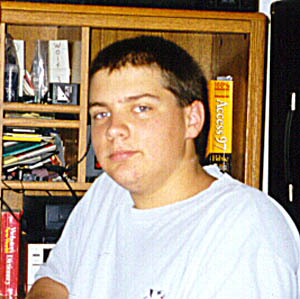 [paz KOW skee] |
Paczkowski, 16, is active in emergency communication. He holds a Technician-class license and attends New Smyrna Beach High School. He was selected as this year's YHOTY recipient based on his four-year Amateur Radio career that has been dedicated almost exclusively to public service, including organizing communication support during the recent Florida wildfires. Paczkowski is a member of Volusia County ARES and serves as an AEC. When the wildfires began raging out of control in late June, the EC was out of town, so the job of organizing the region's hams fell to Paczkowski.
During the fire emergency, he coordinated operators for Red Cross shelters in Volusia County and worked late shifts at the emergency operations center.
In a magnanimous gesture, Paczkowski has donated part of his prize--an all-expenses-paid week at Spacecamp Huntsville underwritten by CQ magazine--to the Make A Wish Foundation. The Foundation attempts to grant wishes for children with life-threatening illnesses.
Richard is the son of Richard Sr, KE4ZTP, and Joan Paczkowski. The father and son team studied together to obtain their ham tickets in hopes of being able to schedule contacts with Richard's uncle, Bill Paczkowski, KT4OM, in North Carolina.
Presentation of the 1998 Newsline Young Ham of the Year Award will be August 15 at the Huntsville (Alabama) Hamfest banquet. As Young Ham of the Year, Paczkowski also will receive--courtesy of Yaesu USA--an all-expenses-paid trip to the hamfest, along with a gift of Yaesu ham radio equipment. CQ magazine also will present him with a variety of products. Newsline will present a commemorative plaque, underwritten by Dave Bell, W6AQ, President of DBA Entertainment in Hollywood (and chairman of the ARRL Public Relations committee).
The YHOTY award goes annually to a ham 18 or younger who has provided outstanding service to the nation or his community, or the betterment of the state of the art in communications through Amateur Radio. Last year's YHOTY winner was Brian Mileshosky, N5ZGT.--thanks to Amateur Radio Newsline
NOON TIME NET HELPS FIGHT FOREST FIRE
Hams on the HF Noon Time Net (40 and 75 meters) on the West Coast were able to help forest service crews get the jump on a potentially dangerous forest fire July 19. Net member Jan Van Allen, N7WJB, reports that Clyde Little, AA7WC, in Grants Pass, Oregon, was running the 40-meter side of the net. Typically, he starts greeting potential check-ins early, before the net gets down to business at noon.
On July 19, a Sunday, a ham couple from Dublin, California, camping in the Stanislaus National Forest discovered a forest fire that had just started. John Hayward, KE6ME, and his wife, Jeanette, KF6NCA, first tried their cell phone but were out of range. John Hayward then dialed up the Noon Time Net and broke in. Little immediately had the net stand by. Fortunately, KE6ME had his GPS with him and was able to give precise coordinates for the fire. Not only that, he was able to relay the numbers of the fire service roads and highways to get to the fire site.
Little then called Dave Glisan, WB6JJR, in Fenton, California, and relayed all the pertinent information, Glisan, in turn, called the Forest Service and alerted them to the situation. The Forest Service relayed back through Glisan to Little to John Hayward, who by then had jumped into his jeep and was on his way to high ground to try his cell phone, in case contact could not be accomplished via ham radio. He need not have worried.
Van Allen says the entire procedure, including relays took less than ten minutes to get firefighters on their way to the two-acre (and growing) fire. Fire crews had the blaze under control within a short time.
The Noon Time Net meets every day on 7.268.5 MHz and 3.970 MHz, and covers the entire West Coast handling traffic, informal contacts, and--occasionally--an emergency like this.--Jan Van Allen, N7WJB
GENERAL, WEEKEND TECH CLASSES POPULAR, SURVEY SHOWS
The ARRL Educational Activities Department has completed the tally of data from this spring's Volunteer Instructor Questionnaire. EAD received nearly a 14% return of questionnaires. Volunteer instructors taught more General Class courses in 1998 than in 1997, and more taught weekend Technician courses--probably due to encouragement of each from EAD. Other results from the instructors' survey:
- Volunteer instructors taught an average of 1.5 classes in the past year. This is about the same as last year.
- Pass rate for students in the classes is 71%, again about the same as last year.
- Average class size is 8.2 students, up slightly from last year.
- Novices made up 12% of the graduates, up by 7% from last year.
- Techs made up 56% and Tech Plus licensees made up 21% of the graduates, down by 11% less than last year.
- Generals made up 9.5% of the graduates, up nearly 5% from last year.
- Advanced licensees made up 1.5% of the graduates, up slightly from last year.
- 72% of volunteer instructors used Now You're Talking, down from last year.
- 28% of volunteer instructors used the Tech Q & A, 23% more than last year.
- 9% of volunteer instructors used the ARRL Tech Video Course, up 4% from last year.
- 90.5% of the volunteer instructors are ARRL members, up slightly from last year.
- Instructors estimated that more than half of their graduates join the ARRL.
FAR 1998 SCHOLARSHIP WINNERS
The Foundation for Amateur Radio announces these 1998 scholarship winners:
FAR Silent Key Memorial Scholarships ($1000):
-
Hernan G. Hidalgo, N3OKP, Silver Spring, Maryland; Jeffrey K. Meunier, KE4PDQ, Great Falls, Virginia; Cynthia A. Mann, KA3ZNQ, Severna Park, Maryland.
QCWA Memorial Scholarships:
-
Ralph Hasslinger (W2CVF) Charter Member Scholarship ($1000): Christie L. Berger, N0YVV, House Springs, Missouri; Max Jacobson, John Kelleher Family Scholarship ($1000): David P. Swaney, N3KCS, Mifflinburg, Pennsylvania; QCWA Leo Meyerson Family Living Scholarship ($800): Adam K. Lassiter, KB8UUE, Bunker Hill, West Virginia; Donald & Phyllis Doughty Family Scholarship ($600): Matthew P. Robbins, N8UGD, Kalamazoo, Michigan; QCWA Edwin Woodruff (W3SX) Memorial Scholarship ($600): Ramona M. Gonzales, KD6GHK, Fresno, California; QCWA Travis Baird (W9VQD) Memorial Scholarship ($500): Beth A. Harris, KJ7FC, Cheyenne, Wyoming.
QCWA Memorial Scholarships ($800):
-
Thomas A. Brunet, KD4LMH, Round Rock, Texas; James E. Catalano, KC4SZT, Woodbridge, Virginia; Victoria L. Crawford, N4XDR, Virginia Beach, Virginia; Carolyn M. Creel, N3UXZ, Silver Spring, Maryland; Sarah R. Dalton, N0MAS, Lexington, Missouri; Christopher T. Duncan, AD4G, Asheville, North Carolina; Jason C. Haren, KB8NOH, North Canton, Ohio; Jason E. Jensen, KC7UDB, Longview, Washington; Arkadiusz Misztal, SQ8AQY, Cieszanow, Poland; Jason A. Pelaez, N8NDQ, Huber Heights, Ohio; Andrew Webb, VE3UIY, Carp, Ontario.
Radio Club of America Scholarships:
-
From the Richard Somers Fund ($1000): Zachary D. Sadecki, KB7FUV, Ashton, Idaho; from the Poppele Fund ($750): Scott A. Zastoupil, KB0KFX, Williston, North Dakota; from the J. Alan Biggs Fund ($750): John M. Steenis, KI7LX, Phoenix, Arizona; from the Leo Meyerson (W0GFQ) Fund ($750): David G. Sansone, KB2WEV, Webster, New York; in Memory of Stuart Meyer, W2GHK ($750): Kyle E. Britain, K5UBE, Grand Prairie, Texas.
Richard G. Chichester Memorial Scholarship ($1000), sponsored by Patricia and Jack (W9AMF) Chichester: James J. Behnke, K2VER, Highland Lakes, New Jersey
Young Ladies' Radio League Scholarship ($1500): Sarah L. Kozup, KB8RHG, Warren, Ohio
Columbia Amateur Radio Association Scholarship ($1000): Colleen M. Traughber, KB0PWW, Laurel, Maryland
Baltimore Amateur Radio Club Scholarships ($1000):
-
Nicholas P. Schaub, KE3HV, Baltimore, Maryland; Franklin L. Wright, N3OQB, Silver Spring, Maryland; Aileen K. Hudspeth, N3YAC, Woodbine, Maryland; Edward M. Cabic, N3IHX, Columbia, Maryland; Ernie Dobos Memorial Scholarship: Michael S. Calhoon, N3SNI, Arnold, Maryland.
Ralph V. "Andy" Anderson, K0NL, Memorial Scholarship ($1000): Nathan P. Jeffries, KI7QT, Spokane, Washington
Dade Radio Club Tropical Hamboree Scholarships ($1000):
-
Theresa A. Hartley, N4WVF, St. Augustine, Florida; Dennis M. Feehan, KD4SBN, Boca Raton, Florida.
Rose Ellen Bills Memorial Scholarships ($2000):
-
Jeffrey P. Morris, N3WEL, Hockessin, Delaware; Daniel S. Zimmerman, N3UMH, Erie, Pennsylvania.
Vienna (VA) Wireless Society Memorial Scholarships ($1000):
-
Victor C. Clark Memorial Scholarship: Melody L. Siff, KE4ACK, Chesapeake, Virginia; Paul E. Wilkins Memorial Scholarship: James S. Sikorski, N3PBH, Wapwallopen, Pennsylvania.
Frederick Amateur Radio Club Scholarship ($1000): Brian G. Roberts, KB3AWM, Knoxville, Maryland
10-10 International Net Scholarships ($1000):
-
Michelle R. Sciarini, KB8ILX, Dover, Ohio; April D. Rodgers, N3PPU, Butler, Pennsylvania; Michelle G. Pettus, KC4FBE, Lineville, Alabama; John K. Cowden, KC5DCP, Benton, Arkansas.
Kevin Barry Perdue Memorial Scholarship ($2000), sponsored by Kay (WT3P) and Carter (N3AO) Craigie: Paige E. Forrest, KE3UB, Baltimore, Maryland
WARAC Memorial Scholarships ($1000), sponsored by the West Allis Radio Amateur Club:
-
Jessica L. Winzenried, KB9AMX, Stevens Point, Wisconsin; Kurtis M. Kaun, N9PPF, Menomonie, Wisconsin; Michael R. Placek, KB9SCH, Oak Creek, Wisconsin.
South Milwaukee Amateur Radio Club Scholarships ($500):
-
Joseph A. Streeter, AA9TV, Fond du Lac, Wisconsin; Wayne N. Poole, KB9ROV, Manawa, Wisconsin; Michael M. Imrick, KB9LPJ, Mason, Wisconsin; David J. Bahr, KB9GHE, Sheboygan, Wisconsin.
Nanticoke Amateur Radio Club Scholarship ($1000): James D. Osborne, N3LNS, Seaford, Delaware
Murgas Amateur Radio Club Scholarship ($500): Gregory Gutka, N3NLF, Easton, Pennsylvania
Virginia Beach Hamfest Scholarships ($1000):
-
Jeremy A. Williams, KO4SJ, Virginia Beach, Virginia; Matthew P. Ipock, KM4WZ, Chesapeake, Virginia; Ann Marie Stanley, KE4SCR, Chesapeake, Virginia.
William R. Jochimsen, K4ZK Memorial Scholarship ($1000), sponsored by the Martin County Amateur Radio Association: Marco M. Midon, N5ACR, Miami, Florida
Ernest L. Walker, WB3DVL Memorial Scholarship ($1000), sponsored by the Baltimore Radio Amateur TV Society: Dana L. Eshelman, WS3L, Ft Washington, Maryland
Free State Amateur Radio Club Scholarship ($1000): Andrew M. Roberts, W3KN, Davidsonville, Maryland
Robert E. True Memorial Scholarship ($1000), sponsored by Mrs. Shirley True Banning: Derrick I. Cobb, KB8NZT, Peebles, Ohio
Lawrence E. and Thelma J. Norrie Memorial Scholarship ($2500): Patricia L. Pelczar, KA1TPM, Rocky Hill, Connecticut
Old Old Timers Club Scholarship ($600): Erin M. Swaney, N3MGY, Mifflinburg, Pennsylvania
Ozaukee Amateur Radio Club Scholarship ($1000): Christopher D. Molek, KB9GTK, Richland Center, Wisconsin
Northern California DX Foundation Scholarship ($1000): Elizabeth M. Pelczar, KA1SLD, Rocky Hill, Connecticut
Maryland Mobileers Memorial Scholarship ($1000): Dean E. Merritt, N3PTD, Hunt Valley, Maryland
Congratulations to this year's scholarship winners. For more information, contact the Foundation for Amateur Radio, PO Box 831, Riverdale, MD 20738.
SOLAR UPDATE
Solar sage Tad Cook, K7VVV, Seattle, Washington, reports: Solar activity was a bit higher this week, with average solar flux up nearly 14 points and sunspot numbers higher by about 6 points. On July 23 the planetary A index was 37, exactly the same as a week earlier. A few days later geomagnetic indices had settled down, and after July 25 conditions were quite stable. Solar activity is still lower than most forecasters had predicted for this point in the solar cycle. Perhaps we can take some solace by comparing current conditions with those of a year ago. Average solar flux this week is about 45 points higher than the average solar flux for the same week last year. You can peruse last year's propagation bulletins at http://www.arrl.org/w1aw/prop/1997-index.html
For July 31 through August 2, predicted solar flux should decline to 112, 110 and 108, and planetary A index should be around 10 each day. Solar flux is expected to bottom out just above 100 around August 9-13, then rise above 110 after mid-month and back around 120 after August 20. Look for disturbed conditions around August 17-21, with the highest A and K indices around August 19 and 20. This is due to a recurring coronal hole rotating back into a position which should affect Earth.
A good way to visualize the rotation of the sun with sunspots and coronal holes drifting across the visible solar disk is to look at the Marshall Space Weather bureau 10 day solar animation site at http://spaceweather.com/java/solar-anim.html.
Radio telescopes have finally located the SOHO spacecraft rotating slowly near its original position. It is not far off course, and it still may be possible to establish contact and get it working again. If not, it might be feasible to put similar instruments in another proposed orbital craft called Triana, the proposed craft that is supposed to beam a live picture of Earth back to a Web page on the Internet.
The loss of SOHO has been a big disappointment for solar observers. Things went awry when ground control turned off a gyroscope, hoping to extend the life of the instrument. When a previously unknown software error caused the craft to spin out of control, craft computers looked to the gyroscope for emergency guidance, and, due to the lack of signal, misjudged the position in relation to the sun. When this happened, solar panels turned away from the sun, and SOHO lost power.
In August, particularly later in the month, we may start to see some fall conditions on HF, with higher usable frequencies during daylight. Twenty meters should be the most reliable band for long range communications, but look for occasional openings on 15 meters and transequatorial conditions on 10 and 12 meters.
Interesting events continued on VHF this week, with 6 and 2-meter openings from Hawaii to the West Coast. There was a report of six meter propagation from South America to Israel from PY5CC, and N5JHV worked Japan after 0030 UTC on 6 meters.
Sunspot numbers for July 23 through 29 were 129, 110, 85, 80, 109, 116, and 115, with a mean of 106.3. The 10.7-cm flux was 115.4, 125.2, 121.7, 119.1, 119.5, 121.3 and 119.5, with a mean of 120.2. Estimated planetary A indices were 37, 22, 16, 6, 6, 6, and 6, with a mean of 14.1.
In Brief:
- This weekend on the radio: The ARRL UHF Contest is on tap this weekend. Also: The Ten-Ten International Net Summer Phone Contest, the QRP ARCI Summer Daze SSB Sprint, and the YO-DX Contest (CW). Just ahead: The Maryland-DC QSO Party and the Worked All Europe DX Contest (CW) are set for the August 8-9 weekend.
- ARRL job opportunity: The ARRL seeks an energetic, challenge-driven amateur with a passion for contests to be Contest Branch Manager. This person reports to the Membership Services Department Manager and supervises activities of the Contest Branch. Candidates must be familiar with the ARRL contest program and be familiar with The DXCC List and ARRL divisions and sections. Candidates must have knowledge of Microsoft Office, an Amateur Radio license, a college degree or equivalent, and public-speaking ability. Writing and programming skills are a plus. This person represents the League in public. Some travel is required. Duties include supervising Contest Branch employees as well as coordinating with volunteers. Responsibilities include receiving and processing contest logs, and preparing results of ARRL contests for publication in QST, as well preparing material for the ARRLWeb page. The Contest Branch Manager also participates in preparing branch budgets, answers correspondence, and handles telephone requests. Salary is commensurate with experience. Send résumé to: Membership Services Manager Bill Kennamer, K5FUV, 225 Main St, Newington CT 06111. No telephone calls please. The ARRL is an equal opportunity employer.
- Call for papers: The ARRL seeks articles for the next volume of the very popular The ARRL Antenna Compendium series. An article should be previously unpublished and should deal with antennas, transmission lines, or propagation. Submit articles (or solid ideas for possible articles) to Dean Straw, N6BV, ARRL, 225 Main St, Newington, CT 06111 or via e-mail to n6bv@arrl.org.
- Educational Workshop Proceedings available: The Proceedings of the 1998 ARRL National Educational Workshop now are available. This publication lets authors share their ideas, thoughts and experiences so volunteer instructors and recruiters can gain valuable input for their own Amateur Radio classes, projects and recruiting. Topics focus on teaching Amateur Radio classes, getting new hams on the air, and recruiting new hams. Articles of interest to volunteer instructors and recruiters include "Teaching the Radio Merit Badge," by Stephen Auyer, N2TKX; "A Parallel Resistance Demonstration," by Alan Mills, KA7GKH; "Summary of Science Lecture Program to Middle Schools," by Fred Schnittker, W0NDQ; and "Teaching Amateur Radio to Persons with Disabilities," by Jim Hammock, KI0DN. Copies of the 1998 Proceedings are $12 from the ARRL. Send checks and money order to ARRL, 225 Main St, Newington, CT 06111; for credit card orders, call 800-326-3942. Back issues of Proceedings from 1989-1996 also are available at a cost of any three editions for $12. To submit articles for future editions, contact Jean Wolfgang, WB3IOS, ARRL Educational Activities Department, for an author's guide; tel 860-594-0200; e-mail jwolfgang@arrl.org.
- International-style foxhunt set: A practice run for the Amateur Radio Direction Finding World Championship is set for August 1 at Hacienda Heights, California. ARRL ARDF Coordinator Joe Moell, K0OV, says the international-style on-foot foxhunt is an official training event for the World Championship during early September in Hungary. At least three members of the USA ARDF Team are scheduled to attend, including Team Captain Dale Hunt WB6BYU. The California event is free and open to all. For details, contact Joe Moell, K0OV, e-mail homingin@aol.com; http://members.aol.com/homingin/.
- More astro-hams: According to our latest count, the number of astronauts with ham tickets now stands at 86. Among the latest licensees are Kalpana Chawla, KD5ESI; Stephen N. Frick, KD5DZC; Stephanie D. Wilson, KD5DZE; and Timothy J. Creamer, KC5WKI.
- New DX reflector: Jim Kehler, KH2D, reports that with the demise of the VE7TCP reflector, he has set up an unmoderated e-mail reflector. "Anyone interested in DXing is welcome to subscribe," he says. "In the event that the old reflector doesn't find a new home, this one will stay in place." Information is available on the Mariana Islands DX Association Web site, http://www.guam.net/pub/midxa/dx-list.html. The MIDXA site is mirrored at http://www.qsl.net/midxa. The site has recently added a public service page, club photos, and MIDXA digital voice keyer software for Windows, which may be downloaded.--Jim Kehler, KH2D
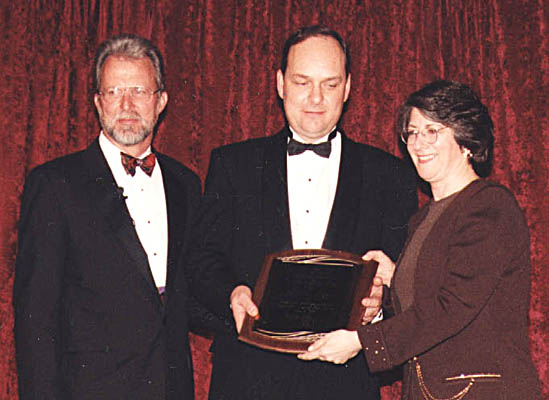
PCIA President Jay Kitchen (l) and FCC Commissioner Susan Ness present the Eugene C. Bowler Award to FCC Legal Advisor Dave Siddall, K3ZJ, at a May 5 awards dinner in Washington, DC.
- K3ZJ gets PCIA Foundation Award: The Personal Communications Industry Association (PCIA) Foundation has presented its annual Eugene C. Bowler Award to former FCC legal advisor Dave Siddall, K3ZJ. The award, named for a former chief of the FCC's Private Radio Bureau/Land Mobile and Microwave Division, recognizes an outstanding public servant who has demonstrated career excellence. Siddall left the FCC July 8 and is now "of counsel" at a major Washington, DC, law firm. An FCC veteran, Siddall had worked in the office of FCC Commissioner Susan Ness.--thanks to PCIA
- Y2K info: The July/August issue of The AMSAT-NA Journal will discuss the year 2000 (Y2K) computer problem. The issue contains a few articles on the topic and discusses how the problem will affect the amateur satellite community.--AMSAT News Service
- K6DUE remembers Alan Shepard flight: Retired NBC science reporter and SAREX Working Group Chairman Roy Neal, K6DUE, got to know astronaut Alan Shepard very well in the early days of the space program. Shepard--the first US astronaut launched into space--died July 21 at age 74. Shepard also was one of 12 astronauts to walk on the Moon (Apollo 14). While Shepard never was interested in ham radio, Neal says he was very aware of radio and communication. "I was the Pool Producer for his Mercury flight," he said. "The combined networks built a special mobile unit to feed some 100 networks worldwide." Neal said NASA had the networks fire up its broadcast system to make sure it would not generate RFI that could affect Shepard's spacecraft. It was clean. "Later that day, Shepard accosted me. 'Are we compatible?' he asked. I retorted, 'If you mean RF, yes we are. Socially I'm not so sure!' Neal said network employees who were hams used that background to advantage. "The coverage from the [aircraft] carrier was provided by a pair of Collins KWM-2s, which the Navy let us install," Neal recalled. "When President Kennedy preempted all Navy circuits to talk to Shepard aboard the carrier, we had a great exclusive. The whole world, including NASA, had to turn to the radio-TV pool to find out what was going on!"
- Mongolian special event station: JU60MTZ will remain active until Aug 31 to mark the 60th anniversary of the Mongolian Railway Board. QSL via JT1CJ, Sh. Gankhuyag, PO Box 100, Ulaanbaatar-44, Mongolia; e-mail jt1kaa@publica.ub.mng.net.--thanks JT1CD