ARRL Audio News
| · | To subscribe, unsubscribe, or change your e-mail delivery address: see How to Get The ARRL Letter, below |
| · | Delivery problems (ARRL member direct delivery only!): letter-dlvy@arrl.org |
| · | Editorial questions or comments: Rick Lindquist, N1RL, rlindquist@arrl.org |
| · | ARRL Audio News: http://www.arrl.org/arrlletter/audio/ or call 860-594-0384 |
| · | The ARRLWeb Extra: http://www.arrl.org/members-only/extra |
IN THIS EDITION:
- +Many comment on LMCC petition
- +Ham letters on LMCC flood FCC
- +Andy Thomas bids Mir farewell
- +Next WRC to be in 2000
- +WB6BYU to lead US ARDF team
- +Doug Smith, KF6DX, named QEX Editor
- K5TR is new QST Contest Corral/Special events editor
- FCC sequential call sign update
- Solar update
- In Brief: This weekend on the radio; Vanity update; Dayton attendance up! Filing deadline extended; Nominations due
+Available on ARRL Audio News
MANY COMMENT ON LMCC PETITION
Hundreds of formal comments have been filed in the wake of the Land Mobile Communications Council's rulemaking petition (RM-9267) seeking primary access to 420 to 430 MHz and 440 to 450 MHz for the Private Mobile Radio Service (PMRS) at the expense of the federal government. The petition also seeks other UHF spectrum. It's now expected that the FCC will extend the comment deadline on the LMCC petition.
Among formal commenters, those weighing in on the side of Amateur Radio--at least in terms of preserving the current secondary (shared) allocation on 70 cm for ham use--included the ARRL (see "ARRL asks FCC to deny LMCC 70 cm grab," The ARRL Letter, Vol 17, No. 23); the National Telecommunications and Information Administration (NTIA), which manages federal spectrum; the Quarter Century Wireless Association (QCWA); the Amateur Television Network; the Sarpy County, Nebraska, Emergency Management Agency; the Washtenaw County, Michigan, Emergency Management Division; the DiPaolo Timber Corporation; AMSAT-NA, and the Association of Public-Safety Communications Officials-International (APCO). All cited the public service benefit derived from volunteer Amateur Radio operations in the event of emergencies and disasters.
Washtenaw County Director of Emergency Management Marc Breckenridge called 440 to 450 MHz "a priceless resource to emergency management organizations" and said its reallocation would not be in the public interest. DiPaolo Timber CEO Carl DiPaolo, W7EXH, likened the sharing arrangement by hams and the federal government to "multiple use of the forests, many citizen users sharing a resource." DiPaolo went on to day, "Once the PMRS users get to the frequency area, it is lost forever." There's "no way" amateurs could be secondary to PMRS, he concluded.
AMSAT-NA President Bill Tynan, W3XO, mentioned use of 70 cm for the upcoming Phase 3D satellite and pointed out that the International Space Station is expected to make "heavy use" of the band for Amateur Radio. Ham radio is an official ISS payload. In all, AMSAT-NA cited more than a dozen examples of current and future amateur use of 70 cm (see http://www.amsat.org/amsat/regs/rm9267c1.html).
But it was the NTIA that spoke the loudest in favor of retaining the current federal-amateur sharing arrangement on 70 cm. The NTIA said it supports amateur operation at 70 cm and other bands "as an important adjunct to the National Communications System and the National Weather Service, and with general recognition of the valuable public service performed" by hams. Amateur operations "share well" with military radiolocation radars because hams can tolerate the restrictions involved. But, the NTIA's bottom line was that "critical Federal operations in the 420-450 MHz band" make it inappropriate to consider reallocation. The NTIA also noted that Wind Profiler Radar operations at 448 to 450 MHz--which the LMCC had suggested be "discouraged"--are operational, not experimental. The NTIA said it "consulted extensively" with the amateur community to coordinate WPR operation and said plans for an extensive WPR network at 449 MHz were proceeding.
Annexed to the NTIA comments were individual comments from members of the Interdepartment Radio Advisory Committee. These include federal agencies ranging from USDA, the National Weather Service, and the Department of Defense to NASA. All opposed reallocation from the federal government. Some, such as the NWS, specifically cited the value of Amateur Radio public service and the network of 150,000 weather spotters on call for emergencies. On a more practical level, the Department of Defense said that interference from its radars and communication activities--including "very high power critical safety-of-life command destruct, flight termination and drone control"--would preclude sharing with PMRS.
Several commenters were altogether silent on amateur issues. A few challenged the FCC to address the larger issue of private wireless spectrum allocation policy or urged the FCC to issue a Notice of Inquiry to initiate a dialogue on spectrum needs. The Industrial Telecommunications Association (ITA) encouraged the Commission to respond "with a publication of its own views on the character and needs of the private wireless community." The ITA said the petition "makes a compelling case" for additional PMRS spectrum. Other commenters said they felt the needs of the private radio community had been subsumed by demand for consumer wireless services. Some debunked the notion that commercial services could satisfy private wireless needs.
Some organizations indicated full and wholehearted support for the LMCC petition. These included the UTC, The Telecommunications Association, an LMCC member that, itself, represents other commercial spectrum users. Motorola declared that private wireless users "are in dire need" of new spectrum. The American Petroleum Institute urged the FCC to "move forward as soon as possible" on the LMCC petition.
A copy of the League's comments is available at http://www.arrl.org/news/bandthreat/RM-9267/arrl-cmt.html. Selected comments on RM-9267 also have been posted to the ARRL Web site.
MORE ON LMCC PETITION: HAMS FLOOD FCC WITH LMCC LETTERS; AAA CHANGES TUNE
The June 8 issue of Wireless Week reports that hams "flooded the FCC with letters" opposing RM-9267, "often in vehement terms." The article, "Hams Oppose Spectrum Sharing," by Caron Carlson, says that hams "warned the FCC that any further loss of their spectrum would be debilitating to the services they provide to the public free of charge," including help in natural disasters and emergencies. Carlson quoted as a typical comment one from John Kovac, K0VAC, a medical doctor from Hermosa Beach, California who's involved in disaster communication. "The reallocation of these frequencies would be a disaster in its own right," Kovac told the FCC.In a related matter, the American Automobile Association says it got incorrect information from the LMCC about how amateur frequencies came to be identified as targets for reallocation. Triple-A had told some correspondents that the Spectrum Planning and Policy Advisory Committee (SPAC) worked with the NTIA to identify 70 cm for reallocation (see "More LMCC developments: support from APCO; AAA admonished," The ARRL Letter, Vol 17, No 23). "We now know that was incorrect and that it was the LMCC that initiated the plan without support from either SPAC or NTIA," the AAA's Gary Ruark said in response to a letter from ARRL Executive Vice President David Sumner, K1ZZ. Ruark said AAA's future correspondence would "reflect the correct information."
Ruark also said AAA would contact the LMCC secretary and other Council members to discuss the status of the petition. "We are aware that the Association of Public Safety Communications Officials (APCO) has withdrawn its support and that may have a bearing on how the remaining LMCC members perceive the value of the petition," Ruark wrote.
ANDY THOMAS BIDS MIR FAREWELL
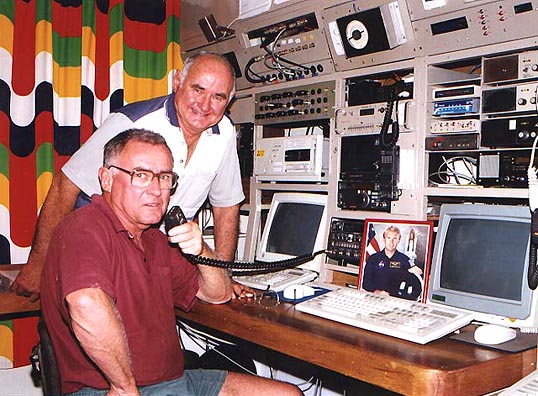 Tony Hutchison, VK5ZAI (seated), in Australia has handled several phone patches between Andy Thomas, KD5CHF/VK5MIR, aboard Mir. Looking on at the VK5ZAI shack is Doug Tamblyn, VK5GA. Photo by Murray Pioneer, Remnark.
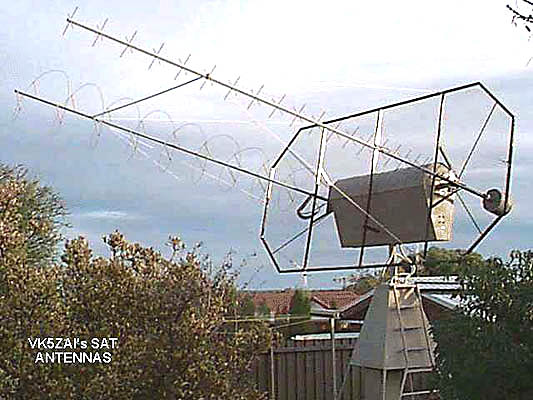
The VK5ZAI antenna system. |
US astronaut Andy Thomas, KD5CHF, said good-bye to Mir June 8 as he left for home aboard the shuttle Discovery after spending 130 days in space. The shuttle was due to return to Earth June 12.
Before he left the aging Russian space outpost, Thomas broadcast a general "thank you" to the worldwide amateur community via the R0MIR packet system. "I am leaving Mir today, and this will be my last message," he said. "Thank you all for your interest in the mission and your messages." Thomas again apologized for not being able to give individual replies. "I wish you all every success. Good-bye and good luck." Thomas is the last US astronaut scheduled to serve a tour of duty aboard Mir.
The day after Discovery docked with Mir, June 5, Thomas engaged a last-minute flurry of random Amateur Radio contacts on 2-meter FM simplex (145.985 MHz). It happened after Thomas tried unsuccessfully to reach W5RRR, the Johnson Space Center club station. Al Lark, KD4SFF, in Greenville, South Carolina, broke in and offered to help, and the two got into a conversation. Thomas told Lark that "a decent hot shower is going to be the first order of business" on Earth. Following his chat with Lark, Thomas also worked WA6LR, AA2DR, and WF1F, among other stations called. "You guys have given me a lot of pleasure during my time up here," Thomas told AA2DR.
Australian Peter Ellis, VK1KEP, also spoke with Thomas on June 5 and found himself thrust into celebrity status as a result. Thomas, a native of Australia who also holds the call sign VK5MIR, told Ellis that he was the first VK1 he'd ever worked. Trying for some local publicity for Amateur Radio, Ellis notified the local media, and soon wound up in the midst of a media frenzy--on local radio twice, the front page of the Canberra Times, on TV in Canberra and Sydney, and on ABC Radio nationwide. See the whole story at http://www.geocities.com/CapeCanaveral/5796/vk1kep.htm.
During his Mir stay, Thomas spoke frequently with his family via Amateur Radio, sometimes with Tony Hutchison, VK5ZAI, serving as the Earth station. Hutchison says he set up phone patches with Thomas' father, Adrian, 74, who lives in Adelaide. Hutchison also provided Adrian Thomas with a computer to track Mir and a receiver so he could listen to his son's conversations. "Adrian flew bombers during the war and is an extremely interesting man to talk to--and a very proud father as well," Hutchison said. "He said that it has been an ambition of Andy's to become an astronaut since he was a young boy." Hutchison, who attended the same college as Thomas but about a dozen years earlier, said they've never met but he hopes to have the opportunity when Thomas returns to his home country for a visit.
Meanwhile, news reports say that Russia's plans to host French and Slovak astronauts aboard Mir have fallen through. This has again raised expectations that Russia will discard Mir a year ahead of schedule unless it can come up with another way of supporting it financially. Russia has been hoping to keep Mir aloft until 1999, when the International Space Station will be in place. --thanks to Tony Hutchison, VK5ZAI, and QNews
NEXT WRC TO BE IN 2000
It's settled. The next World Radiocommunication Conference--until now referred to as WRC-99 for planning purposes--actually will take place in 2000. The ITU Council decided the question when it met May 20-29 in Geneva. What's now likely to be called WRC-2000 tentatively is set to be held May 8 to June 2 of that year in Istanbul, Turkey. The agenda and final schedule are subject to confirmation by the ITU Plenipotentiary Conference this fall in Minneapolis. Since 1993, the worldwide conferences have taken place every two years. However, this time, members of the international community felt they needed more time to prepare. The change also means the following WRC won't happen until at least 2002.Still expected to be lurking in the wings at WRC-2000 and hoping for an allocation of additional spectrum will be the low-Earth orbiting satellite industry, the infamous "Little LEOs." The industry seeks an additional 7 to 10 MHz of spectrum below 1 GHz.
Another potentially hot ham radio topic at the next WRC is a technology called "fixed wireless access." FWA--sometimes called wireless local loop--uses radio instead of wires to connect user telephone or data equipment to an access point in the public switched telephone network. FWA proponents are looking at the suitability of more than 100 frequency bands between 27 MHz and 66 GHz--some of which involve amateur bands.
An ITU task group has also been studying the topic of "unwanted emissions," which includes both spurious emissions and out-of-band (OOB) emissions. OOB emissions include splatter and key clicks. A plan to replace current spurious emission limits with more stringent standards was adopted at WRC-97 (see "WRC-97--An Amateur Radio Perspective," QST, Feb 1998, pp-33-34). Still under consideration are new spurious emission limits for spacecraft and mandatory OOB limits for all radio services.
One issue of concern to hams may be postponed to WRC-2002 or later. The Earth Exploration Satellite Service has been eyeing the 430 to 440 MHz band for use by synthetic aperture radars (SARs). These systems are capable of penetrating the upper canopy of a rain forest to monitor ecological changes. The ARRL and the IARU already have introduced papers expressing concerns with respect to the use of the 420 to 450 MHz band. However, it now appears that the ITU will not take up the issue at the next conference due to a lack of funding.
For more information on WRC-99 preparations, see http://www.fcc.gov/wrc-99.
WB6BYU TO LEAD US ARDF TEAM
Dale Hunt, WB6BYU, of Yamhill, Oregon, will lead the US fox-hunting team at the ninth World Championships of Amateur Radio Direction Finding (ARDF) this fall. The competition of radio orienteers will be held in Hungary during the first week of September. The US foray will mark this country's first effort at the World Championship of foxhunting.
The aptly named Hunt, 45, is experienced in the sport of international-style foxhunting. He competed last year against Russian, Canadian and Japanese hams at the Friendship Radiosport Games near Tokyo, Japan.
Under WB6BYU's leadership, four other West Coast hams are expected to compete on Team USA at the City of Nyiregyhaza, 150 miles east of Budapest. Team USA will be up against hundreds of the best foxhunters from more than two dozen European and Asian countries in a pair of two-hour sprints through a large forest. "There are two separate transmitter hunts, each on a different day," Moell says. One hunt is on 80 meters (CW foxes) and the other hunt is on 2 meters (MCW AM foxes). "Each hunt has five fox transmitters hidden in a forested area," he explains.
Some spaces remain on the Team USA roster, especially in the Junior Division (boys under 18 years of age), Veteran's Division (men over age 55), and Women's Division (any age, nobody asks!). For information, contact ARRL ARDF Coordinator Joe Moell, K0OV, PO Box 2508, Fullerton, CA 92837; e-mail homingin@aol.com.
For a look at the official invitation to the championships and for more information about ARDF rules, equipment and techniques, see http://members.aol.com/homingin/.
DOUG SMITH, KF6DX, NAMED QEX EDITOR
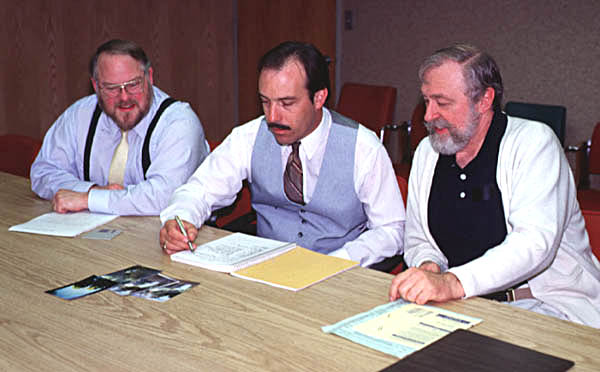 Incoming QEX Editor Doug Smith, KF6DX (center), meets with outgoing QEX editor Rudy Severns, N6LF (right), and QEX Managing Editor Bob Schetgen, KU7G (left), at ARRL HQ. |
Doug Smith, KF6DX, the Chief Engineer at Kachina, will take over the editorial reins of QEX--the Forum For Communications Experimenters--beginning with the September issue. The current QEX editor, Rudy Severns, N6LF, is stepping down to devote more time to his business and family. Also, Severns is moving and will take on duties as an adjunct faculty member at Oregon State University in Corvallis, where he'll teach power electronics.
Smith, 40, has spent the past 20 years involved in HF SSB, with a particular emphasis on control systems. He's been with Kachina for five years and was instrumental in the development of the company's PC-controlled 505DSP HF transceiver, which debuted at the 1997 Dayton Hamvention. Smith will continue at Kachina. Previously he worked for Hull Electronics and Transworld Communications.
While DSP has been the focus of the past few years of his career, "I enjoy all aspects of RF engineering," Smith said. Originally from San Diego, California, Smith is a graduate of Cal Tech. He now lives in Sedona, Arizona. Under his leadership, he said, QEX will remain "the mouthpiece of front-level experimentation in Amateur Radio" and will embrace new technologies, while still appealing to a broad readership.
Smith also says he'll be on the lookout for new material. "We're always looking for good, analytical articles," he said. It was Smith's own series of articles on DSP, "Signals, Samples, and Stuff--a DSP Tutorial," that brought him to the attention of ARRL Publications Manager Mark Wilson, K1RO, and QEX Managing Editor Bob Schetgen, KU7G. Smith says DSP will play a big role in the future of communication. "The entire radio industry is pushing toward a direct digital conversion receiver," he said.
Licensed in 1982, Smith has always been on the hobby's cutting edge. He put one of the first scanning HF bulletin boards on the air and was involved in AMTOR before most hams had even heard of it. His current ham radio pursuits include antennas, HF RTTY and SSB, and ragchewing.
Smith says a lot of hams still build their own gear, although he agrees that homebrewing is not as prevalent as it once was. "A lot of hams out there are experimenters," he said, adding that he'd like some of them to consider publishing their projects in QEX. "There are hams out there building a lot of very good equipment, and not all of them are writing about it," he said.
Smith, Severns, Wilson, Schetgen, and other ARRL staff members met in June at ARRL Headquarters to work out the details of the transition from Severns to Smith. That will occur as of the September issue of QEX.
NEW QST CONTEST CORRAL/SPECIAL EVENTS EDITOR
George Fremin III, K5TR, will become the QST Contest Corral and Special Events editor. His appointment is effective with the August 1998 issue. Fremin, who's ex-WB5VZL, lives in Austin, Texas.
Fremin got his first ticket in 1976 at age 13. "I did all of my operating as WB5VZL over the years," he said. "My first contest was the 1977 ARRL 10 Meter Contest. I entered as a Novice and made 22 contacts."
He's expanded his contesting efforts in the intervening years. During the 1980s he operated from the N5AU contest station, and now often works contests from W5KFT, where he spent a lot of time designing the setup and doing antenna work. He's operated the 6D2X multiop station in Mexico as well. "I like all sorts of contests but favor the ARRL SSB Sweepstakes," he said. He's operated the 'phone SS every year since 1979. He also enjoys VHF contesting and fox hunting. Lately, he's been fiddling with QRP.
The 'TR suffix plays a bigger-than-obvious role in Fremin's life. "I sell the TR-Log contest logging program for N6TR. I drive a University of Texas shuttle bus and also work for a small consulting firm run by N5TR," he said.
Fremin holds a BA in history from the University of Texas. Hid dad also is a ham, WB5UKU.
Members can contact Fremin at geoiii@kkn.net. He has a Web site at Web page http://www.kkn.net/~k5tr/.
FCC SEQUENTIAL CALL SIGN UPDATE
The following is a list of FCC sequentially assigned call signs issued as of June 3, 1998. For more information about the sequential call sign system, see Fact Sheet PR5000 #206S.
| District | Group A Extra | Group B Advanced | Group C Tech/Gen | Group D Novice |
|---|---|---|---|---|
| Extra | Advanced | Tech/Gen | Novice | |
| 0 | AB0HQ | KI0NH | ++ | KC0DQD |
| 1 | AA1TR | KE1JU | ++ | KB1CWV |
| 2 | AB2FJ | KG2OL | ++ | KC2DRC |
| 3 | AA3RD | KF3BR | ++ | KB3CRI |
| 4 | AF4KF | KU4SO | ++ | KF4YRX |
| 5 | AC5QG | KM5QS | ++ | KD5EJW |
| 6 | AD6FK | KQ6WK | ++ | KF6RFW |
| 7 | AB7YD | KK7NZ | ++ | KD7BZX |
| 8 | AB8CS | KI8FZ | ++ | KC8KHX |
| 9 | AA9WD | KG9NS | ++ | KB9SYK |
| N. Mariana Island | NH0E | AH0AY | KH0GY | WH0ABJ |
| Guam | ++ | AH2DH | KH2TK | WH2ANW |
| Hawaii | NH7H | AH6PK | KH7JZ | WH6DEO |
| American Samoa | AH8R | AH8AH | KH8DM | WH8ABF |
| Alaska | AL0L | AL7RD | KL0OQ | WL7CUU |
| Virgin Islands | ++ | KP2CN | NP2KD | WP2AIJ |
| Puerto Rico | NP3W | KP3BG | NP3WP | WP4NNT |
++All call signs in this group have been issued in this district.
SOLAR UPDATE
Solar seer Tad Cook, K7VVV, Seattle, Washington, reports: Solar activity was up again last week. Average solar flux for the previous 90 days rose one point to 110, and flux values were above this level on every day, which indicates an upward trend. Geomagnetic indices showed fairly unsettled conditions, particularly on June 7 when planetary K indices went as high as four and five.
The predicted solar flux for June 12-14, is 115, 120 and 122, and the planetary A index is expected to be 10, 8 and 12. Beyond that the solar flux is may peak for the short term around 126 on June 16 or 17, then drop below 120 by June 20, below 115 by June 24, and bottom out above 110 for June 26 through July 6. Somewhat unsettled geomagnetic conditions may appear again June 19-21 and July 2-4. Old region 8226 appeared to be growing as it left the west limb of the sun near the end of May, and it could produce some flares between June 12-25.
Dr. Dick Altrock of the US Air Force released a statement in conjunction with the National Solar Observatory about the peak of this solar cycle. He is looking at long-term variation of solar emission features that move toward the solar poles prior to solar cycle maximum. Since this emission feature already appeared over a year ago at 55 degrees north latitude and is continuing to move toward the poles, the solar maximum earlier believed to be slated for 2000 is now predicted for next year.
On VHF, GJ4ICD reports fantastic conditions on 6 meters, and N7EIJ near Portland, Oregon, reported working N7ML in Montana on aurora and backscatter on the same band over the weekend. On the same date VE6XT in Calgary reported incredible auroral E conditions on 6 meters with stations all across Canada and Alaska. Also on Saturday K2SPO in New York worked EH7KW (Spain) on 6.
N1BUG has a wonderful site on the Web to monitor auroras. It's at http://www.mint.net/~n1bug/prop/aumon/aufr.html and at http://www.qsl.net/n1bug/prop/aumon/aufr.html.
Sunspot numbers for June 4 through June 10 were 92, 99, 110, 96, 104, 101 and 103 with a mean of 100.7. The 10.7 cm flux was 111.7, 115, 115.1, 113, 116.9, 112.3 and 112.4, with a mean of 113.8. The estimated planetary A indices were 12, 13, 14, 18, 12, 10, and 15, with a mean of 13.4.
In Brief:
- This weekend on the radio: The ARRL June VHF QSO Party and the TOEC WW Grid Contest are on tap this weekend. Just ahead: The Kid's Day Operating Event, the All-Asia DX Contest (CW), the SMIRK (6-meter) QSO Party, and the West Virginia QSO Party are the weekend of June 20-21.
- Vanity update: The FCC in Gettysburg reports it has processed all vanity applications received through May 21, 1998. On June 9, the FCC granted 59 new call signs. Another 69 applications hit the work in process stack and have been processed.
- Dayton attendance up! Attendance at this year's Dayton Hamvention was up slightly over last year's attendance. Convention General Chairman Dick Miller, N8CBU, reports that 28,120 attended this year's Hamvention. That tops the 28,000 attendance figure from 1997 and reverses a trend of declining attendance. The ARRL National Convention in 2000 will be at the Dayton Hamvention.--thanks to Dave Coons, WT8W
- Filing deadline extended: The FCC has extended the deadline to receive reply comments on its rulemaking petition to implement the Universal Licensing System (ULS), Docket WT 98-20. The new deadline is June 16.--FCC
- Nominations due: Nominations for the AMSAT-NA Board of Directors are now open. AMSAT member societies or five individual members may make nominations of fellow members to serve a two-year term on the board. Three seats on the seven-member board must be filled this year. Board members whose terms are due to end include Keith Baker, KB1SF; Tom Clark, W3IWI; and Andy MacAllister, W5ACM. Persons who accept nomination must understand that meeting attendance is mandatory. There are generally two meetings per year. Nominations should be marked Board of Directors Nomination and sent to AMSAT, 850 Sligo Ave #600, Silver Spring, MD 20910 Nominations must arrive by June 15, 1998. An election will follow.