ARRL Audio News from this edition is available at http://www.arrl.org/arrlletter/audio/ for two weeks after publication.
Address Changes: Kathy Capodicasa, N1GZO, e-mail kcapodicasa@arrl.org.
Editorial: Rick Lindquist, N1RL, e-mail elindquist@arrl.org.
[NOTE: Because your editor will be on the road for the rest of this week, The ARRL Letter is being posted early. Hope to see you in the ARRL 160 Meter Contest (or on other bands) from FP-land.--Rick Lindquist, N1RL]
| IN THIS EDITION: |
- +Hams to be among first ISS crew members
- +ARRL Humanitarian Awards nominations open
- +UK hams to get another LF band
- +Comments due on ARRL petition
- +Phase 3D update
- Nevada hams get a better deal
- Just in time for the holidays
- FCC issued sequential call signs
- Solar update
- In Brief: This weekend on the radio; Vanity update; The FCC clarifies; KC5VPF says ham radio on his "to do" list; Correction; ARRL instructors, teachers take note; 1X5AA; Schweitzer Institute gets antenna; DOVE-17 QSLs; First Arkansas 5.7 GHz EME QSO; AMSAT News Chief recuperating
+Available on ARRL Audio News
| INTERNATIONAL SPACE STATION CREW TO INCLUDE HAMS |
Hams will be among the first crew members to live and work aboard the International Space Station. In addition, several of the crew members named recently by the US and Russia are studying for their licenses. The RØMIR Mir club station call may also be available to the Russian crew members on the ISS.
The first crew will consist of US astronaut William M. Shepherd, as the expedition commander. Shepherd is studying for his ticket. He'll be accompanied by Russian cosmonauts Yuri Gidzenko and Sergei Krikalev, U5MIR. All three have previous space flight experience. The crew is training for an early 1999 launch on a Soyuz vehicle for a planned five-month mission on the ISS. Initially, crews will inhabit the service module, which will include a ham radio antenna. Ham gear will be delivered aboard STS-96 late next year.
The second crew, headed by Russian cosmonaut Yuri Usachev, R3MIR, will include US astronauts Susan Helms, KC7NHZ, and James S. Voss, who's indicated an interest in getting his ham ticket. All three have spaceflight experience.
No licensed hams are among the third crew, which will be headed by astronaut Kenneth Bowersox and will include Russian crewmates Vladimir Dezhurov and Mikahil Turin. Bowersox also has said he'd like to get his ham license.
Russian cosmonaut Yuri Onufrienko will head the fourth crew. US astronauts Carl Walz, KC5TIE, and Daniel Bursch will accompany him.
NASA has said it won't have the International Space Station assembled fully until the end of 2003--some 18 months behind the June 2002 date announced earlier this year. Microsat/repeater payloads are supposed to arrive in early 2002, expanding ham radio capability aboard the ISS. NASA says the US habitation module--the astronaut's living quarters--should be in place by the end of 2003. Fifteen countries are cooperating in building the International Space Station.--NASA; Matt Bordelon, KC5BTL
| ARRL INTERNATIONAL HUMANITARIAN AWARD NOMINATIONS OPEN |
We radio amateurs provide assistance to people in need throughout the world on a regular basis. We communicate daily with common people from all parts of the world. Amateur Radio is one of the few media where average people throughout the world can meet to talk to each other and spread goodwill across otherwise impenetrable political boundaries. The world needs positive efforts toward international understanding and peaceful communications.
Recognizing the above, the League established an annual international prize to be awarded to truly outstanding Amateur Radio operators in areas of international humanitarianism and the furtherance of peace. The award is dedicated to those amateurs who, through Amateur Radio, are devoted to promoting the welfare of mankind.
The selection of the recipient of the award is made by a committee appointed by the President of the ARRL.
All licensed radio amateurs or group of amateurs who, by use of their skills of Amateur Radio, have provided extraordinary service for the benefit of others in times of crisis or disaster, are qualified to receive the award.
Nominations for the award will be accepted by the committee from a licensed radio amateur, governmental or any other organization which has received the benefits of the radio amateur's extraordinary service. In the event that no nominations are received, the committee may determine possible recipients or may decide to make no award in a given year.
Nominations must contain a summary of the actions of the nominee which qualify the recipient for the award, and statements from at least two references, including names and addresses for verification. All nominations and supporting materials for 1997's award must be submitted in writing in English to ARRL International Humanitarian Award, 225 Main St, Newington, CT 06111 USA. Nominations must be received by December 31, 1997. The award winner receives an engraved plaque, and is profiled in QST.--Rick Palm, K1CE
| UK HAMS LOOK FORWARD TO ANOTHER NEW LF BAND |
Hams in the United Kingdom are looking forward to another new low frequency band. The Radiocommunications Agency--the British equivalent to our FCC--has told the RSGB that it hopes to release the 136-kHz band to all UK Class A licensees early in 1998. Like the 73-kHz band opened in the UK last year (see "73 kHz--A New Band for Great Britain," by Paul Duell, GØ0TLG, QST, Mar 1997, page 40), the new allocation will be a "sliver band." But at 2.1 kHz, it will be slightly smaller than the 2.8 kHz available at 73 kHz. The RSGB says the band likely will be in accordance with a CEPT recommendation for 135.7 to 137.8 kHz. However, unlike the 73-kHz band, hams will not have to apply for special permission to use 136 kHz. Finland made 135.7-137.8 kHz available last April to all holders of general or technical (CEPT 1 or CEPT 2) licenses with an output power limit of 100 W.
The RSGB said it anticipates that the new band soon will be added to the table of allocations and will become available for use shortly thereafter.
Meanwhile, the 73-kHz band will remain available in parallel with the new allocation "for a while," the RSGB says. Permission to operate on 73 kHz will available through next June. It's expected the band will be withdrawn from amateur use in the UK after June 30, 2000.
UK hams have managed distances of up to 400 km (248 miles) on 73 kHz, and it's expected that greater distances will be achieved on the new 136 kHz band.--RSGB
| COMMENTS DUE ON FCC PETITION |
Comments are due December 29 on the ARRL's petition to change the way Morse code exam exemptions for severely handicapped applicants are handled. The League wants to change the procedural requirements in Part 97 that must be met, prior to granting examination credit. The FCC has designated the petition as RM-9196.
The League has proposed that a candidate at least would have to attempt the CW test--with any and all necessary accommodations--before being granted an exam waiver based on a physician's certification. Also, Volunteer Examiner Coordinators (VECs) would be entitled to request medical information pertinent to an applicant's handicap from the certifying physician. VECs also would be required to have this information on file before the application is forwarded to the FCC for processing.
In its petition filed September 23, the League said the two "rather minor changes" would stem abuses of the waiver system and limit its use only to severely handicapped individuals without putting an unreasonable burden on examinees.
Comments to the FCC should reference RM 9196. Address them to Secretary, Federal Communications Commission, 1919 M St NW, Washington DC 20554.
| PHASE 3D UPDATE |
AMSAT's Keith Baker, KB1SF, reports that AMSAT-DL President and Phase 3D Project Leader Karl Meinzer, DJ4ZC, visited the Phase 3D Integration Lab in Orlando recently for a top-to-bottom review of Phase 3D's status. While work remains to recover from the structural rebuild as well as to finish up the satellite and make it flight-ready, "the end is in sight!" says Baker. Phase 3D was to have been aboard the Ariane 502 flight in October, but the imposition of new structural standards last summer--and the consequent "structural rebuild," made it impossible for Phase 3D to remain on the flight schedule.
Baker says he doesn't expect any developments on setting a new launch date for Phase 3D until European space authorities pin down the cause of the problems during the recent Ariane 502 flight. He says reports indicate that analysis of telemetry from the recent Ariane 502 flight is proceeding and that ESA/CNES and ArianeSpace officials now seem to have isolated the direct cause--but not the root cause--of the early cryogenic stage shutdown on that flight. The early shutdown put the payloads into lower-than-expected orbits.
The Orbital Report On-Line newsletter reports that ArianeSpace took over operations of the $900-million Ariane 5 launch processing facilities in Kourou, French Guiana, on November 25. The next Ariane 5 vehicle (503) is due to lift off next May for the last qualification flight on behalf of ESA and CNES, the French space agency. ArianeSpace's first commercial launch (L504) is planned for the second half of 1998.
| NEVADA HAMS GET A BETTER DEAL |
Glenn Roberts, KU7Z, says that, for years, hams in Boulder City, Nevada, have been limited to an antenna height of 35 feet. Last spring, with guidance from the ARRL, hams there submitted what Roberts called "a very detailed and well documented petition" asking for a revision in the antenna code to allow a maximum tower height of 70 feet.
"We had been working closely with city officials ever since, to get this code revised," he says. On November 25, the City Council voted unanimously to approve a new code allowing antennas up to 70 feet tall.
"Persistence paid off!" Roberts concluded.
| JUST IN TIME FOR THE HOLIDAYS |
The ARRL is offering three new coffee mugs, just in time for holiday giving. You have your choice of "The Old Man" mug, which features a picture of ARRL cofounder Hiram Percy Maxim, W1AW, at his radio and the legend "The Old Man" surrounding the ARRL diamond. Order item number 6494.
Traffic handlers will want the National Traffic System mug, featuring the NTS logo in red, white and blue. Order item number 6486.
Members of the Amateur Radio Emergency Service will enjoy the ARES mug , featuring the ARES logo in red, white and blue, Order item number 6478.
Each mug is $7 plus $3 shipping. To order, call toll-free, 888-277-5289 (8 AM until 9 PM Eastern Time) or visit the ARRLWeb, http://www.arrl.org/catalog.
| FCC SEQUENTIAL CALL SIGN UPDATE |
The following is a list of FCC sequentially assigned call signs issued as of December 1, 1997.
|
District |
Group A Extra |
Group B Advanced |
Group C Tech/Gen |
Group D Novice |
|
0 |
ABØGQ |
KIØKU |
KCØCIG |
|
|
1 |
AA1SX |
KE1IV |
N1ZXA |
KB1CFW |
|
2 |
AB2EP |
KG2ND |
KC2CSQ |
|
|
3 |
AA3QN |
KF3AP |
KB3BXZ |
|
|
4 |
AF4GW |
KU4MR |
KF4UWW |
|
|
5 |
AC5OG |
KM5NI |
KD5CUB |
|
|
6 |
AD6DX |
KQ6TM |
KF6OTL |
|
|
7 |
AB7WV |
KK7KU |
KC7ZTP |
|
|
8 |
AB8BP |
KI8ER |
KC8IWZ |
|
|
9 |
AA9VD |
KG9MA |
KB9RTD |
|
|
N Mariana Island |
NHØB |
AHØAY |
KHØGT |
WHØABI |
|
Guam |
AH2DF |
KH2SR |
WH2ANV |
|
|
Hawaii |
KH7V |
AH6PE |
KH7HH |
WH6DEL |
|
American Samoa |
AH8P |
AH8AH |
KH8DL |
WH8ABF |
|
Alaska |
ALØH |
AL7QW |
KLØKX |
WL7CUO |
|
Virgin Islands |
KP2CM |
NP2JW |
WP2AIJ |
|
|
Puerto Rico |
NP3Q |
KP3BD |
NP3SR |
WP4NNM |
++All call signs in this group have been issued in this district.
| SOLAR UPDATE |
Check W1AW bulletins on December 5 for a complete report.
The sunspot numbers for November 20 through 26 were 57, 52, 62, 70, 61, 58 and 43 with a mean of 57.6. 10.7 cm flux was 88.7, 95.9, 100.2, 99.8, 103.3, 102.1 and 108.1, with a mean of 99.7, and estimated planetary A indices were 2, 2, 45, 60, 7, 3, and 2, with a mean of 17.3.
| In Brief: |
- This weekend on the radio: The ARRL 160 Meter Contest (CW) gets under way December 5 (Friday) evening at 2200 UTC and continues until December 7 at 1600 UTC. Complete rules are in November QST, page 107. Also on tap: The QRP ARCI Holiday Spirits Homebrew Sprint, the TOPS Activity 3.5 MHz CW Contest, and the TARA RTTY sprint.
- Vanity update: As it cleared the decks for an anticipated rush of Gate 4 vanity applications on December 2, the FCC office in Gettysburg, Pennsylvania, processed all vanity applications received during the last week of October on November 25. A spokesman reports 74 grants and 80 WIPs (work in process). All WIPs have been processed for that period. The FCC reports it got 828 new, electronically filed vanity applications on December 2 (the numbers are not yet in for paper applications). The FCC will not schedule processing of first-day applications until the 10-day deadline to receive fee payments for electronically filed applications is past.
- The FCC clarifies: All club station trustees requesting the call sign of a deceased former member as a club station vanity call sign (and holding a letter of consent of a close relative of the former holder), should check Box 7D on FCC Form 610V and fill in the call sign of the deceased former holder plus the relationship of the close relative to the former holder. Do this whether applying under Gate 1A or Gate 4. Applicants should ignore the Box 7D reference to clubs that held a club station license granted before March 24, 1995. This date is no longer relevant. Do not check Box 7F and do not put the requested in memoriam call sign in the preference list on the back of the Form 610V.--thanks to FCC via Bart Jahnke, W9JJ
- KC5VPF says ham radio on his "to do" list: The MIREX and SAREX teams report that US astronaut David Wolf, KC5VPF, aboard Mir has not been active on either the 2 meter or 70-cm Amateur Radio equipment, since a temporary power outage November 21. Wolf has stated that powering up the radio equipment is "on his list," however.--AMSAT News Service/Frank Bauer, KA3HDO
- Correction: Our report in The ARRL Letter, Vol 16, No 47 about the availability QSL cards for working the space shuttle contained the incorrect shuttle missions. It should have said "STS-83/STS-94."
- ARRL instructors, teachers take note: If you're an ARRL-registered instructor or ARRL-registered school teacher and have not been receiving your educator's newsletter via mail or e-mail, it's possible that your name has been removed from our database or that we may not have your current e-mail address--especially if we have not heard from you in a while. To get current, contact Jean Wolfgang, WB3IOS, EAD, ARRL, 225 Main, Newington CT 06111; tel 860-594-0200; fax 860-594-0259; e-mail wb3ios@arrl.org.
- 1X5AA: You might have snagged 1X5AA as a "new one" recently, but, at least for now, it's no good for DXCC, says ARRL DXCC Manager Bill Kennamer, K5FUV. The 1X5 prefix is an unofficial one that does not have international recognition. The station--said to be operating from Chechnya, a "breakaway" Russian republic--has been attracting huge pileups on 40 meter CW in recent days. Kennamer said that for 1X5 contacts to count towards DXCC, a petition would have to be filed for new country status, and it would have to be studied and voted on. Kennamer said the determination of the starting date for valid contacts would depend on the circumstances.
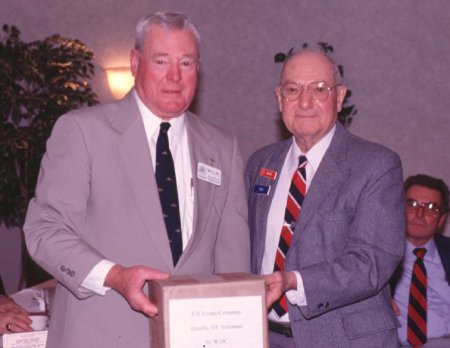
Tom Evans, W1JC (left), donates an antenna to Phil D'Agostino, W1KSC, trustee of W1BV. - Schweitzer Institute gets antenna: The non-profit Albert Schweitzer Institute for the Humanities in Wallingford, Connecticut, has accepted the donation of an antenna for its proposed new ham station, which will operate as W1BV. Accepting the gift November 8 was station trustee Philip D'Agostino, W1KSC. Antenna manufacturer Thomas Evans, W1JC, donated the antenna, a G5RV design. The donation ceremony was held recently during a regular luncheon meeting of the local QCWA chapter. Plans call for the Schweitzer Institute to use W1BV in carrying out its disaster relief and humanitarian efforts. By the way, W1BV will be on the air January 18 as a special event station commemorating Schweitzer's birth.--Al Cohen, W1FXQ
- DOVE-17 QSLs: QSL cards for the DOVE (DO-17) satellite are again available. These cards, depicting a dove carrying an olive branch, will be provided to all who send a report indicating they've heard the satellite. DO-17 transmits on 145.825 and 2401.220 MHz. It's now sending 1200 baud AX.25 (standard packet) ASCII telemetry on 2 meters. On S band, DOVE transmits PSK flags continuously, and then repeats the same data transmitted on 2 meters. To receive a DOVE QSL, send a reception report and an SASE to Dianne White, NØIZO, 45777 Rampart Rd, Parker, CO 80138-4316.--AMSAT News Service
- First Arkansas 5.7 GHz EME QSO: On November 26, ARRL Vice President Joel Harrison, W5ZN, and well-known VHF/UHFer Al Ward, WB5LUA, completed a 5760-MHz EME contact-- the first-ever QSO of its kind from Arkansas! W5ZN was using a 10-foot dish, 18 W, and a homebrew WR-137 to 1.5-inch copper pipe feed with coffee can scalar ring and a homebrew LuaCom preamp. WB5LUA was using a 5-meter dish, 28 W, and a homebrew WR-137 to 1.5" copper pipe feed with scalar ring and homebrew LuaCom preamp. Moon conditions were not good, and the moon was at apogee, but the contact was fully completed after about five sequences.--Joel Harrison, W5ZN
- AMSAT News Chief recuperating: BJ Arts, WTØN, the chief editor for the weekly AMSAT News Service bulletins, was reported to be resting comfortably at home after major surgery recently. He sends his thanks to all for their thoughts and prayers during his recent hospitalization. Dan James, NNØDJ, has volunteered to join the editorial team for ANS and will be assisting BJ Arts with the weekly bulletins.--AMSAT News Service
| The ARRL Letter |
The ARRL Letter is published by the American Radio Relay League, 225 Main St, Newington, CT 06111; tel 860-594-0200; fax 860-594-0259. Rodney J. Stafford, KB6ZV, President; David Sumner, K1ZZ, Executive Vice President.
Circulation, Kathy Capodicasa, N1GZO, e-mail kcapodicasa@arrl.org.
Editorial, Rick Lindquist, N1RL, e-mail elindquist@arrl.org.
Visit the ARRLWeb page at http://www.arrl.org.
The purpose of The ARRL Letter is to provide the essential news of interest to active, organizationally minded radio amateurs faster than it can be disseminated by our official journal, QST. We strive to be fast, accurate and readable in our reporting.
Material from The ARRL Letter may be reproduced in whole or in part, in any form, including photoreproduction and electronic databanks, provided that credit is given to The ARRL Letter and The American Radio Relay League.
| How to Get The ARRL Letter: |
The ARRL Letter is distributed directly from ARRL HQ only to elected League officials and certain ARRL appointees and to paid subscribers of the now-defunct hard-copy edition of The ARRL Letter . For members and nonmembers alike, The ARRL Letter is available free of charge from these sources:
- The ARRLWeb page (http://www.arrl.org/arrlletter/). This version of The ARRL Letter includes any photographs.
- The HIRAM BBS: 860-594-0306.
- The ARRL Technical Information Server (Info Server): Send an e-mail message to info@arrl.org. The subject line should be blank. In the message body, type send ltrmmdd.txt, where mm represents two digits for the month and dd represents two digits for the day (The ARRL Letter is published every Friday). For example, to request The ARRL Letter file for Friday, January 3, 1997, you'd type send ltr0103.txt. Then, on a separate line, type quit.
- CompuServe and America Online subscribers, as a downloadable text file in the services' ham radio libraries
- The Netcom server, run by the Boston Amateur Radio Club and Mike Ardai, N1IST: Send e-mail to listserv@netcom.com (no subject needed). The body of the message should say subscribe letter-list.