ARRL Audio News from this edition is available at http://www.arrl.org/arrlletter/audio/ for two weeks after publication.
Address Changes: Kathy Capodicasa, N1GZO, e-mail kcapodicasa@arrl.org.
Editorial: Rick Lindquist, N1RL, e-mail elindquist@arrl.org.
| IN THIS EDITION: |
- WRC-97 concludes in Geneva
- Ballots counted in Directors' races
- FCC issues Amateur RF safety Supplement B
- Florida hams respond to surprise tornado
- Arizona QRMer to pay up
- Texas hams claim antenna law victory
- Section Manager election results
- Solar update
- In Brief: This weekend on the radio; Correction; SAFEX II reported operational; Worldradio on tape; WXØB forms Array Solutions; California HANDI-HAM camp set; KC5NTW honored; KB9FO wins Emmy; Club saved at last minute; Ham to edit railroaders' newsletter; New VP9 Web site; Precourt to command STS-91
| WRC-97 WRAPS UP IN GENEVA |
The 1997 World Radiocommunication Conference concluded its talks in the early morning hours of November 21 in Geneva, Switzerland. Amateur Radio survived WRC-97 largely unscathed, but the stage has been set for renewed spectrum battles at WRC-99.
The Little LEOs (non-voice, non-geostationary mobile satellite interests)--which put a huge scare into the ham radio community in 1996 with their proposals to share ham radio VHF and UHF bands--were unable to muster much support for new allocations at WRC-97. However, they came away with up to 3 MHz of additional spectrum on a regional basis, in the bands between 454 and 460 MHz. The Little LEOs also got a resolution calling for urgent studies in preparation for WRC-99--what some at the conference called "a hunting license" for additional VHF/UHF spectrum. A second issue that will recur at WRC-99 is finding a place in the 420-470 MHz frequency range for the Earth Exploration Satellite Service (EESS). Synthetic aperture radars (SARs) using frequencies in this range are said to be capable of penetrating the rain forest for mapping purposes.
Two significant ham radio-related issues failed to make the cut for consideration at WRC-99. For budgetary reasons, the WRC-97 delegates had to limit the WRC-99 agenda only to the most urgent issues. Pushed back to the tentative agenda for WRC-2001 were the possible realignment of the 40 meter band to resolve a conflict between hams and broadcasters in part of the band (along with possible expansion of broadcasting bands between 4 and 10 MHz), and Article S25 of the international radio regulations. Article S25 contains the international regulations specific to the Amateur and Amateur-Satellite Services, including the Morse code requirement for operation below 30 MHz.
WRC-97 delegates approved a resolution encouraging administrations to facilitate the use of ham radio and other "decentralized means of communications" for disaster mitigation and relief operations. This resolution eliminated the need for Resolution 640, which defined how certain ham bands could be used for international disaster communications by non-amateur stations, so Resolution 640 was suppressed.
WRC-97 delegates did agree to upgrade the Earth Exploration Satellite Service from secondary to primary at 1215 to 1300 MHz, which should have only minimal impact on amateur use of 1240-1300 MHz. The presence of EESS there also reduces the possibility that other, less-compatible services might later be introduced into this band.
In other allocations decisions, amateur satellite segments were not included among allocations for wind profiler radars. Except for a worldwide primary allocation at 1270 to 1295 MHz, the only specific allocations for wind profiler radars are in Region 1, and those are on a secondary basis. Region 2 administrations were urged to implement wind profilers in radiolocation bands at 440 to 450 MHz, 904 to 928 MHz (protecting the lower, weak-signal segment), 1270 to 1295 MHz (protecting amateur satellite and weak-signal), and 1300 to 1375 MHz. The delegates agreed that the bands 420 to 435 MHz or 438 to 440 MHz could be considered for use in situations where there was incompatibility between wind profiler radars and other radio applications at 440 to 450 MHz or 470 to 494 MHz (only in some Region 1 countries). In this case, too, the amateur-satellite segment is protected.
Several Region 1 (primarily European) countries deleted footnoted exceptions to the international table of allocations in the 1810 to 1830 kHz range, expanding the usability of 160 meters for ham radio. North Korea was persuaded to drop its bid for footnoted exceptions to the allocations table that could have affected some ham radio bands in that part of the world.
Amateur Radio was represented at WRC-97 by a multinational team of International Amateur Radio Union officials, including Secretary Larry Price, W4RA, Vice President Michael Owen, VK3KI, and Region 1 Vice Chairman Wojciech Nietyksza, SP5FM. They were assisted for a time by Tafa Diop, 6W1KI, and Eduardo Estrada, HC2EE, who are members of their respective regional executive committees. Numerous radio amateurs attended the conference in official capacities on behalf of their national administrations, including ARRL Technical Relations Manager Paul Rinaldo, W4RI, who served on the US delegation.
In all, 1801 delegates from 142 countries registered at the conference. Another 141 observers from regional and international organizations also attended.
| BALLOTS DECIDE DIRECTORS RACES |
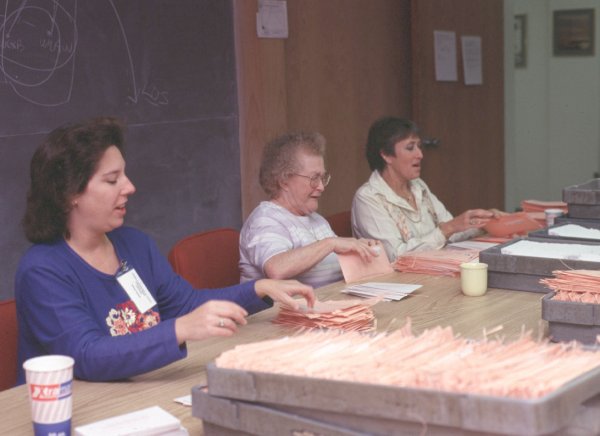
ARRL Headquarters staff members prepare ballots for machine counting November 21. |
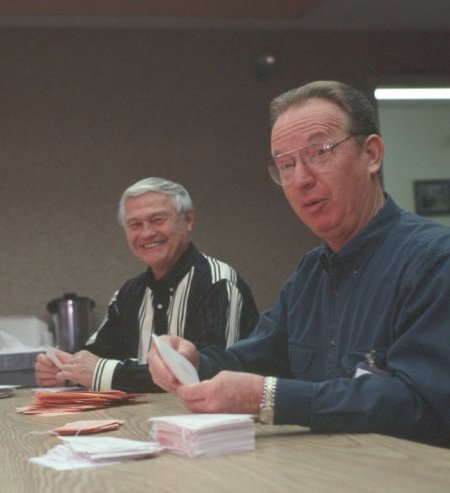
ARRL Directors Tod Olson, KØTO (Dakota Division), left, and Jim Haynie, W5JBP (West Gulf Division), right, pitch in as ballots are readied for counting to choose three ARRL Directors. Olson was unopposed for re-election |
Race served as Great Lakes Division Vice Director before assuming the Director's position in June of 1995, when former Directer Al Severson, AB8P, resigned (Severson died in September).
Falcone, 48, is a tax litigation attorney and an ARRL life member.
Current Great Lakes Division Vice Director Dave Coons, WT8W, was unopposed for re-election.
In the Delta Division, incumbent Director Rick Roderick, K5UR, of Cabot, Arkansas, outpolled Malcolm Keown, W5XX, of Vicksburg, Mississippi, 2106 to 1330. Roderick is an attorney. Delta Division Vice Director Henry Leggette, WD4Q, had no opposition.
In the Atlantic Division, incumbent Director Kay Craigie, WT3P, of Paoli, Pennsylvania, easily beat back a challenge from Jim Carson, WK2K, of Ithaca New York. The vote tally was 4918 to 1573.
Atlantic Division Vice Director Bernie Fuller, N3EFN, was without opposition for his seat.
Candidates in four other ARRL divisions also faced no opposition and are considered re-elected. Uncontested candidates were:
- In the Dakota Division, Director Tod Olson, KØTO, and Vice Director John Bellows, KØQB. (Current Vice Director Hans Brakob, KØHB, decided not to seek re-election.)
- In the Midwest Director Lew Gordon, K4VX, and Vice Director Bruce Frahm, KØBJ.
- In the Pacific Division, Director Brad Wyatt, K6WR, and Vice Director Jim Maxwell, W6CF.
- In the Southeastern Division, Director Frank Butler, W4RH, and Vice Director Evelyn Gauzens, W4WYR.
Terms of office for successful candidates begin January 1, 1998.
| FCC ISSUES RF SAFETY SUPPLEMENT B TO OET BULLETIN 65 |
Hams now have basic guidelines and tools to evaluate their stations for compliance with the FCC's RF exposure guidelines that start phasing in January 1, 1998. The FCC's Office of Engineering and Technology issued the long-anticipated Amateur Radio Supplement B to its OET Bulletin 65 on November 18. The FCC worked closely with the Amateur Radio community to develop the new supplement. Several ARRL Headquarters staff members and Technical Advisors reviewed preliminary drafts of the supplement. ARRL Lab Supervisor Ed Hare, W1RFI, has been the League's point man for RF safety and exposure issues.
"It has been my pleasure to work with the FCC staff and the amateur community in finalizing Supplement B," Hare said. "All who have been part of this process deserve the thanks of the entire amateur community."
Supplement B, entitled Additional Information for Amateur Radio Stations, contains detailed information specific to ham radio stations. It is designed to be used in conjunction with the FCC's OET Bulletin 65 (Version 97-01), Evaluating Compliance with FCC Guidelines for Human Exposure to Radiofrequency Electromagnetic Fields. The revised Bulletin 65 was issued earlier this year. Supplement B covers definitions of RF radiation and discusses the FCC exposure guidelines and their applications, methods of predicting human exposure, estimating compliance distances, and controlling exposure to RF fields. The supplement runs approximately 70 pages. Among its noteworthy highlights are numerous easy-to-use tables based on various frequencies, power levels and antenna configurations to help hams determine whether their stations comply with the FCC's published RF exposure guidelines. Most tables show compliance distance--the distance that an antenna needs to be located from areas of exposure to be in compliance. (For a closer look, see "FCC RF-Exposure Regulations--the Station Evaluation," by Ed Hare, W1RFI, which will appear in the January issue of QST.)
The new RF exposure rules go into effect January 1, 1998 for all new stations and for those filing a Form 610 with the FCC after that date. Existing stations have until September 1, 2000 to comply with the new rules. But, existing stations making changes that could affect RF exposure from their station--such as increasing power or relocating antennas--must evaluate that change if done after January 1, 1998.
As first announced, the FCC set a power threshold of 50 W to trigger the need to do a station evaluation. In late August, the FCC revised the power level thresholds to trigger a routine Amateur Radio station RF exposure evaluation. Those changes were welcome news for most hams. The newest guidelines raised its original 50-W PEP threshold on all bands except 10 meters through 2 meters, where it remains at 50 W PEP. The FCC went along in part with an ARRL request and established a sliding scale for threshold levels dependent upon frequency. The revised thresholds (all PEP) are 500 W for 160 through 40 meters, 425 W on 30 meters (the maximum legal power is 200 W), 225 W on 20 meters, 125 W on 17 meters, 100 W on 15 meters, 75 W on 12 meters and 50 W on 10 meters. The threshold for all VHF bands is 50 W. On UHF, the threshold level is 70 W on 70 cm, 150 W on 33 cm, 200 W on 23 cm, and 250 W on 13 cm and higher frequencies.
The threshold for amateur repeaters is 500 W effective radiated power (ERP) if the repeater antenna is located on a building or is less than 10 meters above ground. Stations operating at or below these respective power levels are categorically excluded from having to conduct a routine RF radiation evaluation. Mobile and portable (hand-held) devices using push-to-talk operation generally are also exempt from evaluation. But, all stations--regardless of power level--still must comply with the RF exposure limits that become effective New Year's Day.
OET Bulletin 65 and the new Supplement B are available at http://www.fcc.gov/oet/info/documents/bulletins/#65. Copies are available from International Transcription Service Inc, 1231 20th St NW, Washington, DC 20036; tel 202-857-3800; fax 202-857-3805.
| FLORIDA HAMS RESPOND TO SURPRISE TORNADO |
|
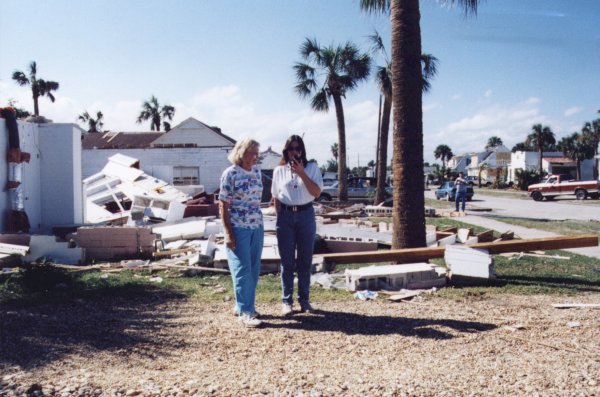
| Red Cross worker Janet Raines, N2SOI (right, with H-T) discusses storm damage with a resident of a New Smyrna Beach, Florida, neighborhood struck by a surprise tornado early on November 2, and relays damage information. Photo: Mike Welch, KF4HFC |
The surprise storm was a bit of a wake-up call for The Central Florida ARES and RACES teams, which had been lulled into complacency by a rather inactive hurricane season.
Volusia County ARES EC Bill Crandall, KM4AE, and his wife, Mary Ann, KD4MSD, activated the Volusia County Amateur Radio Emergency Communications Service (VARECS) and had the emergency operations center operational by 6:45 AM on November 2. An emergency net soon was humming on the 147.24 MHz repeater. Within a couple of hours, Amateur Radio priority traffic began flowing between the Daytona Beach Red Cross and the New Smyrna Beach ARC field disaster site service center. Telephone communication also was established with the New Smyrna Beach Sheriff's Office to verify and update damage reports. In addition, damage reports were funneled through Air Force MARS channels to FEMA.
By noon, a working communication plan was established between Red Cross Communications Director Paul Branch, K3NON, and KM4AE. All East Central District County ARES teams responded to a call for outside support. In all, KM4AE reports, 54 hams--including two ARRL PIOs--volunteered their services to help in the tornado damage assessment and recovery effort. "Our working relationship with the Red Cross communications director was excellent," Crandall said. Hams actively provided communication service for more than 156 hours between November 2 and November 8.--Bill Crandall, KM4AE; Michael Welch, KF4HFC; Norman Lauterette, WA4HYJ
| ARIZONA QRMer TO PAY UP |
Hams in Arizona are cheering, now that a man fined by the FCC for malicious interference and other rules violations has finally agreed to pay up. Last year, the FCC fined Timothy Harold Hoffman of Phoenix $6000 for repeated violations, including interference to Phoenix-area repeaters. The violations were called to the Commission's attention by the Arizona Repeater Association's ARRL-sanctioned Local Interference Committee. Hoffman was cited for five specific violations, including transmitting on ham frequencies without a valid operator or station authorization, and willfully and maliciously interfering with ham radio communications. But, as Lance Halle, KW7LH, tells it, "it took a multitude of long distance calls by committee members, support from FCC personal, input from Congress, and the White House, to get a Notice of Forfeiture and then a federal court judgment" against Hoffman, which he called "one of the major interferers."
"The system does work," Halle said in alerting the ARRL to the October 26 judgment by US District Court judge Robert C. Broomfield. Hoffman will pay off his fine in increments of $200 per month. "Spread the word! Maybe this will deter some of the would-be interferers."
| TEXAS HAMS CLAIM ANTENNA ORDINANCE VICTORY |
Hams in Greenville, Texas, succeeded recently in getting ham radio antennas and towers exempted from a local telecommunications facility ordinance. Members of Greenville's Sabine Valley Amateur Radio Association were claiming victory in getting the City Council to reject a Planning and Zoning Board ruling that would have kept ham antennas in the ordinance.
SVARA President Art Passannante, KC5GQP, cited ARES EC Gary Hall, KB5LWZ; Orin Forrester, KC5LAI; Fire Chief Robert Wood; Assistant ARES EC Danny Ussery, N5VKM, "and many others" for their role in getting the ordinance rewritten favorably for ham radio. Passannante also thanked the ARRL for helping his club to obtain the reference materials it needed to prepare its presentations to the local governing bodies. "The exemption will serve as a model for a larger section-wide ruling," Passannante said.
| NEW WEST TEXAS SM ELECTED |
Charles C. Royall, WD5CJI, of San Angelo, Texas, will be the new West Texas Section Manager. Royall received 84 votes in a three-way race for the position. Ted Harwood, KB5VWC, got 44 votes, while Fred Marble Jr, W6VPI, got 53 votes. The term of office begins January 1, 1998. Royall succeeds Amelia "Milly" Wise, W5OVH, of El Paso.
Section Manager candidates in seven other sections, all incumbents, were not contested and were declared elected. They include: In the Delaware section, Randall Carlson, WBØJJX; in the East Bay Section, Bob Vallio, W6RGG; in the Michigan Section, Richard Mondro, WA4FQT; in the New Mexico Section, Joe Knight, W5PDY; in the Santa Barbara Section, Robert Griffin, K6YR; in the Tennessee Section, O.D. Keaton, WA4GLS; and in the Western Massachusetts Section, William Voedisch Jr, W1UD.
Since no petitions were received for the Alabama, Alaska, and Kansas section manager elections by the September 5, 1997, deadline, nominating petitions will be resolicited in January QST.
| SOLAR UPDATE |
Solar prognisticator Tad Cook, K7VVV, Seattle, Washington, reports: Solar activity was up a little this week compared to last, and geomagnetic conditions were quiet. The average solar flux for the previous 90 days rose one point to 91, and the solar flux was above these numbers every day this week. This indicates an upward trend. The 90-day average was 5 points lower only a month ago.
Solar activity is expected to remain high, with solar flux values over 100. An active area (region 8100) is expected to return November 23, and this may send solar flux to the 110 mark from November 26 to December 1. Flux values are not expected to drop below 95 until December 10. This region, which produced X-class solar flares on November 4 and 6, may produce M-class flare activity this time around. Watch for active geomagnetic conditions around November 20 to 24 and again around December 3.
The 10 and 15 meter bands should open during the day with higher solar flux values. The best conditions, with high solar flux and low geomagnetic conditions are currently forecast for the CQ Worldwide CW DX Contest on the weekend following Thanksgiving.
With solar activity higher, it is fun to watch the progress of cycle 23 with a plotting program which graphs the daily numbers over time. Check out the Solar Data Plotting software from WA4TTK on the web at http://edge.net/~scraig/. This program automatically grabs the solar data from this weekly propagation bulletin to update it's database. If you need to fill in gaps in your data, grab old propagation bulletins from the ARRL web site at http://www.arrl.org/w1aw/prop/1997-index.html.
Sunspot numbers for November 13 through 19 were 41, 48, 35, 58, 74, 71 and 62, with a mean of 55.6. The 10.7-cm flux was 90, 93, 96.2, 96.2, 94.2, 91.5 and 96.5, with a mean of 93.9, and estimated planetary A indices were 4, 11, 7, 9, 7, 9, and 3, with a mean of 7.1.
| In Brief: |
- This weekend on the radio: There's a break in major contest action this weekend. The next major operating event is the CQ WW DX Contest (CW), November 29-30. See October QST, page 107, for details.
- Correction: The correct URL for the WRC club site is http://www.itu.int/radioclub/.
- SAFEX II reported operational: Reports indicate that the SAFEX repeater aboard the Mir space station has been operational, but it's not known for sure if the repeater is back on to stay. AMSAT's VP International, Ray Soifer, W2RS, reports he worked KB2ETV on November 9 using a dual-band hand-held and a half-wave whip. Soifer said the downlink was quite active at the time with many stations calling. For those not familiar with the transponder, SAFEX II's input frequency is 435.750 MHz (CTCSS tone is 141.3 Hz), and its output is 437.950 MHz. Both frequencies are subject to Doppler shift of up to 10 kHz, so users are cautioned to program their radios accordingly.--AMSAT News Service
- Worldradio on tape: Worldradio magazine is available on cassette tape for visually and physically impaired people for $3 per year. Contact Tom Carten, K1PZU, 1602-A King's College, Wilkes-Barre PA 187111-0801; e-mail tfcarten@leo.kings.edu.--Tom Carten K1PZU
- WXØB forms Array Solutions: Jay Terleski, WXØB, has formed Array Solutions to manufacture and sell the WXØB line of products formerly sold by Dunestar Systems. Array Solutions will warranty and repair all StackMatches sold to date. StackMatch owners are asked to register with Array Solutions to receive product update information. For more information, see http://www.arraysolutions.com/index.htm or write Array Solutions, 350 Gloria Rd, Sunnyvale, TX 75182; tel 972-203-8810; fax 972-203-8811; e-mail wx0b@arraysolutions.com.
- California HANDI-HAM camp set: The next session of HANDI-HAM Radio Workshop (camp) will be held at Camp Joan Mier, Malibu, California, from February 24 to March 1, 1998. This camp will provide ham radio instruction at all levels for persons with severe physical (not learning) disabilities and/or sensory impairments. The 1998 camp is free for California residents seeking their first ham ticket or upgrade. All normal care, food, lodging, and Amateur Radio instruction for the session will be provided at no cost to the campers. For more information, contact Jane Rova, Secretary, Courage HANDI-HAM System, 3915 Golden Valley Road, Golden Valley, MN 55422; tel 612-520-0512; e-mail handiham@mtn.org.
- KC5NTW honored: Jon Spargo, KC5NTW, was honored as Man of the Year for 1997 by the Socorro County (New Mexico) Chamber of Commerce. The award recognized Spargo's numerous community-service efforts, including organizing extensive public observing sessions for Comet Hale-Bopp at New Mexico Tech's Etscorn Campus Observatory, leading a new model-train club that is preserving railroad history artifacts in Socorro, and participating in public-service activities of the Socorro Amateur Radio Association. Safety Officer for the National Radio Astronomy Observatory, Spargo also volunteers for Project ASTRO, a nationwide astronomy-education program that brings science into school classrooms. Spargo received his award from outgoing Chamber President Dave Finley, N1IRZ, at the organization's annual banquet in October.
- KB9FO wins Emmy: The 1997 Technical Excellence Emmy from the National Association of Television Arts and Sciences has gone to Henry Ruh, KB9FO, an ARRL life member. The award, presented recently at a ceremony in Chicago, recognizes his creative engineering work in television remote broadcast units, employing digital TV equipment in new and innovative applications to afford versatility and efficiency to broadcasters.--Henry Ruh, KB9FO
- Club saved at last minute: Jeff Hugabone, N7KBY, reports that the 53-year-old Hampden (Massachusetts) County Radio Association was rescued at the last minute from dissolution and will continue to serve hams in the Pioneer Valley. Following some tense moments and a motion to dissolve the club at its last meeting November 7, a ham, rather new to the area, stepped up and offered his interest in becoming president. The individual was quickly voted in. Hugabone says it turned out that their new president, a retiree with some time and resources to invest, had led several California clubs in years past. "Following his election, a fervor of activity ensued," Hugabone said, adding that the new president's enthusiasm was contagious and new officers and board members soon were in place. "Sometimes it takes hitting rock-bottom, before the realization hits that what you are about to lose is so very valuable," he concluded.
- Ham to edit railroaders' newsletter: James Sackey, N9ESM, of Snoqualmie, Washington, has been named editor of the Northwest Railway Museum monthly newsletter, The Sounder. Sackey is visitor services manager for the museum, located in the historic Snoqualmie Depot--the oldest operating train station in the state of Washington. Sackey, a US Navy veteran, has written for QST and other ham radio magazines as well as for newspapers. He took over the helm of The Sounder with the September issue.--Northwest Railway Museum
- New VP9 Web site: The Radio Society of Bermuda has a new Web site. It's at http://www.bermuda-shorts.com/rsb.--Thanks to Glen, VP9ID
- Precourt to command STS-91: US astronaut Charles Precourt, KB5YSQ, will command the final scheduled shuttle/Mir docking mission next May. The flight, designated as STS-91, will be aboard the shuttle Discovery. Precourt has visited the Russian space station twice before. The flight crew will include Wendy B. Lawrence, KC5KII. The May mission will retrieve US astronaut Andy Thomas, KD5CHF, from Mir. Thomas is scheduled to travel to Mir in January.--NASA
| The ARRL Letter |
The ARRL Letter is published by the American Radio Relay League, 225 Main St, Newington, CT 06111; tel 860-594-0200; fax 860-594-0259. Rodney J. Stafford, KB6ZV, President; David Sumner, K1ZZ, Executive Vice President.
Circulation, Kathy Capodicasa, N1GZO, e-mail kcapodicasa@arrl.org.
Editorial, Rick Lindquist, N1RL, e-mail elindquist@arrl.org.
Visit the ARRLWeb page at http://www.arrl.org.
The purpose of The ARRL Letter is to provide the essential news of interest to active, organizationally minded radio amateurs faster than it can be disseminated by our official journal, QST. We strive to be fast, accurate and readable in our reporting.
Material from The ARRL Letter may be reproduced in whole or in part, in any form, including photoreproduction and electronic databanks, provided that credit is given to The ARRL Letter and The American Radio Relay League.
| How to Get The ARRL Letter: |
The ARRL Letter is distributed directly from ARRL HQ only to elected League officials and certain ARRL appointees and to paid subscribers of the now-defunct hard-copy edition of The ARRL Letter . For members and nonmembers alike, The ARRL Letter is available free of charge from these sources:
- The ARRLWeb page (http://www.arrl.org/arrlletter/). This version of The ARRL Letter includes any photographs.
- The HIRAM BBS: 860-594-0306.
- The ARRL Technical Information Server (Info Server): Send an e-mail message to info@arrl.org. The subject line should be blank. In the message body, type send ltrmmdd.txt, where mm represents two digits for the month and dd represents two digits for the day (The ARRL Letter is published every Friday). For example, to request The ARRL Letter file for Friday, January 3, 1997, you'd type send ltr0103.txt. Then, on a separate line, type quit.
- CompuServe and America Online subscribers, as a downloadable text file in the services' ham radio libraries
- The Netcom server, run by the Boston Amateur Radio Club and Mike Ardai, N1IST: Send e-mail to listserv@netcom.com (no subject needed). The body of the message should say subscribe letter-list.