Address Changes: Kathy Capodicasa, N1GZO, e-mail kcapodicasa@arrl.org.
Editorial: Rick Lindquist, N1RL, e-mail elindquist@arrl.org.
| IN THIS EDITION: |
- ARRL Audio News to debut
- KC5VPF on the air from Mir
- Sputnik 1 model launch delayed
- State Department applies for CEPT participation
- FCC update on special events
- ALC upholds decision to deny KV4FZ renewal
- Mayors praise ham radio
- Georgia hams create public awareness
- Solar update
- In Brief: This weekend on the radio; VHF EME Report awards Single-Yagi Challenge trophies; Azden, not Alinco; NASA assigns hams in key positions; APRS donation; SSTV for Sputnik anniversary; RS-12 in Mode A; DOVE-17 back on 2 meters; Pre-teen ham among volunteers during flooding; 70 MHz spectrum assigned to SARL
| ARRL AUDIO NEWS DEBUTS OCTOBER 17 |
The League will inaugurate ARRL Audio News, a weekly, Web-based audio news service, on October 17. Compiled from The ARRL Letter, ARRL Audio News will include the week's top news from the world of Amateur Radio and the League. ARRL Audio News will be available in RealAudio format via the ARRLWeb, http://www.arrl.org/. Tucson Amateur Packet Radio -- TAPR -- has generously agreed to provide space on its Web server to permit the League to offer this service.
Senior Assistant Technical Editor Rick Lindquist, N1RL, who compiles and edits The ARRL Letter will be the regular on-air voice for ARRL Audio News. The service will be available free to anyone and may be retransmitted in whole or in part for bulletin purposes provided ARRL Audio News is credited as the source.
Each edition of ARRL Audio News will contain up to 10 minutes of timely Amateur Radio news. It will be available via the ARRLWeb every Friday by 9 PM Eastern Time. Dial-up telephone access to ARRL Audio News will be announced later.
For more information, contact Rick Lindquist, N1RL, e-mail n1rl@arrl.org; tel 860-594-0222.
| KC5VPF ACTIVE ON PACKET FROM MIR |
Dave Wolf, KC5VPF, now aboard the Russian Mir space station for a four-month stay, has tried his hand at the R0MIR packet system. Wolf posted a message to Francisco Costa, CT1EAT, on October 5. Wolf's message said, "New at ham, but will give it a try. Dave."
His predecessor aboard Mir, Mike Foale, KB5UAC, returned to Earth early this week. While both men were aboard Mir, Foale gave Wolf a quick course in how to use the personal message system (PMS) on Mir. Wolf has little experience as a ham.
On Monday, the Mir crew encountered yet another in a series of glitches that have plagued the space station in recent months when it was unable to undock a Progress rocket. The undocking was required so that Mir could dock a new cargo ship. The crew figured out the problem--an unremoved locking device--and undocked the rocket Tuesday. The incident delayed by one day the docking of the incoming supply rocket. Cargo aboard the new Progress included fuel, oxygen, water and scientific equipment.
| SPUTNIK MODEL LAUNCH DELAYED |
It now appears that the launch of a working model Sputnik 1 from the Russian Mir space station won't happen until October 18-20, and perhaps later. According to AMSAT News Service, the model Sputnik, assembled by students in Russia and equipped with a 2-meter transmitter by students in France, was to be aboard the Progress rocket that docked aboard Mir earlier this week. Earlier information from several sources--including the sponsors--had indicated the model satellite would be launched from Mir October 4, the 40th anniversary of the original Sputnik 1 satellite.
The Sputnik-40, as it's called, reportedly will be hand-released by the Mir crew during a space walk. Latest information indicates the mini-satellite will transmit a "beep-beep" signal on 145.800 MHz (FM) from its 200-mW onboard transmitter. The batteries are expected to last a month or two.
For additional details -- and photos -- see http://www.oceanes.fr/~fr5fc/spoutnik.html. --thanks to AMSAT News Service and Keith Baker, KB1SF
| STATE DEPARTMENT APPLIES FOR US CEPT PARTICIPATION |
The State Department has applied for US participation in the European Conference of Postal and Telecommunications Administrations (CEPT) Amateur Radio licensing system. The move, September 22, could eventually make it easier for US hams to operate temporarily in European countries that participate in CEPT. Holders of a CEPT license could operate in CEPT-participating countries without having to apply for a reciprocal license.
"No doubt there will be some give and take between the European Radiocommunications Office (ERO) and the Department of State over the details before the US is accepted as a participant, but an important milestone has been reached," said ARRL Executive Vice President David Sumner, K1ZZ. The application consists of a four-page letter with voluminous attachments. Last year, the FCC had asked the State Department to apply for participation in the CEPT Agreement as a non-CEPT country.
The action follows in the wake of an earlier suggestion by the ARRL to the FCC that the US take advantage of the CEPT Recommendation T/R 61-01 arrangements and issue a CEPT license that would be recognized by other participating administrations and valid for visits.
Last fall, the FCC proposed amending the Amateur Radio rules to make it easier for hams holding a CEPT license or an International Amateur Radio Permit (IARP) to operate during short visits to the US.
| FCC UPDATES SPECIAL EVENT "FACT SHEET" |
The FCC has revised Fact Sheet 206E, which deals with the Amateur Special Event Call Sign System and has added the W4VEC VEC of High Point, North Carolina, to the list of approved Special Event Call Sign Coordinators. Here's the revised FCC Fact Sheet:
When transmitting in conjunction with an event of special significance, an amateur station "special event station" may transmit the identification announcement using a special event call sign in accordance with the procedures detailed below. Substituting a special event call sign for its assigned call sign may help a special event station call attention on-air to its participation in the special event and to the unique opportunity for the amateur service community to exchange greetings with the station. Use of these provisions, however, must not detract from the station making the source of its transmissions known to those receiving them. The special event station must also transmit its assigned call sign at least once per hour during such operation [emphasis added].
Special event call signs. A block of 750 call signs is available for use in the special event call sign system. The format of each call sign (1x1) consists of a single letter prefix K, N or W, followed by a single digit numeral 0 through 9, followed by a single letter A through W or Y or Z (X is not available to amateur stations). The station license grantee must obtain coordination for the use of a special event call sign through one of the following special event call sign coordinators. These coordinators maintain and disseminate worldwide a common database for the day-to-day usage of the one-by-one format call signs (for example K1A). Upon completing the coordination process, the special event station may substitute the 1x1 format call sign for its assigned call sign during the period of the special event.
Coordinators: These volunteer entities have been certified as special event call sign coordinators.
- ARRL/VEC, 225 Main St, Newington, CT 06111-1494; tel 860-594-0300, fax 860-594-0339, e-mail vec@arrl.org.
- The W5YI Group Inc, 2000 E Randol Mill Rd, Suite 608-A, Arlington, TX 76011, tel 817-461-6443, fax 817-548-9594, e-mail fmaia@internetMCI.com.
- Western Carolina Amateur Radio Society/VEC Inc, 5833 Clinton Hwy, Suite 203, Knoxville, TN 37912-2500; tel 423-688-7771, e-mail WCARS@KORRnet.org.
- Laurel Amateur Radio Club Inc, Box 3039, Laurel, MD 20709-3039, tel 301-317-7819, e-mail rbusch@erols.com.
- W4VEC/VEC, 3504 Stonehurst Pl, High Point, NC 27265, tel 919-841-7576, e-mail W4VEC@aol.com.
Indicators: In addition to the special event call sign system, any amateur station, including a special event station, may include with its assigned call sign one or more indicators (example W1AW/national convention). Each indicator must be separated from the assigned call sign by a slant (/) or by any suitable word that denotes the slant mark ("portable," "stroke," etc.). If the indicator is self-assigned, it may be included before, after, or both before and after, the assigned call sign (example KP2/W1AW/contest). No self-assigned indicator may conflict with any other indicator specified by the FCC Rules (such as AA, AG, AE or KT) or with any prefix assigned to another country (such as DL, F, G or VE) [emphasis added].
Questions concerning 1x1 call signs and the common database should be directed to the special event call sign coordinators. For information concerning Fact Sheet 206E, contact John B. Johnston, e-mail jjohnsto@fcc.gov; tel 202-418-0680. --FCC
| FCC ADMINISTRATIVE LAW JUDGE REAFFIRMS KV4FZ DECISION |
An FCC administrative law judge has reaffirmed his decision to not renew the operator and station licenses of Herbert L. Schoenbohm, KV4FZ, of Kingshill, Virgin Islands. Early last year, FCC Administrative Law Judge Edward Luton determined the Commission should not renew Schoenbohm's ham ticket, but Schoenbohm filed exceptions. The FCC remanded the case back to Luton, who issued a supplemental initial decision September 30 containing additional findings of fact and reaffirming his earlier decision not to renew Schoenbohm's Amateur Radio license.
Schoenbohm's attorney has indicated that he plans to file exceptions to the judge's most recent decision. This appeal will be heard by the full FCC. Thus, Schoenbohm still has an administrative appeal and a judicial appeal (US Circuit Court of Appeals, District of Columbia) available to him. In the meantime, he may continue to operate.
In late 1992, Schoenbohm, now 57, was found guilty in US District Court of using a "counterfeit access device" to make long-distance telephone calls. While his initial conviction did not specifically involve breaking FCC regulations, Schoenbohm eventually ran directly afoul of the Commission, which said his conviction "is relevant to evaluating the likelihood that he will comply" with the FCC's Amateur Radio rules.
In early 1994, the FCC designated his application to renew his ham radio license for a hearing, but extended the expiration date of the license until the matter could be settled. A hearing was held in August 1995.
Luton had concluded last January that Schoenbohm's 1992 felony conviction plus his subsequent "knowing violation" of the FCC's ex parte rules "provides further evidence that the Commission will not be able to rely on him to be truthful or to comply" with FCC rules and policies. Schoenbohm was accused of improperly encouraging other people to intervene on his behalf with the FCC and of using ham radio to do so in at least one instance. The ex parte rules prohibit anyone in Schoenbohm's situation from directly soliciting such political intervention.
FCC documents show that Schoenbohm fraudulently obtained long-distance telephone service by using illicitly obtained telephone access codes. Schoenbohm, then the communications chief for the Virgin Islands Police Department, was sentenced to two months in prison (later suspended) and two years probation and was fined $5000. He lost his job as a result of his conviction.
FCC documents also show KV4FZ had a distinguished record of Amateur Radio public-service and had helped provide emergency communication in several hurricanes. However, the decision's Conclusions of Law found that, at the 1995 hearing, Schoenbohm mischaracterized the facts concerning his conviction in "a conscious effort to influence and mislead the trier of fact" and that his "altered testimony about the facts of his conviction was deliberately false." Luton reached a similar conclusion with regard to Schoenbohm's claims that his on-air efforts to get around the ex parte rules were innocent attempts to explain those rules, contained in Section 1.1210. --FCC
| MAYORS ON BOTH COASTS LAUD HAM RADIO |
For the second time in his administration, New York City Mayor Rudolph Giuliani recognized Amateur Radio by issuing a proclamation declaring Amateur Radio Awareness Day in the Big Apple. The September 19 ceremony was attended by Howard Price, KA2QPJ, NYC ARES EC for media and public relations/NYC RACES deputy radio officer; Charles Hargrove, N2NOV, Staten Island EC/radio officer; Matt Evans, WA2UKM, Brooklyn AEC; Scott Swanson, N9SAT; John Kiernan, KE2UN; and Jerry Cudmore, K2JRC.
On the West Coast earlier this year, San Francisco Mayor Willie Brown praised a local ham radio emergency organization during a meeting of the City and County of San Francisco Disaster Council in late April.
"I must also tell you that I have been frankly fascinated with that unpaid group of people with those ham radios, the Auxiliary Communications Service," the mayor said. Brown said that the ACS makes available "a wireless system that seldom if ever can be totally disrupted by a disaster" and that "ham radio operators are the heart and the soul and the life blood of that system." --thanks to Barry A Schwartz, N2SHP, The Hudson Loop, and Dave Larton, N6JQJ
| GEORGIA HAMS CREATE PUBLIC AWARENESS OF HOBBY |
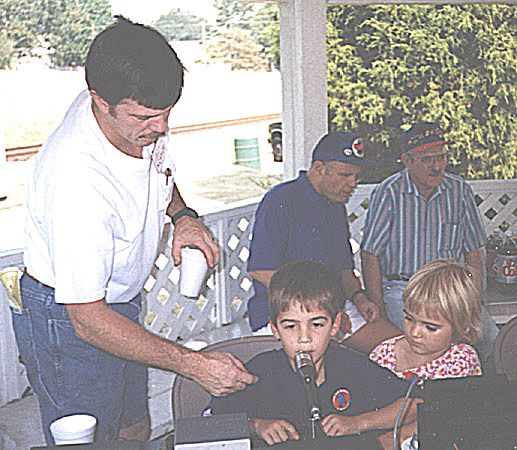 Mike Hough, KC4YCF, helps young Alan Hough get a taste of ham radio while sister Michelle looks on, during Amateur Radio Awareness Day on September 20 in Stone Mountain, Georgia. In the background are Johnny Fearon, W4WKP, and Bill Prince, K4TED.
|
Hams in Stone Mountain, Georgia, took advantage of an Amateur Radio Awareness Day proclamation by Mayor Patricia Wheeler to put the hobby on display. Members of the Alford Memorial Radio Club (W4BOC) set up a station in the gazebo in a city park on September 20. More than 40 people stopped by to sign the visitor log (and enjoy some free refreshments).
Club President Lee Flack, KD4HPD, reports the club gave out ARRL brochures too. "There was a lot of interest and questions about disasters and what hams do to help," Flack said. "I guess the public has been hearing about cell phones and public safety radios being unusable some times."
The club has made Amateur Radio Awareness Day an annual event in Stone Mountain, which is near Atlanta.
| SOLAR UPDATE |
Solar soothsayer Tad Cook, K7VVV, Seattle, Washington, reports: Solar flux was down this week, an average of four points below the previous week. Sunspot numbers were also down, an average of almost 8 points. Average solar flux for the previous 90 days rose another point on Monday to 84, on the same day the solar flux finally dipped below the 90-day average when it hit 83.7. The solar flux was above the average for the previous 90 days for 62 consecutive days, which is a good trend. Cycle 23 is definitely on the rise.
Solar flux is expected to rise again immediately, above 85 by October 12, above 90 a week later, and up around the low to mid-90s around October 23. It may be back to the mid-80s around the end of the month. Look for disturbed geomagnetic conditions with possible high absorption of high latitude signals around October 12, 18, 25, and 28.
When the solar flux is high and A and K indices are low, look for good 10, 12, 15 and 17 meter conditions, especially on north-south paths. Twenty meters is still the best band during daylight and early evening hours. The 30, 40 and 80-meter bands will get better as we move toward winter and nighttime static levels subside.
Sunspot numbers for October 2 through 8 were 26, 27, 26, 26, 24, 35 and 17 with a mean of 25.9. The 10.7-cm flux was 85.9, 85.7, 83.4, 84.4, 83.7, 83.5 and 82.9, with a mean of 84.2, and estimated planetary A indices were 4, 7, 4, 2, 3, 7, and 14, with a mean of 5.9.
| IN BRIEF: |
- This weekend on the radio: The Pennsylvania QSO Party, the VK/ZL/Oceania Contest, CW, and the FISTS CW Fall Sprint all are on tap this weekend.
- VHF EME Report awards Single-Yagi Challenge trophies: After much discourse, the VHF EME Reports Awards Committee has voted unanimously to award Dave Blaschke, W5UN, and Graham Daubney, F/G8MBI, the VHF EME Report Single-Yagi Challenge trophies. W5UN and F/G8MBI made two-way contact on 144-MHz EME on September 21 using single Yagi antennas on each end of the circuit. Both stations ran maximum legal power and neither employed ground gain. They made contact on their third scheduled attempt. Details will appear in the next issue of the VHF EME Report. --Jonathon H. Williams, WB6IMC
- Azden, not Alinco: To alleviate some confusion in the Amateur Radio community, the company that recently pulled out of the US ham radio market was Azden, based in New York, not Alinco, which is on the West Coast. Alinco advises us that it's still very much in business.
- NASA assigns hams in key positions: Kenneth D. Cockrell, KB5UAH, has been named to serve as chief of the Astronaut Office. Cockrell replaces Col Robert D. Cabana, KC5HBV, who begins fulltime training as commander on STS-88. --NASA
- APRS donation: The "father of APRS," Bob Bruninga, WB4APR, has donated a copy of the latest Automatic Packet Reporting System software to W1AW. --Joe Carcia, NJ1Q
- SSTV for Sputnik anniversary: SSTV experimenter G6HMS has been transmitting Sputnik 1 pictures via SSTV on FO-20 and FO-29, to celebrate the 40th anniversary of the launch of Sputnik 1. He plans to continue the transmissions until November 3. Format for the transmissions is Martin 1 on 435.880 MHz to 435.870 MHz (USB). The uplink frequency is fixed, so ground stations trying to receive the images will need to compensate for Doppler shift. --SpaceNews
- RS-12 in Mode A: The Russian satellite RS-12 was reported operational in Mode A with distortion on the 10-meter downlink (uplink, 145.91-145.95 MHz CW/SSB, downlink 29.41-29.45 MHz.) --AMSAT News Service.
- DOVE-17 back on 2 meters: Operational software has again been successfully loaded into DOVE (DO-17) by the DOVE command team, and the satellite once more is operational on 2 meters (145.825 MHz AFSK-FM). Jim White, WD0E, started the software load in mid-September and reports that everything seems to be running okay. WD0E says it remains to be seen how long the intermittent watchdog timer in the satellite will allow this software to run. The S-band transmitter is on to facilitate testing of S-band equipment on the ground, particularly for those working toward Phase 3D Mode S capability. Power level on the 2 meter transmitter is about 1 W day and night. Telemetry is currently being sent every 60 seconds, but this could change due to power-management needs. --AMSAT News Service
- Pre-teen ham among volunteers during flooding: Jevon Gegg-Mitchell, KE6YLH, of Chico, California was the youngest person to answer a call for Red Cross volunteers to help with flood relief efforts in California early this year. Jevon, who was 12 at the time, spent 38 hours on the air helping to deliver information between the Red Cross in Chico and emergency shelters in Butte County. His efforts earned him a mention in the Bay Area Red Cross newsletter.--thanks to W. David Shultz, KA6JHS
- 70 MHz spectrum assigned to SARL: The South African Telecommunications Regulatory Authority (SATRA) has assigned the frequency spectrum 70.000 to 70.01875 MHz to the South African Radio League on a secondary basis for the purpose of propagation studies. The SARL is inviting proposals from South African hams interested in establishing beacons on 70 MHz.--Johan le Roux
| The ARRL Letter |
The ARRL Letter is published by the American Radio Relay League, 225 Main St, Newington, CT 06111; tel 860-594-0200; fax 860-594-0259. Rodney J. Stafford, KB6ZV, President; David Sumner, K1ZZ, Executive Vice President.
Circulation, Kathy Capodicasa, N1GZO, e-mail kcapodicasa@arrl.org.
Editorial, Rick Lindquist, N1RL, e-mail elindquist@arrl.org.
Visit the ARRLWeb page at http://www.arrl.org.
The purpose of The ARRL Letter is to provide the essential news of interest to active, organizationally minded radio amateurs faster than it can be disseminated by our official journal, QST. We strive to be fast, accurate and readable in our reporting.
Material from The ARRL Letter may be reproduced in whole or in part, in any form, including photoreproduction and electronic databanks, provided that credit is given to The ARRL Letter and The American Radio Relay League.
| How to Get The ARRL Letter: |
The ARRL Letter is distributed directly from ARRL HQ only to elected League officials and certain ARRL appointees and to paid subscribers of the now-defunct hard-copy edition of The ARRL Letter . For members and nonmembers alike, The ARRL Letter is available free of charge from these sources:
- The ARRLWeb page (http://www.arrl.org/arrlletter/). This version of The ARRL Letter includes any photographs.
- The HIRAM BBS: 860-594-0306.
- The ARRL Technical Information Server (Info Server): Send an e-mail message to info@arrl.org. The subject line should be blank. In the message body, type send ltrmmdd.txt, where mm represents two digits for the month and dd represents two digits for the day (The ARRL Letter is published every Friday). For example, to request The ARRL Letter file for Friday, January 3, 1997, you'd type send ltr0103.txt. Then, on a separate line, type quit.
- CompuServe and America Online subscribers, as a downloadable text file in the services' ham radio libraries
- The Netcom server, run by the Boston Amateur Radio Club and Mike Ardai, N1IST: Send e-mail to listserv@netcom.com (no subject needed). The body of the message should say subscribe letter-list.