Address Changes: Kathy Capodicasa, N1GZO, e-mail kcapodicasa@arrl.org.
Editorial: Rick Lindquist, N1RL, e-mail elindquist@arrl.org.
| IN THIS EDITION: |
- ARRL Board of Directors meets
- More vanity changes!
- First SAREX contact with PRC!
- FCC approves commercial HF tracking service
- Bill could affect scanner certification
- ARRL Board announces award winners
- Solar Update
- In Brief: This weekend on the radio; W1AW seeks 20 meter bulletin reports; Mir back on the air; Hams provide communication during flooding; Vanity update; K2BSA at Jamboree; QST Cover Plaque Award winner; FCC seeks comments on Strategic Plan
| ARRL BOARD SUPPORTS HAM SPECTRUM PROTECTIONS, BAND PLANS, VE RULES CHANGES |
The ARRL Board of Directors has resolved to support legislation that would provide statutory protections for ham radio frequencies. The action came as the Board met July 18 and 19 in Rocky Hill, Connecticut. In taking this action, the Board cited the potential threat to Amateur Radio bands from the federal policy of selling spectrum to the highest bidder.
In a separate action, the Board voted to seek primary Amateur Service allocations of 5650 to 5725 MHz and 5825 to 5850 MHz in the 5650 to 5925 MHz band that is now a secondary allocation.
Voluntary band plans would be referenced in the FCC's rules under another Board action. Noting the erosion in the level of compliance with the various band plans, the Board voted to petition the FCC to amend the amateur rules to state that hams "should be familiar with, and should abide by" voluntary band plans that apply to the frequencies they use.
In another action, the Board voted to volunteer the League's services as a special event call sign common data base coordinator. The Board approved a motion to submit a request in response to a recent FCC invitation. The request will "express the League's interest in serving as a special event call sign coordinator at no cost to the applicants." The League would cooperate with other groups or individuals the FCC might select to serve as coordinators. Among other things, the League would work with them to develop common guidelines to govern the reservation of special event call signs.
Under a new policy approved by the board, ARRL Volunteer Examiners will not administer exam elements for which they have received credit on the basis of a medical exemption. The Board also proposed changes in the FCC's Volunteer Examiner rules to require that applicants attempt an accommodated Morse code exam before seeking a medical exemption. The Board also wants the rules changed to ensure that medical information supporting an exemption is on file before the application for exemption is forwarded to the FCC.
Noting that no clear consensus has emerged in the wake of suggestions to restructure the Amateur Radio licensing system, the Board voted to extend the period for member comments. At its January meeting, the Board had received a committee report that offered several suggestions to revamp the amateur licensing system. Until further notice, members may continue to direct comments on restructuring to their ARRL directors. The Board plans to revisit the issue at a later date.
In other action, the Board:
- approved a change in Field Day rules to add non-CW digital modes as a separate mode.
- called for the convening of an industry standards conference to explore adoption of common interconnection standards for Amateur Radio equipment. The Board said that adoption of common standards "would reduce the cost and complexity of Amateur radio stations."
- authorized President Rod Stafford, KB6ZV, to appoint an exploratory committee to determine the best way for the ARRL to pursue the development of endowment funds to maintain certain essential ARRL activities "despite budgetary pressures."
- directed the introduction of a program to coordinate a nationwide effort to enlist local volunteers from ARRL-affiliated and special service clubs "to introduce young people to technology through Amateur Radio and to potential careers in technology." In approving the resolution, the Board cited the increasing importance of technological literacy and President Clinton's call for greater volunteer efforts on behalf of youth.
- approved the addition of a system of technical awards to recognize achievement in technical service, innovation, and microwave development.
- voted to have the Volunteer Resources Committee review the duties and responsibilities of the State Government Liaison and consider renaming the position.
| ELECTRONIC VANITY APPLICATIONS TO GET PRIORITY |
When vanity call sign Gate 3 opens on August 6, 1997, the FCC will process electronic applications ahead of paper applications each day. Previously, the FCC did not distinguish in how it handled electronic and paper Form 610V applications. In recent months, the FCC has been receiving more electronic applications than paper applications. The FCC says it will process electronic applications, then paper applications received on any given day.
The FCC also has established a firm deadline for receipt of application fees to accompany electronic applications. After Gate 3 opens, fees for electronic applications must be received by the FCC's fiscal agent, Mellon Bank, within 10 days of the date of application or the application will be dismissed. The fee will remain at $30 for the ten-year term until September 15, 1997, when it will increase to $50 for the ten-year term.
Applicants can find the electronic Form 610V on the FCC's Web site at http://www.fcc.gov/wtb/amradsrv.html. Electronic applications require a Form 159 for any method of payment. Mail payments accompanying electronic applications to Federal Communications Commission, Box 358994, Pittsburgh, PA 15251-5994.
Paper applications require an FCC Form 159 if payment is by credit card or if the application package contains multiple applications being paid for with one check. Individual applications do not require a Form 159 if payment is by personal check or money order. Send paper applications containing payments to Federal Communications Commission, Box 358924, Pittsburgh, PA 15251-5924.
To avoid processing delays, applicants should make sure the information on their license is up to date. If you have changed your name or address, you must file Form 610 with the FCC to request modification of your license to show the correct information. In the case of a club station, you must file Form 610B.
Gate 3 opens the vanity call sign program to Advanced class amateurs. The FCC has not said when it will open Gate 4, for General, Technician Plus, Technician and Novice class operators. For more information, call the FCC's toll-free Consumer Information line at 888-225-5322 (CALL FCC). Please note the 888 area code!
| FIRST SAREX CONTACT WITH PEOPLE'S REPUBLIC OF CHINA SUCCESSFUL |
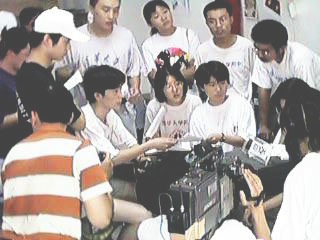
It didn't come off without a hitch, but the crew aboard the shuttle Columbia during mission STS-94 in July nonetheless managed a first for the Shuttle Amateur Radio EXperiment (SAREX) program. On Monday, July, 14, the shuttle crew spoke with students at Tsinghua University. The contact was via a telebridge link with Gordon Williams, VK6IU, in Western Australia. The successful QSO marked the first SAREX contact with a school in the People's Republic of China.
On the first scheduled orbit for the Tsinghua University contact, the designated crew member, Payload Specialist Roger Crouch, was busy with primary mission duties. The SAREX ground team stayed up late and managed a successful QSO on the following orbit. There were 30 people in the Tsinghua University audience, along with Chinese television, Chinese government officials, and some Chinese IARU representatives. David Chang, BY1QH, coordinated the contact at the university's end. Despite some rough copy, the contact went "very well" with 10 questions asked and answered, according to SAREX Principal Investigator Matt Bordelon, KC5BTL.
The Chinese contact was one of 17 scheduled--and successful--SAREX QSOs the STS-94 crew members completed during its 16-day mission. Overall, ham radio had a very prominent role in the mission, which not only completed all of the scheduled SAREX contacts with school groups but made numerous random QSOs with earthbound hams. Aboard the shuttle were Jim Halsell, KC5RNI, the mission commander; Janice Voss, KC5BTK; and Donald Thomas, KC5FVF, who set up the orbiting ham shack and completed 19 random contacts before the "official" scheduled test pass. Toward the end of the mission, the Columbia crew averaged three dozen or so random voice contacts per day during the 16-day mission. The packet robot was activated nine days into the mission.
The other SAREX schools on mission STS-94 were: Alvin C. York Agricultural Institute, Jamestown, Tennessee; Center Street School, El Segundo, California; Crittenden Middle School, Mountain View, California; Discovery Place Inc, Charlotte, North Carolina; Du Bois Middle School, Du Bois, Pennsylvania; Dunn's Corners Elementary School, Westerly, Rhode Island; Edgewater High School, Orlando, Florida; Foursquare Radio Amateur Youth, Oxnard, California; Ione Junior High School, Jackson, California; Lawrence Intermediate School, Lawrenceville, New Jersey; Lexington Traditional Magnet School, Lexington, Kentucky; Mountain View Elementary School, Prescott Valley, Arizona; Public School No 9, New York, New York; Robert J. Burch Elementary School, Tyrone, Georgia; S.J. Davis Middle School, San Antonio, Texas; and Yeso Elementary School, Artesia, New Mexico.
STS-94 marked the 24th SAREX mission. The mission--a "refly" of the aborted STS-83 mission in April--carried the same crew members and the microgravity science lab payload. STS-94 ended July 17.
| FCC OKAYS COMMERCIAL HF MESSAGING SYSTEM |
Over objections from the ARRL and several other parties, the FCC has given a conditional go-ahead to Flash Comm Inc to build and operate a nationwide, commercial, two-way short-data messaging system on HF. The grant, under Part 90 of the FCC regulations, would be on a secondary basis. The frequencies Flash Comm intends to use do not fall in any current ham bands. The League strenuously objected to the plan, however. The ARRL's primary objection stemmed from the fact that some of the frequencies Flash Comm plans to use fall within potential HF band expansions at 30, 20 and 17 meters and close to a potential new ham band at or near 5 MHz. The League said that it would drop its objections to Flash Comm's petition if the frequencies now under consideration for expanded ham allocations were dropped.
All of those who commented on the petition opposed it, fearing unacceptable interference in the HF spectrum. However, the FCC's Wireless Telecommunications Bureau said Flash Comm presented "a compelling case" that the new service "will be a unique and cost-effective way to monitor public and private property and infrastructure." Under the Flash Comm system, so-called "intelligent transceiver units" would be installed on vehicles as well as on structures. Transmitted data would enable the service to track the location or monitor the status of the "asset." Transmissions would be in short bursts averaging two seconds on unoccupied HF channels the Flash Comm system would select automatically. Radiated power would not exceed 1 W, although individual transmitter outputs could be as high as 15 W. The Commission said authorizing the system would provide valuable data for the FCC to evaluate plans to establish permanent rules for these sorts of operations.
The authorization, which involved some rules waivers, is for five years. Flash Comm has petitioned the FCC to establish rules to provide regular authorization of this type of service.
| PRIVACY BILL COULD AFFECT SCANNER CERTIFICATION |
A bill introduced by Rep Edward Markey of Massachusetts that's intended to add privacy protections for consumers using the nation's communication networks has caught the attention of scanner enthusiasts and some amateurs.
One clause in the bill -- HR 1964, the Communications Privacy and Consumer Empowerment Act--would expand electronic privacy provisions in the Communications Act from the cellular telephone service to all Commercial Mobile Radio Services (CMRS). It would do this by prohibiting FCC certification of devices capable of receiving these frequencies. The CMRS is a relative new umbrella designation of subscriber based radio services that act like telephone services. Such services include commercial paging services, commercial air-to-ground services, cellular telephone, offshore radiotelephone, personal communication services and specialized mobile radio services. The bill includes digital transmissions in those services.
While the apparent purpose of the change is to ensure the privacy of "telephone" conversations, scanner enthusiasts fear that a worst-case outcome could be to inhibit, if not block completely, the further certification of scanning radios. This could include ham transceivers with out-of-band receiving capability. Such radios must receive FCC certification to be sold legally. Designing cost-effective devices to filter the proscribed frequencies could prove difficult for manufacturers.
This week, the ARRL with met with Congressman Markey's staff in Washington to express Amateur Radio concerns about HR 1964. We presented information demonstrating what frequencies would be affected and the impact the bill could have on Amateur Radio public service activities.
"We learned several things," said Steve Mansfield, the League's Legislative and Public Affairs Manager. "First, our suspicions were confirmed that, as a Democratic bill referred to the Republican controlled Commerce Committee, the bill has very little chance of passage in its present form."
Mansfield said the League contingent also found out that members of Congress do pay attention. "We explained that, in addressing privacy concerns, the bill casts too wide a net and could hurt Amateur Radio interests," he said. "Rep Markey's staff listened attentively to our concerns and invited us to help them craft language to address the problems we outlined, which we are doing." Since provisions within the bill could still be picked up and put in other bills in this or subsequent sessions of Congress, we felt the bill still required changes.
According to Colin Crowell, Markey's Legislative Assistant for telecommunication issues, the provision in question was intended to provide some privacy protections for fee-based "telephone" type services (especially the new PCS service) between now and the time that providers are able to develop robust digital and encryption technologies to ensure privacy. --Steve Mansfield, N1MZA
| ARRL BOARD ANNOUNCES AWARD WINNERS |
Zachary Manganello, K1ZK (ex-KB1BMG), of Cumberland, Maine, is the winner of the 1996 Hiram Percy Maxim Award. The ARRL Board of Directors approved the award at its recent meeting July 18 and 19 in Rocky Hill, Connecticut. The Maxim award goes annually to the licensed radio amateur under age 21 whose accomplishments and contributions are of the most exemplary nature within the framework of Amateur Radio activities. The winner receives a $1000 award and an engraved plaque.
In other action, the Board chose L. James Biddle, WB3DCL, of Newtown Square, Pennsylvania, and Beverly Priest, N8VZV, of Dayton, Ohio, as joint recipients of the Philip J. McGan Silver Antenna Award. The award recognizes public service contributions, and the Board took the occasion to thank all amateurs engaged in public relations efforts on behalf of Amateur Radio.
The Board also named Eric J. Lagerstrom, KN6FR, of Seaside, California, as the recipient of the Herb S. Brier Instructor of the Year Award for 1996, and Bruce D. Weaver, K3LTM, of Knoxville, Pennsylvania, as the recipient of the Professional Educator of the Year Award for 1996.
"Rick" Lagerstrom says this about his training philosophy: "Tell me and I'll forget. Show me and I'll remember. Involve me and I'll understand." Lagerstrom believes that a trainer's missions are to motivate, generate curiosity, show students how to learn, create a positive environment and to have fun! And his approach works. In just four years of volunteer teaching, he reports that over 600 of his students have passed their licensing exams! Lagerstrom sums up his instructional efforts in this way: "My teaching style is to use every teaching tool available to help my students learn about ham radio."
In just the past four years, Professional Educator of the Year Award winner Bruce D. Weaver, K3LTM, of Westfield, Pennsylvania, has introduced more than 150 students to the magic of ham radio--just as he's been doing for the past 20 years! A fifth-grade teacher, Weaver says he attempts to incorporate many different types of technology into his lessons. For example, in addition to teaching with the aid of Amateur Radio, his students have produced live news programs that air on the local cable system. While his students use computers in the classroom, Weaver says "The most useful teaching tool I have found is Amateur Radio."
Weaver says that while his original intent was only to show his students what Amateur Radio was all about, he soon realized that Amateur Radio was a great teaching tool, too! One 10-minute contact can lead to an English lesson (how to carry on a conversation), a lesson in map skills (locating the other stations location), a math lesson (on time zones and UTC) or handwriting (filling out a QSL card). "The list is endless," he says of the possibilities introduced to the school classroom via ham radio.
Along with a congratulatory letter, the winners of this year's Instructor of the Year awards each receive a beautiful engraved plaque. This year, the ARRL is proud to have a couple of clubs join our efforts, by cosponsoring two of these awards. Our thanks go to the Lake County (La Porte, Indiana) Amateur Radio Club for its long-time support of the Herb S. Brier, W9AD, (volunteer) Instructor of the Year award. In addition, we offer thanks to the Lambda Amateur Radio Club (Int'l), for cosponsoring the 1996 Professional Educator of the Year Award.
The ARRL Board also tapped Sam Brown, WA4IUM, of Knoxville, Tennessee, to receive the first ARRL Media Excellence Award. In making the award, the Board cited Brown's distinguished career as a professional television news anchor and his "outstanding success" and long-term commitment to promoting Amateur Radio on television.
In addition, the Board selected Bill Carver, W7AAZ (ex-K6OLG), of Twin Falls, Idaho, as the recipient of the ARRL Technical Excellence Award for his article, "A High Performance AGC/IF Subsystem," which appeared in May 1996 QST. --thanks to Rick Palm,K1CE, and Glenn Swanson, KB1GW, for contributing to this report
| SOLAR UPDATE |
Solar sage Tad Cook, K7VVV, in Seattle, Washington, reports: This week finally saw a welcome rise in solar activity and the accompanying improvement in HF radio conditions. Solar flux rose above 70 on July 19, was above 72 on July 22, and then at 1700, 2000 and 2300 UTC on July 23 it reached 75.6, 75.7 and 75.8, and at the same times on July 24 it was 77, 78.7 and 79. The 2000 UTC measurement at Penticton, BC is the one reported in this bulletin.
The really great news is that with three active regions on the solar disk, this trend is expected to continue, with flux values around 80, 82 and 82 expected for July 25, 26 and 27. Fortunately, there is no expected rise in geomagnetic indices to go along with the increased activity, so HF conditions should remain stable.
R. Brendle wrote to say that he operates several commercial and GMRS UHF repeaters in Eastern Nebraska, and that the seasonal ducting this year is the longest and most sustained he has ever seen. Normally this only happens during overcast and humid conditions during a severe weather watch, but the most recent period lasted over two weeks. On HF, look for excellent worldwide propagation over the next few days with higher solar flux and continued low A and K indices.
Sunspot numbers for July 10 through 16 were 17, 0, 0, 0, 11, 0 and 0 with a mean of 4. The 10.7-cm flux was 68.5, 68.6, 67.4, 67.1, 68.1, 69.2 and 69.6, with a mean of 68.4, and estimated planetary A indices were 8, 4, 4, 4, 3, 14, and 5, with a mean of 6.
Sunspot numbers for July 17 through 23 were 11, 11, 0, 12, 0, 11 and 31 with a mean of 10.9. The 10.7-cm flux was 69.9, 70.1, 71, 71.2, 71.3, 72.2 and 75.7, with a mean of 71.6, and estimated planetary A indices were 8, 10, 11, 6, 5, 4, and 5, with a mean of 7. /EX
| In Brief: |
- This weekend on the radio: The Venezuelan Independence Day and RSGB Islands-On-The-Air contests, and The Flight of the Bumblebees operating event are all scheduled for this weekend.
- W1AW seeks 20 meter bulletin reports: A change has been made to the W1AW 20 meter bulletin antennas. W1AW requests signal reports from amateurs who listen to the 20 meter transmissions. Please note QTH, time of reception, mode, signal strength and quality. Use of the standard RST system is preferred. Mail reports on a postcard to W1AW, 225 Main St, Newington, CT, 06111; e-mail w1aw@arrl.org. A W1AW Operating Schedule is available.
- Mir back on the air: As US astronaut Mike Foale, KB5UAC, bides his time aboard the troubled Mir space station, he has been active on 2-meter packet and FM voice. Harry Mueller, KC5TRB, in Tulsa, Oklahoma, reports working Foale July 21 on 145.985 MHz FM voice. KC5TRB responded to KB5UAC's CQ. Mueller reports that Foale said he was disappointed that this crew would not get to make the needed Mir repairs, but that he was in "good spirits." Mueller said that Foale "sends his best wishes and a big thank you to the Amateur Radio community" for its support during the Mir crises. From Melbourne, Australia, Chris Edmondson, VK3CE, reports connecting with the R0MIR packet system July 22 on 145.985 MHz and "good copy for the entire high pass of almost 14 minutes." Foale told MIREX CEO Dave Larsen, N6CO, on July 21 that he was having frequent power problems with the TNC and losing messages. "Sorry. No supply store is near at hand," Foale quipped, adding that he was getting ready for the next Mir crew to arrive on August 7. (Note: Mir also uses 145.800/200 MHz--Ed.) --thanks to Rosalie White, WA1STO
- Hams provide communication during flooding: Hams in the Kendall County, Texas, area jumped in to handle health-and welfare-and emergency traffic after flooding struck the area June 22. David McDaniel, AB5UE, president of the Kendall Amateur Radio Society, reports that N5VUO served as net control from the local fire station to coordinate flood and evacuee aid. A Red Cross emergency shelter was set up at a school, and WD5FXZ, WD5FXY and KC5OEG passed health-and-welfare traffic to the local emergency operations center via 2 meters. Also assisting were W5VEO, N5QPU, KA5WJY and KC5WWG. The area received more than 20 inches of rain in 24 hours. Later that same week, hams in Texas responded to a call from the American Red Cross to provide emergency communication as floods threatened the town of Tildon, Texas (50 miles south of San Antonio). Bexar County REACT enlisted the aid of Ray Taylor, N5NAV, who's active in ARES and the Central Texas Traffic Net. Communication was set up on HF. Reports REACT member Lee Besing, N5NTG: "Within a couple of hours, amateurs packed their gear and drove into town on the Friday night before Field Day weekend. On Saturday, while the rest of the ham world was practicing Field Day, these hams were really having a Field Day under emergency conditions!" They stayed for 24 hours until the flood waters receded. Others involved included N5IJR, WB5YQC, KK5LA, KB5TEE, N5WSW, KC5NUW, KC5IIQ, KC5VCF, KC5IFT, and KJ5PS.--thanks to David McDaniel, AB5UE, and Lee Besing, N5NTG
- Vanity update: The FCC in Gettysburg reports it processed vanity call sign applications received during June. The FCC received 418 electronic applications and 232 paper applications during June. It granted 210 new call signs. Several hundred applications remained in the work in process (WIPS) stack, which FCC personnel have continued to process.
- K2BSA at Jamboree: The Boy Scouts' K2BSA will be on the air from the National Jamboree starting July 28, when some 35,000 Scouts are scheduled to arrive at Fort A. P. Hill in Virginia. The ARRL's Larry Wolfgang, WR1B, is among the 34 adult ham Scouters on the Jamboree staff, along with Ray Moyer, WD8JKV, the BSA National Coordinator, Mike Brown, WB2JWD the overall coordinator, and William Burns, WA6QYR the Radio Merit Badge coordinator. In addition, there are seven Scout youth staff members who are licensed amateurs. "We have been busy building K2BSA this week," Larry reports. "Right now we have a packet station operating in the traffic-handling area and one HF station operational as of noon Friday (July 25)." During the Jamboree, K2BSA will have at least three HF stations operating, plus a satellite setup and a station devoted to digital modes and SSTV. "The traffic-handling station will be another big part of our operation, as we take messages from Scouts to send home as well as receive incoming traffic for the Scouts," he said. A 2-meter repeater (145.17 MHz) is also on the air and fully operational.
- QST Cover Plaque Award winner: The July QST Cover Plaque Award goes to Sam Ulbing, N4UAU, for his article, "My All-Purpose Voltage Booster." Congratulations, Sam!
- FCC seeks comments on Strategic Plan: The FCC seeks public comment on its Strategic Plan. A copy of the plan is available at http://www.fcc.gov/Bureaus/Miscellaneous/Public_Notices/1997/spintro.html. Comments should be forwarded by August 1, 1997, to Kathy Fagan, Room 240E, 2000 M St NW, Washington, DC 20554; e-mail kfagan@fcc.gov.
| The ARRL Letter |
The ARRL Letter is published by the American Radio Relay League, 225 Main St, Newington, CT 06111; tel 860-594-0200; fax 860-594-0259. Rodney J. Stafford, KB6ZV, President; David Sumner, K1ZZ, Executive Vice President.
Circulation, Kathy Capodicasa, N1GZO, e-mail kcapodicasa@arrl.org.
Editorial, Rick Lindquist, N1RL, e-mail elindquist@arrl.org.
Visit the ARRLWeb page at http://www.arrl.org.
The purpose of The ARRL Letter is to provide the essential news of interest to active, organizationally minded radio amateurs faster than it can be disseminated by our official journal, QST. We strive to be fast, accurate and readable in our reporting.
Material from The ARRL Letter may be reproduced in whole or in part, in any form, including photoreproduction and electronic databanks, provided that credit is given to The ARRL Letter and The American Radio Relay League.
| How to Get The ARRL Letter: |
The ARRL Letter is distributed directly from ARRL HQ only to elected League officials and certain ARRL appointees and to paid subscribers of the now-defunct hard-copy edition of The ARRL Letter . For members and nonmembers alike, The ARRL Letter is available free of charge from these sources:
- The ARRLWeb page (http://www.arrl.org/arrlletter/). This version of The ARRL Letter includes any photographs.
- The HIRAM BBS: 860-594-0306.
- The ARRL Technical Information Server (Info Server): Send an e-mail message to info@arrl.org. The subject line should be blank. In the message body, type send ltrmmdd.txt, where mm represents two digits for the month and dd represents two digits for the day (The ARRL Letter is published every Friday). For example, to request The ARRL Letter file for Friday, January 3, 1997, you'd type send ltr0103.txt. Then, on a separate line, type quit.
- CompuServe and America Online subscribers, as a downloadable text file in the services' ham radio libraries
- The Netcom server, run by the Boston Amateur Radio Club and Mike Ardai, N1IST: Send e-mail to listserv@netcom.com (no subject needed). The body of the message should say subscribe letter-list.