Address Changes: Kathy Capodicasa, N1GZO, e-mail kcapodicasa@arrl.org.
Editorial: Rick Lindquist, N1RL, e-mail elindquist@arrl.org.
| IN THIS EDITION: |
- Seventeen schools on STS-94 SAREX list
- FCC suspends ticket in interference case
- New NL section official for 97 Sweepstakes
- RS-10 silence explained
- Blaha to visit Oklahoma Field Day
- CyberHam Magazine QRX
- Ham Radio & More goes shortwave only
- NY Amateur Radio Month Proclamation presented
- Solar Update
- Thomas O'Malley Moore, K3LTV, SK
- In Brief: This weekend on the radio; ARRL requests 7100-7300 kHz for American Samoa; DXCC Processing Status; N6TX goes full-time with The SETI League; QSTs for Amateur in Scouting; AEA Division announces appointments; CIB chief quitting FCC; FCC makes 47-GHz band spectrum available; Mir SAFEX 70-cm repeater operational; AO-27 frequency drift
| SEVENTEEN SCHOOLS ON STS-94 SAREX SCHEDULE |
Thanks to SAREX -- the Shuttle Amateur Radio EXperiment -- students at 17 schools, including one in the People's Republic of China, are scheduled to talk with the astronauts on the upcoming STS-94 mission aboard the shuttle Columbia. STS-94 is a "refly" of the April STS-83 mission that had to be cut short when a problem developed in one of the shuttle's fuel cells. STS-94 is set to launch on July 1. During the earlier mission, Columbia prematurely returned to Earth April 8 without making any of the scheduled SAREX QSOs. Most of the schools on the earlier schedule remain on tap for the July mission, which will again carry the microgravity science lab. Three hams are among the STS-94 crew members. They are Jim Halsell, KC5RNI, the mission commander; Janice Voss, KC5BTK; and Donald Thomas, KC5FVF.
Under the SAREX program, students at each of the selected schools ask questions of the astronauts during the contact. The primary goal of SAREX is to excite students' interest in learning.
Schools selected by the SAREX Working Group for a ham radio contact during this mission include: Mountain View Elementary School, Prescott Valley, Arizona; Center Street School, El Segundo, California; Ione Junior High School, Jackson, California; Foursquare Radio Amateur Youth, Oxnard, California; Crittenden Middle School, Mountain View, California; Robert J. Burch Elementary School, Tyrone, Georgia; Edgewater High School, Orlando, Florida; Lexington Traditional Magnet School, Lexington, Kentucky; Discovery Place Inc, Charlotte, North Carolina; Lawrence Intermediate School, Lawrenceville, New Jersey; Yeso Elementary School, Artesia, New Mexico; Public School No 9, New York, New York; Du Bois Middle School, Du Bois, Pennsylvania; Dunn's Corners Elementary School, Westerly, Rhode Island; Alvin C. York Agricultural Institute, Jamestown, Tennessee; S.J. Davis Middle School, San Antonio, Texas; and Tsinghua University, Beijing, People's Republic of China.
During most SAREX missions, many of the crew members will make random contacts with earth-bound hams. This crew will use KC5RNI, KC5BTK and KC5FVF on FM voice and W5RRR-1 on packet. They make these contacts during their breaks, before and after meal time, and during their pre-sleep time. In fact, over the past years the astronauts have contacted thousands of amateurs around the world. On many missions, they have even carried a 2-meter packet radio station. Innovative computer software allows the crew to operate the packet gear in an "unattended" mode, allowing amateurs to make contacts with the ROBOT station when the astronauts are working or sleeping.
The SAREX Working Group has designated the following frequencies during this mission. FM voice downlink (worldwide): 145.55 MHz; FM voice uplink (except Europe): 144.91, 144.93, 144.95, 144.97, and 144.99 MHz; FM voice uplink (Europe only): 144.70, 144.75, and 144.80 MHz; FM packet downlink: 145.55 MHz; FM packet uplink: 144.49 MHz.
Hams should avoid transmitting on the shuttle's downlink frequencies. The uplink is your transmitting frequency. The crew will not favor any uplink frequency, so your ability to communicate with SAREX will be the "luck of the draw." Transmit only when the shuttle is within range of your station, and when the shuttle's station is on-the-air.
QSLs go to ARRL EAD, STS-94 QSL, 225 Main St, Newington, CT 06111-1494. Include the following information in your QSL or report: STS-83, date, time in UTC, frequency and mode (FM, voice or packet). You must also include a business-sized SASE.
Additional STS-94 mission information is available from NASA at the NASA Shuttle Web site, http://shuttle.nasa.gov. --Glenn Swanson, KB1GW
| NEW YORKER'S HAM TICKET SUSPENDED FOR 15 MONTHS |
The FCC has suspended the Technician Class license of a ham in Brooklyn, New York, for causing willful or malicious interference, using obscene or indecent language and failure to identify. The licensee, Anthony Barben Jr, N2WNF, consented to a 15-month suspension which resulted from the FCC's efforts to resolve a rash of interference cases in the New York City-Long Island area. The FCC said the violations occurred in November 1996.
The FCC's Enforcement Division has requested that Barben forward his license to the Commission. The suspension became effective this week.
| NEW SECTION UPS THE ANTE ON SS CLEAN SWEEP |
Keep an ear out for VO1 and VO2 call signs during this fall's ARRL Sweepstakes! Canada's new Newfoundland-Labrador (NL) Section will be among those that SS participants will have to snag this November on their way to that coveted Clean Sweep Award. The ARRL received formal notification of the change last week from Radio Amateurs of Canada President J. Farrell "Hoppy" Hopwood, VE7RD, although the addition of the NL section actually was approved last year. Some NL hams gave NL as their section in last fall's SS, although the change had not yet been incorporated into the list of SS sections. Joe Craig, VO1NA, of Torbay, Newfoundland, is the Section Manager in NL. RAC Vice President and General Counsel Tim Ellam, VE6SH, said the new section was created "primarily as it was hard to service VO1/2 from the MAR (Maritimes) section due to geography."
The addition of a new section could prove to be a significant challenge for those hoping to work all ARRL and RAC sections, plus VE8/VY1 (a total of 79 multipliers) in the popular fall event. Some Canadian sections already are among the more difficult ones to find and work. (A heads up: Ellam says RAC has also explored the possibility of creating additional new sections north of the border, but no decisions have been reached yet.) The change also means that those who use computerized logging programs will have to add the new section to their program's list of SS sections--just as they had to do last fall with the addition of the Northern New York section.
This year's ARRL Sweepstakes weekends are November 1-2 (CW) and November 15-16 (SSB).
| RS-10 SILENCE EXPLAINED |
AMSAT News Service reports that the RS-10 beacon, ROBOT and transponder remain silent while designer and builder Andy Papkov carries out experimental work with the satellite from the RS3A command station. Leonid Labutin, UA3CR, reports that it is hoped that RS-10 will be active again before its tenth birthday later this month.
A special event station to celebrate RS-10's number 10 is being planned from June 21 until June 29 by a group of UK RS enthusiasts, including G4CUO, G4ZHG, G6HMS, G0MKA, G7MUB, G8DYK and G0MKA. They will be active as GB0RAS on all modes on each pass of RS-10, RS-12, and RS-15 and the Japanese FUJI satellites. A serial number will be given for all QSOs on each satellite, and a commemorative QSL card will be sent to each station contacted or SWL.
The RS-10 uplink (CW or SSB) is 145.865 to 145.905 MHz, and the downlink is 29.36 to 29.40 MHz. --AMSAT News Service
| ASTRONAUT TO VISIT FD, SPACE CAMPS IN OKLAHOMA |
Ham-astronaut John Blaha, KC5TZQ, will be on the air for Field Day later this month as a guest of Oklahoma's Lawton/Ft Sill Amateur Radio Club, W5KS. That word from Mark G. Ewell, KC5IZN, who reports the club confirmed the arrangements with NASA's Johnson Space Center. Blaha and his wife, Brenda, will visit Oklahoma June 26-29, and will also visit two area youth camps the day before FD begins.
"Although our initial desire was to arrange for John Blaha to meet one of his more frequent Mir contacts, Ashley Cagle, WB5OTD, we quickly found out serendipitously that Cameron University will be sponsoring its two-week SpaceCamp for high school students ending June 27 and that the Great Plains Regional Vo-Tech Center will be sponsoring its TechWeek technical camp for junior high students ending June 26." He said the club would try to set up a 2 meter station at one or both of the camps to give the youths a chance to use ham radio. Ewell says Blaha will spend Friday with the campers and be a guest at a Chamber of Commerce luncheon, then help to operate Field Day the next day with the W5KS group. "We might try to make a Mir contact," Ewell said.
While he was aboard Mir for approximately four months late last year and early this year, Blaha was very active on ham radio.
For more information, see the W5KS Web site, http://www.w5ks.org.
| CYBERHAM MAGAZINE QRX |
CyberHam Magazine publishers Gene Harlan, WB9MMM, and Shari Harlan, WB9SFT, have announced that the magazine has been put "on hold" and has ceased publication. Gene Harlan said the reason is that the magazine has not been successful getting enough new advertisers, and some advertisers had dropped out altogether. In addition, he said subscriptions were down. "I know times are tough for all amateur radio retailers and manufacturers, and we were hoping that we could ride the upcoming sunspot cycle as the interest came back," Harlan said, adding that he and his wife want to "leave the door open" for someone to take over the magazine or perhaps try it again later when its prospects look brighter.
"A mailing will go out around July 1 explaining what we will do to take care of what we owe people," Harlan said. "We intend on keeping Harlan Technologies going." He said software sales had been supporting the magazine.
CyberHam Magazine began publication last September as an effort to merge interest in ham radio and computers. It had been published bi-monthly.
| HAM RADIO & MORE TO GO SHORTWAVE ONLY |
Starting this Sunday, June 15, The Ham Radio & More show, hosted by Len Winkler, KB7LPW, will only be available via short-wave broadcast on WWCR, 5.070 MHz. The program airs live at 2200 UTC. The former originating station--KFNN, an AM broadcast station in Phoenix, Arizona--dropped the program for lack of advertiser support.
Winkler, who had announced that his June 8 broadcast would be the last, had a change of heart this week and will continue HR&M on WWCR. The program had been syndicated by KFNN via satellite to local commercial outlets. It also was available via Internet audio. "I will continue to have guests each week, except the first week of each month, which is Rag Chew Open Lines with my co-host, Ned "The Professor" Stearns, AA7A," Winkler said. The Ham Radio & More will rebroadcast on WWCR Sundays at 0500 UTC on 5.070 MHz and Tuesdays at 0800 UTC on 3.210 MHz. The program, now in its seventh year, will continue to be commercially sponsored.
For more information, contact Len Winkler, KB7LPW, Ham Radio & More, Box 9219, Phoenix, AZ 85068-9219; tel 602-861-0303; e-mail lenwink@goodnet.com, http://www.goodnet.com/~lenwink/hrm.htm.
| AMATEUR RADIO MONTH PROCLAMATION PRESENTED AT ROCHESTER |
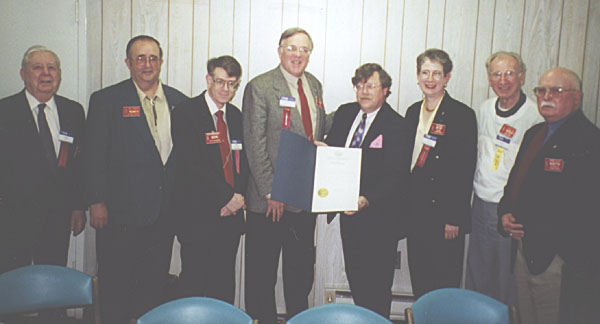 Several ARRL dignitaries were on hand May 31 at the Atlantic Division Convention at Rochester, New York, when Hudson Division Assistant Director (and Eastern New York Public Information Coordinator) Stephan Anderman, WA3RKB (fifth from left), formally presented the document signed by New York Gov George Pataki, ex-K2ZCZ, proclaiming June as Amateur Radio Month. Those pictured (from left to right): ARRL Vice President Hugh Turnbull, W3ABC; Western New York Section Manager Bill Thompson, W2MTA; ARRL First Vice President Steve Mendelsohn, W2ML; Hudson Division Director Frank Fallon, N2FF; Anderman; Atlantic Division Director Kay Craigie, WT3P; Former Hudson Division Director Stan Zak, K2SJO; and Atlantic Division Vice Director Bernie Fuller, N3EFN. Similar ceremonies were held at the Northern New York hamfest June 7, at the LIMARC meeting June 9 and in Carmel, New York at the QSY Society meeting on June 11. (Photo by Arte Booten, N2ZRC) --Frank Fallon, N2FF
| SUN FALLS FLAT AGAIN |
Solar prognosticator Tad Cook, K7VVV, Seattle, Washington, reports: Solar activity is flat again, with solar flux headed into the low 70s. Flux values are expected to stay this way into the next month. There was an upset on Monday when the planetary A index was 33 and the K index was as high as six. This signaled greater absorption of radio waves, especially over polar paths. NOAA had a recent report on the number of days with no sunspots for each month over the past four years. The values are in a bar graph, and there was a trend of more and more spotless days per month until October, 1996. The number of spotless days per month have been declining since then, a welcome sign for propagation watchers hoping for better conditions.
W6LX wrote to inquire about the comments of KE8YX in our last report, asking what he meant by the next solar cycle perhaps being a record cycle. I assume that he meant that the next cycle could rival cycle 19 from the late 1950's in activity. That would be nice.
Sunspot numbers for June 5 through 11 were 15, 15, 17, 36, 23, 11 and 11 with a mean of 18.3. The 10.7 cm flux was 73.9, 74.2, 74.7, 73.2, 73.1, 71.9 and 70.8, with a mean of 73.1, and estimated planetary A indices were 3, 8, 11, 11, 33, 6, and 3, with a mean of 10.7.
| THOMAS O'MALLEY MOORE, K3LTV, SK |
Veteran amateur and broadcasting engineer Thomas O. Moore, K3LTV, of Bethel Park, Pennsylvania, died June 6, 1997. He was 86. An ARRL member, Moore was active on 40 meter CW and on 6-meter SSB and CW and had been on the air up until a few weeks before his death. Moore worked at WMMN radio in Fairmont, West Virginia, WDTV-TV (Channel 3) in Pittsburgh, Pennsylvania, and KDKA-TV (Channel 2) in Pittsburgh, Pennsylvania. He retired from KDKA-TV as chief audio engineer. His son, Thomas II, W7KMA, and daughter-in-law Samboon, WH6CRA, are among his survivors. --Thomas O'Malley Moore, II, W7KMA
| In Brief: |
- This weekend on the radio: ARRL June VHF QSO Party, Asia Pacific Sprint, West Virginia QSO Party, Portugal Day, WW South America CW Contest and the TOEC WW Grid Contest are all on tap for this weekend.
- ARRL requests 7100-7300 kHz for American Samoa: The League has asked the FCC to amend its Amateur Service rules to permit ham use of 7100 to 7300 kHz in the Territory of American Samoa on a non-interference basis to broadcasters "as a domestic exception to the International table of Frequency Allocations." American Samoa, in ITU Region 3, is an unincorporated, unorganized territory of the US some 2100 miles from New Zealand. The current 40-meter band in Region 3 extends from 7000 to 7100 kHz. The ARRL said the absence of ham access to the entire 7000 to 7300 kHz band impedes communication "because the emergency communications stations that would otherwise be accessible to American Samoa amateurs are established above 7100 kHz." The petition notes that Western Samoa, Australia and New Zealand all permit domestic use of the entire 7000 to 7300 kHz allocation by hams as long as harmful interference is not caused to the primary occupant of the 7100 to 7300 segment in Region 3, the broadcasting service.
- DXCC Processing Status: The DXCC Desk reports that the number of unprocessed applications at the end of May 1997 was 350 (28,738 QSLs). The DXCC Desk received 443 applications (32,928 QSLs) for endorsements and new awards during the month. This compares with 313 applications (25,423 QSLs) for April and 322 applications (23,897 QSLs) for March. Applications being sent out at the end of May were received about two weeks earlier. A few applications received prior to that time were in the process of being audited, and so had not yet been completed.
- N6TX goes full-time with The SETI League: H. Paul Schuch, N6TX, will become full-time executive director of the non-profit SETI League Inc. The organization, devoted to a scientific, privately funded search for extraterrestrial intelligence, signed a five-year contract with Schuch last month. During his first year with the SETI League, Schuch was on sabbatical from his teaching duties at the Pennsylvania College of Technology. He'll now resign that position to devote his full energies to SETI. "After 24 years of teaching, I was, frankly, quite ready for a new challenge," said Schuch. The SETI League recently welcomed its 500th member. For more information, contact The SETI League, Box 555, Little Ferry, NJ 07643; tel 201-641-1770; fax 201-641-1771; e-mail n6tx@setileague.org; http://www.setileague.org/.
- QSTs for Amateur in Scouting: Rich Reitz, KB2CNJ, would like to donate his complete collection of QST from 1930 until 1975 to someone in Amateur Radio and Scouting. If you or your group is interested, contact him at rbreitz@eclipse.net. --ScoutRadio
- AEA Division announces appointments: Former AEA president and cofounder Mike Lamb, N7ML, has been formally named director of marketing of the new AEA Division of Tempo Research. Lamb will work out of his office in Bozeman, Montana. He'll be responsible for marketing and sales. The AEA line of antenna products, antenna analyzers, and the AEA trade name were purchased early this year by Tempo Research Corporation of Vista, California. L. Wayne Dewey, WD6AHZ, has been appointed product manager for the AEA division. He'll direct customer service. Founded in 1984, Tempo Research is a manufacturer of test equipment for the telecommunications industry. For more information, contact AEA at 760-598-9677 or Mike Lamb at 406-587-3795.
- CIB chief quitting FCC: Beverly G. Baker, chief of the FCC's Compliance and Information Bureau, has announced she will leave the FCC next month to pursue opportunities in the private sector. She has been bureau chief since August 1994. --FCC
- FCC makes 47-GHz band spectrum available: The FCC has made available for public, commercial use 1 GHz of spectrum in the 47-GHz band. The FCC made available 47.2 to 48.2 GHz, which is currently allocated for fixed, fixed-satellite and mobile uses. The action does not involve the Amateur Radio allocation at 47.0 to 47.2 GHz. The Report and Order was adopted May 2. --FCC
- Mir SAFEX 70-cm repeater operational: Reports from Europe indicate that the Mir UHF FM voice repeater is now working. The uplink frequency is 435.750 MHz, and the downlink is 437.950 MHz. The required CTCSS tone is 141.3 Hz. Francisco Costa, CT1EAT, reports working ON6GP on a June 7 pass over Europe. --AMSAT News Service
- AO-27 frequency drift: The 70-cm downlink signal from AO-27 is slowly drifting lower in frequency with time. This drift is due to the natural aging of the transmitter crystal. Controllers can adjust the downlink frequency slightly to compensate for the drift, however the frequency change that has occurred to date is greater than the amount that can be compensated for by controllers. Users are asked to take this into consideration when monitoring the AO-27 downlink (currently 436.792 MHz). --SpaceNews
| The ARRL Letter |
The ARRL Letter is published by the American Radio Relay League, 225 Main St, Newington, CT 06111; tel 860-594-0200; fax 860-594-0259. Rodney J. Stafford, KB6ZV, President; David Sumner, K1ZZ, Executive Vice President.
Circulation, Kathy Capodicasa, N1GZO, e-mail kcapodicasa@arrl.org.
Editorial, Rick Lindquist, N1RL, e-mail elindquist@arrl.org.
Visit the ARRLWeb page at http://www.arrl.org.
The purpose of The ARRL Letter is to provide the essential news of interest to active, organizationally minded radio amateurs faster than it can be disseminated by our official journal, QST. We strive to be fast, accurate and readable in our reporting.
Material from The ARRL Letter may be reproduced in whole or in part, in any form, including photoreproduction and electronic databanks, provided that credit is given to The ARRL Letter and The American Radio Relay League.
| How to Get The ARRL Letter: |
The ARRL Letter is distributed directly from ARRL HQ only to elected League officials and certain ARRL appointees and to paid subscribers of the now-defunct hard-copy edition of The ARRL Letter . For members and nonmembers alike, The ARRL Letter is available free of charge from these sources:
- The ARRLWeb page (http://www.arrl.org/arrlletter/). This version of The ARRL Letter includes any photographs.
- The HIRAM BBS: 860-594-0306.
- The ARRL Technical Information Server (Info Server): Send an e-mail message to info@arrl.org. The subject line should be blank. In the message body, type send ltrmmdd.txt, where mm represents two digits for the month and dd represents two digits for the day (The ARRL Letter is published every Friday). For example, to request The ARRL Letter file for Friday, January 3, 1997, you'd type send ltr0103.txt. Then, on a separate line, type quit.
- CompuServe and America Online subscribers, as a downloadable text file in the services' ham radio libraries
- The Netcom server, run by the Boston Amateur Radio Club and Mike Ardai, N1IST: Send e-mail to listserv@netcom.com (no subject needed). The body of the message should say subscribe letter-list.