Address Changes: Kathy Capodicasa, N1GZO, e-mail kcapodicasa@arrl.org.
Editorial: Rick Lindquist, N1RL, e-mail elindquist@arrl.org.
| IN THIS EDITION: |
- Hams aid flood relief
- STS-83 refly is a "go" with SAREX aboard
- New ham-astronaut class
- ARRL ham-in-a-weekend class a success
- W2AX attempts to fill maritime CW gap
- Solar update
- Elmer C. (Chuck) Kunze, W0WVM, SK
- Granville Klink Jr, W3AFV, SK
- Robert G. Osborn Jr, N6MSO, SK
- Eugene Black, W2LL, SK
- Guy Black, W4PSJ, SK
- In Brief: This weekend on the radio; HQ job opening; WW II sub radio rooms to be reactivated; Morse special event set; Correction; IRCI gets new owner, shorter name; Astronaut Jay Apt, N5QWL, to head museum; KB2LUO to become NNJ SM on May 1
| HAMS CONTINUE FLOOD RELIEF ASSISTANCE |
Ham radio has assumed a critical role in the wake of major flooding along the Red River that overtook the cities of Grand Forks, North Dakota, and East Grand Forks, Minnesota. Most area residents--an estimated 50,000 people--were evacuated into surrounding towns and emergency shelters. The Salvation Army has been assisting at many of the temporary camps and shelters, providing food and other necessities, and Amateur Radio has been maintaining important communication links--including one between various flood relief sites and a Salvation Army warehouse in Minneapolis.
ARRL Minnesota Section Manager Randy Wendel, N0FKU, reports that ARES, RACES, MARS and other members of the Amateur Radio community have been working together with the primary aim of assisting the Salvation Army and other emergency relief agencies. Some nearby areas have few or no hams, so some operators have volunteered to drive long distances to help out, he said. When an HF link was needed between Salvation Army relief sites and the Minneapolis warehouse, a number of HF mobile operators from Minneapolis volunteered to make the nearly six-hour trip to the flooded region to help assure communication.
Wendel also reports that many hams are among the flood refugees who have been forced from their homes by what's being dubbed "the 500-year flood." Many homes have been damaged or destroyed, and the flooding was compounded by a large fire in downtown Grand Forks. The disaster also brought out many hams who had not previously been involved with emergency preparedness but suddenly found themselves in the midst of a major disaster--in some cases as victims themselves. He said this has served as a grim reminder that "disaster doesn't always occur from the comfort of our ham shacks." Wendel said hams must realize the importance of "having the capability to travel and set up a remote station at various locations."
North Dakota Section Manager Bill Kurtti, WC0M, reports that hams in that stricken state are providing backup communication for the various agencies involved in the flood-relief effort. "A book could be written about just the ham radio involvement," he said. Kurtti said the biggest communication obstacle hams are trying to help overcome is to coordinate communication among the various relief agencies that don't share one another's radio frequencies. "Ham flexibility can tie them together," he said. Links have been established on HF (75 meters), VHF and UHF, he reports. Several Amateur Radio clubs, the American Red Cross, the Salvation Army, the National Guard and FEMA have been active in dealing with the emergency in North Dakota. Kurtti said today (April 25) that in the northeastern North Dakota, the water is rising to record levels, and the cities of Drayton and Pembina may have to evacuate because water might overrun the dikes at those towns. Harold McConnell, WA0YSF, the RACES EC for Pembina County, North Dakota, reports that hams in that region have been supporting the local emergency manager, the National Guard, the US Coast Guard, the Air Guard and the Salvation Army. "We have portable remote stations operating from the City of Drayton and the City of Pembina EOCs," he reported. He said hams in North Dakota are also in contact with Canadian hams to the north who will get the flood waters leaving North Dakota. "The dikes in Pembina County are holding, but people are getting pretty tired and the water is still rising," he said. "We have assisted the Coast Guard and National Guard in setting up and installing some of their radio equipment in their vehicles and in the emergency operations center."
The ARRL's emergency 2-meter repeater has been shipped to the Forx Amateur Radio Club in Grand Forks, North Dakota, to serve as a backup to the single repeater still in operation as the Red River begins to recede and the massive clean-up and damage-assessment process begins. The repeater was previously loaned to the US Virgin Islands after a hurricane took out all amateur repeaters on St Thomas in 1995.
Morgan James, KF0EN, a meteorologist at the University of North Dakota, reports that Grand Forks ARES worked with emergency management agencies to install communication for dike patrols. The ARES group also set up a mobile 420-MHz ATV repeater in a van and was able to send live video back to the emergency operations center of dike-building activity. He said ARES was running continuous VHF and UHF nets in the Grand Forks area to assist with flood efforts. "We expect to continue 24-hour operations until the Red River recedes significantly," James said.
Mike Woytassek, N0VGV, of Fargo, North Dakota, reports that even hams who were traveling in the area and were caught in the flooding have pitched in to help. "It has been truly unbelievable how the radio community has come together for this," he said. Woytassek, president of Red River Radio Amateurs, said hams helped Cass County emergency management officials with communication, passing traffic on water levels and road closings. The county lost its radio towers during the earlier ice storm and blizzard, but with the hams' ingenuity and physical labor, the county's radio system was back on the air the next day. According to Woytassek, area hams also jumped in to help the US Coast Guard to communicate with its rescue units in the Red River Valley from a temporary headquarters in Fargo. "The Grand Forks hams are victims as well as on the front lines working," he pointed out.
Other clubs pitching in include the Wahpeton Radio Amateurs in Wahpeton, North Dakota and the Cavalier County Amateur Radio Club, Cavalier, North Dakota. All involved with the relief and recover efforts in Minnesota and the Dakotas have praised the countless hams who have turned out as well as the degree of teamwork. "We should all be proud of the Amateur Radio community today," said Mike Woytassek. "Regardless of what club, regardless of what city, county or state, they came together and worked as one team."
President Clinton visited the flooded region this week to survey the damage. Wendel said he expected flood relief efforts would continue for several more weeks.
| STS-83 REFLY IS A "GO" FOR JULY WITH SAREX ON BOARD |
Word from NASA this week is that shuttle mission STS-83--cut short in early April because of a fuel cell problem aboard the spacecraft--will be reflown in July with the Shuttle Amateur Radio EXperiment--SAREX--aboard! The new mission will be dubbed STS-94. The space shuttle Columbia prematurely returned to Earth April 8 without making any of the scheduled QSOs with 18 schools in the US, the People's Republic of China, and Japan. Sixteen schools want to arrange new schedules for the July mission, which will again carry the microgravity science lab. Three hams were aboard STS-83: Jim Halsell, KC5RNI, the mission commander; Janice Voss, KC5BTK; and Donald Thomas, KC5FVF. The same crew likely will be tapped for STS-94, set to launch on July 1 for a 16-day mission.
In the meantime, more QSOs of a scheduled round of ten MIREX school contacts have taken place with Jerry Linenger, KC5HBR, aboard the Russian Mir space station. Students at Holy Angels School in Dayton, Ohio, got a chance to chat with Linenger April 21. The ground station, W8DOZ, was running 35 W into a turnstile antenna. On April 23, students at Jerling Junior High School in Orland Park, Illinois--a Chicago suburb--had a 10-minute contact with Linenger. More than a dozen students got to speak directly to Linenger as an audience of 800 students and 200 visitors looked on. Nearly 2500 students in other schools also got to listen in.
Linenger and his cosmonaut flight companions, Mir-23 Commander Vasily Tsibliev and Flight Engineer Alexander Lazutkin, managed to restore one of two Elektron oxygen generators aboard Mir. The repair ended a serious problem for the Russian space outpost. The three used equipment shipped to Mir April 8 aboard a Progress resupply rocket. With the Elektron electrolysis system at least partially back in operation and the Mir's primary carbon dioxide scrubber also operational once more, the air aboard the Mir is healthier than it has been in weeks. Because the system is not producing oxygen at a rate sufficient for three crew members, however, the crew is supplementing the Mir's atmosphere with gaseous oxygen. The Mir also has a healthy stock of oxygen-generating candles to use if necessary. Wire service reports say the Mir crew has, for the time being, given up efforts to track down an elusive cooling system leak that's allowing ethylene glycol coolant to leak into the atmosphere of one spacecraft module.
NASA reportedly intends to go ahead with plans for astronaut Michael Foale, KB5UAC, replace Linenger in mid-May. Foale, who will arrive on the shuttle Atlantis, is scheduled to be replaced in September by astronaut Wendy Lawrence, KC5KII. The last US astronaut scheduled for a tour of duty on Mir is David Wolf, KC5VPF, in early 1998. The 11-year-old Mir space station eventually will be replaced by the International Space Station--a cooperative venture between Russia and the US.
| NEW CLASS OF HAM-ASTRONAUTS |
Ten of the 44 members of the 1996 Astronaut Candidate Class have become Amateur Radio Operators. Here are some of the call signs that might be showing up on future space missions:
- AC Mission Specialist Laurel Clark, KC5ZSU
- AC Mission Specialist Yvonne Cagle, KC5ZSV
- AC Pilot James Kelly, KC5ZSW
- AC Mission Specialist Daniel Burbank, KC5ZSX
- AC Mission Specialist Charles Camarda, KC5ZSY
- AC Mission Specialist Paul Richards, KC5ZSZ
- STS-72 Mission Specialist Koichi Wakata, KC5ZTA
- AC Mission Specialist Lisa Nowak, KC5ZTB
- AC Mission Specialist David Brown, KC5ZTC
- AC Mission Specialist Peggy Whitson, KC5ZTD
- AC Mission Specialist Richard Mastracchio, KC5ZTE
- STS-67 and STS-81 Mission Specialist John Grunsfeld, KC5ZTF
- STS-73 Mission Specialist Catherine Coleman, KC5ZTH (trained to possibly take the place of Don Thomas, KC5FVF, on STS-83 when Thomas broke his ankle in January.)
--Matt, KC5BTL, and Joanna, KC5OCI, Bordelon
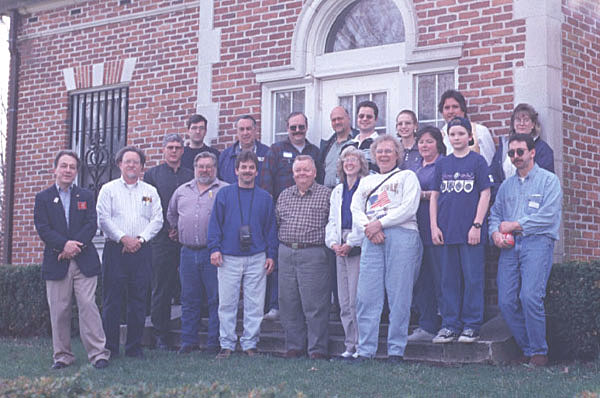
| ARRL HAM-IN-A-WEEKEND CLASS A SUCCESS |
 |
| W2AX ATTEMPTS TO FILL SHIPBOARD CW GAP |
While aboard the Queen Elizabeth II for an around-the-world cruise earlier this year, Larry Amodeo, W2AX, of Manhasset, New York, found his CW ability suddenly in demand. On February 5, while operating /mm from the ship's ham radio shack--which is located in the QE2's radio room--the ship's radio operator called him over to see if Amodeo could copy what he thought was a distress call on 500 kHz--the old maritime emergency frequency. Amodeo said the ship's operator told him he did not copy CW much above 10 WPM, and there was not a telegraph key in sight (although Amodeo said he later found out there's one hidden away in case it's needed).
"We were about two days out of Fiji," Amodeo said. "At the time, I was working JAs on 20--a pileup." By the time he got to the ship's radio, the signal was gone. Amodeo went back to 20 meters, but the ship's operator called him over again after a few minutes when the distress signal reappeared. "It quit by the time I got there," he said. But the third time around, Amodeo managed to copy "4X" out of the noise. He surmised the vessel might be of Israeli registry, but he was not able to copy anything further. The next day, however, he learned his hunch was correct. An Israeli freighter had run aground off Fiji. Another ship intercepted the call and, fortunately, there were no casualties.
Amodeo has been a ham for 45 years and was a merchant marine shipboard radio operator himself in the late 1940s and early 1950s, but he'd never heard a distress call before. "When I sat down at that receiver, I was hit by a wave of nostalgia," he said.
| SOLAR ACTIVITY REMAINS SLUGGISH |
Solar seer Tad Cook, KT7H, in Seattle, Washington, reports: Solar activity was down last week, with the daily solar flux falling below the 74 average for the previous 90 days. The average flux for the week was 7 points below the previous week, and the average sunspot number was down by about 26. The really active geomagnetic day was April 17 when the A index was 26, and the quiet day was the 20th when the K index dropped to 0. Although many have called for the end of the previous solar cycle, we still seem to be stuck in the doldrums. Solar flux should peak for the short term around or just above the mid-70s at the beginning of May, and then fall possibly below 70 in about three to four weeks from now.
Sunspot numbers for April 17 through 23 were 29, 13, 12, 0, 0, 12, and 13, respectively, with a mean of 11.3. The 10.7-cm flux was 71.7, 70.1, 69.9, 69.7, 70.1, 70.7, and 68.9, respectively, with a mean of 70.2, and estimated planetary A indices were 26, 16, 13, 4, 16, 18, and 9, respectively, with a mean of 14.6.
I would like to end this bulletin observing the recent death of Ed Tilton, W1HDQ. He wrote this bulletin for many years, and I took it over from him when he became ill during the peak of the last solar cycle.
| ELMER C. "CHUCK" KUNZE, W0WVM, SK |
Elmer C. "Chuck" Kunze, W0WVM, of St Paul, Minnesota, died March 18, 1997, after a lengthy illness. He was 77. Kunze was an early Amateur Radio space pioneer and a volunteer tracking station for the US Navy in the days when the Navy was using Vanguard rockets to launch satellites. He was very active in the original OSCAR program and the early years of AMSAT. He authored articles on circular-polarized antennas for QST in the 1960s.--John C. Fox, W0LER
| GRANVILLE "GRANNY" KLINK JR, W3AFV, SK |
Legendary broadcast radio engineer Granville "Granny" Klink Jr, W3AFV, of Silver Spring, Maryland, died March 18, 1997. He was 87. Klink spent most of his 61-year engineering career at WTOP in Washington, DC where he engineered broadcasts for the likes of President Franklin D. Roosevelt, Kate Smith, and "Amos 'n Andy." He retired in 1978 but remained a full-time consultant until his death. His wife, Marion, and three sons are among the survivors.
| ROBERT G. OSBORN JR, N6MSO, SK |
Aerospace pioneer and public service volunteer Robert G. Osborn Jr, N6MSO, of Malibu, California, died March 21, 1997 after a lengthy illness. He was 80. A native of Dayton, Ohio, he was inspired early in life by a close personal association with the Wright Brothers. After World War II, Osborn was among the pioneers in manned high-performance jet and rocket-powered aircraft for Douglas Aircraft. Osborn capped a 27 year aerospace career with his involvement in the Saturn/Apollo moon missions, including the historic first manned moon landing. He also was a volunteer community leader in the area of emergency preparedness and disaster communication, both raising and contributing thousands of dollars to support emergency communication efforts in the Malibu region. During the California wildfires of 1993, Osborn was serving at the Malibu Sheriff's Department disaster communication post when his own home was claimed by fire (see "California's Burning," QST, Feb 1994). He was selected the 1995 Sheriff's Department Volunteer of the Year by the Board of Supervisors of Los Angeles County and was awarded a certificate for distinguished service by Sheriff Sherman Block in 1996. Osborn was an ARRL member.--Jeff Reinhardt AA6JR
| EUGENE BLACK, W2LL, SK |
Well-known Long Island, New York, amateur and former CQ editor Gene Black, W2LL, of Glen Cove, New York, died March 31, 1997. He was 81 and had been an active ham up until the day of his death. "Gene was a great guy, a real Elmer to many, and will be sorely missed," said ARRL Hudson Division Director Frank Fallon, N2FF. Black was an ARRL member. A New York City native originally licensed in 1931 as W2ESO, Black also was active in the Quarter Century Wireless Association and the Antique Wireless Association, and served as an advisor to the ARRL Hudson Division director. Black's career included stints as a shipboard radio operator and engineering positions with Raytheon and CBS. At one point during the 1950s, he designed receivers for Hammarlund, and in 1951, he served as the editor of CQ. Also during the 1950s, he worked with the late Bill Leonard, W2SKE, vice president of CBS News, as a writer-producer of an Amateur Radio program on the Voice of America that featured Leonard. From the 1960s until the early 1980s, he taught at New York Institute of Technology, returning to sea in 1978 as a radio operator on container ships at age 65. He retired in 1990. Black also was well-known on Long Island as a jazz guitarist. Donations to the Gene Black Memorial Scholarship Fund may be made in care of the ARRL Foundation, 225 Main St, Newington, CT 06111.--Frank Fallon, N2FF
| GUY BLACK, W4PSJ, SK |
Guy Black, W4PSJ, of Winchester, Virginia, died unexpectedly April 10, 1997. He was 77. Black was an active VHF and UHF operator and well-known within the VHF-UHF community. "Guy provided many with their first FM08 QSO on the higher bands, including myself on 1296 MHz. He will be missed by his many friends," said Steve Harrison, KO0U/1. Black was retired from a teaching position at George Washington University. He was a member of the ARRL, the Winchester Amateur Radio Club, the Shenandoah Valley Amateur Radio Club and the North Shenandoah DX Association. More than 50 hams from Virginia, Maryland and West Virginia attended an April 14 service for Black.
| In Brief: |
- This weekend on the radio: The DX/NA YL Phone Contest, Helvetia Contest, Nebraska QSO Party, Ontario Party and QRP to the Field will fill your contest weekend. The ARRL VHF/UHF Spring Sprint for 432 MHz, is scheduled for April 30.
- HQ job opening: ARRL Headquarters has a full-time opening for the position of Technical Information Service Coordinator. The position is in Newington, Connecticut. Candidates should have an associate degree in electronics technology or equivalent professional and amateur experience; an ability to deal with amateurs by mail, e-mail and telephone; an ability to work with outside volunteers; and broadbased familiarity with a number of modes currently in use by amateurs. Writing skills, and familiarity with PCs, databases and project management are important pluses. Starting salary is in the mid-20s. Send a resume and salary expectations to R. Boucher, ARRL, 225 Main St, Newington, CT 06111; fax 860-594-0298; e-mail rboucher@arrl.org. The ARRL is an equal opportunity employer.
- WW II sub radio rooms to be reactivated: At least a half dozen of the 20 World War II memorial submarine radio rooms will be reactivated on 20 meters on Saturday, April 26, 1997, from 9 AM until 5 PM local time (approximately; times may vary from one location to another). Activity will center on 14.243 MHz (plus or minus 15 kHz). Among the submarines expected to participate are the Pompanito in San Francisco; the Batfish in Muskogee, Oklahoma; the Drum in Mobile, Alabama; the Cod in Cleveland, Ohio; the Requin in Pittsburgh, Pennsylvania; and the Becuna in Philadelphia, Pennsylvania. A certificate is available for working at least three subs. Send QSLs to Jim Flanders, W0OOG, 1539 California Trail, Plano, TX 75023-4300. A $1 donation to defray expenses would be appreciated. --Jim Flanders, W0OOG
- Morse special event set: The Poughkeepsie, New York, Amateur Radio Club (PARC) will operate W2CVT as a special event station May 3 and 4 to commemorate Samuel F.B. Morse, who spent part of his life at Locust Grove, an estate in the town of Poughkeepsie. Visitors to the station are welcome. Locust Grove is on US Rte 9, a couple of miles south of Poughkeepsie. Operation both days will be from 1200 to 2000 UTC. Frequencies are3703, 7103, 10103, and 14265 kHz. A certificate will be offered. QSL with sase to Donald F. Stein, W2PTF, 3 Little Rd, Wappingers Falls, NY 12590-3649. (Across the Atlantic, Samuel Morse's birthday will be celebrated Sunday, April 27, with an annual on-the-air gathering organized by the Morse Enthusiasts Group Scotland. The club's appropriate callsign is GM0RSE, and the station will be operating from the radio cabin on board the Royal Research Ship Discovery in Dundee. --RSGB)
- Correction: A story in The ARRL Letter, Vol 16, No 16 (April 18, 1997) contained incorrect information about the retirement from the ARRL of the late Ed Tilton, W1HDQ, who died March 1, 1997. Tilton stepped down as editor of the QST column "The World Above 50 MHz" in 1960, but he remained VHF Editor until he retired from the League in September, 1972. --Rick Lindquist, N1RL
- IRCI gets new owner, shorter name: George Cutsogeorge, W2VJN, and his wife, Georgia French, of Umpqua, Oregon, have purchased International Radio and Computers, Inc/Fox Tango of Florida. "The Florida operation ceased April 15, and we hope to be operational by May 1," Cutsogeorge said. The company will be known as International Radio. It will supply crystal filters, enhancement kits and newsletters initially, as IRCI did previously. Cutsogeorge said he hopes to update the filter line and add some new products. Cutsogeorge is chief engineer and 50% owner (with N3RD) of Top Ten Devices. For more information, call 541-459-5623 (9 AM to 1 PM Pacific Time, Tuesdays-Saturday); fax 541-459-5632; WWW http://www.qth.com/inrad; e-mail inrad@rosenet.net. --George Cutsogeorge, W2VJN
- Astronaut Jay Apt, N5QWL, to head museum: Astronaut and ham Jay Apt, N5QWL, is leaving the astronaut corps to accept the directorship of the Carnegie Museum of Natural History in Pittsburgh, Pennsylvania, and expects to move to Pittsburgh this summer. The Carnegie is one of the largest natural history museums in the country, with a permanent staff of 85. "Every minute of the 21 years I've been a part of the space exploration program has been fascinating. Now it is time to give something back to the people who sent me there," Apt said in a prepared statement. "I am thrilled by the chance to return to Pittsburgh and lead one of the best museums in America into the next century." Apt, 48, has flown four SAREX missions. He was born in Springfield, Massachusetts, but considers Pittsburgh his hometown. He has degrees from Harvard and MIT.
- KB2LUO to become NNJ SM on May 1: ARRL Northern New Jersey Section Manager-elect Roy Edwards, KB2LUO, will take over the office on May 1, two months before his regular term begins. Outgoing SM Rich Moseson, W2VU said he's stepping down because of other demands on his time. Moseson has been NNJ SM for eight years.
| The ARRL Letter |
The ARRL Letter is published by the American Radio Relay League, 225 Main St, Newington, CT 06111; tel 860-594-0200; fax 860-594-0259. Rodney J. Stafford, KB6ZV, President; David Sumner, K1ZZ, Executive Vice President.
Circulation, Kathy Capodicasa, N1GZO, e-mail kcapodicasa@arrl.org.
Editorial, Rick Lindquist, N1RL, e-mail elindquist@arrl.org.
Visit the ARRLWeb page at http://www.arrl.org.
The purpose of The ARRL Letter is to provide the essential news of interest to active, organizationally minded radio amateurs faster than it can be disseminated by our official journal, QST. We strive to be fast, accurate and readable in our reporting.
Material from The ARRL Letter may be reproduced in whole or in part, in any form, including photoreproduction and electronic databanks, provided that credit is given to The ARRL Letter and The American Radio Relay League.
| How to Get The ARRL Letter: |
The ARRL Letter is distributed directly from ARRL HQ only to elected League officials and certain ARRL appointees and to paid subscribers of the now-defunct hard-copy edition of The ARRL Letter . For members and nonmembers alike, The ARRL Letter is available free of charge from these sources:
- The ARRLWeb page (http://www.arrl.org/arrlletter/). This version of The ARRL Letter includes any photographs.
- The HIRAM BBS: 860-594-0306.
- The ARRL Technical Information Server (Info Server): Send an e-mail message to info@arrl.org. The subject line should be blank. In the message body, type send ltrmmdd.txt, where mm represents two digits for the month and dd represents two digits for the day (The ARRL Letter is published every Friday). For example, to request The ARRL Letter file for Friday, January 3, 1997, you'd type send ltr0103.txt. Then, on a separate line, type quit.
- CompuServe and America Online subscribers, as a downloadable text file in the services' ham radio libraries
- The Netcom server, run by the Boston Amateur Radio Club and Mike Ardai, N1IST: Send e-mail to listserv@netcom.com (no subject needed). The body of the message should say subscribe letter-list.