Address Changes: Kathy Capodicasa, N1GZO, e-mail kcapodicasa@arrl.org.
Editorial: Rick Lindquist, N1RL, e-mail elindquist@arrl.org.
| IN THIS EDITION: |
- Ham radio grows in 1996!
- Marconi memorabilia on the block
- HAARP to air test transmission
- New WATS number for FCC
- ARRL section managers elected
- Solar update
- CW champs to compete in Bulgaria
- Antenna and lightning safety info on Web
- In Brief: This weekend on the radio; FCC drops DOB info; RS-16 launch postponed; Cosmonaut active on ham bands; Girl Guides of Canada calling; Congratulations!; Rescheduled; Address clarification; MARC celebrates 50 years
| HAM RADIO GROWS IN 1996 |
Good news: The number of licensed Amateur Radio operators in the US rose by approximately 1.9% last year! FCC statistics show that ham ranks increased by 12,207 from December 1995 to December 1996. During 1996, 28,854 new licenses were issued by the FCC, while another 13,926 hams upgraded their operating privileges.
Not-so-good news: During January 1997, the total number of hams dropped by 641 (possibly due to the cancellation or expiration of the licenses of deceased hams). The number of new and upgrading hams also was off slightly last month compared to the month previous.
Bad news: The number of applications forwarded to the FCC by the ARRL-VEC for new and upgraded licenses during 1996 was down by 5198 over the previous year. That represents a 16% drop--consistent with what other VECs are reporting.
| MARCONI MEMORABILIA GOES ON THE MARKET |
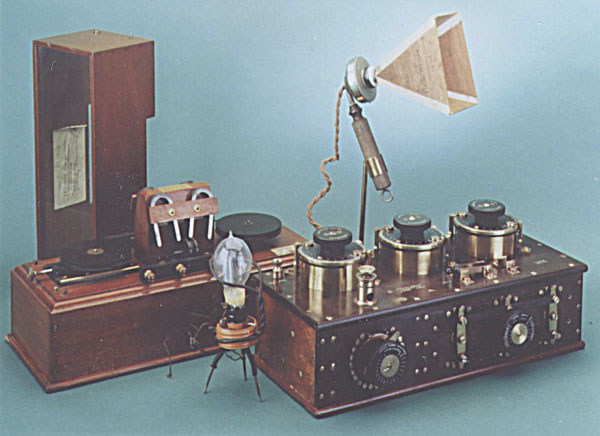 A selection of the early Marconi equipment to be auctioned by Christie's South Kensington in April. |
Sale proceeds will go to "Marconi Days," a new educational initiative that will train up to 1000 electronics teachers each year. The sale will be sponsored by GEC-Marconi as part of its Marconi centenary celebration.
Christie's says the collection "comprises an important cross section of early equipment and experiments" as well as "important technical, business and personal papers." Among the individual items offered for sale is Marconi's 1896 first patent for "Improvements in Wireless Telegraphy" (estimated to be worth $1600 to $2400). Sale highlights include some of the earliest recorded wireless messages, including the first use of wireless to report on a sporting event--the Kingstown Regatta in Dublin, Ireland, in 1898 (estimated value, $4700 to $7900).
Offered with a number of early tubes ("valves") developed by John Ambrose Fleming is Fleming's November 1904 letter to Marconi in which he reports the invention of the "valve" for the first time, and declares, "I have not mentioned this to anyone as it may become very useful." One such "valve" is estimated in value at approximately $8000 to $13,000.
A circa-1900 Marconi coherer receiver will also be offered. Christie's values it at between $23,600 and $31,500. Other items include a microphone used by the singer Dame Nellie Melba, who broadcast from a Marconi transmitter in Chelmsford, England. The microphone features a mouthpiece fashioned from a cigar box and signed by the singer. It's expected to sell for up to $12,600.
Prior to the sale in April, Christie's will exhibit highlights from the Marconi archive centenary sale in the US and Italy. For more information, check Christie's Web site at http://www.christies.com/, or e-mail marconi@christies.com.
| HAARP TO AIR TEST TRANSMISSION FOR HAMS |
The High Frequency Active Auroral Research Program (HAARP) facility in Gakona, Alaska, will transmit a test signal on March 8, 1997, seeking reports from hams and SWLers in Alaska and in the "Lower 48" to determine how well the HAARP transmissions can be heard to the south.
During this test, the HAARP facility will transmit on or near the frequencies 3.4 MHz and 6.99 MHz to give listeners the opportunity to listen for the HAARP facility and to claim a QSL card. The test will be conducted beginning at 0430 UTC on March 8 (2330 Eastern Time on March 7).
The format of the test will be to transmit a constant carrier (no modulation) signal followed by a CW message at 10 WPM, according to the following schedule:
| Time | Frequency | Signal | Antenna Position |
|---|---|---|---|
| 0430 | 6.99 MHz | Carrier only | Pointed up |
| 0435 | 6.99 MHz | CW message | Pointed up |
| 0440 | 6.99 MHz | Carrier only | Pointed to SE |
| 0445 | 6.99 MHz | CW message | Pointed to SE |
| 0450 | 3.4 MHz | Carrier only | Pointed up |
| 0455 | 3.4 MHz | CW message | Pointed up |
The transmission beginning at 0450 is primarly for Alaskan hams. Reception reports should include signal strength during the constant carrier transmission period along with the text of the CW message.
Complete details on this test and a QSL address will be listed on the HAARP home page at http://server5550.itd.nrl.navy.mil/announce.html.
The HAARP facility--now in the developmental prototype stage--has been undergoing testing since it was completed in late 1994. Multiple transmitters feed multiple antenna elements (there are 48 antenna elements on the site, arranged in eight rows of six columns; however, at this time, only 18 elements are active. The test will use 17 antennas with a net transmitter power of 340 kW). The final configuration could have 180 antenna elements and a combined transmitter power of 3.6 MW. HAARP's stated scientific purpose is to study "the properties and behavior of the ionosphere, with particular emphasis on being able to understand and use it to enhance communications and surveillance systems for both civilian and defense purposes." HAARP is managed by the US Air Force and the US Navy.
For more information, see "The High Frequency Active Auroral Research Program" (QST, Sep 1996, p 33), or check out the HAARP home page, http://server5550.itd.nrl.navy.mil/haarp.html. --Ed Kennedy, K3NS
| NEW WATS NUMBER FOR HAM INFO FROM FCC |
The FCC has designated a new, toll-free (WATS) number for Amateur Radio license inquiries--including inquiries about vanity and new call signs. The new number, 888-225-5322, will connect callers to the FCC National Call Center, handled by the FCC's Consumer Information Bureau.
Callers to the old consumer information number will get a message referring them to the new number.
| ARRL SECTION MANAGERS ELECTED |
Several ARRL sections will have new section managers starting April 1.
Ballots were counted this month for SM elections in Arkansas and Northern Texas. In Arkansas, Roger W. Gray, N5QS, of Searcy, Arkansas, outpolled E. Glenn Wolf Jr, AB5RQ, of Pine Bluff, Arkansas, 525 to 185 votes. Gray succeeds George Mitchell, KI5BV, of Pine Bluff. In North Texas, incumbent SM Bob Adler, N5NY (ex-NZ2T), of Southlake, Texas, topped the field in a three-way race. Adler had 785 votes to 470 for challenger Bill Revis, KF5BL, of Irving, Texas, and Dave Allen, WD8LDY, of The Colony, Texas.
Uncontested candidates--including several incumbents--were declared elected in eight other ARRL Sections: In the Arizona Section, incumbent Clifford Hauser, KD6XH, of Tucson; in the Iowa Section, incumbent Jim Lasley, N0JL, of Chillicothe; in the Idaho Section, incumbent Mike Langrell, AA7VR, of Boise (Langrell was appointed earlier to fill the vacant SM position); in the Kentucky Section, Bill Uschan, KC4MIS, of Frankfort (Uschan replaces Steve Morgan, WB4NHO, of Owensboro); in the Mississippi Section, incumbent Ernie Orman Jr, W5OXA, of Biloxi; in the Montana Section, incumbent Darrell Thomas, N7KOR, of Great Falls; in the Orange Section, incumbent Joe Brown, W6UBQ, of Riverside, California; and in the Wyoming Section, Robert Williams, N7LKH, of Wapiti (Williams replaces Warren "Rev" Morton, WS7W, of Casper).
| SOLAR SLUMP CONTINUES |
Sun watcher Tad Cook, KT7H, Seattle, Washington, reports: Solar activity continues low, with flux values still running lower on every day than the average for the previous 90 days, which dropped this week from 78 to 77. Geomagnetic indices rose on February 17 with estimated planetary K indices as high as 5. But, low solar and geomagnetic activity is good news for the 160 meter contest this weekend. Expect good conditions throughout the contest, with little threat of a geomagnetic upset.
For the next few weeks conditions are expected to stay the same, with solar flux in the low to mid 70s. The latest long term forecast shows the next solar cycle peaking just three years from now. This poses the question: Why haven't we seen much activity yet from the new cycle? The projection is based upon previous cycles and indicates an average sunspot number of 19 for January and 22 for February--with the number doubling to 44 by July. It also shows solar flux of 77 for January, 80 for February, 84 for March, and 100 by July. Currently it appears that actual conditions are lagging behind these projections.
Sunspot numbers for February 13 through 19 were 0, 0, 0, 0, 0, 13 and 15, respectively, with a mean of 4. The 10.7-cm flux was 71.1, 71.3, 71.8, 72, 73.1, 72.9 and 72, respectively, with a mean of 72. Estimated planetary A indices for the same period were 4, 5, 4, 8, 17, 7, and 3, respectively, with a mean of 6.9.
| WORLD CHAMPIONSHIP IN HIGH SPEED TELEGRAPHY SET |
Who says CW is dead? Limber up your fists and break out the code practice tapes, because the Second IARU World Championship in High Speed Telegraphy (HST 97) will be held October 6-10, 1997, in Sofia, Bulgaria. Participants may enter one of six categories:
-
A--female juniors, age 20 or younger.
B--male juniors, age 20 or younger.
C--women, age 21 to 39.
D--men, age 21 to 44.
E--female "old timers," age 40 or older.
F--male "old timers," age 45 or older.
IARU member societies--including the ARRL--are being invited to field competitors. The deadline to apply is April 6, 1997. CW-proficient ARRL members interested in participating at their own personal expense as Team ARRL should contact Dave Sumner, K1ZZ, at ARRL HQ (e-mail, dsumner@arrl.org or write him at 225 Main St, Newington, CT 06111) as soon as possible. The sponsoring Bulgarian Federation of Radio Amateurs (BFRA) says it expects more than 150 participants from more than 15 countries to turn out. --BFRA
| ANTENNA AND LIGHTNING SAFETY INFO ON THE WEB |
Andy Funk, KB7UV, assistant news operations manager at WAGA-TV, in Atlanta, Georgia, has posted some information on his station's Web site that's potentially useful to hams. The Microwave ENG Safety and Operations Guidelines are aimed primarily at the station's newsroom personnel using WAGA's electronic news gathering (ENG) vehicle, which has an extendable microwave mast and antenna on top. But many of the same rules apply to Amateur Radio antenna erection. The page also includes some new information on lightning safety--based on tips from the National Lightning Safety Institute.
Some basic safety rules worth repeating:
- Electrical lines can cause serious injury or death.
- Keep all people, tools, and equipment at least 15 feet from all overhead wires.
- Overhead lines are not insulated. They should not be touched.
- Some lines have a weather covering and appear to be insulated, but they are not.
- Stay away from electrical devices such as meters, transformers, and substations.
For more information, set your browser to http://wagatv.com/ENG/ on the Web (this address is case-sensitive).
| In Brief: |
- This weekend on the radio: The CQ WW 160 Meter DX Phone Contest, the YL/OM Phone Contest, the REF French Phone Contest, North Carolina QSO Party, the RSGB 7 MHz Contest, UBA CW Contest, the CQC Winter QRP QSO Party, and the FYBO Winter QRP Field Day will all compete for your participation.
- FCC drops DOB info: Effective February 21, 1997, the FCC no longer will distribute date-of-birth information as part of its Amateur Radio license data. The field has been physically removed from the data stream. At least some call sign lookup systems could be affected by this change.
- RS-16 launch postponed: The launch of the anticipated RS-16 satellite has apparently been delayed. The Start-1 rocket will instead be used to launch a commercial remote sensing payload belonging to the US. RS-16 may be launched at the end of February. The launch had been expected as early as December and has already been delayed once. The new satellite is expected to be a Mode A (2 meters up/10 meters down) bird, like RS-10 and RS-15. --SpaceNews
- Cosmonaut active on ham bands: CE3LWV, PY2FXE, and VE7VDX all report that Russian Cosmonaut Valery Korzun has been very active as R0MIR from the Mir space station, using an uplink of 145.200 MHz and downlink of 145.800 MHz. All stations reported good signals from Mir. He reported that US Astronaut Jerry Linenger, KC5HBR, has not been on the air very much because he has been very busy with experiments on Mir. --SpaceNews
- Girl Guides of Canada calling: Listen for VE7UBC (or possibly the special call sign of VE7GGC) as the Girl Guides of Canada take to the airwaves Saturday, February 22, 1730-2015 UTC (and possibly longer). Announced frequencies are 3.733-3.933 MHz; 7.088 MHz; 14.133, 14.188 and 14.288 MHz and 21.360 MHz. --Dave, VE7CNV
- Congratulations! ARRL Roanoke Division Vice Director Dennis Bodson, W4PWF, recently received the George S. Wham Leadership Medal from the American National Standards Institute (ANSI). The award is given for "long-term leadership and visionary qualities in support of the ANSI Federation." --IEEE Standards Bearer
- Rescheduled: The TV appearance of John Creel, WB3GXW, of Silver Spring, Maryland, has been rescheduled to the March 5 edition of ABC Television's Prime Time Live. He will be interviewed by Chris Wallace. The program airs at 10 PM Eastern Time. Creel is an investigator with the Montgomery County, Maryland, Division of Consumer Affairs. The story to be aired concerns the problem of buying cars from unlicensed car dealers (so-called curbstoners) and odometer fraud. Creel has been a ham for 20 years and is a member of the Laurel (Maryland) Amateur Radio Club, where he's active in the VEC program. He also operates two repeaters in the Silver Spring area. --Mark Doore, N3NTQ
- Address clarification: An e-mail address to send comments about the benefits of differential global positioning system (DGPS) radio beacons has been fixed and should now work (see "Hams using APRS and GPS asked to contribute to DGPS study," The ARRL Letter, Vol 16, No 6, February 7, 1997). Comments may be sent to John F. "Ted" Pugh at pugh@farradyne.com, tpugh@farradyne.com or pught@farradyne.com.
- MARC celebrates 50 years: The Meriden (Connecticut) Amateur Radio Club observes its 50th anniversary this year. The club's "in memoriam" call sign, W1NRG, formerly was held by Ed Bisschert, a club member and World War II Navy veteran radioman who died in 1952. The 100-member club has one 50-year member--Frank Darmofalski, W1FD. MARC members are active in public service communication and operating events. Bill Wawrzeniak, W1KKF, is the current president. For more information, visit MARC at http://www.qsl.net/w1nrg on the Internet.
| The ARRL Letter |
The ARRL Letter is published by the American Radio Relay League, 225 Main St, Newington, CT 06111; tel 860-594-0200; fax 860-594-0259. Rodney J. Stafford, KB6ZV, President; David Sumner, K1ZZ, Executive Vice President.
Circulation, Kathy Capodicasa, N1GZO, e-mail kcapodicasa@arrl.org.
Editorial, Rick Lindquist, N1RL, e-mail elindquist@arrl.org.
Visit the ARRLWeb page at http://www.arrl.org.
The purpose of The ARRL Letter is to provide the essential news of interest to active, organizationally minded radio amateurs faster than it can be disseminated by our official journal, QST. We strive to be fast, accurate and readable in our reporting.
Material from The ARRL Letter may be reproduced in whole or in part, in any form, including photoreproduction and electronic databanks, provided that credit is given to The ARRL Letter and The American Radio Relay League.