| IN THIS UPDATE . . . |
- Some Gate 2 applicants in limbo
- FCC Proposes new service for reallocated 2.3-GHz Segments
- Hams in the hot zone
- Satellite aficionados met
- DOVE-OSCAR 17 update
- Solar manic depression
- Ham-suspect arrested in McKim murders
- Tiago Frederico, CT1WW, SK
- In Brief: W1AW schedule change; Election connections; Vanity connections; Identifying former call sign holders; Happy Birthday!; Photos from space
| VANITY UPDATE: SOME FIRST-DAY APPLICATIONS IN LIMBO |
The FCC calls them WIPS--"works in process"--applications that need some kind of special handling. But for up to 12% of first-day Gate 2 vanity call sign applicants, WIPS means "no new call sign." It now appears that as many as 550 first-day applications ended up in the WIPS pile, either because the FCC was unable to match one of the applicant's call sign choices or because the application contained "inconsistencies"--some as simple as a date of birth on an application that was missing or failed to match one already in the FCC's database. Other problems included an incorrect call sign on an application, a name change not reported, or putting first and last name in the wrong order. The FCC said this week that it hopes to clear its decks of all first-day vanity WIPS by today (November 15).
There's some encouraging news: An FCC spokeswoman in Gettysburg says that if you're in the WIPS pile for a reason other than "no match," it does not necessarily mean you "missed out" on getting one of your call sign choices. A new call sign already may have been attached to your application. As of November 13, a handful of Gate 2 vanity call sign grants already had dribbled out of the FCC's spigot, bringing the grand total of successful Gate 2 applicants to 3805.
One of them was Lester Johnson--formerly K4PTB and now W4LQ--of Rockingham, North Carolina. "I would like to personally thank everyone connected with the vanity call sign program at HQ," he wrote. "After nearly 40 years as K4PTB I decided to try for one of the 1×2 calls. Most of the operators in the area kept telling me I was wasting my time and money. But, I suppose I lucked out. I learned this morning that I did indeed get lucky and was issued the old/new call sign W4LQ. It was not my first choice, but I certainly am not complaining." John Warinsky, formerly KD9NO, of Shoreview, Minnesota, reports he got his first pick, K9NJ (he's a New Jersey native).
One who was not so fortunate was Steve Wolf, NO8M, of North Olmsted, Ohio. His first-day Gate 2 application ended up in the WIPS pile, and he has since determined that all of his choices were assigned to other hams. So he's been working up a new list to submit another vanity application and trying to maintain his sense of humor. "If you want help getting over an initial rejection, have your kids look over the list of available calls," he suggests. "I bet you will wonder why you asked for the other ones."
Those whose applications end up being dismissed because their choices were already taken can take heart that all the "good" (ie, 1×2) Extra class call signs have not been used up--not by a long shot. As of this week, more than 6000 1×2 calls in all US districts were still vacant--substantially more than the number of vanity call signs the FCC has issued under Gate 2 to date.
The FCC will mail to all unsuccessful vanity applicants a copy of their application (including FCC processing numbers) and a copy of their check. To request a refund, applicants then must send a letter to the FCC, 1270 Fairfield Rd, Gettysburg PA 17325-7245, along with their taxpayer ID number (Social Security number). The FCC will not apply your first $30 filing fee toward a second application. You must request a refund if you want your money back.
Some FCC gaffes turned up among the Gate 2 vanity call sign assignments. The call sign AT6A was issued to KK6VY in Santa Rosa, California. Unfortunately, the AT prefix belongs to India, not to the US. A California club station got a new call sign bearing an Alaskan AL6 prefix, not permitted in the lower 48. The FCC says it has dealt with these mistakes.
Still not known is just when Gettysburg will process Gate 2 applications that were received after September 23, the opening day for Gate 2. An FCC spokeswoman said this week she had "no idea" when that would happen. Applications from approximately 1400 hams arrived at the FCC in the days following the opening of Gate 2.
Although many hams learned of their new Gate 2 vanity call signs via the Internet within hours after the FCC made the information public, Owen Garner, formerly W1SBM, of Hampden, Connecticut, found out that he was K1AF during a casual ragchew on 160-meter CW. Owen mentioned to the other op, Dave LeDuc, K1EPJ, of Newton, New Hampshire, that he was waiting for his new vanity call sign call. Dave checked the Internet and was able to tell Owen that his new call was K1AF. "So I began the QSO as W1SBM and completed it as K1AF," he reports. The next day, Owen related his experience to Timothy Hutcheson, KT4LY, in Pensacola, Florida, who also was waiting for his new vanity call sign. Timothy checked the Internet and found out he'd been issued K4LY, which he used to complete the QSO.
A footnote: although the FCC did not release the initial day-one grants until Tuesday, November 5, the applications actually were processed--and the licenses dated--on November 4. The FCC spokeswoman said that computer problems on the morning of November 5 prevented the release of the database file until late that afternoon. The FCC says hard copies of the November 4 grants were mailed on November 8 and November 12, so new call sign holders should have their new tickets soon.
| FCC PROPOSES NEW SERVICE FOR REALLOCATED 2.3-GHZ SEGMENTS |
The FCC has proposed to create a new Wireless Communications Service (WCS) in the 2305-2320 and 2345-2360-MHz bands and to award licenses on the basis of competitive bidding. The bands include a 5-MHz segment that Amateur Radio shares with government services between 2305 and 2310 MHz. Just before it adjourned in October, the 104th Congress approved a provision as part of the much larger appropriations bill that directed the FCC to put the 30 MHz of spectrum in the 2.3-GHz region up for competitive bidding to help balance the budget. It's believed to be the first time the Congress has ordered the reallocation of specific frequencies.
The National Telecommunications and Information Administration (NTIA) had identified for reallocation the amateur segments 2300-2310 MHz and 2390-2400 MHz in May 1994, so reallocation of part of that subband came as no surprise. At its special session in October, the ARRL Board of Directors approved a proposal to seek an increase in the amateur service allocation status--from secondary to primary--in the 2300-2305-MHz segment.
The FCC says the new WCS service would allow licensees to provide any fixed, mobile or radiolocation service, or satellite Digital Audio Radio Services (satellite DARS), consistent with the international frequency allocations for these bands. The Commission also proposed to adopt no restrictions on eligibility for a WCS license and to allow WCS licensees "to partition their service areas, disaggregate spectrum, and franchise portions of their spectrum or service areas on a leased basis."
Competitive bidding for the two segments will begin no later than next April 15. Comments are due by December 4, 1996, and reply comments by December 16, 1996.
| HAMS IN THE HOT ZONE: CALIFORNIA FIRES |
California wildfires tested the mettle of ham radio operators in northern San Diego County as Northern District ARES members responded to a brush fire in the Harmony Grove area of Carlsbad on the afternoon of October 21. Frank Littlebury, KE6WOE--the Northern District assistant emergency coordinator in the San Diego Section--reports that over the next 40 hours, 45 ARES personnel (backed up by other volunteers) stood by if needed to support four separate Red Cross shelters/evacuation centers and to provide supplementary communication support to the Red Cross, local fire departments, sheriff's office and county and city emergency operation centers in Northern San Diego County. Northern Division ARES maintained a net on the Palomar Amateur Radio Club repeater on 146.73 MHz from October 21 until late October 22, to assist Red Cross shelters. The link was instrumental in providing communication for no fewer than 400 people who were displaced by the fire. Littlebury was the primary ARES net controller. He had help during the emergency from Dennis Shirrel, K7DCG, the Northern District EC.
Littlebury reports that volunteers racked up some 1650 manhours during three major brush fires in the area caused by Santa Ana winds and low humidity. Official reports indicate that 131 homes were damaged or destroyed and six people were injured (two critically).
Planning was the key to a successful effort. Littlebury said the Northern District has had a major ARES emergency plan development effort under way since mid-summer. "Each of the 12 separate city/community ARES emergency coordinators was asked to contribute and take part in the overall District Plan development effort as well as write a local city/community Emergency Plan to supplement district's general effort," he reports. The plans were completed in late September. In conjunction with ARRL's annual Simulated Emergency Test (SET) October 12-13, the Northern District held a "no-notice" communication exercise to test procedural and communication provisions of the district and local plans. Having an emergency plan in place for the first time was a big plus in handling the actual emergency a few weeks later, Littlebury said. "We feel fortunate to have had a successful exercise--doubly so for having had the opportunity to put our hard work in planning and training to use in so successful a manner in support of an actual emergency." Littlebury said that having "been there" and "done that" made his volunteer team firm believers in the value of a written, comprehensive emergency plan, training to execute that plan and a dedicated ARES support base to carry it out. "Our thanks to ARRL for an excellent ARRL Emergency Coordinator's Manual, upon which we based our planning efforts," he said.--Frank Littlebury, KE6WOE; Ellen Utschig, N6UWW
| SATELLITE ENTHUSIASTS MEET IN TUCSON |
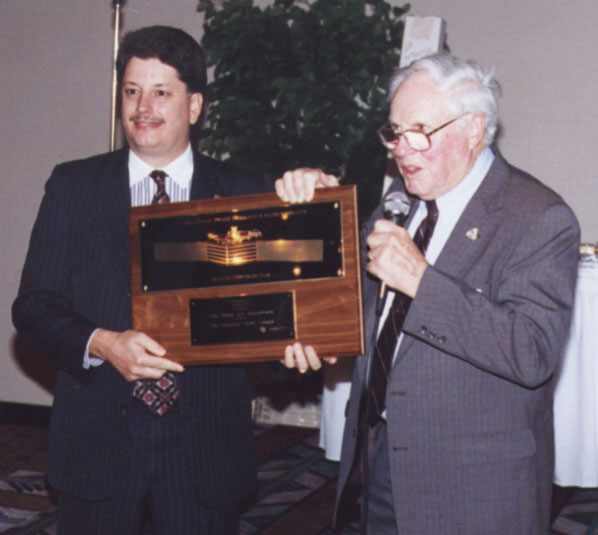 |
| ARRL Vice President Joel Harrison, WB5IGF, accepts a plaque from AMSAT-NA President Bill Tynan, W3XO. The plaque commemorates the dedication of the Phase-3D spaceframe to the ARRL during the 1996 AMSAT-NA Space Symposium in Tucson, Arizona, November 8-10.--Steve Ford, WB8IMY, photo |
More than 300 amateur satellite operators gathered at the Holiday Inn-City Center in Tucson, Arizona, November 8 through 10, for the 1996 AMSAT-NA Space Symposium.
Friday's forums included an update on the SEDSAT project, the PICOSAT system and plans for Amateur Radio aboard the upcoming International Space Station. Phil Karn, KA9Q, offered a spread-spectrum tutorial and Assi Friedman, 4Z7ABA, updated everyone on the status of TechSat.
On Saturday, the attendees were treated to a Phase 3D progress report. Dick Daniels, W4PUJ, said that static system testing would soon be under way in France. (Phase 3D just passed one of its dynamic tests--a vibration test--with flying colors.) He also announced that the satellite would be powered up for the first time next month.
Jim White, WD0E, and Tom Clark, W3IWI, announced that DOVE-OSCAR 17 had returned to the air after a successful recovery. The satellite required a clever software "Band-Aid" to circumvent the effects of radiation damage. (See DOVE-OSCAR 17 UPDATE below.)
Ray Soifer, W2RS, and Richard Limebear, G3RWL, discussed the future of the amateur satellite program. According to their research, most hams favor SSB or CW operation with "entry level" satellites such as RS-10 and RS-12. Ray and Richard both warned that few, if any, such satellites are in the planning stages to replace the aging fleet. In contrast, there are a number of new digital satellites, but they are used only by a relative minority. A lack of new EasySats, they contended, could make it much more difficult to attract new hams to satellite operating.
Darrell Emerson, AA7FV/G3SYS, was the featured speaker at the Saturday night banquet. Darrell is a recent contributor to QST. He authored Radio Observations of Two Solar Eclipses in the February 1995 issue of QST, and The Radio Sky (Parts 1 and 2) in the June and July 1996 issues of QST, as well as articles for other ARRL publications. He is also known in the scientific community through his work at the National Radio Astronomy Observatory.
Another highlight of the banquet was dedication of the Phase 3D spaceframe to the ARRL in recognition of contributions totaling more than $530,000. ARRL Vice President Joel Harrison, WB5IGF, accepted the dedication plaque from AMSAT-NA President Bill Tynan, W3XO.
The time and place for next year's AMSAT-NA meeting has already been set. It will be held at the Delta Airport Hotel in Toronto, Canada, on October 17 through 19. Details will be published as they become available.--Steve Ford, WB8IMY
| DOVE-OSCAR 17 UPDATE |
After nearly a year of problematic operation following an onboard computer crash last December, scientists on the ground may have finally pinpointed the source of problems plaguing DOVE-OSCAR 17. Jim White, WD0E, of the AMSAT DO-17 team, reports that on November 5, a portion of the operating software was successfully loaded into DOVE and executed. "The first few minutes of telemetry shows the satellite is in pretty good shape, with some expected degradation of the solar panels and batteries," he said. The software included a change by Keith Butts, KN6K, that increases the number of times per second the hardware watchdog timer is reset. White says that extensive tests over the past year--and coordination with the WEBERSAT team--have indicated an intermittent watchdog timer may be the culprit that has made it impossible to keep software running for more than a few days in either satellite. All other hardware testing on DOVE had proved negative.
White says time will tell if the command team reached the correct diagnosis. At this point command stations have all the telemetry they need. However, if you don't hear DOVE on 145.825 MHz when it is in range, send an e-mail message to wd0e@amsat.org indicating the time you listened. If the satellite crashes again, it may be valuable to know as closely as possible when it failed. DOVE is sending in the normal PHT telemetry format, the S-band transmitter is on, the telemetry rate will vary from 20 to 60 seconds, and the transmitter power will vary from 2 to 4 W. All previously used telemetry decoder programs will work as they have before, including several shareware programs and TLMDCII, available from AMSAT-NA headquarters.--Amsat News Service; Jim White, WD0E
| SOLAR MANIC DEPRESSION |
Solar prognosticator Tad Cook, KT7H, in Seattle, Washington, reports a rise in solar activity over the past few days, with solar flux moving steadily above the three-month average of 70. It is expected to top out in the mid-70s by November 16, drop to 70 by the middle of next week, and to 68 by December 1. After that, flux values are expected to rise above 70 again after December 7.
Geomagnetic disturbances are rising and should peak today and again around November 19. Perhaps this period of days with solar flux above the recent averages is a sign that the cycle is about to take an upward turn from the bottom. When we start seeing weeks of solar flux numbers that are above the previous 90-day average, we will know that the wait is over.
A packet message from Dick Farman, K2QR, ARRL Technical Coordinator from Western New York, points out that while present HF propagation is not particularly exciting, anything can happen on VHF. The astute VHF DXer usually ignores the reported solar flux and concentrates on the A and K indices, he says. Geomagnetic field disturbances may be sufficient to cause aurora, and the aurora can be reflective at VHF. As pointed out in an earlier report, the A and K indices provide an indication of geomagnetic activity and, therefore, can tip off VHF operators to possible band openings. When the A index is about 20 and the K index is 4 or 5 (or greater!), conditions are often good for VHF aurora. Hollow-sounding signals on 80 meters mean it's time to fire up on VHF and point the antenna north. Phase variations in signals reflected from the auroral curtain make this propagation mode suitable for CW and sometimes for SSB, but not for FM, which becomes too distorted. Contacts are most likely on 10, 6, and 2 meters. As the intensity of the geomagnetic storm increases, higher frequencies are affected. As electrons trapped in Earth's magnetic field spin down and lose energy, they emit photons, and the aurora becomes visible--sometimes as streaks of light, sometimes as "curtains." It's often a tough decision whether to work the bands or go outside to watch the light show!
Sunspot numbers for November 7 through 13 were 0, 0, 11, 11, 14, 27 and 14, respectively, with a mean of 11. The 10.7-cm flux was 68.5, 69.1, 70.2, 71, 71.5, 72.2 and 73.1, respectively, with a mean of 70.8. The planetary A indices for the same period were 5, 4, 11, 6, 3, 8, and 11, respectively, with a mean of 6.9.
Sunspot numbers for October 31 through November 6 were 0, 0, 0, 0, 0, 0 and 0, respectively, with a mean of 0. The 10.7-cm flux was 69.7, 70, 69, 69.5, 69, 68.3 and 69.2, respectively, with a mean of 69.2. The planetary A indices for the same period were 8, 2, 2, 2, 9, 6, and 7, respectively, with a mean of 5.1.
| HAM-SUSPECT'S ARREST IN MURDER CASE FOLLOWS TV EXPOSURE |
A ham-radio acquaintance of the late VHF/UHF pioneer Jim McKim, W0CY, has been charged in the July murders of McKim's widow, daughter and a great-grandson at the McKim home in Salina, Kansas. The arrest of 26-year-old Alan Eugene White, KA0QNB, came shortly after the November 9 broadcast of the TV program America's Most Wanted, which publicized the case and the fact that White had disappeared from the Salina area and was wanted for questioning. Authorities caught up with White at a Boston, Massachusetts, homeless shelter. Boston Police acted on a tip from someone who had recognized White from the TV program.
Kansas media reports say that Administrative District Judge Daniel Hebert signed warrants November 12 charging White with the murders of Dolores McKim, 80, of Salina; her daughter, Carol Abercrombie, 56, of Soddy-Daisy, Tennessee; and McKim's great-grandson, Christopher Abercrombie, 5, of Greenville, South Carolina. White also was wanted for a parole violation and faces other charges.
White has held a Novice class since late 1992. He and Jim McKim both belonged to the Central Kansas Amateur Radio Club, and White reportedly had visited the McKim residence for club functions. Jim McKim died in February.--Bruce Frahm, K0BJ/Bill Pasternak, WA6ITF
| TIAGO FREDERICO, CT1WW, SK |
Well-known DXer Tiago Frederico, CT1WW, of Sao Joao da Pesqueira, Portugal, died October 31. He was 52 years old.--Jose de Sa
| In Brief . . . |
- W1AW schedule change: Starting January 1, 1997, W1AW will offer morning code practice and bulletins on Thursdays and Fridays only. Starting times will remain the same: code practice starts at 1400 UTC; the CW bulletins start at approximately 1500 UTC; and the RTTY/AMTOR/ASCII bulletin session starts at approximately 1600 UTC.--Joe Carcia, NJ1Q
- Election connections: Among those not re-elected in the November 5 balloting was freshman Republican Congressman David Funderburk, K4TPJ, of North Carolina. In Pennsylvania, incumbent Congressman Paul McHale, a Democrat, defeated Republican challenger Robert Kilbanks, WB7NNC.
- Vanity connections: Used to be that those 1x2 "W" call signs marked an old timer. The past and present vanity call sign systems put an end to that. Thirteen-year-old Christina Rea, ex-N2YBU, of Colonie, New York, received one of her top choices, W2GY, in the recent Gate 2 lottery. She's the daughter of proud papa Peter Rea, WZ2X, and very active with local public service events. She got her Extra ticket 14 months ago. W2GY has had at least six previous holders over the years. Possibly the first--Walter Dietz of Yonkers, New York--held 2GY around 1915. Corwin Crosby of Long Island City (and later Scarsdale), New York, held W2GY from around 1930s until 1946 or so. Charles Bowen of Audubon, New Jersey, held the call sign the longest, from around 1947 until around 1976, when he moved to Florida and obtained K4YZ. W2GY was reissued as a vanity call sign in the mid 1970s (the previous holder is a Silent Key). W2GY has another historic connection; the Reas live in the shadow of the transmitting tower of WGY, General Electric's first AM commercial broadcast station.--The Hudson Division Loop
- Identifying former call sign holders: Some vanity call sign holders have become interested in the genealogy of their new call signs and want to know who the former holders were. While we don't have the resources to track down this information at HQ, those interested might try the FCC's official duplicating contractor, International Transcription Service (ITS). Among other things, ITS can research amateur call signs to determine when they were first issued and to whom. The cost of this service varies depending on the volume and research time involved. Research time is $15 per hour, billed in quarter-hour increments. Requests can take up to one business week. Additional charges apply for expedited service. ITS is located in the FCC's Gettysburg Office. Write ITS Inc, 1270 Fairfield Rd, Suite 24, Gettysburg, PA 17325-7245; tel 717-337-1433; fax 717-337-3409.--Tom Hogerty, KC1J
- Happy Birthday! Wilbur E. "Bip" Bachman, W6BIP, of San Francisco, California, celebrates his 85th birthday tomorrow (November 16). "Bip" remains an active CW operator, and his is a familiar call sign in the ARRL November Sweepstakes and other contests. Bill Haddon, N6ZFO, who's been acquainted with W6BIP since the 1950s, says, "Bip's kindness, professionalism, expertise, and perseverance at CW communication have always been an inspiration to me."
- Photos from space: A new book cowritten by astronaut Jay Apt, N5QWL, has more than a casual ham radio connection. The book on photographs of the Earth taken from space, Orbit: NASA Astronauts Photograph the Earth, was coauthored with Michael Helfert and Justin Wilkinson, two Earth-observation scientists at the Johnson Space Center. Space writer and consultant Philip Chien, KC4YER, reports the book was written during the team's personal time, evenings and weekends, while Apt was in training for the STS-49 mission. He says the book contains "incredible-quality photos, with an innovative computer digitizing method to retain the original image quality." Apt wrote the introduction to each chapter. In the section on Australia, he said "I recall many conversations at night with hams in Australia and New Zealand who had gotten up in the wee hours just to talk to us as we flew overhead. I've been surprised by a call from a ham from Hilo, Hawaii, using a tiny radio in his car. I have seen the lights of the Palmer Research Station at the tip of Antarctica, and called the scientists there on our ham set. All of these conversations make me feel more connected to the people and the lands we are flying over." Apt wrote how Maggie "Rita" Iaquinto, VK3CFI, in Australia "relayed my ham radio signals at two in the morning her time so I could talk from Endeavour to a doctor aboard the Russian Mir station." Orbit is published by the National Geographic Society and distributed by Random House (ISBN 0-7922-3714-5). It retails for $40.
| The ARRL Letter |
The ARRL Letter is published by the American Radio Relay League, 225 Main St, Newington, CT 06111; tel 860-594-0200; fax 860-594-0259. Rodney J. Stafford, KB6ZV, President; David Sumner, K1ZZ, Executive Vice President.
Electronic edition circulation, Kathy Capodicasa, N1GZO, e-mail kcapodicasa@arrl.org.
Editorial, Rick Lindquist, N1RL, e-mail elindquist@arrl.org.
Visit the ARRLWeb page at http://www.arrl.org.
The purpose of The ARRL Letter is to provide the essential news of interest to active, organizationally minded radio amateurs faster than it can be disseminated by our official journal, QST. We strive to be fast, accurate and readable in our reporting.
Material from The ARRL Letter may be reproduced in whole or in part, in any form, including photoreproduction and electronic databanks, provided that credit is given to The ARRL Letter and The American Radio Relay League.