April 12, 1996 (Volume 15, Number 4)
You can email this page's content administrator at rlindquist@arrl.org.
INSIDE . . .
- FCC okays special Olympic call signs for Georgia hams
- 4X6KJ visits ARRL HQ
- FCC says interference starts at the factory
- FCC suspends Louisiana ham's license
- FCC busts ham back to Novice
- Ham twins to be on Turning Point
- Ham radio has role in musical event
- TWIAR down again
- Sun spotless
- ARRL WRC-99 team named
- Study looks at public service motivation
- Long-distance rescue
- Teen ham handles emergency response
- Collins exhibit to open
- Milt Chaffee, W1EFW, SK
- In Brief: Special event station marks OK City bombing; Lucid on Mir; OEM1M commemorates International Marconi Day; RF Design moves; Pupils mark decade of School Club Roundup; 1996 AMSAT confab set
FCC OKAYS OLYMPIC CALL SIGNS FOR HAMS OPERATING IN GEORGIA
Hams operating within the state of Georgia may use special call signs from April 15 until August 31, 1996, to commemorate the 1996 Olympics, under a Special Temporary Authority issued by the FCC. Here's how it works: An FCC-licensed radio amateur operating in Georgia with a "4" in his or her call sign may replace that number with "96" (representing the year) or "26" (commemorating the 26th Olympiad) during the period of the STA. Hams with any number in their call signs and operating within the State of Georgia may add "00" to the existing number (to mark the centennial year of the Olympic Games). So, WA4BKD in Georgia could identify as WA96BKD, WA26BKD or WA400BKD, while NG3K, when operating in Georgia, could identify only as NG300K or as NG3K. The Olympics start in July. The STA stemmed from an initiative by James Altman, N4UCK, of Atlanta and the Georgia Amateur Radio Operators Group he organized, with the support of ARRL.
4X6KJ Visits ARRL HQ
FCC: INTERFERENCE PROBLEMS OFTEN START AT THE FACTORY
The FCC says it cannot resolve most of the thousands of complaints
of interference to TVs, radios, stereos and televisions "because
the cause of this interference is the design or construction of
these products and not a violation of any FCC rule." The
FCC points out that basic consumer information concerning interference
solutions now is available on the Internet through the FCC Compliance
and Information Bureau's home page at http://www.fcc.gov/Bureaus/Compliance/WWW. The list also is available through the Commission's Fax on Demand
service at 202-418-2830. Request document 6904.
The basic information includes the CIB Interference Handbook
and the CIB Telephone Interference Bulletin, among others.
The Telephone Interference Bulletin states: "Interference
occurs when your telephone instrument fails to 'block out' a nearby
radio communication. Potential interference problems begin when
the telephone is built at the factory." The Interference
Handbook includes a list of equipment manufacturers who provide
specific assistance with interference problems. "Involving
dealers and manufacturers in the resolution process should give
them knowledge of the problems and provide both the opportunity
and incentive to protect their products through customer service,"
the FCC said in a recent Public Notice.
The Commission emphasized, however, that its Compliance and Information
Bureau "will continue to take appropriate enforcement action
where it has been determined that the interference is caused by
violations of the Communications Act or the Commission's rules
or policies."--FCC
FCC SUSPENDS LOUISIANA HAM'S LICENSE, MULLS FINE
The FCC has suspended the Technician Plus license of Irvin J.
Foret Jr, KB5UJD, of Metairie, Louisiana, after receiving numerous
complaints about interference to Amateur Radio operations in the
New Orleans area. The action came April 5, 1996 after Commission
personnel monitored and documented Foret's transmissions in December
1995 and January 1996. The FCC said some of Foret's transmissions
on January 29, 1996, "constituted willful or malicious interference
to the transmissions of other Amateur Radio stations," in
apparent violation of FCC rules.
The FCC also contended that, during an inspection of his station,
Foret "was lacking in candor and misrepresented material
facts" to Commission personnel by stating that he did not
make the transmissions the Commission observed. The FCC also said
some of Foret's transmissions were unidentified, included music
or were obscene or indecent, the alleged indecent transmissions
occurring at a time when there was a reasonable risk that children
were in the audience.
The FCC suspended Foret's license for two years, and ordered a
final determination based on the issues in the case and whether
to impose a fine against Foret. If he files a timely request for
a hearing or a written statement, the suspension of his operator
license will be held in abeyance pending a Commission decision.
Otherwise, the suspension order takes effect within 30 days of
his receipt of the FCC's order.--FCC
FCC BUSTS WASHINGTON HAM BACK TO NOVICE CLASS
Arthur P. Baumgarden of Bingen, Washington, won't be KI7CW much
longer. In a case that hinged in part on Baumgarden's claimed
driving skill, the FCC concluded that he obtained his Advanced
class license improperly and refused to review that decision.
Baumgarden, 62, said he successfully upgraded to Advanced during
a 1991 test session in Carson, California, a round trip of more
than 2000 miles from his home. According to the FCC, however,
he later told a Commission informant that he obtained his upgrade
"through payment of money, without passing the required examinations."
When the FCC questioned Baumgarden, he denied the allegations.
The FCC asked Baumgarden to take the test again under another
Volunteer Examination team, but he refused and appealed.
FCC records indicate that Baumgarden changed his story after the
FCC first took issue with his version of events and especially
with the travel times he supplied. In part, the Commission expressed
disbelief that Baumgarden could have driven to Carson, California,
and back in the times he claimed and called the alleged travel
schedule "impossible to achieve within the speed limit."
Baumgarden said he made the journey in his RV. The fact that Baumgarden
later changed his story "damages rather than enhances his
credibility, the FCC said." The Commission also noted that
Baumgarden failed to corroborate his tale or to adequately explain
why he provided two versions of events.
Although Baumgarden continues to deny he obtained his amateur
license improperly, the FCC concluded on March 18, 1996, that
"his denials are not credible" and refused to review
the case on both procedural and substantive grounds. The Commission
ordered that because Baumgarden declined to appear for retesting,
his operator license would be reduced to Novice and his call sign
changed to one appropriate for that license class.--FCC
HAM RADIO TWINS TO APPEAR ON TURNING POINT
Twin brothers Keith Heitzmann, KK5FE, and Jake Hellbach, KK5HY,
will appear on the ABC Television news magazine Turning Point May 3. Jake and Keith, who live in Louisiana, were put up
for adoption at birth. Adopted by different families, they lived
only 15 miles apart, unknown to each other, until they met for
the first time some 15 years ago at the home of Keith's adoptive
parents. "As you can imagine, it was a very emotional meeting,"
Jake said. The brothers have been part of the Minnesota twin study
that is looking into genetic versus environmental influences on
separated twins.
Jake reports the two studied together, passed their Technician
tests at the same session, and later upgraded to General and Advanced
about the same time. Both work in the computer field and used
to work for the same company, which led to lots of confusion,
Jake said.
Among other things, the Turning Point crew shot film of
the pair attending the Lafayette (Louisiana) Hamfest. "You
get some pretty good prices when a television camera is over your
shoulder!" said Jake. Of all the film that was shot, Jake
said he hopes the program uses at least some of him and his brother
on the radio. "I was glad that when it was my turn, I contacted
a fellow in Cuba, so at least there was some DX on that night,"
he said.
HAM RADIO HAS PART IN NATIONAL MUSICAL ARTS EVENT
Amateur Radio will play a role at a musical and historical event
April 12-14 at the National Academy of Sciences in Washington,
DC. Special event station W3A starts operation at 0000 April 13
and continues for the next 48 hours. Run by members of the Potomac
Valley Amateur Radio Club, W3A plans to operate 47 kHz up from
band edges.
The event is in conjunction with National Musical Arts end-of-the-season
concert, "Radio and Music," set for April 14. The concert
commemorates the 95th anniversary of Gugliemo Marconi's first
transatlantic radio transmission and the 70th anniversary of NBC.
The musical program includes the work "Radio Music,"
by John Cage, as well as compositions by Paul Schonfield and Peter
Schickele, otherwise known as P.D.Q. Bach.
Leonard Schachter, N3RPQ, has loaned part of his vintage radio
collection for the presentation of "Radio Music," to
be performed by Schickele, Nobel laureate Joseph H. Taylor Jr
and National Academy of Sciences President Bruce M. Alberts. Frank
Turano, KA3GAL, will display Marconi memorabilia, including a
magnetic detector, spark transmitter, receiver and telegraph key.
Representatives of the ARRL will host an informational Amateur
Radio exhibit during the event.
THIS WEEK IN AMATEUR RADIO DOWN BUT NOT OUT
This Week in Amateur Radio, a three-year-old weekly audio
news magazine service, is once again off the satellite airwaves.
The program, produced in Albany, New York, by Community Video
Associates Inc., had been piggybacking for the past several weeks
on the Tech Talk Network, uplinked via Skyvision on Telesat Canada
Anik E2. When Tech Talk Network dissolved earlier this month,
TWIAR was back to square one, explained Stephan Anderman,
WA3RKB, the executive producer. "Needless to say, we are
very discouraged," Anderman said, adding that he'd hoped
the arrangement to use Anik E2 would give the program a C-band
home for several years to come.
The demise of Tech Talk Network also put the Houston AMSAT Net
off the air, AMSAT reports.
Eleventh-hour efforts to secure transponder space for TWIAR
on Anik E2 failed, Anderman said. He and the others involved with
the service are seeking a new satellite home. "Discussions
with other satellite carriers for the donation or lease of satellite
space continue in earnest," he said in a letter to affiliates.
TWIAR relies on donations from Amateur Radio clubs and
individuals to meet production and transmission expenses.
Last fall, the program went dark as a result of the shutdown of
Telstar 302. TWIAR averages 75 minutes of news, carries
ARRL and RAC bulletins, contest and convention information and
propagation forecasts, as well as offerings from the Radio Amateur
Information Network and Amateur Radio Newsline. The program was
fed to over 100 nets and repeaters throughout North America every
Saturday at 8 PM. TWIAR continues to be heard locally in
the Albany area on the WA2OQE repeater (145.33 MHz) and on the
"Gateway 160 Meter Net" (1860 kHz) from WA0RCR. The
Houston AMSAT Net also will air on the Gateway net.
OL' SOL MAINTAINS A SPOTLESS REPUTATION
From solar observer Tad Cook, KT7H, in Seattle, Washington, comes
the now-familiar word that solar activity remains very low. The
sunspot count was zero on March 30 and 31. Over the next few weeks,
Cook says we can expect solar flux to remain near 70, with possible
mild geomagnetic disturbances centered around April 17. On the
air, 20 meters should be the best daytime band, but solar activity
is expected to be too low to sustain much propagation on 15 meters
or above. For worldwide communication at night, 40 meters is the
top choice, but the low solar activity makes this the best time
of the solar cycle for 160 meters, too.
The latest projections, based on current conditions and previous
solar cycles, suggest that we will be at the sunspot number minimum
for the next few months. The minimum is centered around April
through June of this year, with sunspot numbers in February 1997
reaching fall 1995 levels. Previous forecasts have mentioned a
10.7-cm solar flux minimum centered around spring of 1997, but
the latest projection moves that period up a bit. What it shows
is a minimum based on an average flux of 72 for October 1996 through
February 1997, with the flux also averaging 72 for June 1996.
Spring of 1998 should present a radically different picture. By
then, the average flux will climb toward 100, and 10, 12 and 15
meters should be alive with activity again. By April 1999, the
average solar flux is projected to be 158, rising to 192 a year
later! The next cycle is projected to peak near the turn of the
century--in August 2000.
ARRL WRC-99 CONFERENCE PREPARATORY COMMITTEE APPOINTED
ARRL President Rod Stafford, KB6ZV, has appointed the members
of a committee to advise the Board of Directors on policies for
the 1999 World Radiocommunication Conference (WRC-99). The Board
established the committee at its 1996 Annual Meeting, and set
its first task as defining the process by which membership input
should be solicited and the opinions of the membership objectively
determined.
The ARRL WRC-99 Committee is chaired by Dakota Division Director
Tod Olson. K0TO. Also named to the committee were First Vice President
Steve Mendelsohn, WA2DHF; Midwest Division Director Lew Gordon,
K4VX; Southwestern Director Fried Heyn, WA6WZO; Northwestern Division
Vice Director Greg Milnes, W7AGQ; ARRL members Ken Kopp, K0PP,
of Anaconda, Montana, Tuck Miller, KC6ZEC, of San Diego, California,
and Glen Whitehouse, K1GW, of Amherst, New Hampshire; and ARRL
Executive Vice President David Sumner, K1ZZ.
The committee is expected to complete its work by mid-December
1996.
AMATEUR RADIO GOES TO GRAD SCHOOL
Graduate student Bella Romain, N4ILQ, of Carrollton, Georgia,
has a healthy curiosity. For a while now, she's been wondering
what makes hams willingly go out of their way to help during emergencies.
Combining avocation and academe, Bella has made that question
the focus of her master's degree thesis in psychology at West
Georgia College in Carrollton. "The fact that the FCC mentions
public service as part of the reason for Amateur Radio's existence
is obviously not the whole story," she said. "It is
not easy to leave the comfort and security of a warm bed to drive
out into a storm to help set up an emergency shelter."
A ham for more than 25 years, Bella speaks from some experience.
Since she and her husband, Stewart, KF4WC, moved to Carrollton
13 years ago, they have become active in the public service sphere
of Amateur Radio. They took a first-responder course, as well
as numerous Red Cross disaster-training classes "so that
if we are in the field providing emergency communications, we
will be better prepared to handle any kind of emergency,"
she explained. She reports her Amateur Radio club, the West Georgia
Amateur Radio Society, works closely with emergency-management
agencies, the Red Cross, and the National Weather Service "as
the need arises." Club members worked with the Red Cross
to provide damage assessments and communication following Hurricane
Opal. They also helped with emergency shelter operations.
Bella says it's not easy to endure the tedium of long hours at
an emergency communication headquarters, nor to give up leisurely
weekends and evenings to take courses to be better prepared for
emergencies. She says she began to wonder "what hams experience
and feel during the times they participate in providing emergency
help, and what some of their thoughts and reasons were for doing
this." To find out, as part of the information-gathering
phase of her research project, Bella is asking hams to fill out
a questionnaire. She'll then select a number of hams for in-depth
follow-up interviews. Among other things, the questionnaire delves
into respondents' emergency communication experiences and asks
them to rate both their level of personal comfort and personal
safety while responding during an emergency.
For more information, or to obtain a copy of the survey to complete,
contact Bella Romain, N4ILQ, 285 Timber Ridge Trail, Carrollton,
GA 30117-8884; tel 770-834-5674; fax 770-830-9481 or e-mail bella@mindspring.com.
LONG-DISTANCE RESCUE MISSION SUCCESSFUL
Collins enthusiast Bob Karon, AA6RK, of Encino, California, was
checking out some repairs and modifications to his vintage gear
around midnight March 18 when a routine evening of radio suddenly
turned dramatic. While working a Florida station using his Collins
setup, Karon heard the distress call from the 44-foot Canadian
yacht Cambria, which had run aground and was sinking in
the Caribbean Sea, some 150 miles southwest of Jamaica. "The
signal was weak and fading," Karon reports. "I had to
hold my breath sometimes to hear it." The Cambria's
skipper, Kenneth Cunningham, told Karon the vessel was almost
on its side and the antenna nearly in the water. When Karon discerned
the vessel's position, he telephoned the US Coast Guard. The Coast
Guard could not hear the Cambria's weak signal, but was
able to contact a merchant vessel 25 miles away from the distressed
craft. Karon, a freelance musician, stayed on the air for the
next three hours, the only connection between the merchant ship
and the Cambria. "I reassured the panicky crew that
help was on the way and relayed instructions from the Coast Guard
and the rescue ship," he said. The merchant ship eventually
was able to dispatch a lifeboat to the Cambria and rescued
all four crew members. Captain Robert C. Gravino, chief of the
US Coast Guard's Search and Rescue Branch, cited Karon for "professional
and humanitarian actions assisting mariners in distress. A job
well done."--Harvey Laidman, N6HL
13-YEAR-OLD HAM HANDLES EMERGENCY RESPONSE
"STEPS TOWARD MORE PERFECT COMMUNICATION" EXHIBIT
TO OPEN
The story of Arthur Collins, W0CXX, and the Collins Radio Company
is one of genius, vision, dedication and hard work--an inspiration
for anyone with an interest in radio and electronics. Starting
May 4, the public will be able to get a better understanding of
the man, his company and accomplishments through an exhibit, "Steps
Toward More Prefect Communication," at the Linn County History
Center in Cedar Rapids, Iowa, where Collins was headquartered.
The exhibit will point up the value of Collins Radio Company and
Art Collins to the local area and the world between 1923 and 1969.
The exhibit is designed to impart to visitors--especially youth--a
sense of the values and tenacity Art Collins exemplified, and
how--through hard work and application of knowledge--dreams can
be realized.
Photographs, print materials, equipment displays, audio recordings
of historic radio transmissions and other historical memorabilia
will tell the Collins story, which is broken down into several
exhibit topics. These include Teenage Wizard, 1925-1930; A Business
from a Hobby, 1931-1933; Radios for Soldiers: World War II; Post-War
Diversification (which chronicle the company's Amateur Radio,
broadcasting, avionics, military and computer efforts); To the
Moon in a Volkswagen and The Legacy Lives On.
The exhibit draws on the resources of retired Collins Radio Company
and Rockwell Collins employees, the Collins Museum at the Rockwell
Collins facilities in Cedar Rapids, The Collins Collectors Association,
The Cedar Valley Amateur Radio Club, the Collins Amateur Radio
Club and the book, The First Fifty Years, by Ken C. Braband.
The exhibit draws its name from a statement by Art Collins, then
age 16, in Radio Age magazine for May, 1926:
The Linn County History Center is at 101 Eighth Ave SE, Cedar
Rapids. The exhibit will remain open 10 AM to 4 PM Tuesdays through
Saturdays until February 15, 1997.--Rod Blocksome, K0DAS
MILTON E. CHAFFEE, W1EFW, SK
Past New England Division Director Milton E. Chaffee, W1EFW, of
Southington, Connecticut, died April 8, 1996. Milt was 83. He
served as director from 1957 through 1964. Milt was a long-time
ARRL member and official, and served in many League capacities,
including assistant section manager and section traffic manager
in Connecticut. He was an active CW and traffic enthusiast. He
also served on the QCWA board of directors.
Connecticut Section Manager Betsey Doane, K1EIC, called Milt's
passing "the end of an era." ARRL Executive Vice President
David Sumner, K1ZZ, added: "Milt was a stalwart traffic handler
who set and maintained the standards for the rest of us for more
than 40 years."
A memorial service for Milt Chaffee was held April 14 in Southington,
Connecticut.
In Brief . . .
Electronic edition circulation, Kathy Capodicasa,
N1GZO, e-mail kcapodicasa@arrl.org.
Editorial, Rick Lindquist, KX4V, e-mail rlindquist@arrl.org.
The purpose of The ARRL Letter is to provide the
essential news of interest to active, organizationally minded
radio amateurs faster than it can be disseminated by our official
journal, QST. We strive to be fast, accurate and
readable in our reporting.
Material from The ARRL Letter may be reproduced
in whole or in part, in any form, including photoreproduction
and electronic databanks, provided that credit is given to The
ARRL Letter and The American Radio Relay League.
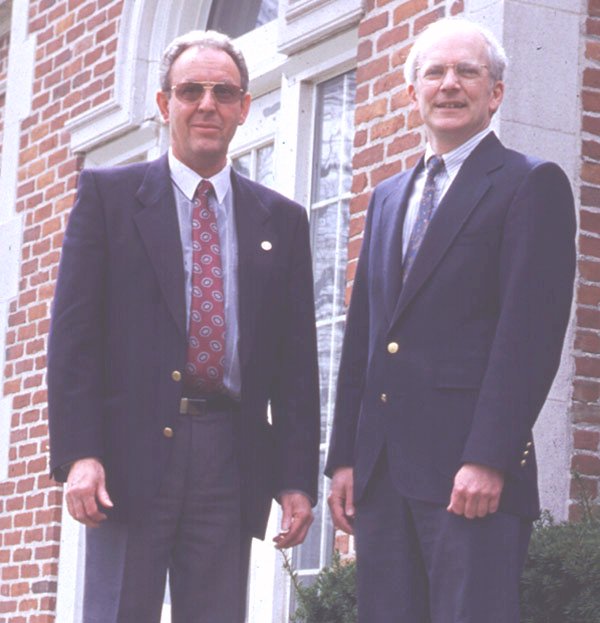 (Photo by Rick Lindquist, KX4V) The president of the Israel Amateur Radio Club, Joseph Obstfeld,
4X6KJ (left), visited ARRL Headquarters on April 1. During his
stay, he and ARRL Executive Vice President Dave Sumner, K1ZZ (right),
discussed the upcoming IARU Region 1 Conference, which will be
hosted by the Israel Amateur Radio Club in Tel Aviv the week of
September 30, 1996.
(Photo by Rick Lindquist, KX4V) The president of the Israel Amateur Radio Club, Joseph Obstfeld,
4X6KJ (left), visited ARRL Headquarters on April 1. During his
stay, he and ARRL Executive Vice President Dave Sumner, K1ZZ (right),
discussed the upcoming IARU Region 1 Conference, which will be
hosted by the Israel Amateur Radio Club in Tel Aviv the week of
September 30, 1996.
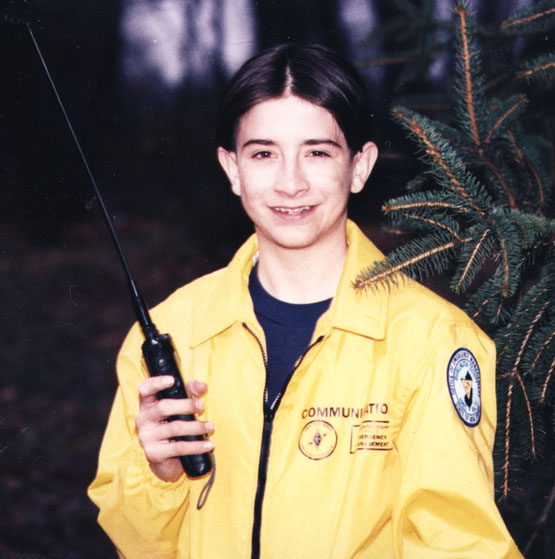 (Photo by Vince Bernotas II, N2WXF)
Vince Bernotas III, N2WXE, an active member of Burlington County
(New Jersey) ARES/RACES, turned out to be in the right place at
the right time on March 17, and a dirt-bike racer is glad he was.
Vince, 13, and his parents were among those helping to provide
communication for the 1996 Sandy Lane Motorcycle Enduro, a 100-mile
dirt bike endurance race through the South Jersey pine barrens.
After an Enduro rider hit a tree a mile from Vince's checkpoint,
N2WXE assisted in locating the paralyzed rider, believed to have
a fractured back, then coordinated response of an ambulance and
emergency vehicles, including a rescue helicopter. Complicating
matters was a catastrophic radio failure in both the ambulance
and state police cruiser. Amateur Radio saved the day when N2WXE
forwarded urgent information about the patient's location and
condition to net control Doug McCray, K2QWQ, who relayed the vital
information to dispatchers. The rider is reported to be recovering.
An active ARRL member since he got his ticket three years ago,
Vince is net control for the K2AA/South Jersey Radio Association's
Hams R Us Kids Net (see page 69 of November 1994 QST).--Vince Bernotas
II, N2WXF
(Photo by Vince Bernotas II, N2WXF)
Vince Bernotas III, N2WXE, an active member of Burlington County
(New Jersey) ARES/RACES, turned out to be in the right place at
the right time on March 17, and a dirt-bike racer is glad he was.
Vince, 13, and his parents were among those helping to provide
communication for the 1996 Sandy Lane Motorcycle Enduro, a 100-mile
dirt bike endurance race through the South Jersey pine barrens.
After an Enduro rider hit a tree a mile from Vince's checkpoint,
N2WXE assisted in locating the paralyzed rider, believed to have
a fractured back, then coordinated response of an ambulance and
emergency vehicles, including a rescue helicopter. Complicating
matters was a catastrophic radio failure in both the ambulance
and state police cruiser. Amateur Radio saved the day when N2WXE
forwarded urgent information about the patient's location and
condition to net control Doug McCray, K2QWQ, who relayed the vital
information to dispatchers. The rider is reported to be recovering.
An active ARRL member since he got his ticket three years ago,
Vince is net control for the K2AA/South Jersey Radio Association's
Hams R Us Kids Net (see page 69 of November 1994 QST).--Vince Bernotas
II, N2WXF
The real thrill in amateur work comes not from talking to stations
in distant lands, nor from receiving multitudes of QSL cards from
all the world, although these are things to stir your imagination,
but from knowing that by careful and painstaking work and by diligent
and systematic study, you have been able to accomplish some feat
or establish some fact that is a new step toward more perfect
communication.
The ARRL Letter is published by the American Radio
Relay League, 225 Main St, Newington, CT 06111; tel 860-594-0200;
fax 860-594-0259. Rodney J. Stafford, KB6ZV, President; David
Sumner, K1ZZ, Executive Vice President.